
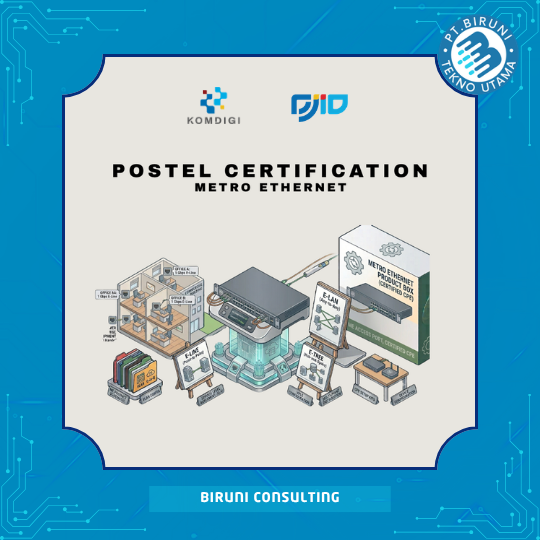
Postel Certification for Metro Ethernet Equipment and DJID Compliance in Indonesia
Metro Ethernet is a telecommunications networking device designed to deliver high-capacity Ethernet services across metropolitan area networks and operator backbone infrastructures. These devices connect multiple locations, including headquarters, branch offices, data centers, commercial buildings, industrial facilities, and telecommunications infrastructure through high-speed fiber optic networks.
Metro Ethernet technology is widely deployed by telecommunications operators, internet service providers (ISPs), enterprises, and government organizations to support broadband connectivity, cloud computing, Voice over IP (VoIP), video conferencing, enterprise networking, and other mission-critical business applications requiring reliable high-bandwidth communication.
Because Metro Ethernet equipment connects directly to public telecommunications networks and serves as part of the telecommunications infrastructure, it is classified as telecommunications equipment that must comply with Postel or DJID certification requirements before being legally imported, distributed, and marketed in Indonesia.
What Is Metro Ethernet Equipment in Regulatory Context
Under Indonesian telecommunications regulations, Metro Ethernet equipment is classified as telecommunications networking equipment used to deliver Ethernet-based transmission services through fiber optic infrastructure and other communication media.
These devices perform functions such as traffic switching, routing, service aggregation, and network distribution between multiple locations. Metro Ethernet equipment commonly supports Gigabit Ethernet, 10 Gigabit Ethernet, SFP and SFP+ interfaces, VLAN, MPLS, Quality of Service (QoS), and various carrier-grade networking protocols.
Because these devices connect to public telecommunications infrastructure and provide communication services, they must comply with applicable technical standards before entering the Indonesian market.
Is Postel Certification Required
Postel certification is mandatory for Metro Ethernet equipment because it functions as telecommunications equipment connected to operator and public telecommunications networks.
Common features found in Metro Ethernet devices include:
- Metro Ethernet connectivity
- Gigabit Ethernet interfaces
- 10 Gigabit Ethernet support
- Fiber optic communication
- Layer 2 switching
- Layer 3 routing
- VLAN support
- MPLS support
- Quality of Service (QoS)
Because the device forms part of telecommunications infrastructure and supports data communication services, certification is required before legal market distribution in Indonesia.
Regulations in Indonesia for Telecommunication Devices
Telecommunication device regulations in Indonesia are administered by the Directorate General of Digital Infrastructure (DJID) under the Ministry of Communication and Digital Affairs, formerly known as SDPPI or Postel.
Any device connected to public telecommunications networks must comply with applicable technical requirements. These regulations are intended to ensure network interoperability, service quality, equipment safety, and compatibility with Indonesia’s national telecommunications infrastructure.
DJID certification confirms that Metro Ethernet equipment complies with Indonesian technical standards before market deployment.
Certification Requirements
Companies are generally required to prepare several important documents, including:
- Business legality documents such as NIB and OSS
- Product technical specifications
- User manual
- Network interface or module datasheets
- Network architecture diagrams
- Product labeling information
- Product photographs
- Laboratory test reports
- Additional supporting documents as required
These documents are reviewed during the technical and administrative evaluation process.
Certification Process Overview
The certification process begins with product identification to determine the applicable regulatory scope and testing requirements. Technical and administrative documentation is then reviewed during the initial assessment.
Laboratory testing is conducted on the telecommunications functions and networking interfaces integrated into the equipment. Testing may include Ethernet interface testing, optical interface testing, electromagnetic compatibility (EMC), electrical safety, network interoperability, and other technical parameters depending on product characteristics.
Once all requirements have been fulfilled and the equipment successfully passes evaluation, the DJID certificate is issued as official authorization for legal distribution in Indonesia.
Common Challenges in Certification Process
Common challenges include incomplete technical documentation, product specification mismatches with Indonesian regulations, regulatory updates, and networking modules or interfaces requiring additional technical verification.
Additionally, Metro Ethernet devices that integrate switching, routing, traffic aggregation, and multiple high-speed communication interfaces generally require broader testing scopes than standard telecommunications equipment.
Understanding regulatory requirements before product development or importation can significantly improve certification efficiency and minimize delays in product commercialization.
Contact Us
Biruni Consulting provides professional services for Postel/DJID certification of Metro Ethernet equipment and various telecommunications networking devices.
We assist companies with:
- Telecommunication regulatory analysis
- Device classification under DJID requirements
- Technical and administrative document preparation
- Coordination of accredited laboratory testing
- End-to-end certification assistance until approval is issued
With experience in telecommunications regulations, fiber optic networking equipment, and enterprise communication systems, we help companies complete certification requirements efficiently and in accordance with applicable regulations.
Contact us for Postel certification consultation so your Metro Ethernet equipment can be legally marketed in Indonesia