
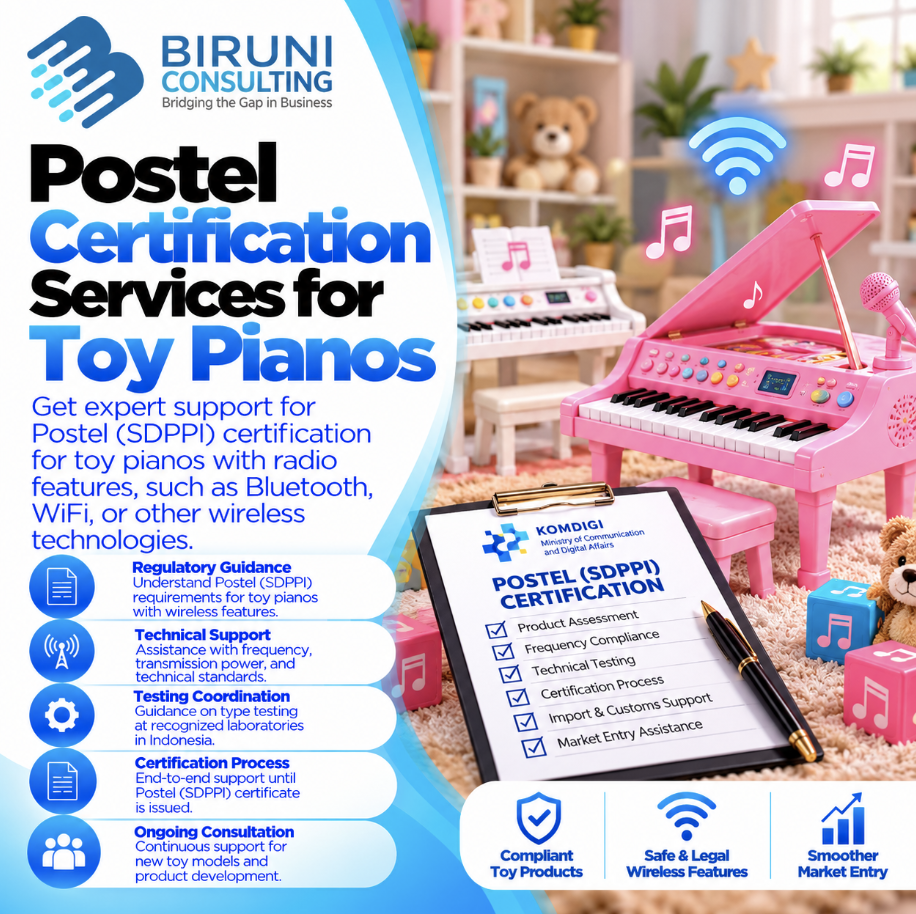
DJID/SDPPI certification services for toy pianos with Bluetooth, wireless audio, applications, and other radio functions in Indonesia.
A toy piano may be a relatively simple electronic product that only produces sounds when its keys are pressed, but more advanced models can incorporate Bluetooth, smartphone connectivity, wireless microphones, wireless audio, or other radio technologies.
Where a toy piano incorporates wireless communication, its Postel/DJID Certification requirements should be assessed based on radio technology, operating frequency, transmission power, wireless modules, antennas, and the final product configuration.
Indonesia’s principal telecommunications-equipment certification framework remains Minister of Communication and Informatics Regulation Number 3 of 2024. The regulation remains in force and repealed Regulation Number 16 of 2018. JDIH Kemkomdigi
Do Toy Pianos Require Postel Certification?
Not every electronic toy piano automatically has the same Postel requirements.
A piano containing only keys, speakers, volume controls, lights, and locally stored music is technically different from a product incorporating wireless communication.
A Postel assessment becomes relevant where the toy contains Bluetooth, WiFi, proprietary RF, a wireless microphone, or another active radio function.
Descriptions such as “electronic toy piano,” “smart piano,” or “Bluetooth kids piano” are therefore not sufficient on their own. The exact model and technical specifications should be reviewed.
Toy Pianos with Bluetooth
Bluetooth is one of the wireless features that may be incorporated into modern toy pianos.
It can allow a smartphone to play audio through the piano speaker, connect an accompanying application, provide pairing functionality, or enable other interactive features.
DJID continues to list Minister of Communication and Informatics Decision Number 260 of 2024 as the Short Range Device Technical Standard. DJID Certificates issued during 2026 also continue to reference Decision Number 260 of 2024 for Bluetooth equipment. Postel
A Bluetooth toy-piano assessment should identify the Bluetooth version, operating-frequency range, transmission power, module or chipset, antenna, and enabled radio functions.
Bluetooth Audio Functions
Some toy pianos also function as Bluetooth speakers.
A smartphone may transmit music through Bluetooth, with the audio then reproduced by the piano’s built-in speaker.
Although the primary product remains a musical toy, Bluetooth introduces an active radio-communication function.
Manufacturers should therefore provide the relevant module datasheet, RF specifications, operating-frequency information, output power, and laboratory report where available.
Toy Pianos with Wireless Microphones
Many children’s pianos are supplied with microphones.
The microphone may be a conventional wired accessory or a wireless microphone.
A wired microphone does not create a radio link between the microphone and piano. A wireless microphone, however, may contain a transmitter while the piano includes a corresponding receiver.
The operating frequency, transmission power, modulation, antenna, and radio technology should therefore be identified.
Where a wireless microphone is included in the commercial package, technical assessment should cover the complete system rather than the piano alone.
Toy Pianos with Smartphone Applications
Some toy pianos use smartphone applications for learning modes, music games, song selection, recording, or interactive functions.
The application may communicate with the piano through Bluetooth or WiFi.
Where Bluetooth is used, the Bluetooth radio forms part of the certification assessment. Where WiFi is used, the RLAN function needs to be reviewed separately.
The existence of an application itself is therefore not the deciding factor; the communication technology connecting the application to the piano is what matters from a radio perspective.
Toy Pianos with WiFi
WiFi is less common than Bluetooth in toy pianos, but it may appear in more advanced educational products.
WiFi can support content downloads, applications, cloud connectivity, or online learning functions.
For RLAN equipment, Minister of Communication and Digital Decision Number 12 of 2025 concerning class-licensed spectrum and Radio Local Area Network Technical Standards remains in force. JDIH Kemkomdigi
Where a piano contains both Bluetooth and WiFi, both radio functions should be included in the technical assessment.
Operating Frequency and Transmission Power
Operating frequency and transmission power are important parameters in wireless-product assessment.
Frequency identifies the radio band while transmission power describes the output from the transmitter.
These values must be considered together with modulation, bandwidth, antennas, and radio technology.
DJID Certificates issued in 2026 continue, for example, to show Bluetooth equipment operating in the 2.4 GHz–2.4835 GHz range under Decision Number 260 of 2024. These values should not simply be copied to another product; the exact toy piano must be assessed using its own technical data. e-Sertifikasi NextGen
Toy Pianos and Short Range Devices
Bluetooth and some other short-range radio technologies may fall within the Short Range Device or SRD framework.
Decision Number 260 of 2024 remains listed in DJID’s official regulatory database as the Short Range Device Technical Standard. Postel
However, short operating range does not automatically mean that a product is exempt from Postel Certification.
Radio technology, operating frequency, transmission power, modulation, bandwidth, antennas, and actual communication functions still need to be assessed.
Does Low Transmission Power Mean an Exemption?
Not automatically.
Regulation Number 3 of 2024 contains specific provisions concerning certain other equipment with telecommunications features below 10 mW and only one identical telecommunications feature.
Where the specified conditions are fulfilled, one Certificate may cover more than one qualifying variant.
This provision should not be interpreted as a general certification exemption for every low-power wireless toy piano.
The exact wireless configuration still needs to be assessed against the applicable requirements.
Is an Existing Bluetooth Module Test Report Sufficient?
Not necessarily.
A toy piano may use a Bluetooth module that already has an LHU, test report, or other certification documentation.
This can support the assessment, but the final equipment must still be compared against the tested module configuration.
DJID’s current e-Sertifikasi requirements specifically state that equipment relying on a module test report must provide a block diagram, a photograph showing where the module is installed in the equipment, and a module-use declaration identifying the module and the final equipment in which it is installed. e-Sertifikasi NextGen
A module report or certificate should therefore not automatically be assumed to cover every final toy piano using that module.
Antennas and Final Product Configuration
The antenna forms an important part of the RF configuration.
Bluetooth and WiFi modules may use integrated PCB antennas, chip antennas, or other designs.
Where a module was tested using one antenna configuration but the final piano uses a different implementation, the relevance of the existing report should be reviewed.
Firmware and transmission-power settings should also be considered because they can affect the final radio configuration.
Documents for Postel Certification
For an initial assessment, businesses should generally prepare:
- Photographs of the toy piano and all wireless accessories.
- Brand, model, product datasheet, and user manual.
- Bluetooth, WiFi, or RF module datasheets.
- Operating frequency and transmission power.
- RF test reports, where available.
- Antenna, manufacturer, and country-of-manufacture information.
If a wireless microphone is supplied with the piano, its technical documentation should also be prepared.
DJID’s current requirements for a new Certificate include NIB and OSS access, an LHU/test report from a qualifying laboratory, technical specifications, a signed Declaration of Conformity, colour photographs showing the brand and model/type, and a declaration that the submitted information and documents are complete and correct. e-Sertifikasi NextGen
RF Test Reports for Toy Pianos
An RF test report provides evidence of the radio configuration that has been tested.
The report may include operating frequency, transmission power, bandwidth, modulation, unwanted emissions, and other radio parameters.
For a Bluetooth toy piano, the laboratory report should correspond to the actual module and final product configuration.
If a separate wireless microphone radio is included, the technical evidence for that radio link should also be reviewed.
DJID’s current certification requirements state that a new Certificate application uses test reports issued by designated domestic laboratories or recognised overseas laboratories. Where an overseas RF report is submitted, the current requirements also call for an LHU summary declared to be correct and consistent. e-Sertifikasi NextGen
Can Several Toy Piano Models Share One Certificate?
Manufacturers may offer toy pianos in different colours, keyboard layouts, characters, speaker designs, or enclosure styles.
Visual differences do not necessarily mean that the wireless hardware is different.
Conversely, almost identical piano models may use different Bluetooth modules, PCBs, antennas, or firmware.
A grouping assessment should therefore compare the exact module, operating frequency, transmission power, antenna, wireless functions, brand, type, and technical configuration.
Potential grouping should be determined from technical similarity rather than product appearance alone.
Our Postel Certification Process for Toy Pianos
The process should begin with an assessment of the exact product model intended for importation or commercial distribution.
Bluetooth, WiFi, wireless microphones, proprietary RF, operating frequencies, transmission power, modules, antennas, and other communication functions are identified first.
Product documentation and available RF test reports are then reviewed to determine the applicable Technical Standards and testing requirements.
Regulation Number 3 of 2024 provides that business applications are submitted through OSS integrated with the Directorate General’s certification facility and requires key supporting documents including test reports and technical specifications. JDIH Kemkomdigi
Once the technical and administrative requirements are prepared, the process can continue with certification-document preparation and DJID/SDPPI Certification assistance.
Certificate Period and Import Activities
Under Regulation Number 3 of 2024, the Certificate itself is not time-limited.
However, the Certificate holder may manufacture, assemble, or import the relevant equipment for trade and/or use in Indonesia for up to three years from the Certificate issuance date. JDIH Kemkomdigi
This is relevant to importers making repeated shipments of the same toy-piano model.
Where commercial activities continue beyond the applicable period, the requirements for renewed Technical Standard compliance and a new Certificate need to be considered.
Postel Labeling for Toy Pianos
Certification is also followed by regulatory-marking obligations.
The annex to Regulation Number 3 of 2024 includes formats covering the Certificate number and PLG ID, QR Code, and warning sign. JDIH Kemkomdigi
DJID’s current certification information also states that Certificate holders must implement the relevant Label, QR Code, and Warning Sign and report implementation within 30 working days after Certificate issuance. e-Sertifikasi NextGen
For toy pianos, appropriate labeling areas should ideally be considered during product or packaging design rather than after mass production.
Postel Certification and Toy Requirements
Postel/DJID Certification focuses on telecommunications and wireless communication functions.
Toy-product safety requirements address a separate area of compliance.
DJID Certification of a Bluetooth or radio function therefore does not automatically replace other applicable toy-product requirements.
Likewise, meeting toy-product requirements does not automatically replace Postel Certification for Bluetooth, WiFi, wireless microphones, or other active radio functions.
Why Pre-Import Assessment Matters
Toy pianos with almost identical designs can use different wireless configurations.
Manufacturers may change Bluetooth modules, PCBs, antennas, firmware, or wireless microphones without significantly changing the external appearance.
Assessment before a large purchase order or shipment helps confirm the exact module, frequency, transmission power, antenna, RF report, wireless accessories, and potential model grouping.
This reduces the risk of inconsistencies between the actual product, datasheets, laboratory reports, packaging, and DJID/SDPPI Certificate information.
Conclusion
Postel Certification services for toy pianos help businesses determine DJID/SDPPI requirements for products incorporating Bluetooth, WiFi, wireless microphones, smartphone applications, or other radio functions.
Not every electronic toy piano requires the same Postel treatment. A non-wireless electronic piano should be distinguished from a product containing active radio communication.
For wireless products, the assessment should identify operating frequency, transmission power, modules, antennas, firmware, wireless accessories, and supporting RF test reports.
A technical assessment before importation or mass production can help businesses prepare testing, technical documentation, model grouping, labeling, and DJID/SDPPI Certification more accurately.
Contact Us
Biruni Consulting assists with DJID/SDPPI assessment and certification for toy pianos and various wireless products that will be imported or marketed in Indonesia.
Our services include:
- Assessment of DJID/SDPPI certification requirements.
- Bluetooth module assessment.
- RF specification review.
- Frequency and transmission power analysis.
- Technical document review.
- Certification document preparation.
- Testing coordination where required.
- DJID/SDPPI Certification assistance.
If you have a toy piano, you can prepare product photos, brand, model, datasheet, RF specifications, and wireless module datasheet for an initial assessment of the Postel Certification requirements.