
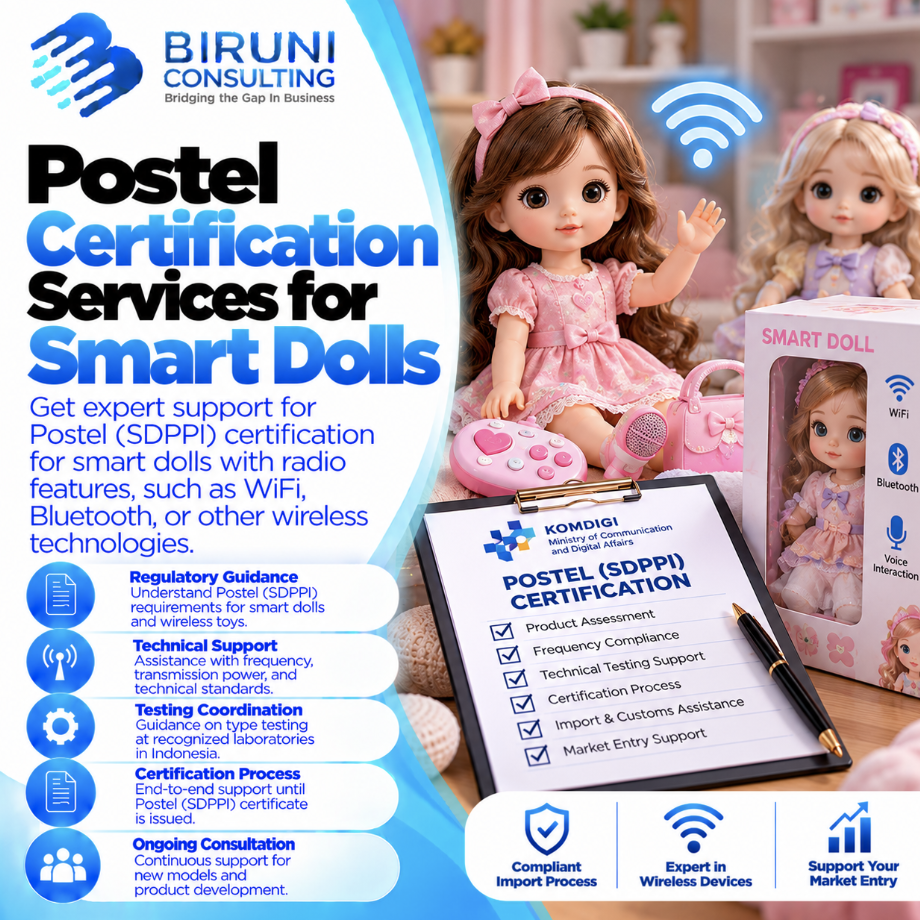
DJID/SDPPI certification services for smart dolls with Bluetooth, WiFi, and other wireless functions in Indonesia.
Smart dolls can incorporate significantly more technology than conventional dolls. A product may contain speakers, microphones, voice-interaction functions, sensors, smartphone applications, Bluetooth, WiFi, or other interactive features.
Where a smart doll contains active wireless communication, its Postel/DJID Certification requirements should be assessed according to the radio technology, operating frequency, transmission power, wireless modules, antennas, firmware, and final product configuration.
Indonesia’s principal telecommunications-equipment certification framework remains Minister of Communication and Informatics Regulation Number 3 of 2024. The regulation is currently in force and repealed Regulation Number 16 of 2018. JDIH Kemkomdigi
Do Smart Dolls Require Postel Certification?
Not every smart doll has the same Postel requirements.
A doll containing only speakers, microphones, buttons, sensors, or locally stored audio is technically different from a connected toy that communicates with a smartphone or network.
Postel assessment becomes relevant where the product contains Bluetooth, WiFi, proprietary RF, or another active radio communication technology.
The requirement should therefore be determined from the exact product configuration rather than simply because a product is marketed as a “smart doll” or “interactive doll.”
Smart Dolls with Bluetooth
Bluetooth may be used in interactive toys for smartphone pairing, application control, audio configuration, data transfer, firmware updates, or other functions.
DJID continues to list Minister of Communication and Informatics Decision Number 260 of 2024 on Short Range Device Technical Standards in its official regulatory database, including Bluetooth within the SRD framework. Postel
For a Bluetooth-enabled smart doll, the assessment should identify the Bluetooth version, module or chipset, operating frequency, transmission power, antenna, and enabled radio modes.
Smart Dolls with WiFi
WiFi may support cloud connectivity, online voice interaction, content downloads, mobile applications, or other network functions.
The WiFi radio should be assessed separately from Bluetooth.
Minister of Communication and Digital Decision Number 12 of 2025 is currently in force and establishes class-licensed spectrum and Technical Standards for Radio Local Area Network equipment, including relevant 2.4 GHz and 5 GHz operation. JDIH Kemkomdigi
Where a smart doll contains both Bluetooth and WiFi, both radio technologies should be included in the technical assessment.
Voice Interaction Does Not Always Mean Wireless
A voice-enabled doll does not necessarily contain radio communication.
Some toys use a microphone and local processing to trigger responses stored in internal memory.
Other products may send voice information through WiFi or Bluetooth to a smartphone, application, or online service.
Microphones, speakers, and voice-recognition functions should therefore be distinguished from active wireless communication.
A block diagram and technical specification can help confirm whether the voice function operates locally or through a radio connection.
Smart Dolls with Smartphone Applications
Some smart dolls depend on a mobile application for part of their functionality.
An application may change stories, configure characters or voices, control play modes, perform pairing, or transfer content to the toy.
Where communication occurs through Bluetooth or WiFi, the applicable radio technology becomes part of the DJID/SDPPI assessment.
Manufacturers should therefore be able to explain the communication architecture between the smart doll and the application.
Operating Frequency and Transmission Power
Operating frequency and transmission power are important parameters for any wireless toy.
Frequency identifies the radio band, while transmission power describes the RF output from the transmitter.
These parameters must be considered together with modulation, bandwidth, antenna configuration, and radio technology.
Indonesia’s class-license spectrum regulation under Regulation Number 2 of 2023 was amended by Minister of Communication and Digital Regulation Number 2 of 2025, which remains in force. JDIH Kemkomdigi
A specification that only states “2.4 GHz” is therefore insufficient for a complete technical assessment.
Smart Dolls and Short Range Devices
Bluetooth and certain other wireless technologies can fall within the Short Range Device framework.
Decision Number 260 of 2024 continues to be listed by DJID as the Short Range Device Technical Standard. Postel
However, the term short range does not create an automatic certification exemption.
Operating frequency, transmission power, modulation, bandwidth, antennas, and the actual radio technology still need to be assessed against the applicable requirements.
Are Smart Dolls Below 10 mW Exempt?
Not automatically.
Regulation Number 3 of 2024 contains a specific provision for certain other equipment incorporating a telecommunications feature with transmission power below 10 mW and only one identical telecommunications feature.
Where all required conditions are met, one Certificate may cover more than one qualifying variant. JDIH Kemkomdigi
This provision concerns variant coverage under one Certificate, rather than creating a general exemption from Postel Certification.
Low-power Bluetooth or RF smart dolls should therefore still undergo technical assessment.
Is a Certified Wireless Module Sufficient?
Not necessarily.
A smart doll may use a Bluetooth or WiFi module that already has an existing laboratory report or certification documentation.
Those documents can support the assessment, but the final product still needs to be reviewed because module integration can involve different antennas, firmware, power settings, or enabled radio functions.
DJID’s current certification requirements also specify additional documentation where a product relies on a module test report, including a block diagram, a photograph showing where the module is installed, and a declaration identifying the module and final equipment. Sertifikasi Postel
A module certificate alone should therefore not automatically be assumed to cover the complete smart doll.
Documents for Postel Certification
For an initial technical assessment, businesses should generally prepare:
- Photographs of the smart doll and packaging.
- Brand, model, product datasheet, and user manual.
- Bluetooth, WiFi, or other wireless-module datasheets.
- Operating frequency and transmission power.
- RF test reports, where available.
- Antenna, manufacturer, and country-of-manufacture information.
DJID’s current e-Sertifikasi NextGen requirements also list a test report, technical specifications, Declaration of Conformity, and colour photographs showing the brand and model/type among the documents required for a new Certificate. Sertifikasi Postel
RF Test Reports
An RF test report provides evidence of the radio configuration that was tested.
It can contain operating frequencies, RF output power, modulation, bandwidth, emissions, and other wireless parameters.
For a smart doll, the report should correspond to the exact module, antenna, firmware, model, and enabled radio functions used in the commercial product.
CE, FCC, or other overseas reports may support technical assessment but do not automatically replace DJID/SDPPI Certification.
Can Several Smart Doll Models Share One Certificate?
Smart dolls may be sold in different characters, clothing styles, hair colours, voices, or body designs.
Visual differences do not necessarily mean that the wireless configuration has changed.
Conversely, nearly identical dolls may use different Bluetooth modules, PCBs, firmware, or WiFi configurations.
A grouping assessment should compare wireless modules, operating frequencies, transmission power, antennas, firmware, wireless functions, brands, types, and countries of manufacture.
For certain qualifying products below 10 mW with only one identical telecommunications feature, Regulation Number 3 of 2024 provides a mechanism allowing one Certificate to cover more than one variant where all applicable criteria are satisfied. JDIH Kemkomdigi
Our Postel Certification Process for Smart Dolls
The process should begin with a technical assessment of the exact model intended for importation or commercial distribution.
Bluetooth, WiFi, proprietary RF, wireless modules, operating frequencies, transmission power, antennas, and all enabled radio functions are first identified.
Product datasheets and available RF test reports are then reviewed to determine the applicable Technical Standards and testing requirements.
Once the technical and administrative documentation is ready, the process can continue with document preparation, testing coordination where required, and DJID/SDPPI Certification assistance.
Certificate Period and Import Activities
Under Regulation Number 3 of 2024, the Certificate itself is not time-limited.
However, the Certificate holder may manufacture, assemble, or import the relevant equipment for trade and/or use in Indonesia for up to three years from the Certificate issuance date. JDIH Kemkomdigi
Businesses selling the same smart-doll models over several years should therefore monitor the Certificate issuance date and the requirements that apply to continued commercial activity.
Postel Labeling for Smart Dolls
Certified products are also subject to regulatory-marking requirements.
The annex to Regulation Number 3 of 2024 provides formats for the Certificate number and PLG ID, QR Code, and warning sign. Their size can be adapted to the labeling medium provided that the information remains readable. JDIH Kemkomdigi
Smart dolls may use textile, plastic, or mixed-material bodies, so regulatory marking should ideally be considered during product and packaging design rather than after mass production.
Postel Certification and Toy SNI Requirements
Postel/DJID Certification and toy-product safety requirements address different areas of compliance.
Postel/DJID focuses on Bluetooth, WiFi, RF, and other telecommunications functions.
Toy SNI requirements address product safety. Indonesia’s Ministry of Industry certification information for 2026 continues to list toys as subject to mandatory SNI, including physical and mechanical safety, flammability, migration of certain elements, and electrical-toy safety standards. Kemenperin
DJID Certification therefore does not automatically replace toy SNI requirements, and toy SNI compliance does not automatically replace Postel Certification for wireless functions.
Why Pre-Import Assessment Matters
Smart dolls may have many variants with different characters, clothing, voices, or interactive features.
Manufacturers may also change wireless modules, PCBs, antennas, or firmware without making major changes to the external design.
Completing an assessment before a large purchase order or shipment helps confirm the exact module, frequency, transmission power, antenna, RF documentation, and potential model-grouping approach.
This reduces the risk of inconsistencies between the actual product, datasheet, test report, packaging, and DJID/SDPPI Certificate.
Conclusion
Postel Certification services for smart dolls help businesses determine DJID/SDPPI requirements for products containing Bluetooth, WiFi, smartphone applications, proprietary RF, or other wireless technologies.
The assessment should identify operating frequency, transmission power, wireless modules, antennas, firmware, RF test reports, and every enabled radio function in the final product.
Regulation Number 3 of 2024 remains the principal certification framework. Bluetooth and other short-range technologies need to be assessed against their relevant Technical Standards, while RLAN/WiFi functions are currently covered by Decision Number 12 of 2025. JDIH Kemkomdigi
A technical assessment before importation or mass production can help businesses prepare testing, documentation, model grouping, DJID/SDPPI Certification, and labeling more accurately.
Contact Us
Biruni Consulting assists with DJID/SDPPI assessment and certification for smart dolls and various wireless products that will be imported or marketed in Indonesia.
Our services include:
- Assessment of DJID/SDPPI certification requirements.
- Bluetooth module assessment.
- RF specification review.
- Frequency and transmission power analysis.
- Technical document review.
- Certification document preparation.
- Testing coordination where required.
- DJID/SDPPI Certification assistance.
If you have a smart doll, you can prepare product photos, brand, model, datasheet, RF specifications, and wireless module datasheet for an initial assessment of the Postel Certification requirements.