
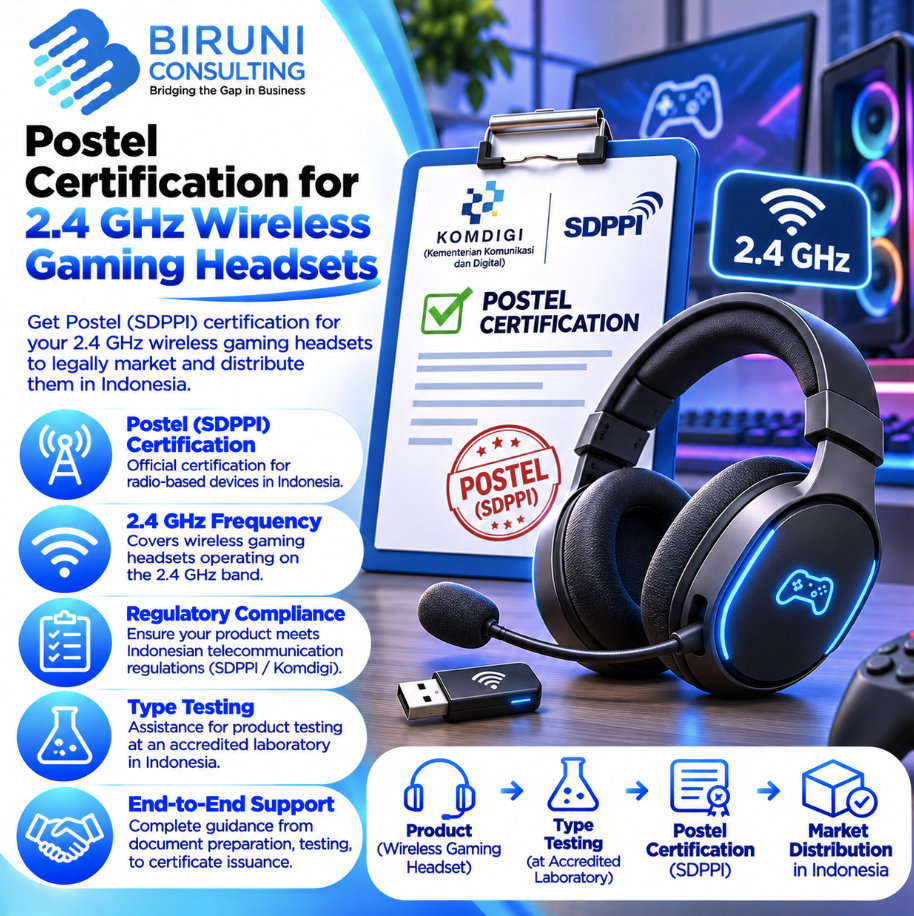
Guide to DJID/SDPPI Certification for 2.4 GHz gaming headsets, wireless USB dongles, and multi-mode gaming audio products in Indonesia
A 2.4 GHz wireless gaming headset commonly connects to PCs, laptops, gaming consoles, and handheld gaming systems through a dedicated USB wireless dongle. Unlike a conventional Bluetooth headset, this type of product often uses a proprietary 2.4 GHz radio link designed for low-latency audio.
For Indonesian Postel/DJID Certification, the assessment should therefore cover more than the headset itself. Where a product package contains both a wireless headset and USB radio dongle, the transmitter and receiver functions in both units should be identified.
Minister of Communication and Informatics Regulation Number 3 of 2024 remains Indonesia’s principal telecommunications-equipment certification framework. JDIH Komdigi
Decision Number 260 of 2024 also remains listed by DJID as the Technical Standard for Short Range Devices. Postel
2.4 GHz Does Not Automatically Mean Bluetooth
Not every wireless product operating at 2.4 GHz is a Bluetooth device.
Gaming headsets may use Bluetooth, a proprietary low-latency 2.4 GHz link, or both technologies.
A statement such as “2.4G Wireless” on the product packaging is therefore insufficient to determine the applicable Indonesian Technical Standard.
The underlying protocol, operating-frequency range, modulation, transmitter power, chipset or module, antennas, and laboratory documentation should be reviewed.
Gaming Headsets with USB Dongles
A gaming-headset USB dongle is often an active radio transceiver rather than a passive adapter.
It can transmit audio to the headset while receiving microphone audio and control information from the headset.
The assessment should therefore consider the radio configuration of both physical units.
DJID’s current database provides an example of a Wireless Dongle holding its own DJID Certificate issued in January 2026. e-Sertifikasi NextGen
This illustrates why the USB receiver should not automatically be ignored merely because it is bundled with another product.
The 2.4 GHz Band
The 2400–2483.5 MHz spectrum can be used by several different wireless technologies.
Bluetooth uses this range, but WiFi/RLAN also operates within the 2.4 GHz spectrum under a different technical framework.
Indonesia’s class-licensed spectrum regime is currently governed by Regulation Number 2 of 2023 as amended by Minister of Communication and Digital Regulation Number 2 of 2025, which remains in force. JDIH Komdigi
The frequency band alone therefore does not determine whether a gaming headset should be treated as Bluetooth, RLAN, or another type of Short Range Device.
Proprietary 2.4 GHz Gaming Audio
Gaming manufacturers frequently use proprietary radio protocols to reduce audio latency.
Although the radio may operate in the same spectrum as Bluetooth or WiFi, its modulation, channel structure, bandwidth, and communication method can differ.
Decision Number 260 of 2024 remains DJID’s listed Short Range Device Technical Standard. Postel
The appropriate technical mapping for a proprietary gaming-radio system should therefore be determined from its actual RF specifications and laboratory report rather than its commercial “2.4G” description.
Headsets with Bluetooth and 2.4 GHz Modes
Many current gaming headsets support two independent wireless modes.
A dedicated 2.4 GHz USB dongle may be used for gaming, while Bluetooth supports smartphones, tablets, or general-purpose devices.
These are separate radio functions.
A Bluetooth report should not automatically be treated as evidence for the proprietary 2.4 GHz interface.
DJID’s database includes Bluetooth headsets certified under Decision Number 260 of 2024. One Certificate issued in March 2026 identifies a Bluetooth headset operating at 2.4–2.4835 GHz. e-Sertifikasi NextGen
Where an additional proprietary 2.4 GHz radio exists, that function should also be included in the overall assessment.
Does a Gaming Headset Require Postel Certification?
A gaming headset containing an active wireless transmitter should be assessed against the applicable DJID/SDPPI certification requirements.
Regulation Number 3 of 2024 establishes the current certification framework for telecommunications equipment and provides for electronic Certificate issuance through the applicable integrated system. JDIH Komdigi
DJID’s public database also contains multiple certified Bluetooth headset products, confirming that wireless headsets can fall within Indonesia’s telecommunications-equipment certification system. e-Sertifikasi NextGen
For a proprietary 2.4 GHz gaming headset, the actual radio configuration needs to be reviewed before the specific certification route is determined.
Assess the Headset and Dongle as a System
A gaming headset and its USB dongle normally operate as one communication system.
The dongle transmits audio information, while the headset may transmit microphone audio and control data back to the dongle.
The radio link can therefore be bidirectional.
Laboratory documentation should be reviewed to establish whether both transmitter configurations were tested and whether the headset and dongle use identical or different power levels, antennas, or radio chipsets.
RF Test Reports
An RF test report provides evidence of the radio configuration actually tested by the laboratory.
For a 2.4 GHz gaming headset, relevant information can include the operating-frequency range, channels, modulation, RF output power, occupied bandwidth, unwanted emissions, antennas, and test configuration.
DJID’s current e-Sertifikasi requirements require an LHU/test report from a designated Indonesian laboratory or a recognised overseas laboratory. e-Sertifikasi NextGen
FCC or CE reports can therefore be useful, but their laboratory status, test coverage, model identification, and relevance to Indonesian Technical Standards still need to be checked.
Wireless Modules and Chipsets
Gaming headsets may use a dedicated proprietary RF chipset or an integrated wireless module.
Where certification relies on a module test report, current e-Sertifikasi requirements include a block diagram, photographs showing the module location, and a module-use declaration linking the module brand/type with the final product brand, type, and variant. e-Sertifikasi NextGen
An existing module report therefore does not automatically cover every gaming headset or dongle using the same component.
Antennas and Transmission Power
The headset and USB dongle may use different antenna designs.
A headset can contain an integrated PCB or chip antenna inside the earcup, while the USB dongle may have a much smaller integrated antenna.
The final RF characteristics should therefore be compared against the laboratory configuration.
Transmission power should also be reviewed against the test report, module specification, firmware settings, and antenna characteristics rather than relying only on a product-marketing specification.
Low Power Is Not an Automatic Exemption
Gaming headsets usually operate over relatively short distances and may transmit at low power.
That does not automatically create an exemption from Postel/DJID Certification.
Regulation Number 3 of 2024 contains a special multiple-variant mechanism for certain equipment with a telecommunications function below 10 mW and only one identical telecommunications feature, where the specified conditions are satisfied. JDIH Komdigi
This is a variant-coverage provision, not a general exemption for low-power wireless equipment.
Multiple Gaming Headset Models
One gaming-headset series can contain several versions.
A basic product may use only a proprietary USB dongle, another version may add Bluetooth, and a premium model may provide additional wireless functions.
Even where the enclosure, speakers, microphone, and product design are similar, the RF configurations may be different.
Potential model grouping should therefore consider wireless chipsets, frequencies, transmission power, antennas, firmware, manufacturing origin, and enabled communications functions rather than appearance alone.
Certification Documents
For an initial assessment, it is useful to prepare:
- Headset and USB-dongle photographs.
- Product-label photographs.
- Exact brand and model/type.
- Product datasheet and user manual.
- Proprietary 2.4 GHz radio specifications.
- Bluetooth specifications where applicable.
- Operating frequencies and transmission power.
- Module or chipset datasheets.
- Antenna information.
- Block diagrams.
- Available RF test reports.
For a new Certificate, current e-Sertifikasi requirements also include NIB and OSS access for business applicants, an LHU/test report, technical specifications, and additional documentation according to the applicant and equipment configuration. e-Sertifikasi NextGen
Certification Before Importation
Technical assessment should ideally be completed before a large purchase order or commercial shipment.
The exact model shipped by the supplier should match the model represented by the technical documents and laboratory reports.
This is particularly important for gaming headsets because one product family may be sold in different bundles or regional configurations.
One package may include a proprietary USB dongle only, while another may add Bluetooth or a different receiver.
Early assessment reduces the risk of discovering a certification mismatch after the goods have already arrived in Indonesia.
Regulatory Labeling
After Certificate issuance, labeling obligations also apply.
Current e-Sertifikasi requirements state that Certificate holders must implement the relevant Label, QR Code, and Warning Sign and report their implementation within 30 working days after Certificate issuance. e-Sertifikasi NextGen
Regulation Number 3 of 2024 also provides for the Certificate number and PLG ID and states that the certification QR Code is generated for each Certificate issued. JDIH Komdigi
For a headset-and-dongle bundle, the labeling arrangement should be planned according to the exact certification configuration.
Certificate Period
Under Regulation Number 3 of 2024, the Certificate itself is not time-limited.
However, the Certificate holder may manufacture, assemble, or import the covered equipment for trade and/or use in Indonesia for up to three years from the Certificate issuance date. JDIH Komdigi
Distributors making recurring imports of gaming accessories should therefore include Certificate issuance dates in their compliance planning.
Conclusion
Postel Certification for a 2.4 GHz wireless gaming headset should be based on the actual radio technology, not simply the statement “2.4 GHz Wireless.”
A gaming headset may use Bluetooth, a proprietary 2.4 GHz radio through a USB dongle, or both. Decision Number 260 of 2024 remains DJID’s listed Short Range Device Technical Standard, while Regulation Number 3 of 2024 remains the principal equipment-certification framework. Postel
Where a USB dongle is provided, both the headset and dongle should be included in the wireless-system assessment. Their operating frequencies, transmitter power, modules, antennas, firmware, bidirectional communication, and RF test reports should be reviewed before the certification strategy is finalised.
DJID’s database also demonstrates that wireless headsets and wireless dongles can appear as certified telecommunications equipment, reinforcing the need to assess all active radio components in the package before importation. e-Sertifikasi NextGen
Contact Us
Biruni Consulting assists with DJID/SDPPI assessment and certification for 2.4 GHz wireless gaming headsets and various wireless products that will be imported or marketed in Indonesia.
Our services include:
- Assessment of DJID/SDPPI certification requirements.
- Transmitter and receiver assessment.
- RF specification review.
- Frequency and transmission power analysis.
- Technical document review.
- Certification document preparation.
- Testing coordination where required.
- DJID/SDPPI Certification assistance.
If you have a 2.4 GHz wireless gaming headset, you can prepare product photos, brand, model, datasheet, RF specifications, and wireless module datasheet for an initial assessment of the Postel Certification requirements.