
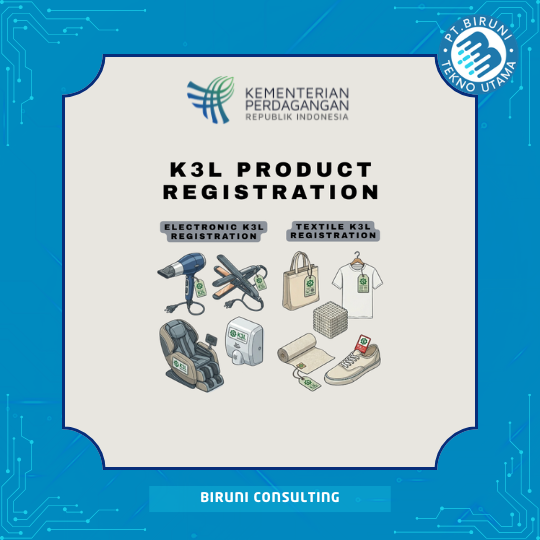
Guide to K3L Product Registration for Products Distributed in Indonesia
K3L Product Registration is the process of registering products related to Safety, Security, Health, and Environmental Protection (K3L) before they are distributed or marketed in Indonesia. This registration system is part of the government’s effort to ensure that products available in the market comply with applicable requirements and provide adequate protection for consumers and the environment.
As the Indonesian market continues to grow with both locally manufactured and imported products, product supervision has become increasingly important. Through the K3L registration system, authorities can identify, verify, and monitor products that may affect consumer safety, public health, or environmental sustainability.
For manufacturers, importers, distributors, and brand owners, K3L registration is often an important step before a product can be legally marketed in Indonesia. Beyond regulatory compliance, registration demonstrates a company’s commitment to product quality, consumer safety, and responsible business practices.
In practice, K3L registration involves more than administrative documentation. Depending on the product category, the process may include technical evaluations, laboratory testing, verification of product specifications, review of labels and packaging, and assessment of supporting technical documentation.
Objectives of K3L Product Registration
The primary objective of K3L registration is to provide better protection for consumers and ensure that products circulating in the market meet applicable safety and quality requirements.
The government implements K3L registration to reduce the risks associated with products that may negatively impact consumer safety, public health, or environmental conditions.
Key objectives of K3L registration include:
- Enhancing consumer protection against unsafe products.
- Supporting compliance with applicable regulations.
- Improving government supervision of imported and domestic products.
- Encouraging higher product quality standards.
- Reducing the circulation of non-compliant products.
- Strengthening legal certainty in commercial activities.
A well-managed registration system also allows products to be traced more effectively if issues arise after they have entered the market.
Products That May Require K3L Registration
The scope of K3L products is broad and may include various consumer goods used in everyday life. Product categories covered by K3L requirements can change depending on government policies and regulatory updates.
Examples of products that may fall within the K3L scope include:
- Household electrical appliances
- Lighting products and lamps
- Household textile products
- Textile carpets and plastic carpets
- Towels, bedsheets, bedcovers, and blankets
- Footwear products
- Erasers and stationery products
- Food and beverage contact products
- Baby bottles and children’s products
- Household consumer goods
- Products containing specific chemical substances
- Other consumer products covered by K3L regulations
Each product category may have different registration requirements, testing obligations, and technical documentation needs.
Why Is K3L Product Registration Important for Businesses?
Many companies initially view K3L registration as merely an administrative requirement. However, the benefits extend far beyond regulatory compliance.
Products that have completed the registration process generally have stronger legal standing when distributed through official sales channels, including distributors, retailers, department stores, supermarkets, e-commerce platforms, and modern trade networks.
K3L registration can also help companies reduce the risk of delays during importation, customs clearance, product inspections, and market surveillance activities. In addition, it strengthens a company’s reputation by demonstrating commitment to compliance and product quality.
Some of the major benefits of K3L registration include:
- Supporting compliance with applicable regulations.
- Enhancing product credibility and market acceptance.
- Facilitating distribution through official sales channels.
- Reducing the risk of regulatory issues.
- Supporting import and commercial activities.
- Increasing trust among consumers and business partners.
For many businesses, K3L registration becomes an important component of a broader product compliance strategy.
K3L Product Registration Process
The K3L registration process typically begins with identifying whether a product falls within a category subject to registration requirements. This initial assessment is important because different products may be subject to different technical and administrative requirements.
Once the applicable category has been determined, the company must prepare the required documentation and supporting information for evaluation.
The registration process generally includes the following steps:
- Product category and specification identification.
- Regulatory requirement assessment.
- Preparation of company administrative documents.
- Preparation of technical product documentation.
- Laboratory testing when required.
- Review of documents and test reports.
- Submission of registration applications.
- Verification and evaluation by the relevant authority.
- Registration approval after all requirements have been fulfilled.
Processing times may vary depending on product type, documentation completeness, and testing requirements.
Common Documents Required for Registration
To support the registration process, companies are usually required to prepare various administrative and technical documents.
Commonly requested documents include:
- Company business registration information
- Business Identification Number (NIB)
- Company tax identification documents
- Product specifications
- Product photographs
- Product labels and packaging artwork
- User manuals or instructions, when applicable
- Supporting technical documentation
- Laboratory test reports, if required
- Declarations and other compliance-related documents
Providing complete and accurate documentation is one of the most important factors in ensuring a smooth registration process.
Challenges in K3L Product Registration
Many companies encounter challenges when attempting to complete K3L registration independently. Regulatory updates, changing requirements, product-specific rules, and testing obligations can create difficulties for businesses unfamiliar with the process.
Incomplete documentation, inconsistent product specifications, or missing technical information may result in delays during the evaluation stage. In some cases, additional testing or documentation requests can extend the registration timeline.
Understanding the applicable requirements before beginning the registration process can significantly reduce potential obstacles and improve efficiency.
Why Use a Professional K3L Registration Consultant?
Working with an experienced compliance consultant can help businesses navigate the registration process more effectively.
Professional consultants can provide assistance with:
- Product category identification
- Regulatory requirement analysis
- Technical documentation preparation
- Laboratory testing coordination
- Registration application management
- Ongoing process monitoring and support
By utilizing professional assistance, companies can focus on their core business activities while reducing the complexity associated with regulatory compliance and product registration.
Contact Us
Biruni Consulting provides professional assistance for K3L product registration services covering a wide range of local and imported products.
Our services include:
- K3L registration requirement analysis
- Technical and administrative documentation assistance
- Product compliance and regulatory consultation
- Laboratory testing assistance
- Product registration and licensing support
We are ready to help ensure your products meet applicable requirements before entering the Indonesian market