
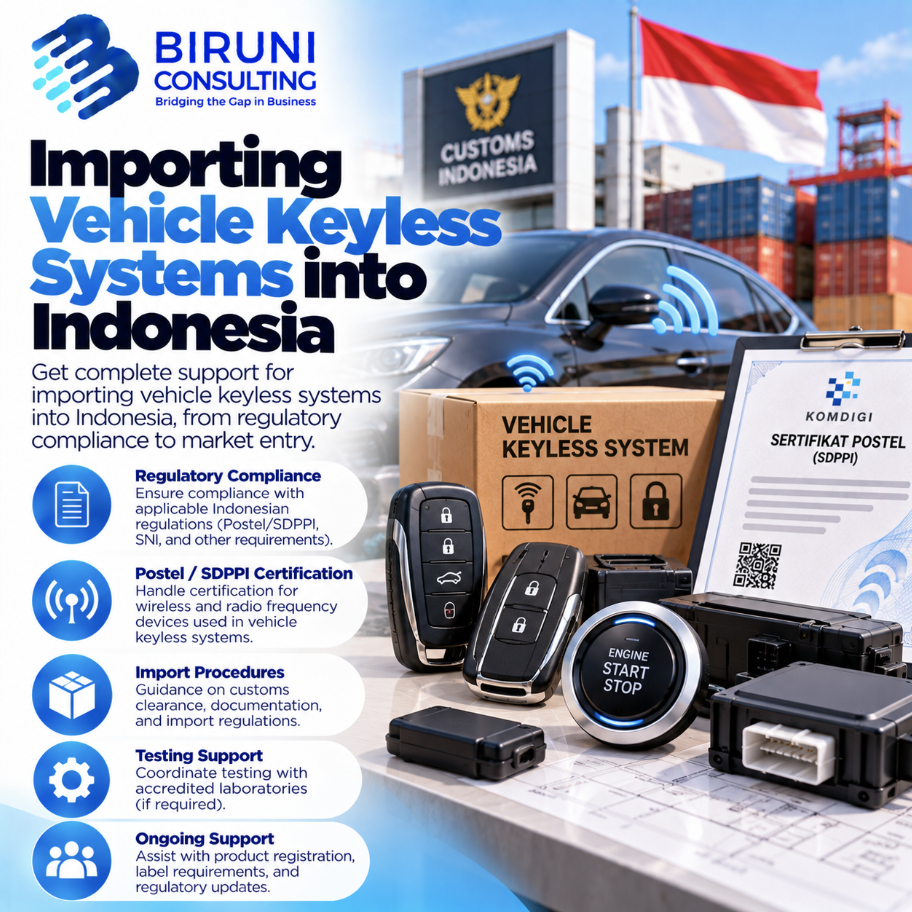
Guide to importing vehicle keyless systems and meeting DJID/SDPPI Certification requirements in Indonesia.
Vehicle keyless systems use wireless communication to lock, unlock, identify, or operate a vehicle without relying solely on a conventional mechanical key. Products may include remote keyless entry systems, smart keys, key fobs, passive keyless entry, passive start systems, and other vehicle access equipment incorporating radio communication.
Because these products contain telecommunications functions, their transmitters, receivers, operating frequencies, transmission power, antennas, and overall RF configuration should be assessed before commercial importation.
Minister of Communication and Informatics Regulation Number 3 of 2024 applies to telecommunications equipment and other equipment incorporating telecommunications features and requires applicable equipment imported into Indonesia to comply with the relevant Technical Standards. JDIH Kemkomdigi
Types of Vehicle Keyless Systems
Vehicle keyless products do not all use the same radio architecture.
A Remote Keyless Entry system normally transmits a command when the user presses a button on the key fob.
A Passive Keyless Entry system can detect the presence of an authorised smart key and may allow the vehicle to be unlocked without pressing a button.
More advanced systems may combine passive entry, passive start, immobiliser functions, Bluetooth, or additional radio technologies.
The certification assessment should therefore be based on the actual technical configuration rather than the commercial term “smart key.”
Remote Keyless Entry
In a conventional RKE system, the key fob normally acts as the radio transmitter.
When the lock, unlock, or other button is pressed, the key transmits a coded radio signal to a receiver installed in the vehicle.
The assessment should identify the frequency range, RF output power, modulation, bandwidth, antenna, and exact transmitter model.
The vehicle-side component should also be reviewed where it contains transmitting functions or forms part of a two-way radio system.
Passive Keyless Entry and Passive Start
Passive keyless systems can use a more complex radio architecture.
One radio path may be used to detect or activate the smart key, followed by another radio transmission from the key to the vehicle.
This means a passive keyless system may contain several RF components or operating frequencies.
Where only a key-fob frequency is provided but the vehicle antenna or control-module specification is missing, the complete radio configuration may not yet be clear.
A manufacturer block diagram or detailed RF specification can therefore be particularly useful for passive systems.
Vehicle Keyless Frequencies
Frequency is one of the most important issues to check before importing a vehicle keyless system.
Products intended for different international markets may use different RF variants even where the external appearance is identical.
Indonesia’s current Short Range Device Technical Standard, Minister of Communication and Informatics Decision Number 260 of 2024, includes frequency ranges such as 300–322 MHz and 433–434.79 MHz, with the relevant table specifying power limits up to 10 mW ERP for those entries. Postel Certification
The same standard also contains other SRD ranges, including 863–865 MHz, 868.6–868.7 MHz, and several ranges around the 900 MHz region, each subject to its corresponding requirements. Postel Certification
A marketing description such as “315 MHz key” or “868 MHz keyless system” should therefore not replace confirmation of the exact operating frequency and technical parameters.
315 MHz and 433 MHz Keyless Systems
Vehicle keyless transmitters for some markets operate around 315 MHz, while others may use frequencies around 433 MHz.
Indonesia’s SRD Technical Standard includes 300–322 MHz and 433–434.79 MHz within its frequency tables. Postel Certification
However, being within one of those frequency ranges does not automatically establish full compliance.
Output power, spurious emissions, modulation, antenna characteristics, and applicable test methods still need to be reviewed.
An RF test report is therefore much more useful than a frequency value printed on the key-fob label alone.
Vehicle Keyless as a Short Range Device
Vehicle keyless systems generally use short-range radio communication and may fall within the technical framework for Short Range Devices.
Decision Number 260 of 2024 defines SRD as telecommunications equipment or devices presenting a relatively low risk of causing harmful interference and sets technical requirements for multiple short-range radio technologies. Postel Certification
Indonesia’s class-license spectrum framework is governed by Regulation Number 2 of 2023 as amended by Minister of Communication and Digital Regulation Number 2 of 2025, which remains in force. JDIH Kemkomdigi
Class-licensed spectrum use should not be confused with exemption from equipment certification. Applicable class-license equipment remains subject to Technical Standards and certification requirements. JDIH Kemkomdigi
Bluetooth and Additional Wireless Technologies
Modern vehicle access systems may also contain Bluetooth, particularly for smartphone-based digital keys or configuration functions.
Where Bluetooth is available, the primary RKE transmitter is not the only radio function that needs to be assessed.
Bluetooth version, output power, module, antenna, and frequency configuration should also be reviewed.
Decision Number 260 of 2024 defines Bluetooth IEEE 802.15.1 as short-range data communication equipment operating in the 2400–2483.5 MHz frequency band. Postel Certification
Where other radio technologies are also incorporated into the vehicle access system, those functions should likewise be included in the technical assessment.
Key Fob and Vehicle-Side Modules
It is important to identify exactly what is being imported.
The shipment may contain only key fobs, only a vehicle receiver module, a transmitter/receiver ECU, an antenna module, or a complete keyless system.
A key fob typically contains an active transmitter, while the vehicle-side equipment may be receive-only, transmit-only in a specific path, or bidirectional depending on the system design.
The certification assessment should therefore reflect the actual imported components and their radio functions.
Importing Overseas-Market Keyless Systems
A vehicle keyless product approved for another country should not automatically be assumed suitable for Indonesia.
Manufacturers may supply different RF versions for North America, Europe, Japan, or other markets.
The housing or commercial part name may be similar even though the internal transmitter frequency or firmware differs.
Before shipment, importers should therefore confirm the exact model and part number, operating frequency, output power, regional variant, and corresponding RF test report.
This reduces the risk of importing a frequency variant different from the one assessed for Indonesia.
HS Code Considerations
The HS classification should be determined from the actual form and function of the imported goods.
Indonesian tariff nomenclature describes HS 8526.92.00 as radio remote control apparatus. INSW API
This can be an important reference for certain standalone radio remote-control products.
However, not every key fob, vehicle control module, receiver, ECU, or complete automotive keyless kit should automatically be assigned the same HS Code.
The final classification may depend on how the item is presented at importation and its principal technical function.
Documents to Prepare Before Importation
Importers should obtain sufficient manufacturer documentation before commercial shipment.
The main documents normally include product and label photos, brand and model information, product or RF datasheets, operating frequency, transmission power, antenna specifications, and available RF test reports.
For passive keyless systems, a system description or block diagram can be particularly useful because it shows the radio relationship between the smart key, antennas, and vehicle control units.
Documentation for Bluetooth or any additional wireless technology should also be included where applicable.
Foreign RF Test Reports
An overseas RF laboratory report can provide valuable technical evidence.
However, it should correspond to the exact product, transmitter, frequency range, RF output power, modulation, antenna, and firmware configuration being imported.
Decision Number 260 of 2024 also provides that existing SRD test reports issued before the decision became effective may continue to be submitted for certification where they do not conflict with the new Technical Standard or other applicable rules. Postel Certification
A foreign test report can therefore support the process, but it does not by itself constitute DJID/SDPPI Certification.
Does Low Transmission Power Mean an Exemption?
No general exemption should be assumed simply because a key fob transmits at low power.
Regulation Number 3 of 2024 includes specific provisions for certain other equipment with telecommunications features below 10 mW and only one identical telecommunications feature. In qualifying circumstances, a single Certificate may cover more than one variant.
This provision concerns certificate coverage under particular conditions and should not be interpreted as a general exemption for every low-power vehicle keyless product.
The complete technical configuration still needs to be assessed.
Can Several Vehicle Models Share One Certificate?
Potential model grouping should be based on technical similarity.
One vehicle manufacturer may use the same keyless platform across several car models, while a single vehicle model may use different RF suppliers depending on production year, market, or trim level.
The assessment should therefore compare transmitter and receiver part numbers, frequency, output power, antenna configuration, manufacturer information, and country of manufacture.
Where the applicable regulatory criteria are satisfied, possible grouping should be assessed before submitting the certification application.
Import Process for Vehicle Keyless Systems
For commercial importation, technical assessment should ideally be completed before shipment.
The process normally begins by identifying the exact keyless architecture, model, frequency, transmission power, transmitters, receivers, antennas, and any additional wireless technologies.
RF test reports and manufacturer documentation can then be reviewed against the applicable Technical Standards to determine the testing and certification route.
Regulation Number 3 of 2024 also provides for Certificate information to be transmitted to the Indonesia National Single Window (SINSW) in real time, including the HS code, country of origin, brand, product type, and the period for which the Certificate can be used for import purposes. JDIH Kemkomdigi
Accurate product data is therefore important for both certification and import documentation.
Certificate Period for Import Activities
Under Regulation Number 3 of 2024, the Certificate itself is not time-limited.
However, the Certificate holder may manufacture, assemble, or import the relevant equipment for trade and/or use in Indonesia for up to three years from the Certificate issuance date. JDIH Kemkomdigi
Where those activities continue beyond the three-year period, the applicable requirements for renewed Technical Standard compliance and a new Certificate need to be followed.
This is relevant for automotive suppliers importing the same keyless system or spare part over several years.
DJID Labeling
Certified equipment is also subject to labeling requirements.
The annex to Regulation Number 3 of 2024 provides a format including the Certificate number and PLG ID, QR Code, and warning sign. JDIH Kemkomdigi
Because key fobs and vehicle radio modules can be physically small, regulatory labeling and packaging should ideally be considered before mass production or shipment.
Why Pre-Shipment Assessment Matters
Vehicle keyless systems are particularly sensitive to regional RF configurations.
One product family may have 315 MHz, 433 MHz, or other frequency versions for different target markets. Passive keyless systems may also contain more than one radio path.
Completing the assessment before shipment helps determine whether the actual frequency configuration is suitable, which test documents are required, whether several variants may be grouped, and how certification and labeling should be prepared.
This is significantly safer than identifying a frequency mismatch only after the products have already reached Indonesia.
Conclusion
Importing vehicle keyless systems into Indonesia requires a detailed review of the radio functions incorporated into the key fob and vehicle-side equipment.
Operating frequency, transmission power, transmitters, receivers, RF modules, antennas, modulation, and additional technologies such as Bluetooth are important parts of the assessment.
HS 8526.92.00 is a tariff subheading for radio remote control apparatus, but final classification should still reflect the actual form and function of the imported product. INSW API
Conducting an assessment before importation helps businesses prepare DJID/SDPPI Certification, RF testing, HS-code information, model grouping, labeling, and shipment documentation more accurately.
Contact Us
Biruni Consulting assists with DJID/SDPPI assessment and certification for vehicle keyless systems and various wireless products that will be imported or marketed in Indonesia.
Our services include:
- Assessment of DJID/SDPPI certification requirements.
- Transmitter and receiver assessment.
- RF specification review.
- Frequency and transmission power analysis.
- Technical document review.
- Certification document preparation.
- Testing coordination where required.
- DJID/SDPPI Certification assistance.
If you have a vehicle keyless system, you can prepare product photos, brand, model, datasheet, RF specifications, and wireless module datasheet for an initial assessment of the Postel Certification requirements.