
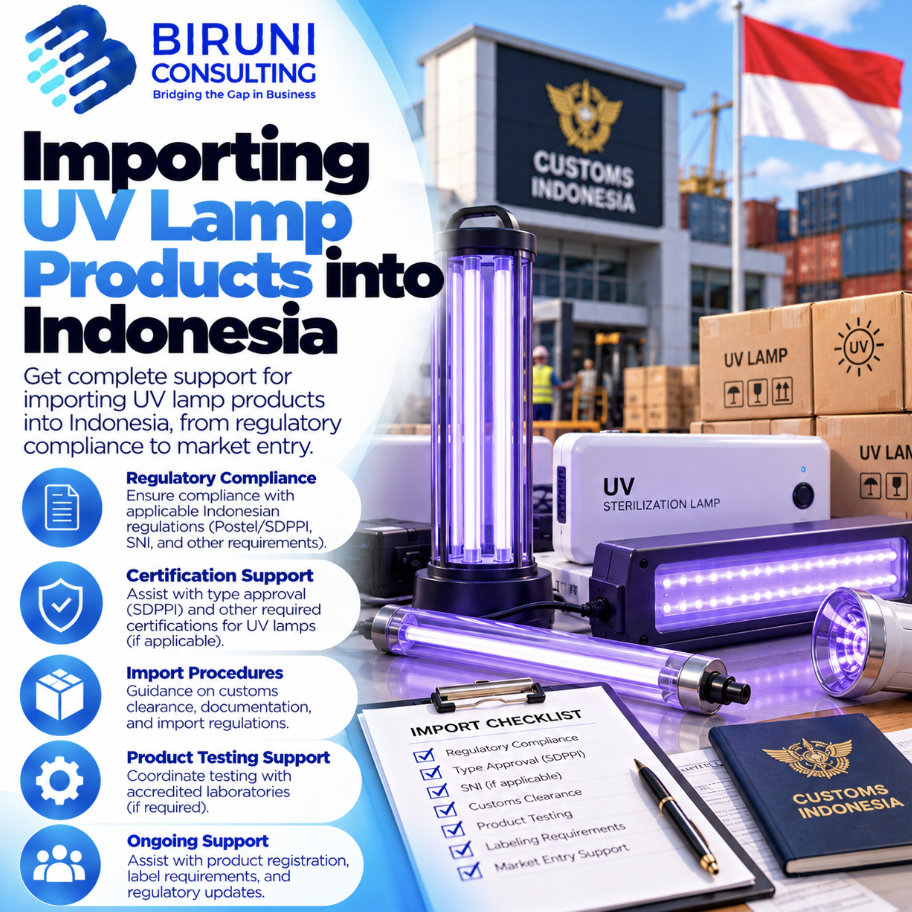
Guide to Import Requirements, SNI, HS Code, Testing, and UV Lamp Certification in Indonesia
Importing UV lamp products into Indonesia requires more detailed assessment than ordinary lighting products because the term UV lamp can cover products with very different functions and risks. Ultraviolet products may be used for sterilization, air disinfection, surface disinfection, water treatment, industrial inspection, curing, fluorescence detection, phototherapy, and laboratory applications.
These differences are important when determining import requirements. A UV lamp supplied only as a light source may follow a different regulatory pathway from a complete UV luminaire. Likewise, a UV-C product marketed to sterilize rooms or medical equipment may be classified as a medical device and require a marketing authorization from the Ministry of Health.
Companies should therefore not determine requirements solely from commercial descriptions such as “UV lamp,” “UV sterilizer,” “germicidal lamp,” or “UV-C disinfection light.” Product assessment should be based on wavelength, function, construction, power source, intended claims, HS Code, and complete product configuration.
What Is a UV Lamp?
A UV lamp is a light source that produces ultraviolet radiation with wavelengths shorter than visible light.
Ultraviolet radiation is generally divided into:
- UV-A.
- UV-B.
- UV-C.
Each group has different characteristics and applications.
UV-A is commonly used for curing, fluorescence inspection, nail curing, insect traps, and certain industrial applications.
UV-B may be used for specific applications such as phototherapy or specialized technical processes.
UV-C is commonly used for germicidal or disinfection purposes because radiation within certain wavelength ranges can be used to inactivate microorganisms.
These differences make “UV lamp” too broad a description to directly determine the applicable standard or import authorization.
Common Types of Imported UV Products
UV products imported into Indonesia may include:
- UV fluorescent tubes.
- UV-C germicidal lamps.
- UV LED modules.
- UV sterilizer lamps.
- UV disinfection boxes.
- UV sterilizer cabinets.
- UV room sterilizers.
- UV air purifiers.
- UV water sterilizers.
- UV curing lamps.
- UV inspection lamps.
- UV nail lamps.
- UV insect trap lamps.
- UV phototherapy devices.
- Portable UV sterilizers.
- UV fixtures or complete luminaires.
Each category needs to be assessed separately because its intended function may affect the standard, HS Code, and responsible regulatory authority.
Are UV Lamps Required to Have SNI?
Not every UV product is automatically subject to one specific mandatory SNI.
The first step is determining whether the product is a:
- Lamp or light source.
- Complete luminaire.
- Household electrical appliance.
- Air purifier.
- Water-treatment appliance.
- Industrial equipment.
- Germicidal sterilizer.
- Medical device.
Where a UV product is constructed as a luminaire, luminaire standards may be among the standards that need to be reviewed. BSN currently lists SNI IEC 60598-1:2016 and SNI IEC 60598-1:2017 as active luminaire standards. Pesta
The Ministry of Trade’s LAMANSITU also lists certain luminaire categories with SNI IEC 60598-1:2016 and the Goods Registration Number or NPB as quality-policy requirements for several HS Codes under heading 9405. Laman Situ
This does not mean that every UV lamp needs to be certified as a luminaire. Classification needs to be based on the actual construction of the product.
UV Lamps as Luminaires
Where a UV product includes a housing, lamp holder or LED module, power supply, wiring, reflector, protective cover, and mounting system, it may have the characteristics of a complete luminaire.
In such cases, SNI IEC 60598-1 is one of the standards that should be reviewed.
LAMANSITU lists several luminaire categories using SNI IEC 60598-1:2016 and NPB. General-purpose portable luminaires, for example, use SNI IEC 60598-1:2016 together with the applicable particular standard. Laman Situ
Where a UV product is constructed as a spotlight or floodlight, its physical design and function also need to be assessed. LAMANSITU has a floodlight category using SNI IEC 60598-1:2016 and SNI IEC 60598-2-5:2016. Laman Situ
However, the ultraviolet function may introduce additional safety considerations, meaning the assessment should not stop at the electrical and mechanical luminaire standard.
Ultraviolet Radiation Safety
UV products create risks that are not normally associated with ordinary visible-light lamps.
Certain ultraviolet wavelengths can create hazards to the eyes and skin when exposure is not controlled. Photobiological safety is therefore an important consideration when evaluating UV equipment.
IEC 62471 is internationally used for photobiological safety assessment of lamps and lamp systems. Indonesian laboratories have also been listed with testing scope for IEC 62471:2006 – Photobiological Safety of Lamps and Lamp Systems under ASEAN testing arrangements. ASEAN
For UV products, information regarding wavelength, irradiance, exposure distance, exposure duration, shielding, interlocks, sensors, and warning labels should be reviewed.
This is particularly important for UV-C products where direct human exposure may be possible.
UV-C Lamps for Sterilization
UV-C germicidal lamps are widely used for sterilization and disinfection.
Products may include:
- Open UV-C lamps.
- UV sterilizer cabinets.
- UV disinfection boxes.
- Portable UV sterilizers.
- UV room sterilizers.
- UV air-disinfection units.
- UV water-treatment systems.
However, using terms such as “sterilizer” or making medical claims may change the regulatory classification of the product.
Indonesia has standards specifically covering a mobile ultraviolet room sterilizer and ultraviolet water sterilizer, namely SNI 16-4284-1996 and SNI 16-4285-1996, both of which are currently listed as active in the BSN catalogue. Pesta
The existence of these standards does not automatically mean that every UV product requires certification under them, but it demonstrates the importance of product function when determining the relevant standard.
UV Products Classified as Medical Devices
Where a UV product has a medical purpose or medical claim, it may be classified as a medical device.
The Ministry of Health classifies a Germicidal ultraviolet device as a Class B medical device. Its classification documentation also lists an Ultraviolet (UV) radiation chamber or UV sterilizer as Class B. Regal Kes
For imported products meeting the medical-device definition, Minister of Health Regulation No. 11 of 2025 regulates imported medical-device marketing authorization. The regulation states that marketing authorization applies to medical devices imported by medical-device distributors for distribution in Indonesia. JDIH Kementerian Kesehatan
Companies importing UV sterilizers for medical applications should therefore not review only SNI or NPB. The product’s medical-device status, risk class, distributor licensing, and marketing authorization also need to be assessed.
Household UV Sterilizers and Medical UV Sterilizers
Marketing claims can significantly affect regulatory classification.
A UV cabinet marketed for sterilizing medical instruments may follow a different regulatory pathway from a household UV box with no intended medical purpose.
Relevant factors may include:
- Intended use.
- Packaging claims.
- User manual.
- Website and marketing materials.
- Items being disinfected.
- Target users.
- Microbiological effectiveness claims.
- Use in medical facilities or with patients.
Importers should therefore ask the manufacturer to clearly define the intended use before beginning registration.
UV Air Purifiers
Some air purifiers incorporate UV-C lamps as one component of the air-treatment system.
Such a product should not automatically be classified only as a “UV lamp” because its principal function may be air purification.
BSN currently lists SNI IEC 60335-2-65:2015 – Household and similar electrical appliances – Safety – Part 2-65: Particular requirements for air-cleaning appliances as an active standard. Pesta
Where the UV lamp is only one component of a complete air purifier, the entire appliance configuration needs to be assessed.
Importers should provide specifications for the fan, filter, UV module, power supply, enclosure, rated power, and all other functions.
UV Water Sterilizers
UV water sterilizers use ultraviolet radiation for water treatment.
The equipment may consist of a UV lamp installed inside a stainless-steel chamber together with a ballast or driver, quartz sleeve, sensors, and a controller.
BSN currently lists SNI 16-4285-1996 – Ultraviolet water sterilizer as an active standard. Pesta
Whether this standard creates a mandatory certification requirement for a particular product still needs to be determined by reviewing the implementation regulation, HS Code, and actual product function.
Where the product is intended for medical applications or includes medical claims, medical-device regulations may also need to be assessed.
UV Curing Lamps
UV curing lamps are used in processes such as:
- Printing.
- Coating.
- Adhesive curing.
- Resin curing.
- Electronics manufacturing.
- Wood coating.
- Industrial production.
Such products generally have an industrial intended use and are not automatically equivalent to germicidal UV lamps.
UV sources may use mercury lamps, metal-halide lamps, UV LEDs, or other technologies.
Important technical information includes:
- Wavelength.
- Optical power.
- Electrical power.
- Cooling system.
- Driver.
- Lamp type.
- Shielding.
- Working distance.
- Industrial machine interface.
Because the primary function differs, the applicable standard and HS Code may also differ from those used for UV sterilizers.
UV Nail Lamps
UV nail lamps are used to cure gel and other nail products.
Although they use UV or violet radiation, these products are not automatically germicidal devices.
The assessment should include:
- Wavelength.
- Rated power.
- Adapter specification.
- Timer function.
- Sensor function.
- Number of LEDs.
- Product construction.
- Intended use.
Radiation safety is also relevant because the user’s hands are positioned relatively close to the light source.
Product classification needs to be based on the actual construction and intended function.
UV Inspection Lamps
UV inspection lamps are used in fluorescence inspection, nondestructive testing, leak detection, forensic work, and industrial applications.
They may be supplied as handheld UV lamps, UV flashlights, or inspection-station luminaires.
For these products, wavelengths such as 365 nm or 395 nm are often important technical parameters.
For handheld products, the electrical construction, battery, charger, and optical safety should also be reviewed.
Where rechargeable lithium batteries are used, battery and charger information should be included in the product assessment.
UV-A, UV-B, and UV-C in Product Assessment
Wavelength is one of the most important pieces of information for UV imports.
Importers should avoid relying on a datasheet that simply states “UV lamp” without specifying wavelength.
Information should ideally include:
- Peak wavelength.
- Wavelength range.
- Irradiance.
- Optical power.
- Exposure distance.
- Exposure time.
- Beam angle.
- Lamp life.
- Ozone generation where relevant.
Different wavelength ranges may significantly affect both the intended use and safety profile of the product.
Ozone from UV Lamps
Certain UV sources may generate ozone depending on wavelength and lamp technology.
For UV-C sterilizers or germicidal lamps, companies should confirm whether the product is:
- Ozone-free.
- Ozone-generating.
If ozone is generated, ventilation, room use, warning information, operating procedures, and user exposure need to be reviewed.
Manufacturers should provide technical data or test reports supporting any ozone-related claims used on the product.
UV-C Safety Systems
UV-C products should incorporate safety measures appropriate to their actual use.
These may include:
- Protective enclosure.
- Door interlock.
- Motion sensor.
- Occupancy sensor.
- Automatic shut-off.
- Timer.
- Remote operation.
- Warning indicator.
- Audible alarm.
- Safety labeling.
For example, a UV sterilizer cabinet may use an interlock that switches the UV source off when the door is opened.
An open-room UV sterilizer has a different exposure risk because the radiation can directly reach users.
HS Code for UV Lamps
The HS Code for UV products should not be determined solely from the word “lamp.”
Products may be classified differently depending on whether they are:
- UV light sources.
- Discharge lamps.
- LED modules.
- Complete luminaires.
- Sterilizers.
- Air purifiers.
- Water-treatment equipment.
- Medical devices.
- Industrial curing equipment.
If a product is classified as a luminaire, several luminaire categories listed by LAMANSITU use HS Codes under heading 9405 and are subject to SNI and NPB quality policies. Laman Situ
A UV tube imported only as a light source may, however, have a different classification from a complete luminaire.
HS Code classification should therefore be based on datasheets, photographs, materials, function, construction, power supply, and the physical form of the goods at importation.
NPB for UV Lamps
The Goods Registration Number or NPB needs to be reviewed where the UV product falls within a goods category subject to NPB requirements.
LAMANSITU lists NPB for the general luminaire category together with SNI IEC 60598-1:2016. Laman Situ
However, companies should not assume that every UV product requires NPB.
Where the product is more appropriately classified as a medical sterilizer, industrial machine, lamp source, or another type of appliance, a different regulatory pathway may apply.
Product classification therefore needs to be established before determining the NPB requirement.
Importer Requirements
Indonesia’s current import-policy framework is based on Minister of Trade Regulation No. 16 of 2025 concerning Import Policy and Regulation, as subsequently amended, most recently through Minister of Trade Regulation No. 18 of 2026. Regulation No. 18 of 2026 is currently in force. JDIH Kemendag
Minister of Trade Regulation No. 16 of 2025 requires importers to have an NIB functioning as an API. JDIH Kemendag
General importer legality does not, however, automatically satisfy all product-specific requirements.
For UV products, companies should review:
- NIB and API.
- HS Code.
- UV type.
- Intended use.
- SNI.
- NPB where relevant.
- Medical-device marketing authorization where relevant.
- Product family.
- Manufacturer documentation.
- Test reports.
Marketing Authorization for UV Medical Devices
If the product is assessed as an imported medical device, companies need to review Ministry of Health marketing-authorization requirements.
Minister of Health Regulation No. 11 of 2025 is currently in force and regulates business standards and product/service standards under risk-based licensing in the health subsector. The regulation includes standards for Imported Medical Device Marketing Authorization. JDIH Kementerian Kesehatan
Medical-device registration is conducted through the Ministry of Health’s Regalkes system, which provides licensing services for medical devices and household health supplies. Regal Kes
Companies importing germicidal UV devices with medical claims should therefore determine the product’s regulatory status before shipment.
Documents to Prepare
For UV product import assessment, companies should prepare:
- Product name.
- Brand.
- Model.
- Product photographs.
- Product datasheet.
- User manual.
- Intended use.
- Manufacturer name.
- Factory address.
- Country of origin.
- Rated voltage.
- Rated current.
- Rated power.
- Frequency.
- UV type.
- Peak wavelength.
- Wavelength range.
- Irradiance.
- Optical power.
- Lamp or LED-module specification.
- Driver or ballast specification.
- Adapter specification.
- Housing material.
- Safety-interlock information.
- Sensor specification.
- Ozone information.
- Label artwork.
- Existing IEC or safety test reports.
- Photobiological safety report where available.
- Microbiological efficacy report where disinfection claims are made.
Complete documentation makes it easier to determine the correct regulatory pathway from the beginning.
Germicidal Efficacy Test Reports
Products claiming to kill or inactivate bacteria, viruses, fungi, or other microorganisms should be supported by evidence.
Relevant information may include:
- Type of microorganism.
- Reduction rate.
- Exposure time.
- Distance.
- UV dose.
- Test method.
- Laboratory information.
- Product configuration during testing.
Claims such as “99.9% sterilization” should not be based solely on lamp specifications.
Disinfection effectiveness depends on several factors, including UV dose, distance, exposure time, shadowing, microorganism type, and actual conditions of use.
UV Lamp Product Family
One manufacturer may offer many UV models differing in power, wavelength, dimensions, lamp type, or product configuration.
Product-family assessment may consider:
- Intended use.
- UV-A, UV-B, or UV-C.
- Wavelength.
- Lamp technology.
- Rated voltage.
- Rated power.
- Driver or ballast.
- Housing.
- Safety system.
- Sensors.
- Product dimensions.
- Electrical class.
- Medical claims.
- Manufacturer.
A UV-A curing lamp should not automatically be grouped with a UV-C sterilizer simply because their housings look similar.
UV Lamp Testing
Testing requirements depend on product classification.
For luminaires, testing may include:
- Marking.
- Construction.
- Protection against electric shock.
- Wiring.
- Terminals.
- Insulation resistance.
- Electric strength.
- Mechanical strength.
- Temperature rise.
- Resistance to heat.
For UV products, additional assessment may include:
- Wavelength.
- UV irradiance.
- Photobiological safety.
- Leakage radiation.
- Safety interlocks.
- Ozone generation.
- Germicidal effectiveness where claimed.
For medical devices, safety and performance documentation needs to follow the applicable registration requirements for that product type.
Stages of Importing UV Lamps into Indonesia
Product Identification
Determine whether the product is a UV lamp, UV luminaire, UV sterilizer, UV air purifier, UV water sterilizer, curing lamp, or medical device.
Intended Use Identification
Confirm the product function and claims clearly.
This stage is particularly important because medical sterilization claims can change the regulatory pathway.
HS Code Identification
Determine the HS Code based on the actual form and function of the goods at importation.
Regulatory Assessment
Review whether the product falls under:
- Luminaire SNI.
- Household-appliance requirements.
- Industrial equipment.
- Medical-device requirements.
- NPB-controlled goods.
Product Family Assessment
Compare all models to determine appropriate grouping.
Document Preparation
Prepare company legal documents, manufacturer documents, technical specifications, safety documentation, and test reports.
Testing
Conduct testing according to the applicable standards and intended product function.
Certification or Registration
Where the product falls within an SNI certification scope, certification should be conducted through the appropriate certification body.
Where the product is a medical device, marketing authorization needs to follow Ministry of Health requirements.
NPB Registration
Where the product falls within a luminaire category requiring NPB, the NPB registration process also needs to be completed.
Why Is Assessment Before Shipment Important?
UV lamps are highly dependent on their intended use.
Products with almost identical physical construction may fall under different regulatory pathways simply because their functions and marketing claims differ.
For example, a UV-C lamp sold as an industrial component may follow a different pathway from a product marketed as a “medical UV sterilizer.”
If products are manufactured and shipped before regulatory assessment, companies may later discover requirements for additional test reports, marketing authorization, certification, or labeling changes.
Assessment should therefore be conducted before mass production and shipment.
Contact Us
Biruni Consulting assists companies with importing UV lamp products into Indonesia, including product-category identification, SNI consultation, HS Code review, document evaluation, testing, certification, and regulatory-registration assistance.
Our services include:
- Consultation on UV lamp import requirements.
- Identification of UV-A, UV-B, and UV-C products.
- Identification of applicable SNI standards and regulations.
- HS Code and product-scope review.
- Intended-use and product-claim assessment.
- Review of luminaires, drivers, ballasts, and major components.
- Product family assessment.
- Assessment of NPB requirements.
- Assessment of medical-device marketing authorization requirements where relevant.
- Testing, certification, and product-registration assistance.
Contact Biruni Consulting for information regarding UV lamp SNI services, UV-C lamp certification, UV sterilizer import licensing, germicidal UV device certification, UV luminaire NPB, and UV lamp import requirements in Indonesia according to your product’s brand, model, wavelength, function, specifications, HS Code, and country of origin.