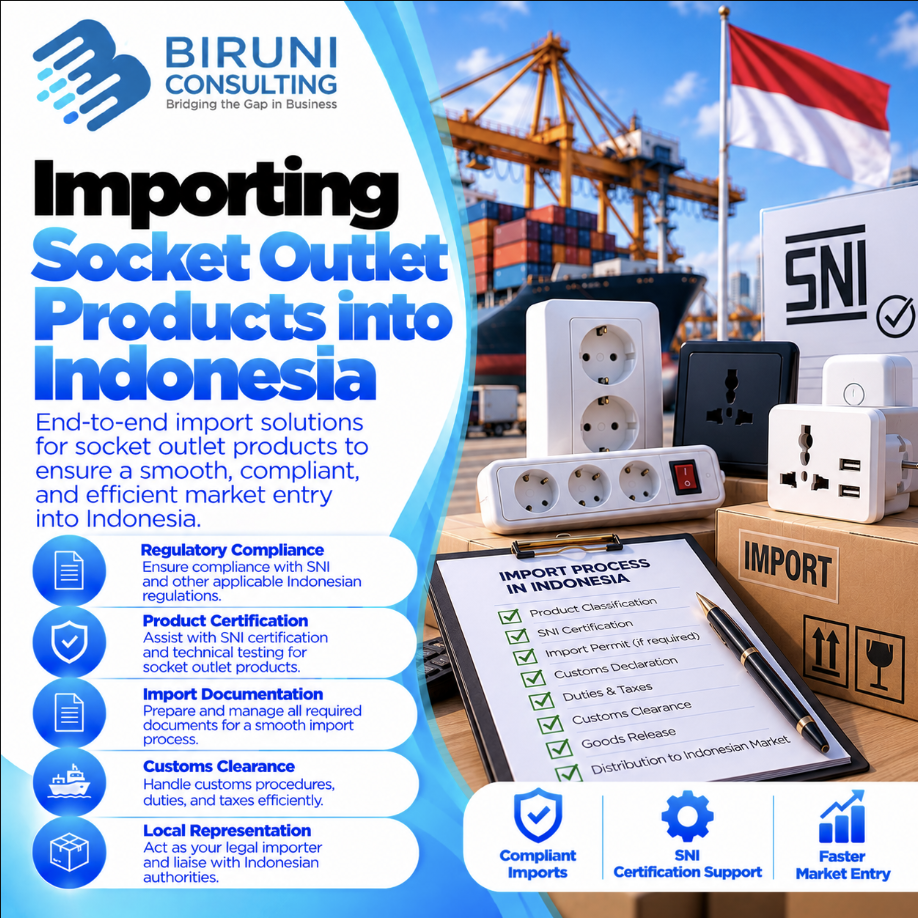
Guide to Import Requirements, SNI, NPB, HS Code, Testing, and Socket Outlet Certification
Importing socket outlet products into Indonesia requires an assessment of product type, installation method, rated voltage, rated current, earthing arrangement, shutters, terminals, housing materials, pin configuration, HS Code, and applicable SNI standards. Products commercially described as wall sockets, power outlets, electrical sockets, floor sockets, portable sockets, extension sockets, smart sockets, or sockets with USB functions do not necessarily have identical construction or regulatory pathways.
In Indonesia, plugs and socket outlets for household and similar purposes are included among products subject to mandatory SNI requirements. Minister of Energy and Mineral Resources Regulation No. 7 of 2021 lists SNI IEC 60884-1:2014 and SNI 04-3892.1.1-2003 for plugs and socket outlets falling within the regulatory scope. The requirement also applies to imported products according to the relevant HS classifications. JDIH ESDM
Importers should therefore conduct a product assessment before mass production or shipment to determine the product category, ratings, socket configuration, applicable SNI, HS Code, product family, NPB requirement, and certification documentation.
What Is a Socket Outlet?
A socket outlet is an electrical accessory providing a connection point for a plug, allowing electrical equipment to connect to an electrical supply. In Indonesia, it is commonly referred to as a stop kontak.
Products may be permanently mounted on walls, recessed into wall boxes, installed in floors, used as portable accessories, or incorporated into extension cords and multi-socket assemblies.
Common imported types include:
- Wall sockets.
- Flush-mounted and surface-mounted socket outlets.
- Floor sockets and furniture sockets.
- Portable sockets, extension sockets, and power strips.
- Smart sockets and socket outlets with USB-A/USB-C or switching functions.
Although these products all provide an electrical outlet function, their construction and additional features need to be assessed separately.
Are Imported Socket Outlets Subject to Mandatory SNI?
Yes. Plugs and socket outlets falling within Minister of Energy and Mineral Resources Regulation No. 7 of 2021 are subject to mandatory SNI requirements.
The regulatory scope includes plugs and socket outlets for household and similar purposes intended for connection to fixed installations; fixed or portable products; products with or without earthing contacts; rated voltages above 50 V and not exceeding 440 V; and rated currents not exceeding 32 A. It also includes flush and surface-mounted products and portable socket outlets incorporated into cord extension sets. JDIH ESDM
The regulation lists ex 8536.69.92 and ex 8536.69.99 for this mandatory scope. The “ex” designation is important because the obligation depends on the product description and technical characteristics, not solely on the tariff number. JDIH ESDM
SNI IEC 60884-1:2014
The principal standard is SNI IEC 60884-1:2014 – Plugs and socket-outlets for household and similar purposes – Part 1: General requirements.
BSN currently lists SNI IEC 60884-1:2014 as an active standard, adopting IEC 60884-1:2006. Pesta
Minister of Energy and Mineral Resources Regulation No. 7 of 2021 also explicitly lists SNI IEC 60884-1:2014 for the mandatory plug-and-socket category. JDIH ESDM
Assessment generally addresses construction, protection against electric shock, earthing, terminals, mechanical strength, temperature, insulation, current-carrying capability, insulating materials, and other safety characteristics defined by the standard.
SNI 04-3892.1.1-2003
Minister of Energy and Mineral Resources Regulation No. 7 of 2021 additionally lists SNI 04-3892.1.1-2003 – Plugs and socket-outlets for household and similar purposes – Part 1-1: General requirements – Shapes and dimensions. JDIH ESDM
BSN currently continues to list SNI 04-3892.1.1-2003 as active. Pesta
Dimensional requirements are important because mechanical compatibility between plugs and socket outlets is a safety issue. It is not sufficient to confirm only that a particular plug can physically enter the outlet. Dimensions, contact arrangements, earthing, and overall configuration need to comply with the applicable requirements.
Wall Socket Outlets
Wall sockets are among the most common socket outlets in houses, apartments, hotels, offices, and commercial buildings.
They can be flush-mounted into wall boxes or surface-mounted directly to a wall.
Assessment should consider rated voltage, rated current, number of outlets, earthing contacts, terminal types, shutters, faceplates, mounting frames, insulating materials, and installation methods.
Products rated at 10 A, 16 A, or another current should not automatically be treated as one product family where their internal contact systems or construction differ.
Socket Outlets with Earthing
Socket outlets may be supplied with or without protective earthing contacts.
Ministerial Regulation No. 7 of 2021 explicitly includes plugs and socket outlets with or without earthing contacts where they fall within the defined technical scope. JDIH ESDM
For earthed models, the earthing-contact construction and continuity of the protective connection become important.
The earthing configuration used in mass production should remain consistent with the certified sample.
Socket Outlets with Shutters
Many modern outlets incorporate safety shutters to reduce access to live contacts.
The shutter may be designed to open only when plug pins are correctly inserted or may use another protective mechanism.
Products with and without shutters can have different internal constructions. Ministerial Regulation No. 7 of 2021 identifies the level of protection against access to hazardous parts as one of the product-family grouping parameters. JDIH ESDM
Shutter configuration should therefore be clearly identified in technical drawings and model lists.
Flush-Mounted and Surface-Mounted Sockets
The mandatory scope includes both flush-mounted and surface-mounted socket outlets. JDIH ESDM
A flush-mounted product normally has most of its mechanism located within a wall or mounting box, while a surface-mounted outlet contains an enclosure positioned directly on the wall.
These differences can affect housing, terminal access, mechanical protection, and product-family classification.
Importers should prepare front and rear product photographs, installation drawings, and dimensions for assessment.
Outdoor Socket Outlets
Outdoor socket outlets require additional consideration because they can be exposed to dust, moisture, and water.
Products may incorporate covers, gaskets, enclosures, cable entries, and other sealing features.
Where IP44, IP55, IP66, or another protection level is claimed, supporting test evidence should ideally be available. A protective cover alone is not sufficient to establish an IP rating.
Outdoor outlets still need assessment against the applicable socket-outlet standard, while any claimed enclosure protection also needs to correspond to actual construction.
Floor Sockets
Floor sockets are commonly installed in offices, meeting rooms, hotels, showrooms, and commercial premises.
Products may incorporate metal covers, pop-up mechanisms, or recessed enclosures and can combine electrical sockets with data connectors, USB ports, HDMI, or other interfaces.
It is important to distinguish the electrical socket outlet, its enclosure, and other functions included within the assembly.
Where the imported item is a complete floor socket with an integrated mains outlet, the socket portion still needs assessment against the relevant SNI requirements. HS classification should also follow the complete imported product.
Portable Socket Outlets
Portable socket outlets can be used without permanent wall installation.
Ministerial Regulation No. 7 of 2021 includes portable socket outlets and portable outlets incorporated into cord extension sets within its defined product scope. JDIH ESDM
For portable sockets and power strips, the cable, plug, strain relief, terminals, switches, and enclosure need consideration in addition to the socket mechanism.
Extension products should not be assessed solely according to the number of outlets. Cable type, cable length, conductor size, rated current, plug construction, switching, and protection devices can affect the complete product.
Extension Sockets and Power Strips
Indonesia has SNI IEC 60884-2-7:2017 – Plugs and socket-outlets for household and similar purposes – Part 2-7: Particular requirements for cord extension sets, which BSN currently lists as active. Pesta
The existence of a particular standard should, however, be distinguished from the standards explicitly referenced by the mandatory regulation. Ministerial Regulation No. 7 of 2021 lists SNI IEC 60884-1:2014 and SNI 04-3892.1.1-2003 for the plug-and-socket group while including cord extension sets within the technical scope. JDIH ESDM
Standard mapping should therefore be completed according to the applicable certification scheme before testing an extension socket.
Socket Outlets with Switches
Socket outlets may incorporate individual or master switches.
These products have additional switching mechanisms, contacts, internal conductors, and sometimes indicator lamps compared with basic sockets.
Importers should provide circuit diagrams or internal wiring diagrams where available.
Switched and unswitched versions should not automatically be treated as a single product family without reviewing the certification grouping criteria.
Universal Socket Outlets
A universal socket is commercially designed to accept several different plug configurations.
These products require careful technical assessment.
The ability to accept multiple plug types does not automatically demonstrate compliance with Indonesian safety requirements. Contact pressure, accessibility of live parts, earthing continuity, dimensional compatibility, shutter arrangements, and the possibility of incorrect plug insertion need to be considered.
Importers should therefore not assume that a universal outlet can be certified merely because its rated voltage and current appear suitable.
Socket Outlets with USB-A or USB-C
Modern wall sockets may combine AC outlets with USB-A, USB-C, or USB Power Delivery.
These products contain two main systems: the AC socket outlet and an electronic power supply converting mains voltage to DC for the USB output.
The AC outlet remains subject to applicable socket-outlet requirements where it falls within the mandatory scope. The additional charger or power-supply circuit needs separate technical assessment based on its construction, output, insulation, PCB, transformer or switching system, and relevant standards.
A conventional socket outlet and a USB-equipped model should therefore not automatically be treated as the same product family.
Smart Socket Outlets with WiFi or Bluetooth
Smart sockets may use WiFi, Bluetooth, Zigbee, or another radio technology for application-based control.
They generally incorporate a relay, internal power supply, wireless module, PCB, and, in some cases, energy-metering circuitry in addition to the socket contacts.
From an electrical-safety perspective, the socket portion still needs assessment against the applicable socket-outlet requirements. Where an active radio device is incorporated, telecommunications-device certification also needs consideration.
Minister of Communication and Informatics Regulation No. 3 of 2024 regulates certification of telecommunications equipment and devices, while the current Komdigi risk-based licensing framework requires telecommunications devices made, assembled, or imported for use or trade in Indonesia to have the appropriate certification where applicable. JDIH Kemkomdigi
Electrical certification and wireless-device compliance should therefore be assessed as complementary regulatory pathways for smart sockets.
Smart Sockets with Energy Metering
Some smart sockets can display voltage, current, power, or energy consumption.
These functions require additional sensing circuitry and microcontrollers, making their internal construction different from ordinary mechanical outlets.
Models with and without energy monitoring should be differentiated in the model list where their PCBs or electrical construction differ.
Socket Outlets with Surge Protection
Power strips and extension sockets may incorporate surge-protection components such as MOVs.
Where surge protection is claimed, the product specification should identify the protection component, rating, indicator where provided, and relevant circuit configuration.
Products with additional surge protection should not automatically be treated as identical to versions without protection because their electrical and thermal constructions differ.
Socket Outlets with Fuses or Circuit Breakers
Portable sockets may incorporate fuses, overload protectors, resettable thermal breakers, or circuit breakers.
The type and rating of the protective device should be identified in the product datasheet.
A product should not simply claim “overload protection” without documenting the actual protection mechanism used.
Rated Voltage and Rated Current
Ministerial Regulation No. 7 of 2021 defines the relevant plug-and-socket scope as products with rated voltage above 50 V and not exceeding 440 V and rated current not exceeding 32 A. JDIH ESDM
Common household outlets may have ratings such as 10 A or 16 A depending on their design.
The declared current rating needs to be supported by the contact dimensions, terminals, internal conductors, materials, and thermal characteristics of the product.
Screw and Screwless Terminals
Socket outlets may use screw or screwless terminals.
Ministerial Regulation No. 7 of 2021 identifies terminal type—screw or screwless—as one of the product-family grouping criteria. JDIH ESDM
Different terminal constructions can affect conductor retention, contact pressure, temperature rise, and mechanical characteristics.
They should therefore be assessed before being combined into one certification family.
Rewirable and Non-Rewirable Construction
For plugs and portable assemblies, cable connection may be rewirable or non-rewirable.
Cable-connection method is also listed among the product-family criteria in Ministerial Regulation No. 7 of 2021. JDIH ESDM
The difference should be identified in model lists and technical documentation.
Socket Outlet Materials
Socket housings and faceplates may use polycarbonate, thermoplastics, thermosetting materials, metal, glass, or combinations.
Internal insulating materials supporting electrical contacts and terminals are particularly important because they need suitable insulation and heat-resistance properties.
Changing resin materials after testing may affect heat resistance, mechanical strength, and electrical insulation.
Manufacturers should therefore control critical materials during production.
Contact Materials
Socket contacts need suitable conductivity, contact pressure, mechanical durability, and thermal performance.
Manufacturers may use copper alloys, brass, phosphor bronze, or other suitable materials.
Changes to contact material or thickness can affect temperature rise and current-carrying performance.
Contacts are therefore important critical components and should not be substituted without appropriate change assessment.
Socket Outlet Product Family
One manufacturer may offer dozens of socket designs using similar mechanisms.
Conversely, products with identical faceplates may have different internal mechanisms because of current ratings, earthing arrangements, shutters, switches, or terminal systems.
Ministerial Regulation No. 7 of 2021 identifies family-grouping characteristics including rated current and voltage, protection against access to hazardous parts, earthing, cable-connection methods, terminal type, protection against electric shock, presence of covers, mounting method, and installation arrangement. JDIH ESDM
Product-family grouping should therefore be based on technical construction rather than colors or faceplate appearance alone.
HS Code for Socket Outlets
Ministerial Regulation No. 7 of 2021 lists ex 8536.69.92 and ex 8536.69.99 for the mandatory plug-and-socket category. JDIH ESDM
The exact HS classification still needs to be determined according to the actual imported product and tariff nomenclature applicable at the time of import.
Recent trade data also continues to show 85366992 and 85366999 being used for various plug-and-socket products imported into Indonesia, but each product still requires individual classification. Data Indonesia Assets
Wall sockets, floor sockets, smart sockets, extension sockets, and industrial connectors should therefore not automatically be assigned the same HS Code simply because they are all described as sockets.
NPB for Socket Outlets
In addition to SNI, importers need to consider the Goods Registration Number or NPB.
LAMANSITU currently lists SNI IEC 60884-1:2014 and NPB under the Plugs and Socket Outlets product category. Laman Situ
Where a product falls within that quality-policy scope, companies should confirm NPB requirements and maintain consistent information for the brand, model, certificate, product type, and company.
For combination products such as smart sockets or USB-equipped power strips, classification should be completed before determining the applicable registration pathway.
Importer Requirements for Socket Outlets
Indonesia’s current general import-policy framework is based on Minister of Trade Regulation No. 16 of 2025 concerning Import Policy and Regulation, as amended, including through the second amendment under Minister of Trade Regulation No. 18 of 2026. Regulation No. 18 of 2026 was established on June 3, 2026, promulgated on June 4, 2026, and is currently in force. JDIH Kemendag
Under Minister of Trade Regulation No. 16 of 2025, business importers are required to hold an NIB functioning as an API, comprising API-U or API-P. Certain goods may also be subject to import business licensing and/or technical verification depending on the product category. JDIH Kemendag
Importers should therefore review both general importer legality and product-specific requirements before shipment.
Documents from Overseas Manufacturers
Manufacturers should provide technical documentation before certification begins.
Documents may include product catalogues, datasheets, model lists, photographs, technical and dimensional drawings, internal construction drawings, installation instructions, label artwork, and manufacturer and factory information.
Technical data should identify rated voltage, rated current, earthing arrangement, terminal type, shutters, switches, protective devices, socket configuration, housing materials, and contact materials.
For extension sockets, plug type, cable specification, conductor size, cable length, strain relief, and switching should also be documented. Smart sockets should additionally include wireless-module information and a circuit or block diagram.
Socket Outlet Testing
Socket outlet testing follows the applicable standard and product configuration.
Assessment may address marking, dimensions, protection against electric shock, earthing, terminals, construction, ageing resistance, insulation resistance, electric strength, temperature rise, mechanical strength, resistance to heat, and other specified characteristics.
Products incorporating shutters need appropriate shutter evaluation. Outdoor products may require additional assessment of claimed enclosure protection.
Test samples need to represent mass-production units, including contacts, terminals, shutter mechanisms, insulating materials, screws, springs, and earthing components.
Temperature Rise
Temperature rise is particularly important because socket outlets may carry significant current for extended periods.
High contact resistance can result in excessive temperatures at the terminals and socket contacts.
Contact material, thickness, spring force, terminal construction, conductor size, and assembly quality can all influence thermal performance.
Contact-material changes after certification testing should therefore be assessed before implementation.
Mechanical Durability
Socket outlets undergo repeated insertion and withdrawal of plugs throughout their service life.
Contacts need to maintain suitable pressure and mechanical performance after repeated use.
Faceplates, frames, shutters, terminals, screws, and enclosures also need adequate mechanical strength for their intended application.
Floor and pop-up sockets may introduce additional hinges, covers, and mechanisms that need consideration in the complete product assessment.
Labels and Marking
Products should carry marking appropriate to the applicable standard and certification scheme.
Information can include brand, model, rated voltage, rated current, manufacturer information, earthing symbols where relevant, and other required markings.
For USB-equipped products, USB output ratings should also be clearly identified. For smart sockets, model information should be consistent between electrical labels and wireless-device documentation.
Labels should ideally be finalized before mass production.
Component Changes After Certification
Socket outlets have compact internal constructions where seemingly small changes can significantly affect safety.
Suppliers may substitute contact metals, terminals, springs, shutters, housing resins, switches, PCBs, relays, or screws due to price or availability.
These changes can affect temperature rise, insulation, mechanical operation, earthing, and electrical safety.
Importers or certificate holders should therefore maintain an approved component list and a change-control procedure with the manufacturer.
Stages of Importing Socket Outlets into Indonesia
The process begins by identifying whether the product is a wall socket, surface socket, floor socket, portable socket, extension socket, smart socket, or another combination product.
Rated voltage, rated current, earthing, terminals, shutters, HS Code, applicable SNI, NPB, and the complete model list are then reviewed.
The manufacturer prepares technical drawings, datasheets, labels, internal-construction information, material information, and factory documentation. Product-family assessment is used to determine appropriate representative samples.
Where the product falls within mandatory scope, SNI certification needs to be completed according to the electricity conformity-assessment scheme. Ministerial Regulation No. 7 of 2021 requires covered electrical products to comply with the designated SNI and applies the requirement to imported goods according to the relevant HS classifications. JDIH ESDM
NPB and other applicable import requirements should then be confirmed before the products are marketed.
Mistakes to Avoid Before Shipment
One common mistake is assuming that every product containing a socket outlet can use one certificate. Wall sockets, extension sockets, smart sockets, USB sockets, and floor sockets can have materially different constructions.
Another mistake is grouping products solely according to faceplate appearance. Internal contacts, terminals, earthing, shutters, current ratings, switching arrangements, and mounting methods are more important for technical grouping.
Companies should also avoid mass production before contact materials, housing resins, terminals, labels, and model lists have been finalized.
For smart sockets, electrical SNI assessment should not replace the separate review of WiFi, Bluetooth, or other radio functionality.
Why Is Assessment Before Import Important?
Socket outlets are directly connected to electrical installations and undergo repeated use throughout their service life.
Poor contacts, overheating terminals, inadequate earthing, access to live parts, or unsuitable insulating materials can create significant safety risks.
Modern socket products also vary considerably in complexity. A conventional outlet and a smart socket containing a relay, PCB, energy meter, USB charger, and WiFi module may have very similar external designs but very different compliance requirements.
Assessment before mass production and shipment helps companies determine SNI, HS Code, NPB, product-family grouping, representative testing, wireless requirements, and manufacturer documentation from the beginning.
Contact Us
Biruni Consulting assists companies with importing socket outlet products into Indonesia, including SNI consultation, HS Code identification, product-category assessment, product family assessment, testing, and certification assistance.
Our services include:
- Consultation on socket-outlet import requirements and applicable SNI standards.
- HS Code, rated voltage, rated current, product-specification, and product-list assessment.
- Identification of wall sockets, floor sockets, portable sockets, extension sockets, USB sockets, and smart sockets.
- Review of terminals, earthing contacts, shutters, switches, contact materials, housings, cables, and critical components.
- Product family assessment and certification-document preparation.
- Testing, factory-audit or production-evaluation assistance where required, SNI certification, and NPB assistance.
Contact Biruni Consulting for information regarding socket outlet SNI services, socket outlet certification, SNI IEC 60884-1:2014, wall socket certification, smart socket certification, socket outlet NPB, and socket outlet import requirements in Indonesia according to your product’s brand, model, construction, rated voltage, rated current, features, HS Code, and country of origin.