
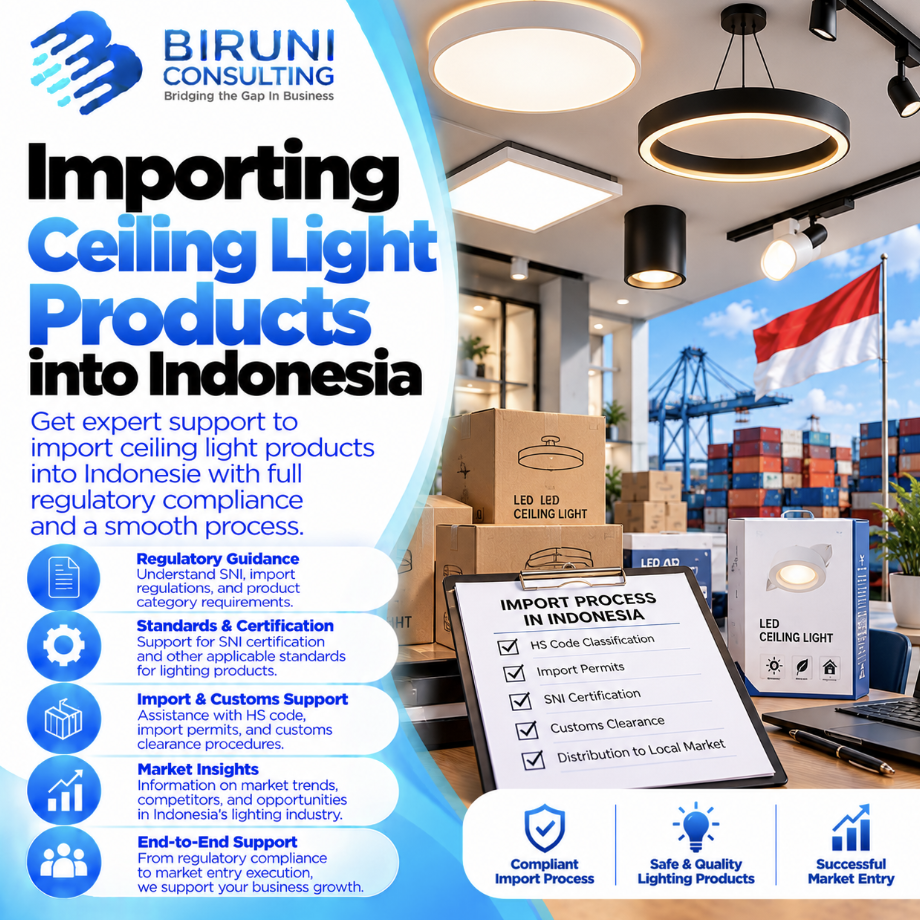
Guide to Import Requirements, SNI, NPB, HS Code, Testing, and Ceiling Light Certification
Importing ceiling light products into Indonesia requires an assessment of luminaire type, mounting method, light source, voltage, wattage, LED driver, housing material, earthing system, HS Code, and applicable SNI standards. The term ceiling light may cover surface-mounted ceiling lights, flush-mount lamps, semi-flush ceiling lights, recessed ceiling lights, downlights, decorative ceiling lamps, and smart ceiling lights.
Construction differences are important because luminaires mounted directly on the ceiling do not necessarily use the same particular standard as luminaires recessed into the ceiling. Minister of Energy and Mineral Resources Regulation No. 7 of 2021 includes several luminaire categories under mandatory SNI requirements, including general-purpose fixed luminaires and recessed luminaires. The regulation lists SNI IEC 60598-1:2016 as the general luminaire standard, SNI 04-6973.2.1-2005 for general-purpose fixed luminaires, and SNI IEC 60598-2-2:2016 for recessed luminaires. JDIH ESDM
Importers should therefore conduct a product assessment before mass production or shipment to establish whether the product is a surface-mounted fixed luminaire, recessed luminaire, decorative hanging luminaire, or another category.
What Is a Ceiling Light?
A ceiling light is a luminaire installed on, in, or near the ceiling to provide general, decorative, or localized illumination.
These products are widely used in homes, apartments, offices, hotels, restaurants, retail stores, lobbies, corridors, meeting rooms, and commercial buildings.
Common imported products include:
- Surface-mounted and flush-mounted ceiling lights.
- Decorative ceiling and semi-flush lights.
- Recessed ceiling lights and downlights.
- Integrated LED ceiling lights.
- Ceiling lights with sensors, remote controls, RGB, WiFi, or Bluetooth.
Although these products may all be marketed as ceiling lights, their technical categories and particular standards need to be assessed according to the actual construction.
Are Imported Ceiling Lights Required to Have SNI?
Ceiling lights falling within the general-purpose fixed-luminaire or recessed-luminaire scope listed in Minister of Energy and Mineral Resources Regulation No. 7 of 2021 are included within mandatory SNI requirements according to the limits of the regulation. Its annex also connects mandatory implementation with the relevant HS classifications. JDIH ESDM
For general-purpose fixed luminaires, the regulation lists SNI IEC 60598-1:2016 together with SNI 04-6973.2.1-2005 – Luminaires – Part 2-1: Particular requirements – Fixed general-purpose luminaires. For recessed luminaires, it lists SNI IEC 60598-1:2016 together with SNI IEC 60598-2-2:2016. JDIH ESDM
The commercial description “ceiling lamp” is therefore not sufficient. The mounting method is one of the first technical characteristics that needs to be established.
SNI IEC 60598-1:2016 for Ceiling Lights
SNI IEC 60598-1:2016 – Luminaires – Part 1: General requirements and tests is the general standard used for several luminaire categories covered by Minister of Energy and Mineral Resources Regulation No. 7 of 2021. The regulation applies this general standard together with relevant particular standards according to luminaire type. JDIH ESDM
Luminaire assessment generally covers construction, protection against electric shock, terminals, wiring, earthing, insulation resistance, electric strength, temperature, material resistance, and mechanical safety characteristics.
Because SNI IEC 60598-1 is a general standard, the applicable particular standard still needs to be determined. A surface-mounted ceiling light and a recessed downlight, for example, should not automatically be treated as the same category.
Surface-Mounted Ceiling Lights
A surface-mounted ceiling light is installed directly onto the ceiling surface without most of the luminaire housing extending into the ceiling cavity.
Products may be round, square, linear, dome-shaped, flush-mounted, or designed as decorative architectural luminaires.
Depending on the actual function and construction, this type of product generally needs to be assessed against the general-purpose fixed luminaire category. Minister of Energy and Mineral Resources Regulation No. 7 of 2021 lists fixed general-purpose luminaires among its mandatory luminaire categories. JDIH ESDM
Importers should provide information regarding the mounting plate, terminals, earthing, housing, LED driver, internal wiring, diffuser, and installation method.
Flush-Mount and Semi-Flush Ceiling Lights
A flush-mount ceiling light is fitted close to the ceiling surface, while a semi-flush model has a short distance between the ceiling canopy and the main luminaire body.
Both are commonly marketed as decorative ceiling lamps. For certification, however, the important characteristics are whether the luminaire is fixed, its power supply, electrical class, light source, and electrical construction.
Products may use replaceable E27 or E14 lamps, but modern models often contain integrated LED modules.
For integrated LED models, the driver, LED PCB, insulation system, metal housing, and earthing arrangements are important critical elements.
Recessed Ceiling Lights and Downlights
Ceiling lights installed partly or fully within a ceiling have a different construction from surface-mounted products.
Minister of Energy and Mineral Resources Regulation No. 7 of 2021 lists SNI IEC 60598-2-2:2016 as the particular standard for recessed luminaires, together with SNI IEC 60598-1:2016 as the general requirement. JDIH ESDM
A recessed downlight normally has part of the luminaire, spring clips, or installation assembly inside the ceiling cavity. The driver may be integrated or installed separately above the ceiling.
Cut-out dimensions, installation depth, driver location, mounting springs, thermal conditions, and clearance from surrounding materials should therefore be prepared before testing.
Surface-mounted ceiling lights and recessed downlights should not automatically be grouped within the same product family without technical assessment.
Ceiling Lights with Lamp Holders
Some ceiling lights use lamp holders that allow users to replace the light source.
Examples include ceiling fittings using E27 or E14 lamp holders.
For these products, the manufacturer should identify maximum lamp wattage, lamp-holder type, wiring, terminals, housing material, electrical class, and earthing configuration.
Where the housing is metal, protection against electric shock requires particular attention.
The lamp selected by the user must also remain within the maximum rating declared for the luminaire.
Integrated LED Ceiling Lights
An integrated LED ceiling light uses an LED module forming a permanent part of the luminaire.
The product commonly consists of an LED PCB, LED driver, diffuser, housing, mounting plate, wiring, and terminals.
The driver is an important critical component because changes to output current, output voltage, insulation, or thermal characteristics may affect testing results.
Importers should ideally require the supplier to finalize the driver model before samples are submitted for testing. Substituting a driver after certification without assessment can result in a mass-produced product differing from the configuration that was evaluated.
Ceiling Lights with External Drivers
Some ceiling lights use an external driver installed above the ceiling or within the ceiling space.
Companies should identify the relationship between the luminaire and driver, including connectors, cable length, driver output, installation location, and whether the driver is included in the sales package.
An external driver should not be considered unimportant merely because it is physically separated from the luminaire housing.
The tested product configuration should correspond to the driver and installation system that will ultimately be marketed.
Decorative Ceiling Lights
Decorative ceiling lighting may use glass, acrylic, crystal, metal, aluminium, wood, resin, or combinations of different materials.
A decorative design does not remove electrical-safety requirements where the product falls within mandatory SNI scope.
Metal housings require appropriate earthing or insulation arrangements. For glass and crystal products, mechanical mounting is also important to ensure decorative components remain secure during normal use.
For larger products, luminaire weight and mounting arrangements should also be considered in relation to the intended installation.
Ceiling Lights with Remote Controls
Many integrated LED ceiling lights include remote controls for brightness, color temperature, RGB color, timers, and lighting modes.
Minister of Energy and Mineral Resources Regulation No. 7 of 2021 includes relevant luminaires equipped with lighting-control devices, remote controls, electronic controls, sensors, or similar systems within the applicable product scope. JDIH ESDM
The presence of a remote control therefore does not automatically remove the product from luminaire classification.
Where the remote uses radio transmission, its frequency and transmitter specifications should also be assessed against applicable telecommunications-device requirements.
Smart Ceiling Lights with WiFi or Bluetooth
Smart ceiling lights may communicate through WiFi, Bluetooth, Zigbee, or other smart-home systems.
Functions can include ON/OFF, brightness, CCT, RGB color, timers, scenes, scheduling, and automation through an application.
From an electrical perspective, the product still needs to be assessed according to its luminaire category. In addition, the wireless module may introduce separate telecommunications-device assessment requirements.
Importers should request the module manufacturer, module model, frequency band, transmit power, antenna type, and available RF test reports from the supplier.
Ceiling Lights with Motion Sensors
Some ceiling lights incorporate motion, occupancy, microwave, or PIR sensors.
These functions are common in corridors, toilets, stairways, storage areas, lobbies, and commercial spaces.
The sensor forms part of the electronic construction and should be identified in the product list. Models with and without sensors should not automatically be treated as one family without review.
Sensor information such as detection range, detection angle, delay time, operating mode, and control PCB can support the product assessment.
Emergency Ceiling Lights
Some ceiling lights incorporate rechargeable batteries so that they remain illuminated when mains power fails.
Such products have more complex constructions because they may include a normal driver, charging circuit, battery, emergency-control circuit, and switching system.
They need to be assessed according to their actual function. A standard ceiling light with an emergency backup function may have additional requirements compared with a conventional luminaire without a battery.
Manufacturers should therefore provide battery specifications, charging-circuit information, emergency duration, and available wiring diagrams.
Indoor and Outdoor Ceiling Lights
Most ceiling lights are intended for indoor use, but some products are installed on terraces, balconies, canopies, outdoor corridors, or semi-outdoor areas.
For outdoor products, the IP rating becomes important.
Importers should ensure that claims such as IP44, IP54, IP65, or another rating are supported by appropriate technical evidence or test reports.
Cable entries, gaskets, terminal covers, diffuser joints, driver enclosures, and mounting interfaces should also correspond to the claimed protection level.
Bathroom Ceiling Lights
Ceiling lights used in bathrooms are exposed to greater humidity and potentially more water than products installed in bedrooms or living rooms.
The intended installation should therefore be clearly defined.
Companies should not rely only on the commercial description “bathroom ceiling light.” The IP rating, enclosure construction, materials, cable entry, and manufacturer installation instructions need to be reviewed.
Where one model is marketed for several environments, its claims should remain consistent with the product’s actual specifications and supporting documentation.
Drivers as Critical Components
For integrated LED ceiling lights, the driver is one of the most important components to control.
Driver information should include manufacturer, model, input voltage, output voltage, output current, rated power, dimming function, and available safety test reports.
LED PCBs, connectors, terminals, internal wiring, insulation materials, earthing components, and housings may also form important parts of the evaluated construction.
Suppliers should avoid changing critical components after testing without appropriate review.
Ceiling Light Product Family
One ceiling-light manufacturer may offer many models with different diameters, wattages, shapes, CCT options, or decorative housings.
A single series may, for example, include 12 W, 18 W, 24 W, 36 W, and 48 W variants.
Product-family assessment needs to consider more than external appearance. Rated voltage, electrical class, LED module, driver, wiring, mounting arrangement, housing material, and control systems should also be compared.
Models incorporating WiFi, motion sensors, emergency batteries, or different drivers also need to be reviewed to determine whether they can remain within one certification family.
HS Code for Ceiling Lights
HS Code classification depends on luminaire type, light source, material, function, and the condition of the goods when imported.
LAMANSITU currently lists the Luminaire category with HS Codes 94051191, 94051199, 94051991, 94051992, 94051999, 94054140, 94054220, 94054250, 94054920, and 94054950. The same page lists SNI IEC 60598-1:2016 and NPB as quality-policy requirements. LAMANSITU
This does not mean that every ceiling light automatically falls under one of these HS Codes without further classification.
Surface-mounted LED ceiling lights, chandeliers, recessed downlights, and other luminaire types still need to be classified according to their actual product characteristics.
NPB for Ceiling Lights
In addition to SNI, the Goods Registration Number or NPB needs to be reviewed where the product falls within the applicable quality-policy category.
LAMANSITU currently lists SNI IEC 60598-1:2016 and NPB for the Luminaire category together with several HS Codes under heading 9405. LAMANSITU
Importers should therefore not stop after obtaining SNI certification. Where the product category and HS Code fall within the relevant quality policy, NPB processing also needs to be confirmed before marketing.
HS Code and product classification should be reviewed first so that NPB requirements are not applied using an incorrect classification.
Importer Requirements for Ceiling Lights
Indonesia’s current import-policy framework is based on Minister of Trade Regulation No. 16 of 2025 concerning Import Policy and Regulation, subsequently amended through Minister of Trade Regulation No. 37 of 2025 and then through the second amendment, Minister of Trade Regulation No. 18 of 2026. Regulation No. 18 of 2026 was established on June 3, 2026, promulgated on June 4, 2026, and is currently in force. JDIH Kemendag
Under Minister of Trade Regulation No. 16 of 2025, business importers are required to hold an NIB functioning as an API, with API-U and API-P provided under the import framework. Certain goods may also require import business licensing or technical verification according to the applicable category. JDIH Kemendag
Companies therefore need to review HS Code, SNI, NPB, and product-specific technical requirements in addition to general importer legality.
Documents from Overseas Manufacturers
Before certification begins, importers should request sufficient technical documentation from the manufacturer.
Basic documents can include the product catalogue, datasheet, model list, product photographs, technical drawings, installation drawings, label artwork, user manual, and manufacturer and factory information.
Technical information should also identify rated voltage, frequency, rated power, electrical class, LED module or lamp holder, driver, terminals, cables, earthing, housing material, diffuser, and mounting method.
For smart ceiling lights, wireless-module information should also be provided. For emergency ceiling lights, battery and charging-circuit information should be prepared.
Ceiling Light Testing
Ceiling-light testing follows the general and particular standards applicable to the product category.
Luminaire evaluation may include marking, construction, protection against electric shock, terminals, earthing, internal wiring, insulation resistance, electric strength, temperature, resistance to heat, mechanical construction, and other relevant characteristics.
For recessed luminaires, installation conditions and thermal behavior inside the ceiling cavity may be important. For outdoor ceiling lights, claimed IP protection should also be supported by suitable testing or evidence.
Test samples should represent mass-production units, including the driver, LED module, mounting system, and other critical components.
Component Changes After Testing
Changing components after testing is an important certification risk.
A supplier may substitute drivers, LED PCBs, cables, connectors, terminals, diffusers, or housing materials because of price or component availability.
Although the external appearance may remain the same, internal component changes can affect temperature, insulation, power, mechanical properties, and electrical safety.
Companies should therefore maintain an approved component list and a factory change-control process.
Stages of Importing Ceiling Lights into Indonesia
The process begins by identifying whether the product is a surface-mounted ceiling light, recessed light, decorative ceiling lamp, or another type. The mounting method is one of the main factors used to determine the applicable particular standard.
The HS Code, SNI requirements, NPB, model list, and product family can then be reviewed. The manufacturer prepares datasheets, drawings, labels, driver information, and critical-component documentation.
Where the product falls within mandatory SNI scope, certification proceeds through an appropriately scoped certification body, including product testing and production evaluation under the applicable scheme.
After certification, NPB registration and any other import requirements linked to the HS Code should be confirmed before marketing.
Mistakes to Avoid Before Shipment
A common mistake is assuming that every ceiling lamp uses the same standard. Surface-mounted ceiling lights and recessed downlights may fall under different particular standards.
Another mistake is starting mass production before the driver, mounting bracket, terminals, labels, and model list are finalized.
Importers should also avoid submitting only product photographs without an installation drawing. For ceiling lighting, the mounting method is important in determining the technical product category.
Conducting product assessment before purchase orders and shipment can reduce the risk of certification changes after production.
Why Is Assessment Before Import Important?
Ceiling lights may appear simple, but their constructions vary widely.
One product may be a 220–240 V surface-mounted luminaire with an integrated driver, another may be a recessed downlight with an external driver, while another may incorporate sensors, WiFi, emergency batteries, or remote controls.
These differences can affect the applicable particular standard, product family, testing, HS Code, NPB, and certification documentation.
Assessment based on datasheets, product lists, and installation drawings before shipment allows companies to determine Indonesian requirements earlier and reduce the risk of non-compliance after production.
Contact Us
Biruni Consulting assists companies with importing ceiling light products into Indonesia, including SNI consultation, HS Code identification, luminaire-category assessment, product family assessment, testing, and certification assistance.
Our services include:
- Consultation on ceiling-light import requirements and applicable SNI standards.
- HS Code, product specification, installation-drawing, and product-list assessment.
- Identification of surface-mounted ceiling lights, recessed ceiling lights, downlights, decorative ceiling lamps, and smart ceiling lights.
- Review of drivers, LED modules, lamp holders, terminals, cables, earthing, sensors, and critical components.
- Product family assessment and certification-document preparation.
- Testing, factory-audit or production-evaluation assistance where required, SNI certification, and NPB assistance.
Contact Biruni Consulting for information regarding ceiling-light SNI services, ceiling-light certification, recessed ceiling-light certification, LED ceiling-lamp certification, luminaire NPB, and ceiling-light import requirements in Indonesia according to your product’s brand, model, construction, mounting method, specifications, HS Code, and country of origin.