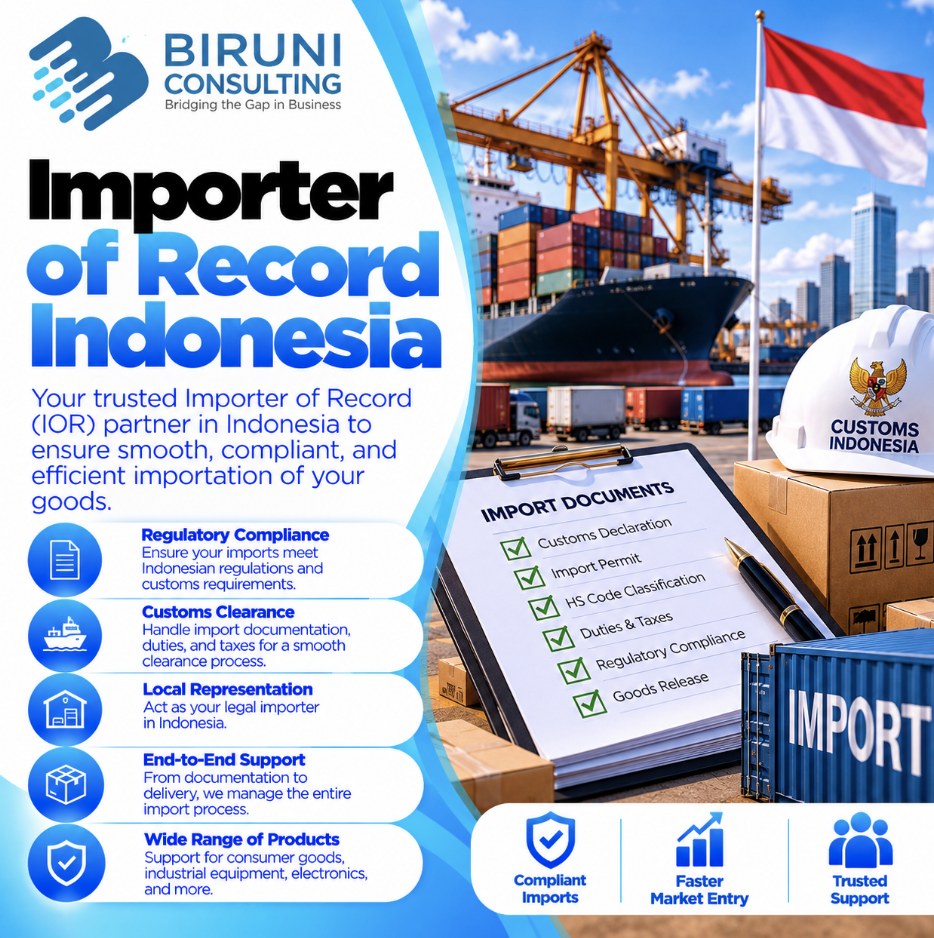
Importer of Record Services for Overseas Manufacturers and Companies
Importer of Record Indonesia is a structure used by overseas companies when they require an Indonesian party to legally perform import activities and satisfy applicable customs and import requirements.
The Indonesian regulations referenced for this purpose formally use the term Importer. Minister of Trade Regulation No. 16 of 2025 defines an Importer as an individual, institution, or business entity conducting imports and requires the Importer to hold an NIB functioning as an API or Importer Identification Number. Database Peraturan | JDIH BPK
In international commercial practice, the term Importer of Record or IOR is commonly used to describe the party acting as importer for a shipment and handling responsibilities involving customs declarations, import licensing, import duties and taxes, and compliance with prohibitions and restrictions.
Selecting an Importer of Record Indonesia should therefore involve more than reviewing freight-forwarding or customs-clearance capabilities. Companies need to establish whether the importer structure corresponds with the product category, NIB/API, Business Licensing, product approvals, and long-term commercial strategy.
Indonesia’s current general import framework includes Minister of Trade Regulation No. 16 of 2025 concerning Import Policy and Regulation. The framework has subsequently been amended, including through the second amendment under Minister of Trade Regulation No. 18 of 2026, effective June 4, 2026, which amended provisions concerning Import Business Licensing, Import Approvals, Surveyor Reports, Import Customs Declaration documentation, import-realization reporting, and administrative sanctions. Database Peraturan | JDIH BPK
What Is Importer of Record Indonesia?
Importer of Record Indonesia can be understood as the Indonesian party performing the importer function for shipments entering Indonesia and taking responsibility for ensuring that importation follows applicable requirements.
Indonesian regulations formally use the term Importer rather than creating a separate legal category called “Importer of Record.” The commercial concept of IOR therefore needs to be translated into the correct Indonesian legal and licensing structure.
The function can include:
- Acting as importer for the shipment.
- Maintaining appropriate NIB/API and Customs Access.
- Filing or taking responsibility for the PIB.
- Settling customs duties and import taxes.
- Ensuring prohibitions and restrictions are satisfied.
Indonesia Customs explains that for Imports for Use, the Importer prepares the PIB from Supporting Customs Documents and is responsible for calculating, paying, and depositing applicable Customs Duty, Excise, and/or Import Taxes based on the PIB. Beacukai
Why Does an Overseas Manufacturer Need an Importer of Record?
An Overseas Manufacturer does not necessarily have its own Indonesian company.
Commercial importation, however, still requires an importer structure satisfying Indonesian requirements.
A foreign manufacturer can face situations where it:
- has not established an Indonesian subsidiary;
- has a distributor that cannot serve as importer for the relevant product;
- uses another party as product-registration holder;
- requires an import structure before establishing its own entity; or
- wants to separate importer and distributor functions.
An Importer of Record structure can support these situations, but it still needs to be assessed against product-specific requirements.
Not every company is eligible to import every category of goods.
Importer of Record Is More Than a Name on a Document
The importer role extends beyond the company name appearing on shipping documents.
Importers have substantive customs obligations.
Indonesia Customs states that for Imports for Use, the Importer generally needs to submit the release documentation, pay applicable Customs Duty, Excise and/or Import Taxes, and satisfy import prohibitions and restrictions. Beacukai
An Importer of Record arrangement therefore requires review of:
- Legal eligibility.
- NIB and API.
- Customs Access.
- Product-specific import licensing.
- Customs and tax responsibilities.
The Importer of Record should not be selected merely because a company is willing to place its name on shipping documentation.
NIB as API
Minister of Trade Regulation No. 16 of 2025 requires Importers to hold an NIB functioning as an API.
The NIB is evidence of business registration and an identity for conducting business activities, while API is the importer identification mechanism. Database Peraturan | JDIH BPK
One of the initial checks when selecting an Importer of Record Indonesia is therefore whether the proposed importer’s NIB provides the appropriate import function.
NIB/API is not necessarily the only required approval.
Certain goods can also require import licensing, Import Approvals, technical recommendations, product registrations, SNI certification, or other authorizations.
Customs Access
The importer also needs a structure capable of performing customs obligations.
Indonesia Customs explains that an Importer or Exporter is treated as having completed Customs Registration requirements after holding an NIB functioning as TDP, API, and Customs Access.
Customs Registration data is also integrated with NIB data in OSS and taxpayer data maintained by the Directorate General of Taxes. Beacukai
An Importer of Record structure therefore cannot be separated from legal-entity and Business Licensing information.
Inconsistent data can affect operational readiness for customs processing.
Business Licensing and OSS
The NIB needs to be reviewed together with the company’s actual activities.
Government Regulation No. 28 of 2025 currently governs Risk-Based Business Licensing. It has been effective since June 5, 2025, revoked Government Regulation No. 5 of 2021, and covers Basic Requirements, Business Licensing, PB UMKU, OSS services, supervision, evaluation, and sanctions. Database Peraturan | JDIH BPK
An Importer of Record assessment should review:
- Legal entity.
- NIB.
- KBLI.
- Business Licensing.
- Product-specific licensing.
Simply having an Indonesian company does not automatically make that entity an appropriate importer for every product category.
KBLI and Importer Activities
KBLI describes the business activities conducted by an Indonesian entity.
A proposed Importer of Record therefore needs a business structure aligned with the intended import and post-import activities.
If the company will also conduct distribution, wholesale trading, or another activity, the relevant Business Licensing needs to be reviewed.
The assessment should not only determine whether the company has an NIB but whether its actual activities correspond with the licensing it holds.
This becomes particularly important for regulated products requiring applicants or importers with specific qualifications.
Product Classification Before Selecting the Importer
Importer selection should follow product classification.
Information commonly reviewed includes:
- Product name.
- Intended use.
- Technical specifications.
- Materials or ingredients.
- HS code.
- Country of origin.
- Manufacturing site.
Product classification helps determine whether goods can be freely imported or are subject to particular regulatory requirements.
Without this assessment, a company can appoint an importer capable of general import activity but not eligible for the specific product category.
HS Code and Importer of Record
HS classification is an important element in identifying import requirements.
The classification can affect customs duties, import taxes, prohibitions and restrictions, Import Approvals, technical requirements, and relevant regulators.
HS codes should not be selected solely from commercial product names.
Technical specifications, composition, functions, and intended use also need to be considered.
The Importer of Record needs a classification that can be supported and remains consistent with invoices, packing lists, product approvals, and customs declarations.
Prohibitions and Restrictions
Before shipment, the Importer of Record needs to establish whether the goods are subject to prohibitions or restrictions.
Indonesia Customs explains that an Imports for Use PIB needs to satisfy applicable prohibitions and restrictions where the goods fall within regulated categories. Beacukai
Import restrictions can originate from several ministries or agencies.
Requirements can include Import Approvals, product registrations, certifications, technical verification, Surveyor Reports, or other permits.
Customs readiness therefore involves much more than invoices and freight documents.
Import Approval
Certain products can require an Import Approval.
The requirement is not universal and needs to be determined according to product category and the applicable regulation.
Minister of Trade Regulation No. 18 of 2026 amended several provisions relating to Import Business Licensing, changes to licensing, extensions of Import Approvals, Surveyor Reports, and Import Customs Declaration documents. Database Peraturan | JDIH BPK
The Importer of Record needs to ensure that mandatory approvals are available and valid before commercial shipment.
Attempting to resolve approvals after cargo has already departed can create unnecessary customs risks.
Surveyor Reports
Certain product categories can require Verification or Technical Inspection and a Surveyor Report.
The requirement is product-specific.
Information concerning product descriptions, HS codes, models, quantities, country of origin, and shipment details needs to remain consistent among Surveyor Reports, import approvals, and actual cargo.
Where inspection or verification is required before shipment, the Importer of Record needs to coordinate it at the appropriate stage.
PIB in Importer of Record Indonesia
The Pemberitahuan Impor Barang or PIB is a principal document for Imports for Use.
Indonesia Customs explains that the release of goods under Imports for Use generally uses a PIB for each transport-contract document and that the Importer prepares the PIB based on Supporting Customs Documents. Beacukai
The Importer submits the PIB through the Customs Service Computer System to the Customs Office supervising the final destination of the goods. Beacukai
The Importer of Record therefore needs to ensure that PIB information corresponds with shipping and regulatory documentation.
Supporting Customs Documents
Documents supporting the PIB can include:
- Commercial Invoice.
- Packing List.
- Bill of Lading or Air Waybill.
- Certificate of Origin where applicable.
- Documents demonstrating compliance with import requirements.
Indonesia Customs identifies invoices, packing lists, Bills of Lading or Air Waybills, product-identification documents, and documentation satisfying import requirements as examples of Supporting Customs Documents. Beacukai
The Importer of Record needs to ensure consistency in shipper, consignee, quantities, product descriptions, models, values, and origin information.
Customs Duties and Import Taxes
The Importer has responsibilities concerning import payments.
Under Indonesia Customs’ self-assessment framework, the Importer is responsible for calculating, paying, and depositing applicable Customs Duty, Excise, and/or Import Taxes based on the PIB submitted. Beacukai
Before shipment, companies therefore need to understand landed-cost components.
Costs can depend on:
- HS classification;
- customs value;
- country of origin;
- customs duties;
- applicable import taxes; and
- preferential tariffs where requirements are met.
An Importer of Record agreement should clearly allocate the commercial burden of those costs even though customs obligations remain attached to the Importer structure.
Customs Valuation
Customs value is one of the bases for calculating Customs Duty.
Indonesia Customs explains that the customs value used to calculate Customs Duty is based on CIF international commercial terms. Beacukai
Invoices, freight, insurance, and transaction information therefore need to remain consistent.
Overseas suppliers and Importers should avoid artificial values or documentation that does not represent the actual transaction.
Related-party transactions should also maintain appropriate supporting documentation.
Customs Inspection
A shipment can undergo customs document review or physical inspection based on risk management.
Indonesia Customs uses release channels including Red and Green channels within the import process. Beacukai
During a physical inspection, the Importer has obligations to provide supporting documentation, prepare the goods, attend or appoint a representative, and open the packaging selected for inspection. Beacukai
An Importer of Record therefore needs operational capability rather than corporate documentation alone.
Importer of Record and PPJK
A PPJK or customs broker can assist with customs processing.
However, the PPJK and Importer perform different roles.
Indonesia Customs explains that PIB processing can involve the Importer or PPJK, while the Importer retains responsibilities within the customs process. Beacukai
Accordingly:
- the Importer of Record provides the importer structure;
- the PPJK supports customs-clearance activities where authorized;
- the freight forwarder generally manages logistics or transportation.
These functions should not be treated as interchangeable.
Importer of Record and Freight Forwarder
A freight forwarder generally assists with international transportation, booking, shipment coordination, and logistics.
The ability to arrange freight does not automatically mean that a company qualifies as an Importer under Indonesian regulations.
Where a logistics provider will also act as Importer, its eligibility and Business Licensing still need to be assessed.
An Overseas Manufacturer should therefore understand which entity legally performs the importer function and which party merely handles logistics.
The distinction should be established before shipping instructions are issued.
Importer of Record and Distributor
Importers and distributors also perform different functions.
The Importer manages the entry of goods into Indonesia, while the distributor generally manages sales and commercial distribution.
One company can perform both functions where licensing and regulatory requirements allow.
Companies can also use:
- An importer separate from the distributor.
- A distributor that also acts as importer.
- Their own Indonesian entity as importer.
- A third-party import structure where permitted.
The appropriate structure should reflect both commercial control and regulatory continuity.
Importer of Record and Official Representative
An Official Representative performs a different role from an Importer.
Certain product-specific regulations require an Overseas Manufacturer to appoint an Official Representative in Indonesia.
Under some schemes, the Official Representative can also act as importer. Under other structures, the import function can be performed by another party where the regulation permits.
Appointing an Importer of Record should therefore not automatically be treated as satisfying an Official Representative requirement.
The product-specific regulation needs to be reviewed.
Importer of Record and Product Registration Holder
An Importer is also not automatically the product-registration holder.
For regulated products, the applicant or holder can be determined by product-specific rules.
An Overseas Manufacturer should establish:
- Who is the importer.
- Who acts as registration applicant.
- Who holds the registration.
- Who acts as distributor.
- Who controls the regulator account.
Separating these functions where permitted can help protect regulatory control if commercial partners change.
Regulatory Ownership
Regulatory ownership becomes particularly important where the Importer of Record also holds the product approval.
Before appointment, an Overseas Manufacturer should understand:
- whether the approval can be transferred;
- whether changing the importer requires an amendment;
- who manages renewal;
- who controls regulator-account access; and
- what happens when the agreement ends.
Selecting an importer purely for short-term commercial convenience can therefore create long-term dependency.
Importer appointment and product-approval ownership should be planned together.
SNI and Importer of Record
Certain industrial products can require Mandatory SNI before importation or distribution.
The existence of an SNI does not by itself make certification mandatory. Mandatory status needs to be established from the relevant product regulation.
For products under Ministry of Industry Mandatory SNI schemes, certification applications use SIINas within the applicable process.
Product-specific SNI regulations can also contain provisions concerning manufacturers, Official Representatives, importers, warehouses, testing, and SPPT SNI.
The Importer of Record should therefore be selected after the SNI pathway has been assessed.
BPOM and Importer of Record
Products supervised by BPOM can also have specific local-applicant or importer requirements.
Food, cosmetics, health supplements, medicines, and other categories do not use identical regulatory pathways.
An Overseas Manufacturer should distinguish:
- Importer for customs purposes.
- BPOM registration applicant.
- Product-registration holder.
- Distributor.
Under some structures, one company can perform several roles. Under others, the functions can be separated.
BPOM assessment should therefore occur before the Importer of Record is appointed.
Halal and the Import Structure
Products within halal requirements also need halal compliance to be considered during market-entry planning.
Halal certification and import licensing are separate compliance layers.
An Importer of Record does not automatically become the halal certificate holder or satisfy halal obligations merely because it can clear goods through customs.
Product category, origin, certification status, and local-party structure still need to be assessed under the applicable halal framework.
Where relevant, halal assessment should be coordinated with product registration and label review.
Labeling and Importer Information
Certain product categories can require importer or local-responsible-party information on the label.
Selecting an Importer of Record after packaging has already been printed can therefore create relabeling requirements.
Before artwork is finalized, companies should determine:
- Whether importer information must appear.
- Whether registration-holder information is required.
- Applicable language requirements.
- Required regulatory markings.
- Approval numbers that need to appear.
Labeling review should ideally occur before mass production.
Importing Samples
An Overseas Manufacturer can require samples for laboratory testing, certification, product registration, exhibitions, or market evaluation.
Sample shipments should not automatically be treated in the same manner as commercial imports.
Product regulations can contain specific exemptions or mechanisms.
Under certain certification schemes, samples can also need to be selected by specified parties to qualify as official test samples.
The sample-import structure should therefore be assessed before shipment.
Commercial Invoice
The Commercial Invoice is a principal supporting document.
It generally contains information concerning the seller, buyer, product description, quantity, value, currency, and commercial terms.
The Importer of Record needs to ensure that the invoice corresponds with the actual shipment and the information used for customs declaration.
Late changes to descriptions or values can create inconsistencies.
The invoice should also correspond with the Purchase Order, Packing List, transport documents, and relevant approvals.
Packing List
The Packing List provides details on packaging and shipment quantities.
Information can include cartons, pallets, weights, dimensions, models, and quantities.
For regulated products, models and product descriptions should correspond with the approved regulatory scope.
The Importer of Record should conduct a pre-shipment documentation review so discrepancies can be corrected before the cargo arrives.
Bill of Lading and Air Waybill
Sea shipments generally use a Bill of Lading, while air shipments use an Air Waybill.
Consignee and shipment information needs to match the import structure.
Changing the Importer of Record while goods are already moving can complicate documentation and can also affect relevant approvals.
The importer should therefore be finalized before shipping instructions are locked.
Certificate of Origin
A Certificate of Origin can support origin documentation and, in specified circumstances, preferential tariff treatment.
Eligibility still depends on applicable rules of origin.
The Importer of Record needs to ensure that certificate information corresponds with the invoice, HS classification, manufacturer, and shipment.
Country of shipment is not necessarily the same as country of origin.
Preferential tariffs should not be claimed unless the applicable origin requirements are satisfied.
Pre-Shipment Compliance Review
A pre-shipment review is an important component of Importer of Record services.
Before cargo is shipped, companies should confirm:
- Importer eligibility has been verified.
- NIB/API and Customs Access are ready.
- Product and import approvals are available where required.
- Shipping documentation is consistent.
- Customs and restriction requirements have been satisfied.
Indonesia Customs requires compliance with applicable prohibitions and restrictions as part of the formal PIB requirements for regulated goods. Beacukai
Correcting issues before shipment is generally safer than attempting to obtain approvals after cargo arrives.
Customs Clearance
When cargo arrives, the Importer of Record performs or coordinates the customs-clearance process.
The PIB is submitted, applicable customs duties and taxes are resolved, restrictions are verified, and the shipment can undergo document review or physical inspection.
Once applicable requirements are completed, Customs issues the relevant release approval under the applicable procedure. Beacukai
Customs-clearance readiness therefore depends on:
- importer readiness;
- documentation readiness;
- regulatory approvals; and
- actual cargo conformity.
A problem in one of these areas can affect the entire process.
Warehousing and Delivery
After customs clearance, goods can move to warehouses, distributors, customers, or other destinations according to the commercial structure.
Certain product-specific regulations can impose particular warehouse requirements.
Importer of Record services therefore need to establish whether goods can be delivered directly to a distributor or need to enter a specified warehouse first.
Storage conditions can also be important for regulated categories such as food, chemicals, pharmaceuticals, or goods subject to technical storage requirements.
Product Traceability
The Importer of Record should maintain records connecting shipments with actual products.
Traceability can include:
- Invoice references.
- PIB references.
- Batch or serial numbers.
- Manufacturing sites.
- Distribution destinations.
Traceability supports responses to customs queries, regulator inspections, complaints, product recalls, or compliance investigations.
It also helps maintain consistency between imported goods and approved products.
Post-Import Compliance
Compliance obligations do not necessarily end when cargo leaves the customs area.
Product approvals can involve renewals, surveillance, reporting, labeling, distribution, storage, or other post-market requirements.
An Importer of Record arrangement should establish who manages these continuing obligations.
Importers, distributors, registration holders, and Official Representatives can perform different roles.
Responsibilities should therefore be documented before the first shipment.
Changing the Importer
Changing the importer can have regulatory consequences.
Certain product approvals can identify the importer directly or be associated with a specified local entity.
When an importer changes, companies need to determine whether the change requires:
- an amendment;
- notification;
- new approval;
- label changes; or
- updates to regulator systems.
The Importer of Record should therefore be selected with continuity in mind rather than only one shipment.
Temporary Importer of Record Structure
An Overseas Manufacturer can sometimes require an importer arrangement before its own Indonesian entity is operational.
A third-party importer structure can be considered where permitted by the applicable requirements.
Companies should establish from the beginning:
- Duration of the arrangement.
- Ownership of product approvals.
- Transition mechanisms.
- Customer and distributor relationships.
- Ownership of regulatory data and documentation.
An unplanned transition can result in new registrations or packaging changes when the company later moves to its own subsidiary.
Importer of Record for Multiple Products
Companies managing several product lines should conduct regulatory mapping before using one importer for everything.
An importer can be eligible for one product category but unsuitable for another.
Regulatory mapping can identify:
- Product.
- HS code.
- Regulatory category.
- Import approvals.
- Product approvals.
- Proposed importer.
- Commercial distributor.
The mapping helps determine whether a single Importer of Record is sufficient or whether multiple structures are required.
Importer of Record for Multiple Shipments
The importer arrangement should support recurring commercial imports rather than only the first shipment.
For recurring imports, companies need to maintain:
- licensing validity;
- product-approval validity;
- consistency of customs data;
- origin documentation;
- import-realization reporting where applicable; and
- regulatory monitoring.
Minister of Trade Regulation No. 18 of 2026 specifically amended provisions involving import-realization reporting and administrative measures under the current framework. Database Peraturan | JDIH BPK
Ongoing monitoring is therefore important for supply continuity.
Product Changes After Import Approval
Manufacturers can change specifications, models, materials, formulations, manufacturing sites, packaging, or trademarks.
Such changes can affect customs classification, import approvals, product registrations, or certifications.
The Importer of Record should be informed of changes before the next shipment.
A regulatory impact assessment can determine whether existing documentation and approvals remain usable.
Shipments should avoid relying on outdated approvals where the actual product has materially changed.
Importer of Record and Regulatory Monitoring
Indonesia’s import framework can change.
Minister of Trade Regulation No. 16 of 2025 has been amended, including through the second amendment under Minister of Trade Regulation No. 18 of 2026 effective June 4, 2026. Database Peraturan | JDIH BPK
Regulatory monitoring should cover:
- general import policy;
- product-specific import rules;
- customs procedures;
- prohibitions and restrictions;
- product registrations;
- certifications; and
- reporting obligations.
An Importer of Record supporting recurring imports needs to remain compliant with current requirements rather than only those that applied when the first agreement was signed.
Initial Documents for Importer of Record Assessment
Before appointing an Importer of Record, an Overseas Manufacturer can prepare:
- Product Catalogue.
- Technical Data Sheet.
- Current HS classification.
- Draft Commercial Invoice.
- Country of Origin.
- Manufacturing-site information.
- Existing product certificates.
- Product-registration information where available.
- Intended importer and distributor structure.
These documents help identify regulatory gaps before shipment.
Importer of Record Roadmap
An Importer of Record Indonesia project can generally follow five stages:
- Product classification and regulatory assessment.
- Importer eligibility and Business Licensing review.
- Import approvals and product-compliance preparation.
- Pre-shipment documentation and customs preparation.
- Customs clearance and post-import compliance.
The roadmap needs to be adapted to the product category.
For regulated products, mandatory approvals should generally be treated as dependencies before commercial shipping schedules are confirmed.
Importer of Record Indonesia Timeline
There is no single timeline applicable to every import project.
Products with limited approval requirements can have relatively straightforward preparation.
Regulated products can require additional time for:
- import licensing;
- product registration;
- SNI certification;
- laboratory testing;
- technical verification;
- labeling; or
- Official Representative setup.
The availability of an importer therefore does not automatically mean that products can be shipped immediately.
The timeline should be established after regulatory gaps are understood.
Importer of Record Indonesia Cost
Importer of Record costs can consist of several components.
Costs can include:
- regulatory assessment;
- importer services;
- customs brokerage;
- product registration;
- import approvals;
- laboratory testing;
- certification;
- freight;
- customs duties;
- import taxes;
- warehousing; and
- local distribution.
Companies should distinguish the IOR service fee from government duties, taxes, certification fees, freight, and third-party expenses.
This provides greater transparency when calculating landed costs.
Risks of Selecting the Wrong Importer
An unsuitable importer can cause problems before and after shipment.
Risks can include:
- unsuitable NIB/API;
- missing product approvals;
- unmet prohibitions or restrictions;
- inconsistent customs data;
- unclear regulatory ownership;
- cargo delays;
- storage costs; and
- excessive dependency on a commercial partner.
Importer due diligence should therefore occur before purchase orders and shipping instructions are finalized.
Common Importer of Record Indonesia Mistakes
A common mistake is assuming that a freight forwarder automatically qualifies as the Importer of Record.
Other mistakes include:
- appointing a distributor without reviewing NIB/API;
- shipping before Import Approvals or product approvals are available;
- assuming an NIB alone is sufficient;
- failing to review product-specific regulations;
- treating the Importer and Official Representative as the same role;
- giving product registration to the importer without an exit strategy; and
- reviewing labels only after packaging has been printed.
Many of these risks can be reduced through regulatory assessment before shipment.
Benefits of Importer of Record Indonesia Services
Importer of Record services can support Overseas Manufacturers that do not yet have their own Indonesian import structure.
Potential benefits include:
- Establishing a compliant import structure.
- Reviewing importer eligibility before shipment.
- Integrating product approvals with customs requirements.
- Reducing the risk of using an unsuitable local-party structure.
- Supporting recurring imports and regulatory monitoring.
Importer of Record services do not replace mandatory certifications or product registrations.
All product-specific approvals still need to be completed where required.
How to Select an Importer of Record Indonesia
An Importer of Record should be selected according to regulatory capability rather than price per shipment alone.
Important factors can include:
- NIB/API and Customs Access.
- Business Licensing and KBLI.
- Experience with the relevant product category.
- Customs-documentation capability.
- Regulatory ownership and exit arrangements.
An Overseas Manufacturer should also establish who controls customer relationships, inventory, product registrations, distribution agreements, and regulatory data.
A clear structure from the beginning can reduce commercial disputes later.
Conclusion
Importer of Record Indonesia is an importer structure that allows Overseas Manufacturers to bring goods into Indonesia through a party satisfying applicable import and customs requirements.
Indonesian regulations formally use the term Importer. Minister of Trade Regulation No. 16 of 2025 requires Importers to hold an NIB functioning as an API, while the current import framework has subsequently been amended, including through Minister of Trade Regulation No. 18 of 2026 effective June 4, 2026. Database Peraturan | JDIH BPK
For Customs Registration, Indonesia Customs explains that Importers are treated as satisfying registration requirements once they hold an NIB functioning as TDP, API, and Customs Access. Beacukai
For Imports for Use, the Importer uses the PIB, is responsible for calculating and paying applicable Customs Duty, Excise and/or Import Taxes, and needs to comply with applicable prohibitions and restrictions. Beacukai
Importer of Record Indonesia should therefore not be selected solely for customs-clearance capability. Product classification, NIB/API, Business Licensing, import approvals, product registration, SNI, BPOM, Official Representative structures, labeling, and long-term regulatory ownership should be assessed before commercial shipment.
Contact Us
Biruni Consulting assists companies with Importer of Record Indonesia professionally and in accordance with applicable regulations in Indonesia.
Our services include:
- Regulatory consultation.
- Identification of applicable standards.
- Preparation of certification documents.
- Assistance with laboratory testing.
- Certification processing until certificate issuance.
Biruni Consulting assists Overseas Manufacturers with regulatory assessment, importer structures, NIB/API review, product compliance, SNI, BPOM, Official Representative requirements, customs preparation, and market-entry planning before products are imported and marketed in Indonesia.
Contact Us for Importer of Record Indonesia, Indonesia Importer Service, Market Entry Indonesia, Indonesia Regulatory Approval, and imported-product regulatory compliance assistance.