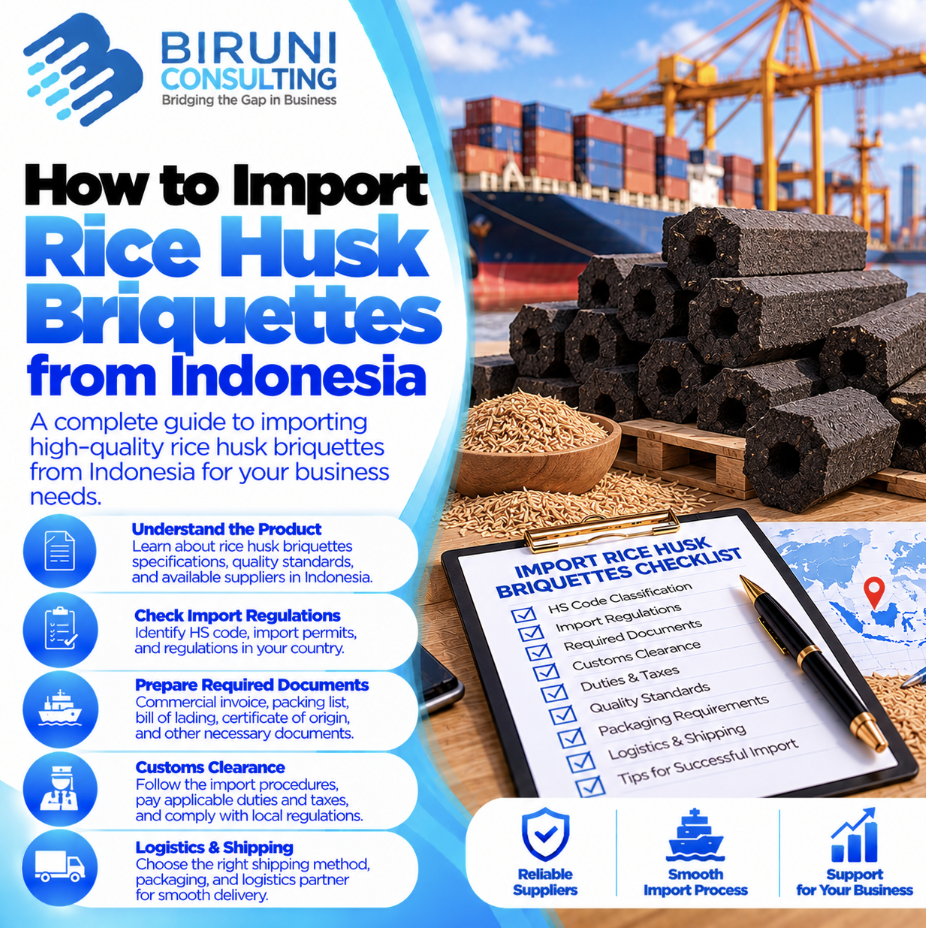
Importing Rice Husk Briquettes from Indonesia
Indonesia can be considered a sourcing market for rice husk briquettes because rice-milling activities generate rice husk that can be processed into densified solid biomass fuel.
For importers, distributors, biomass traders, and industrial users, importing successfully involves considerably more than finding a supplier and booking a container.
Buyers should address product specifications, HS classification, supplier capacity, Incoterms, payment terms, export and import documents, container loading, customs clearance, and requirements in the destination country.
It is also important to distinguish non-carbonized rice husk briquettes from rice husk charcoal briquettes because their technical characteristics and potentially their customs treatment can differ.
There is no single import procedure that applies identically to every destination. Indonesian export requirements need to be combined with the customs, biosecurity, product, and import rules of the buyer’s country.
Step 1 – Define the Product
Before contacting suppliers, determine exactly which product is required.
A non-carbonized rice husk briquette is generally produced by drying, processing, and densifying rice husk without first converting it into charcoal.
A carbonized rice husk briquette uses thermally treated rice husk or rice husk charcoal.
The two can differ in calorific value, fixed carbon, volatile matter, ash, ignition behavior, and intended applications.
Buyers should also identify whether the product will be used in an industrial boiler, furnace, dryer, commercial heating system, or another application.
Step 2 – Establish Technical Specifications
A request such as:
“Please quote rice husk briquette.”
does not provide enough information for accurate sourcing.
A better technical requirement can include:
| Parameter | Requirement to Define |
|---|---|
| Product Type | Carbonized / non-carbonized |
| Raw Material | Rice husk or specified blend |
| Calorific Value | Minimum GCV/NCV |
| Moisture | Maximum percentage |
| Ash | Maximum percentage |
| Proximate Analysis | Where required |
| Dimensions | Diameter, length, shape |
| Packaging | Bags, jumbo bags, other |
| Volume | Trial and monthly requirement |
Rice husk is a non-woody biomass resource. ISO 17225-7:2021 establishes quality classes and specifications for graded non-woody briquettes and includes herbaceous biomass and cereal-processing by-products within its scope. ISO
It can therefore provide a useful quality framework, although buyers should still determine which standards are legally or commercially required in their destination market.
GCV, NCV and Test Basis
Calorific value is frequently one of the main commercial specifications.
The buyer should confirm whether the supplier reports:
Gross Calorific Value (GCV/HHV)
or:
Net Calorific Value (NCV/LHV).
Laboratory results may also be stated on a dry, air-dried, or as-received basis.
ISO 18125:2017 specifies the determination of gross calorific value of solid biofuels using a bomb calorimeter and provides calculations for net calorific value. ISO confirms that the standard remains current. ISO
Quotations should therefore not be compared using kcal/kg alone when testing methods or reporting bases differ.
Step 3 – Confirm the HS Classification
HS classification should be resolved before shipment.
Do not assign the tariff code solely because the product is called a briquette.
Rice husk briquettes are not wood briquettes, and a classification commonly used for woody biomass should not automatically be applied to agricultural-residue fuel.
Classification may depend on:
- composition,
- carbonized or non-carbonized status,
- manufacturing process,
- product characteristics,
- destination-country customs rules.
The HS code can affect customs duty, import restrictions, declarations, Certificates of Origin, and additional documentation.
The importer should therefore confirm the classification with its customs broker or relevant customs authority before signing a final supply contract.
Step 4 – Check Destination-Country Import Requirements
Import rules are determined by the destination country.
Depending on the market and product classification, requirements may cover import permits, biomass or agricultural-product controls, biosecurity, treatment or fumigation, packaging, labeling, customs duties, or fuel-quality requirements.
Importers should verify these requirements before placing a purchase order.
The Indonesian exporter can manage the Indonesian side of the transaction under the agreed terms, but the importer remains responsible for ensuring that the cargo can legally clear customs in the destination market.
Step 5 – Qualify Indonesian Suppliers
Supplier qualification should go beyond reviewing a website or marketplace listing.
Buyers can investigate company information, production or sourcing arrangements, actual manufacturing location, feedstock access, quality-control procedures, warehouses, and export capability.
If the seller is a trader or aggregator, ask where the briquettes are actually manufactured.
A trader is not automatically inferior to a manufacturer.
The important factors are quality consistency, volume, traceability, documentation, and delivery reliability.
Production Capacity vs. Available Capacity
Installed capacity should not be confused with available capacity.
Suppose a supplier claims:
600 MT/month production capacity.
If 450 MT is already committed to existing customers, only approximately:
150 MT/month
may be available to a new buyer.
For recurring imports, ask about actual monthly production, existing commitments, available capacity, and backup arrangements.
Step 6 – Request Technical Data and a CoA
A Certificate of Analysis or CoA can provide an initial technical basis for supplier screening.
Relevant information may include:
- Calorific value and reporting basis.
- Moisture and ash.
- Volatile matter and fixed carbon.
- Dimensions or density where relevant.
- Sulfur, chlorine, or other parameters when required.
Buyers should review the test date, methodology, sample identity, and whether the laboratory sample represents current production.
A historical CoA should not automatically be assumed to represent every future shipment.
Step 7 – Obtain Samples
Samples should generally be evaluated before a large commercial order.
The buyer can review dimensions, physical strength, fines, appearance, packaging, and laboratory characteristics.
For industrial fuel applications, however, a small courier sample is only an initial qualification tool.
Actual combustion performance requires a larger representative trial.
Step 8 – Conduct a Boiler or Combustion Trial
A fuel with a strong laboratory specification may still perform poorly in a particular combustion system.
A trial can focus on:
- Fuel consumption and useful heat or steam output.
- Feeding and combustion stability.
- Ash generation.
- Deposit or clinker behavior.
- Cleaning requirements and operating cost.
The trial can also confirm whether briquette dimensions are suitable for the buyer’s hopper, conveyor, grate, or feeder.
Step 9 – Send a Detailed RFQ
Once the supplier passes initial technical screening, send a formal Request for Quotation.
For example:
Product: Rice husk briquette
Quantity: 200 MT/month
Calorific Value: Buyer specification
Moisture/Ash: Maximum buyer specification
Packaging: Jumbo bags
Destination: Named port
Incoterm: FOB, CFR, or CIF
Trial Order: One container
A standardized RFQ makes supplier quotations much easier to compare.
Step 10 – Select the Incoterm
Incoterms define how responsibilities, costs, and risks are allocated.
For sea freight, FOB, CFR, and CIF are commonly discussed.
Under FOB, delivery takes place on board the vessel at the named port of shipment according to the applicable Incoterms rule.
Under CFR, the seller pays freight to the named destination port, while risk transfers according to the CFR rule when the goods are on board.
Under CIF, the seller also contracts for insurance within the scope required by CIF. ICC Library
An RFQ should therefore state the named port, for example:
FOB Tanjung Priok, Indonesia – Incoterms 2020.
FOB or CIF?
Neither is automatically better.
FOB can suit buyers that already have a freight forwarder and want greater control of ocean freight.
CIF can simplify procurement when the exporter is expected to arrange freight and insurance to the destination port.
In either case, compare the total landed cost, not simply the quoted price.
Destination charges can materially change the economics of a shipment.
Step 11 – Agree Payment Terms
Payment terms should be resolved before production begins.
Commercial options may include advance payment, deposit and balance, Letter of Credit, Documentary Collection, or another mutually agreed arrangement.
For new supplier relationships, buyers can reduce risk through company verification, clear contracts, inspection procedures, and payment milestones.
Any unexpected change in beneficiary bank details should be independently verified before funds are sent.
Step 12 – Confirm Packaging
Packaging should match the importer’s unloading and storage system.
Rice husk briquettes may be supplied in woven bags, big bags, jumbo bags, or other configurations.
The agreement can define net weight, packaging material, labeling, moisture protection, and palletization.
Pallets can simplify handling but may reduce the amount of product that fits into the container.
Packaging and container planning should therefore be evaluated together.
Container Loading
Do not assume that every container can carry a fixed number of metric tons.
Payload depends on briquette density, packaging, pallet configuration, container type, local transport restrictions, and shipping-line weight limits.
The exporter should provide an estimated loading quantity for the specific shipment plan.
The parties should clearly distinguish:
net product weight, gross cargo weight, and total container gross weight.
Container Condition
Biomass briquettes should be protected from water and contamination during ocean transport.
Before loading, the exporter can inspect the container to confirm that it is dry, clean, free from visible leaks, free from previous-cargo contamination, and capable of closing and sealing correctly.
Photographs of the empty container, loading process, final cargo, and seal can provide useful shipment records.
Step 13 – Consider Pre-Shipment Inspection
For a first transaction or substantial contract, an independent pre-shipment inspection may be useful.
Inspection can cover quantity, packaging, sampling, container condition, and loading.
Where laboratory results form part of the acceptance criteria, the sales contract should define the sampling method, testing laboratory, parameters, and procedure for off-specification cargo.
These rules are far easier to agree before production than after a quality dispute.
Step 14 – Indonesian Export Customs Procedures
Commercial exports from Indonesia generally involve a Pemberitahuan Ekspor Barang (PEB).
Indonesian Customs describes the process as including goods preparation, submission of the export declaration, risk-based physical inspection where applicable, documentary review, loading, and departure. Beacukai
Where export restrictions or licensing requirements apply to a particular classification, the relevant supporting authorization must also be satisfied. Official Website Bea Cukai Kendari
The exporter or an authorized customs representative handles the Indonesian export declaration.
Important PEB Document Rule Since August 3, 2026
For current shipments, buyers and sellers should be aware of an important Indonesian customs change.
Since August 3, 2026, Indonesian Customs requires mandatory electronic uploading of specified supporting PEB documents.
Invoice and packing list are mandatory at initial PEB submission. A bill of lading, master bill of lading, or relevant transport document is also handled through the mandatory supporting-document procedure according to the prescribed timing. Beacukai
Accurate and consistent shipment data are therefore particularly important.
Common Export Documents
A commercial rice husk briquette shipment may involve:
- Commercial Invoice.
- Packing List.
- PEB and applicable export-clearance records.
- Bill of Lading.
- Certificate of Analysis.
- Certificate of Origin where required.
Additional documents may apply depending on the destination country, HS classification, and contractual requirements.
Importers should send exporters a document checklist before the first shipment.
Indonesian Certificate of Origin
Indonesia uses the Surat Keterangan Asal (SKA), or Certificate of Origin, to certify the origin of exported goods.
The Ministry of Trade’s e-SKA system distinguishes between preferential certificates, which can support tariff preferences under qualifying trade arrangements, and non-preferential certificates, which provide origin evidence for other trade requirements. E-Ska
Preferential tariff treatment requires compliance with the applicable Rules of Origin. E-Ska
Importers should investigate whether an applicable trade agreement exists between Indonesia and the destination country for the relevant tariff classification.
A Certificate of Origin Does Not Automatically Mean Zero Duty
A COO does not automatically eliminate import duty.
The importer must verify:
- the applicable agreement,
- HS classification,
- preferential tariff,
- Rules of Origin,
- required certificate type,
- and any direct-shipment conditions.
Indonesia’s e-SKA service provides information on a range of preferential tariff arrangements for export destinations. E-Ska
Incorrect classification or an incorrect origin document can prevent the importer from claiming the expected tariff preference.
Step 15 – Check Draft Shipping Documents
Before final documents are issued, the importer should review the drafts.
Key information should be consistent across documents, including the consignee, product description, agreed HS code, quantities, net and gross weights, commercial value, ports, and container information.
Differences between the invoice, packing list, Bill of Lading, COO, and customs declaration can create delays during clearance.
Step 16 – Complete Import Customs Clearance
When the vessel arrives, the importer or customs broker follows the destination country’s import-clearance procedure.
Costs can include:
Import Duty + Import VAT/Tax + Port Charges + Customs Brokerage + Inspection/Treatment + Inland Transportation
The exact structure varies by country.
Before confirming the purchase order, buyers should obtain an estimate of these costs from their customs broker.
Calculate Landed Cost Before Buying
FOB or CIF price is not necessarily the final cost delivered to the buyer’s warehouse.
A simplified calculation is:
Product + Origin Logistics + Ocean Freight + Insurance + Import Duty + Import Taxes + Destination Charges + Customs Clearance + Inland Delivery
Which components are already included depends on the Incoterm.
Understanding this prevents double counting and allows buyers to compare Indonesian suppliers with alternative sourcing countries more accurately.
Start With a Trial Container
For a new supplier, one trial container can provide valuable information.
It allows the importer to evaluate product consistency, packaging, loading, documentation, communication, customs clearance, and cargo condition after ocean transportation.
For industrial users, the volume can also support a more meaningful boiler or combustion trial.
Once the shipment performs satisfactorily, the buyer can consider a recurring supply agreement.
Long-Term Supply Agreements
After supplier qualification, the parties may establish a three-, six-, or twelve-month supply arrangement.
The contract should at least address technical specification, monthly quantity, price and Incoterm, payment terms, shipment schedule, inspection, and procedures for off-specification cargo.
Larger transactions may also require quantity tolerance, price-review mechanisms, and clear dispute-resolution provisions.
Appropriate legal review is advisable for substantial international contracts.
Red Flags When Importing From a New Supplier
Further verification may be appropriate when a supplier cannot provide consistent specifications, cannot explain its actual production source, refuses reasonable samples or inspections, or promises unusually large volumes without explaining feedstock availability.
Unexpected changes to payment instructions, unclear packaging arrangements, or limited knowledge of export documentation should also be investigated.
An unusually low quotation should be compared carefully with product specifications and commercial terms.
Lower pricing may reflect higher moisture, higher ash, different packaging, or simply a different Incoterm.
Information Buyers Should Send to Indonesian Suppliers
An initial inquiry can be kept concise while still providing enough information:
- Product type and application.
- Required technical specifications.
- Trial quantity and monthly demand.
- Destination port and Incoterm.
- Packaging requirements.
- Required documents, inspection, and shipment schedule.
This is usually sufficient for a supplier to confirm technical feasibility and available production capacity.
Import Process Summary
The process can be summarized as:
Define Product → Set Specifications → Confirm HS Code → Check Destination Rules → Qualify Supplier → Sample & Trial → RFQ → Agree Incoterm & Payment → Inspect → Indonesian Export Clearance → Ocean Shipment → Import Customs Clearance → Final Delivery & Performance Review
The safest approach is to resolve product specifications, tariff classification, and destination-country requirements before the container leaves Indonesia.
Problems discovered after vessel departure can be considerably more expensive to correct.
Is Importing Rice Husk Briquettes from Indonesia Worth Considering?
Indonesia can be a relevant source of rice husk briquettes for industrial and commercial biomass applications.
A successful transaction, however, depends on much more than finding the lowest product price.
Importers should evaluate the combination of fuel quality, supplier capacity, correct customs classification, documentation, shipping arrangements, landed cost, and actual combustion performance.
For new sourcing relationships, supplier screening followed by laboratory evaluation and a controlled trial shipment can significantly reduce technical, customs, and supply-chain risk.
Contact Us
Biruni Consulting can assist companies that require information and support regarding product requirements, documentation, and compliance processes related to product importation, marketing, or use according to business requirements in Indonesia.
The services that can be supported include:
- Consultation on product requirements for industrial needs.
- Initial assessment of product specifications and applications.
- Technical document review.
- Review of product specifications and information.
- Consultation on applicable regulatory requirements according to the product type and business activities.
- Assistance in preparing required documents.
- Consultation on certification or licensing processes when required based on the product characteristics and intended use.
Contact Biruni Consulting for information regarding product requirements, documentation, certification, and compliance needs to support business activities and product marketing in Indonesia.