
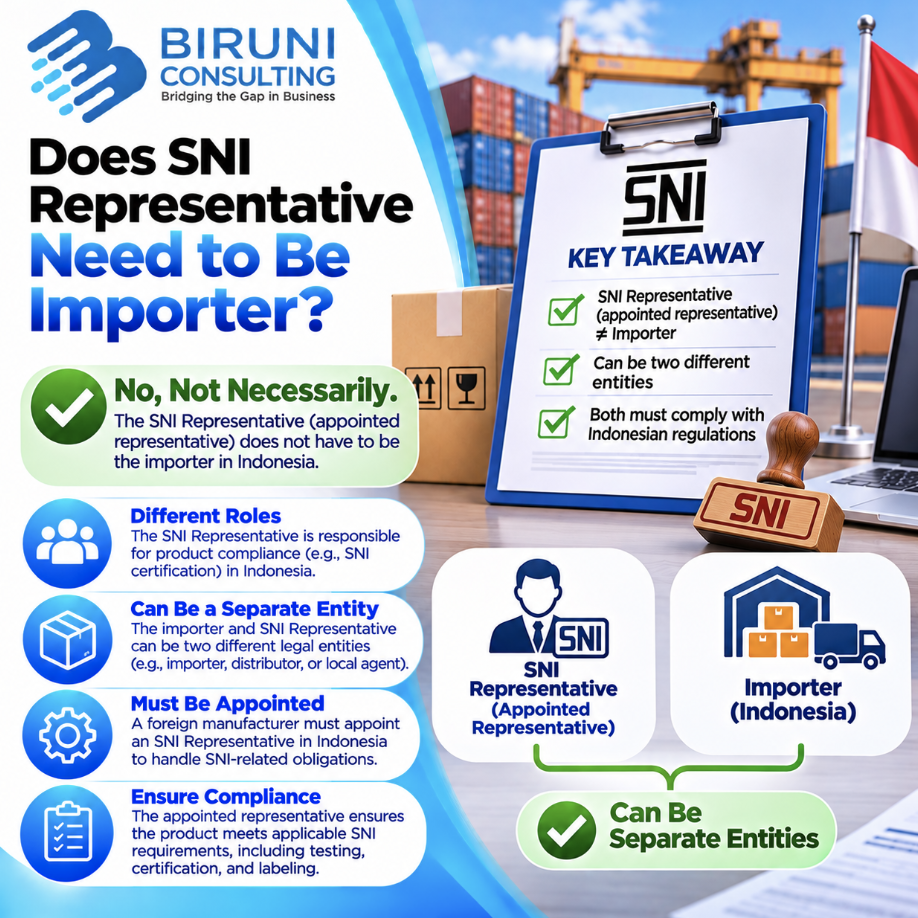
Does an SNI Official Representative Have to Act as the Importer in Indonesia?
Does SNI Representative Need to Be Importer? The answer is no, not always. An Official Representative of an Overseas Manufacturer does not automatically need to perform the Importer function. Whether both functions need to be combined, may be combined, or can be separated depends on the product-specific Mandatory SNI regulation.
This distinction matters because the Official Representative and Importer perform different functions. The Official Representative generally represents the Overseas Manufacturer within a specified regulatory and certification structure, while the Importer brings goods into Indonesia and performs import and customs obligations.
A particularly clear example is Minister of Industry Regulation No. 8 of 2025 concerning Mandatory SNI for lubricating oil. The regulation permits the Official Representative to act as Importer, but where the Representative does not import directly, it can appoint up to five Importers. Under that regulatory scheme, the Official Representative therefore does not have to be the Importer. CRPG Law Database
Short Answer: Does the SNI Representative Have to Be the Importer?
No.
For some products, the Official Representative can also perform the Importer function. Under another permitted structure, the Importer can be a separate Indonesian company.
Three possible arrangements can therefore exist:
- Official Representative also acts as Importer.
- Official Representative and Importer are separate entities.
- One Official Representative uses multiple Importers where the product regulation expressly allows it.
The appropriate arrangement should be established from the product regulation rather than a general assumption that every Representative needs to import.
What Is an SNI Representative?
An SNI Representative or Official Representative is an Indonesian company appointed by an Overseas Manufacturer to perform responsibilities established under a particular Mandatory SNI regulation.
Not every product with an SNI requires an Official Representative. The requirement generally appears where the regulation imposing Mandatory SNI specifically establishes an Overseas Manufacturer structure.
The Official Representative can be responsible for:
- Local regulatory representation.
- SIINas applications.
- Appointment and trademark documentation.
- LSPro and certification coordination.
- SPPT SNI and continuing compliance.
- Warehousing where required.
The exact responsibilities remain product specific.
What Is an Importer Indonesia?
An Importer is the party conducting importation into Indonesia.
Under the current general import framework, Minister of Trade Regulation No. 16 of 2025 requires Importers to hold an NIB functioning as an API. The regulation became effective on August 29, 2025 and has subsequently been amended, including through the second amendment under Minister of Trade Regulation No. 18 of 2026, effective June 4, 2026. Database Peraturan | JDIH BPK
The Importer role therefore has its own legal requirements separate from the Official Representative appointment.
Representative Appointment Is Different from Importer Authorization
An appointment letter from an Overseas Manufacturer does not automatically make the Indonesian Representative legally ready to import.
Where the Representative will also conduct commercial importation, it still needs an appropriate Importer structure, including an NIB functioning as API and other applicable import requirements. Database Peraturan | JDIH BPK
Accordingly:
Official Representative appointment ≠ automatic Importer eligibility.
Both roles need to be assessed separately.
Lubricating Oil Example: The Representative Does Not Have to Import
Minister of Industry Regulation No. 8 of 2025 provides a particularly clear example.
An Overseas Manufacturer of lubricating oil needs an Official Representative. The Representative is subject to requirements involving manufacturer appointment, trademark arrangements, warehousing, the ability to act as Importer, and SIINas. CRPG Law Database
However, the regulation does not require the Representative always to perform importation itself.
If it does not act as Importer, the Representative may appoint up to five Importers. CRPG Law Database
Structure One: Representative Also Acts as Importer
One structure can therefore be:
Overseas Manufacturer → Official Representative + Importer → Distributor
One Indonesian entity manages regulatory representation and importation.
The arrangement can simplify operational coordination because the manufacturer works with one local party for certification-related matters and import processes.
That company still needs to satisfy the legal requirements applicable to both roles.
Structure Two: Representative and Importer Are Separate
Another arrangement can be:
Overseas Manufacturer → Official Representative → Importer → Distributor
The Official Representative focuses on certification and regulatory compliance, while the Importer manages importation and customs.
For lubricating oil, this arrangement is expressly contemplated because an Official Representative that does not import directly can appoint up to five Importers. CRPG Law Database
Structure Three: One Representative with Multiple Importers
Under certain product schemes, one Official Representative can use several Importers.
The lubricating-oil regulation permits up to five where the Representative does not import directly. CRPG Law Database
This can support an Overseas Manufacturer operating several commercial or distribution channels in Indonesia.
The five-Importer limit is specific to that regulatory scheme and should not be treated as a universal SNI rule.
Product-Specific Regulations Determine the Answer
The question “Does SNI Representative Need to Be Importer?” cannot be answered from general import regulation alone.
Mandatory SNI products are governed by separate product regulations.
For example, Minister of Industry Regulation No. 8 of 2025 governs lubricating oil, Regulation No. 9 of 2025 governs tires, and Regulation No. 15 of 2025 governs motor-vehicle safety glass. These regulations remain in force and establish their own conformity-assessment structures. Database Peraturan | JDIH BPK
A structure used for one product should therefore not automatically be copied to another.
Motor-Vehicle Safety Glass Example
Mandatory SNI for motor-vehicle safety glass provides another example showing that the Official Representative and Importer should not simply be treated as the same role.
Minister of Industry Regulation No. 15 of 2025 allows the Official Representative to act as Importer for safety glass manufactured by the Overseas Manufacturer. It also includes a separate-Importer arrangement for certain imports of safety glass used as raw material for vehicle-assembly activities. CRPG Law Database
The important point is the regulatory wording that the Representative may act as Importer. The Importer function does not automatically become inseparable from regulatory representation.
SNI Representative vs Importer
The two functions can be summarized as follows:
| Area | SNI Representative | Importer |
|---|---|---|
| Main function | Regulatory representation | Importation |
| Legal basis | Product-specific SNI regulation | Import framework |
| Manufacturer appointment | Generally required | Depends on structure |
| NIB/API | Required if also acting as Importer | Required |
| SIINas | Can be a core responsibility | Not automatic |
| SNI Certificate | Not automatically the holder | Not automatically the holder |
| Customs | Not automatic | Yes |
| PIB | Not automatic | Yes |
| Warehousing | Can be required | Product specific |
| SPPT SNI | Can have a role | Not automatic |
One company can perform several functions, but the legal basis for each function remains distinct.
NIB Functioning as API
Where the Official Representative will act as Importer, it needs to satisfy general Importer requirements.
Minister of Trade Regulation No. 16 of 2025 requires Importers to hold an NIB functioning as API. API is the identification used for the Importer function. Database Peraturan | JDIH BPK
A manufacturer’s Letter of Appointment alone therefore does not make the Representative import-ready.
Customs Access
The Importer also needs customs operational readiness.
Indonesia Customs explains that Importers and/or Exporters are treated as satisfying Customs Registration requirements after holding an NIB functioning as TDP, API, and Customs Access. The registration information is integrated with OSS NIB and tax information. Beacukai
An Official Representative that does not import does not automatically perform that customs function.
Import Requirements Can Extend Beyond NIB/API
NIB/API is fundamental but can be only one layer of the import structure.
Specified goods can also involve Import Business Licensing, Import Approvals, Surveyor Reports, and other requirements. Minister of Trade Regulation No. 18 of 2026 amended several aspects of these procedures under the current framework. Database Peraturan | JDIH BPK
A Representative intending to become Importer therefore needs assessment against the actual product and applicable import restrictions.
The SNI Representative Is Not Automatically the Certificate Holder
The Official Representative is also not automatically the SNI Certificate Holder.
Under the lubricating-oil structure, certification is associated with the Industrial Company or Overseas Manufacturer, while the Official Representative performs a separate function within the Indonesian regulatory structure. CRPG Law Database
A possible structure can therefore be:
- Overseas Manufacturer = SNI Certificate Holder.
- Official Representative = Indonesian regulatory representative.
- Importer = Indonesian importer.
Some functions can be combined where permitted.
The Importer Is Not Automatically the Certificate Holder
The same principle applies to the Importer.
Holding NIB/API and completing customs clearance does not itself transfer SNI Certificate ownership.
Certificate ownership follows the applicable product-specific regulation.
Descriptions such as “the Importer holds the SNI” should therefore be checked against the actual Certificate and regulatory scheme.
Official Representative and SPPT SNI
The SNI Certificate should also be distinguished from SPPT SNI.
Under certain Mandatory SNI schemes, SPPT SNI represents approval to use the SNI Mark, and the applicant or holder can differ from the SNI Certificate Holder.
Under the lubricating-oil regulation, the Official Representative has a direct role in the SPPT SNI application through SIINas. CRPG Law Database
Manufacturers should therefore map:
- SNI Certificate Holder;
- Official Representative;
- SPPT SNI party;
- Importer; and
- Distributor.
SIINas
SIINas or the National Industrial Information System plays an important role in many Ministry of Industry Mandatory SNI schemes.
Under the lubricating-oil structure, the Official Representative is required to maintain a SIINas account. CRPG Law Database
Where the Representative and Importer are separate companies, the Importer does not automatically control the SIINas certification structure.
This can be strategically useful for an Overseas Manufacturer that wants regulatory representation separated from commercial importation.
Why Would a Manufacturer Use a Representative That Is Not the Importer?
There can be strategic reasons.
An Overseas Manufacturer can want the Official Representative to remain stable while changing Importers or Distributors according to commercial performance.
A separated structure can also preserve regulatory continuity across multiple sales channels.
The Official Representative can focus on:
- Certification.
- SIINas.
- Regulatory documentation.
- Surveillance.
- Regulatory monitoring.
The Importer can focus on shipments and customs.
Why Can Combining Representative and Importer Be Simpler?
Combining the roles also provides advantages.
The Overseas Manufacturer works with fewer local parties, while certification, product, shipping, and customs information can be coordinated more centrally.
This can work well where the manufacturer has one stable Indonesian partner and does not require several import channels.
Risks of Combining Representative and Importer
Operational simplicity can create commercial dependency.
Where the same company also acts as Distributor, one local partner can potentially control:
- regulatory representation;
- importation;
- warehousing;
- customs;
- domestic distribution; and
- significant regulatory documentation.
Changing that partner later can therefore become more complicated.
First-shipment convenience should be weighed against long-term market control.
Risks of Separating Representative and Importer
A separated structure also creates complexity.
More parties need to coordinate the same regulatory and product information.
The Overseas Manufacturer should maintain consistency among:
- Official Representative;
- Importer;
- SNI Certificate;
- SPPT SNI;
- SIINas;
- manufacturing sites;
- Invoices;
- Packing Lists; and
- actual products.
Responsibility allocation should be agreed from the beginning.
Changing the Importer
Changing the Importer can have certification consequences even where the Importer is not the Certificate Holder.
Under the lubricating-oil regulation, changes to an Importer or its information before SNI Certificate expiration require the Official Representative to apply for an amendment to the Certificate. CRPG Law Database
A separated Importer structure therefore does not necessarily mean the Importer can be replaced without regulatory action.
Changing the Official Representative
Changing the Official Representative can have even more fundamental consequences.
Under the lubricating-oil scheme, replacing the Official Representative before expiration of the SNI Certificate causes the Certificate to expire. CRPG Law Database
This demonstrates that the Official Representative can have a much stronger relationship with certification continuity than an ordinary Importer.
Warehouse Requirements
The Official Representative can also have warehousing responsibilities distinct from ordinary Importer obligations.
Under the lubricating-oil regulation, the Representative must control a warehouse under the specified location requirements. CRPG Law Database
The motor-vehicle safety-glass regulation also establishes warehousing requirements for its Official Representative and specified separate-Importer arrangements. CRPG Law Database
Warehousing can therefore be a regulatory issue rather than merely a logistics decision.
Representative, Importer, and Distributor
These three functions should remain distinct conceptually.
The Official Representative manages regulatory representation.
The Importer manages importation.
The Distributor manages commercial sales and domestic distribution.
Potential structures include:
- Representative = Importer = Distributor;
- Representative = Importer, with a separate Distributor;
- Representative separate, while Importer = Distributor; or
- all three functions assigned to different companies.
The available structure still depends on the product regulation and business licensing.
The Representative Does Not Have to Be the Distributor
An Official Representative does not necessarily need to sell the product.
A manufacturer can use a Representative focused on compliance while commercial distribution is carried out by another company.
This can reduce regulatory dependence on a sales partner.
The product regulation nevertheless needs to permit the intended arrangement.
The Importer Does Not Have to Be the Distributor
Importer and Distributor functions can also be separated.
The Importer can handle customs and physical importation before products move into a Distributor’s domestic commercial channel.
One company can also perform both functions where legally eligible.
The appropriate arrangement should follow long-term market strategy.
Regulatory Ownership
The question Does SNI Representative Need to Be Importer is fundamentally connected with regulatory ownership.
Before appointment, the Overseas Manufacturer should determine:
- Who holds the SNI Certificate?
- Who acts as Official Representative?
- Who holds or applies for SPPT SNI?
- Who is the Importer?
- Who is the Distributor?
- Who controls SIINas?
- Who maintains the regulatory records?
- Who manages surveillance?
- What happens when a commercial partner changes?
Clear allocation makes it easier to maintain market continuity.
LSPro
An LSPro or Lembaga Sertifikasi Produk / Product Certification Body is the conformity-assessment body and is different from both the Representative and Importer.
The Representative can support certification coordination.
The Importer can support logistics or samples.
Neither replaces the LSPro or its certification decision.
Laboratory Testing
Mandatory SNI certification can also require laboratory testing.
The Representative does not need to be the Importer merely to coordinate testing.
Similarly, an Importer does not automatically become the certification applicant because it helps move testing samples.
Laboratory testing and commercial import responsibilities are separate workstreams.
Factory Audit
Where a certification scheme uses factory audits, the assessment focuses on the manufacturing facility and quality-management system.
The Official Representative can coordinate with the LSPro and Overseas Manufacturer.
The Importer can remain separate because customs importation is not the primary subject of the factory audit.
This is another reason the Representative does not necessarily need to be the Importer.
Manufacturing Site
Certification can also be linked to production locations.
The Representative needs to ensure that the manufacturer and production site fall within the approved certification scope.
The Importer needs to ensure the shipment actually originates from an approved source.
Different roles still need to use the same product and production data.
Multiple Models
Manufacturers with several models should maintain a model matrix.
The Representative can control certification scope, while the Importer ensures commercial shipments contain models falling within the applicable approvals.
Certificate information, test reports, Invoices, Packing Lists, and actual goods should remain consistent.
Multiple Manufacturing Sites
A global manufacturer can use several factories.
Where certification is site specific, using a different Importer does not change the site-specific requirement.
The Importer can only bring in products that satisfy the relevant approval.
Manufacturing-source changes should therefore undergo regulatory review.
Multiple Importers
Where a regulation permits several Importers, strong governance becomes important.
Manufacturers should control:
- appointed Importer lists;
- model scope;
- manufacturing sites;
- Certificate references;
- shipping records;
- warehousing;
- distribution destinations; and
- regulatory amendments.
Multiple Importers increase flexibility while also increasing administrative complexity.
Customs Responsibilities Remain with the Importer
An Official Representative that does not act as Importer does not assume customs obligations simply because it manages SNI compliance.
The Importer remains responsible for its importer and customs structure. Indonesia Customs states that Importers/Exporters are treated as meeting Customs Registration requirements after obtaining an NIB functioning as TDP, API, and Customs Access. Beacukai
This reinforces the distinction between regulatory representation and customs importation.
Pre-Shipment Compliance Review
Before cargo departs, the Representative and Importer should conduct a joint pre-shipment review.
Key points can include:
- Mandatory SNI scope.
- SNI Certificate.
- SPPT SNI where applicable.
- Official Representative appointment.
- Importer eligibility.
- Models and manufacturing sites.
- Warehousing requirements.
- Import Approvals or restrictions.
- Commercial Invoice and Packing List.
- Transportation documentation.
A separated structure should not result in regulatory and logistics teams using inconsistent product information.
Product Traceability
The Representative and Importer should establish an effective traceability mechanism.
Certificate information should be connectable with the actual shipment, PIB, Invoice, production batches, manufacturing site, and distribution destination.
Where the parties are separate, data-sharing responsibilities should be documented.
Traceability supports surveillance, inspections, complaints, and recalls.
Post-Market Compliance
Official Representative obligations can continue after shipment.
The Importer can also maintain continuing customs records and reporting responsibilities.
Separating the roles does not mean compliance ends when the goods clear customs.
Surveillance, Certificate changes, reporting, and regulatory monitoring still need coordination.
Regulatory Monitoring
The general import framework continues to develop.
Minister of Trade Regulation No. 18 of 2026, the second amendment to Regulation No. 16 of 2025, changed provisions relating to Import Business Licensing, Import Approvals, Surveyor Reports, import declaration documentation, import-realization reporting, and administrative sanctions. Database Peraturan | JDIH BPK
Product-specific Mandatory SNI regulations can also change.
Manufacturers therefore need to monitor both layers.
Regulatory Gap Analysis
Before deciding whether the Official Representative should also act as Importer, companies should perform regulatory gap analysis.
Typical gaps include:
- applicable Mandatory SNI regulation not identified;
- Representative eligibility incomplete;
- Importer’s NIB/API not ready;
- Customs Access unavailable;
- SIINas not ready;
- warehousing requirements incomplete;
- SNI Certificate not yet issued;
- Import Approval unavailable; or
- regulatory ownership unclear.
Gap analysis helps determine the most workable structure.
When Should the Representative Also Act as Importer?
A combined structure can be appropriate where:
- The product regulation permits it.
- The Representative satisfies Importer requirements.
- The company has customs capabilities.
- Warehousing and Business Licensing are appropriate.
- The manufacturer uses one commercial channel.
- The manufacturer is comfortable placing regulatory and import functions with the same entity.
This structure can be operationally simpler.
When Does the Representative Not Need to Be the Importer?
A separated structure can be appropriate where:
- The product regulation permits it.
- The manufacturer wants the regulatory Representative to remain stable.
- Several Importers or Distributors will be used.
- Commercial partners can change over time.
- The manufacturer wants to reduce dependency on one Indonesian entity.
- The Representative’s primary role is regulatory rather than logistics.
Under the lubricating-oil regulation, such a separated structure is expressly available subject to its specific conditions. CRPG Law Database
Does SNI Representative Need to Be Importer Roadmap
An Overseas Manufacturer can generally use this roadmap:
- Identify the product and applicable Mandatory SNI.
- Review the product-specific regulation.
- Determine Official Representative requirements.
- Determine the legal SNI Certificate Holder.
- Decide whether the Representative will also be the Importer.
- If separate, assess the proposed Importer.
- Review NIB/API and Customs Access.
- Complete LSPro assessment, testing, audits, and certification.
- Complete SPPT SNI and SIINas requirements.
- Complete import requirements.
- Conduct pre-shipment review.
- Manage surveillance and regulatory monitoring.
The local structure should ideally be finalized before the first commercial shipment.
Timeline
There is no single timeline applicable to all products.
Timing can depend on:
- Representative appointment;
- certification scheme;
- LSPro;
- factory audits;
- testing;
- SIINas;
- SPPT SNI;
- warehousing;
- Importer setup;
- NIB/API;
- Customs Access; and
- Import Approvals.
Using separate Representatives and Importers does not necessarily make a project slower where responsibilities are designed early.
Cost
Costs should also be divided according to the two workstreams.
Representative-related costs can include regulatory representation, certification coordination, warehousing, SIINas, surveillance, and regulatory monitoring.
Importer-related costs can include importer services, customs brokerage, duties, import taxes, freight, warehousing, and domestic delivery.
LSPro, laboratory testing, factory audits, auditor travel, and sample shipments can create additional certification costs.
Transparent separation helps the Overseas Manufacturer understand total market-entry costs.
Common Mistakes
Common mistakes concerning Does SNI Representative Need to Be Importer include:
- assuming the Representative must import every SNI product;
- assuming every product permits a separate Importer;
- applying the lubricating-oil structure to other products without regulatory review;
- assuming the Representative automatically holds the SNI Certificate;
- assuming the Importer automatically holds SPPT SNI;
- failing to verify NIB/API;
- failing to verify Customs Access;
- changing the Importer without assessing certification consequences; and
- selecting an Official Representative solely because it can handle customs clearance.
The product-specific regulation should remain the primary reference.
How to Determine the Appropriate Structure
An Overseas Manufacturer should start with a regulatory map before selecting local partners.
Important questions include:
- Is Mandatory SNI applicable?
- Does the Overseas Manufacturer need an Official Representative?
- Can the Representative act as Importer?
- Must the Representative act as Importer?
- Can a separate Importer be appointed?
- Are multiple Importers permitted?
- Who holds the SNI Certificate?
- Who holds SPPT SNI?
- Who controls SIINas?
- Who performs domestic distribution?
Once those roles are clear, the contractual structure can be developed more safely.
Conclusion
Does SNI Representative Need to Be Importer? No, not always.
The Official Representative and Importer perform different functions. The Representative operates within the product-specific SNI regulatory structure, while the Importer performs importation and customs responsibilities. Indonesia’s general import framework continues to require the Importer to hold an NIB functioning as API. Database Peraturan | JDIH BPK
Minister of Industry Regulation No. 8 of 2025 provides a clear example that the SNI Representative does not have to be the Importer. The Official Representative may act as Importer, but if it does not, the regulation allows it to appoint up to five Importers. Changing an Importer can require amendment of the SNI Certificate, while changing the Official Representative before Certificate expiration causes the Certificate to expire under the lubricating-oil scheme. CRPG Law Database
Minister of Industry Regulation No. 15 of 2025 for motor-vehicle safety glass also demonstrates that an Official Representative may act as Importer while a separate-Importer structure applies under specified circumstances. CRPG Law Database
An Overseas Manufacturer should therefore not focus only on “who will import?” The company should first map the SNI Certificate Holder, Official Representative, SPPT SNI party, Importer, Distributor, SIINas control, and regulatory ownership according to the actual product regulation.
Contact Us
Biruni Consulting assists companies with Does SNI Representative Need to Be Importer professionally and in accordance with applicable regulations in Indonesia.
Our services include:
- Regulatory consultation.
- Identification of applicable standards.
- Preparation of certification documents.
- Assistance with laboratory testing.
- Certification processing until certificate issuance.
Biruni Consulting assists Overseas Manufacturers with determining the Official Representative, Importer, SNI Certificate Holder, SPPT SNI, SIINas, NIB/API, customs readiness, LSPro, warehousing, and regulatory ownership before products are imported and marketed in Indonesia.
Contact Us for guidance on Does SNI Representative Need to Be Importer, SNI Official Representative Indonesia, SNI Importer Indonesia, SNI Certificate Holder Indonesia, and imported SNI product regulatory compliance assistance.