
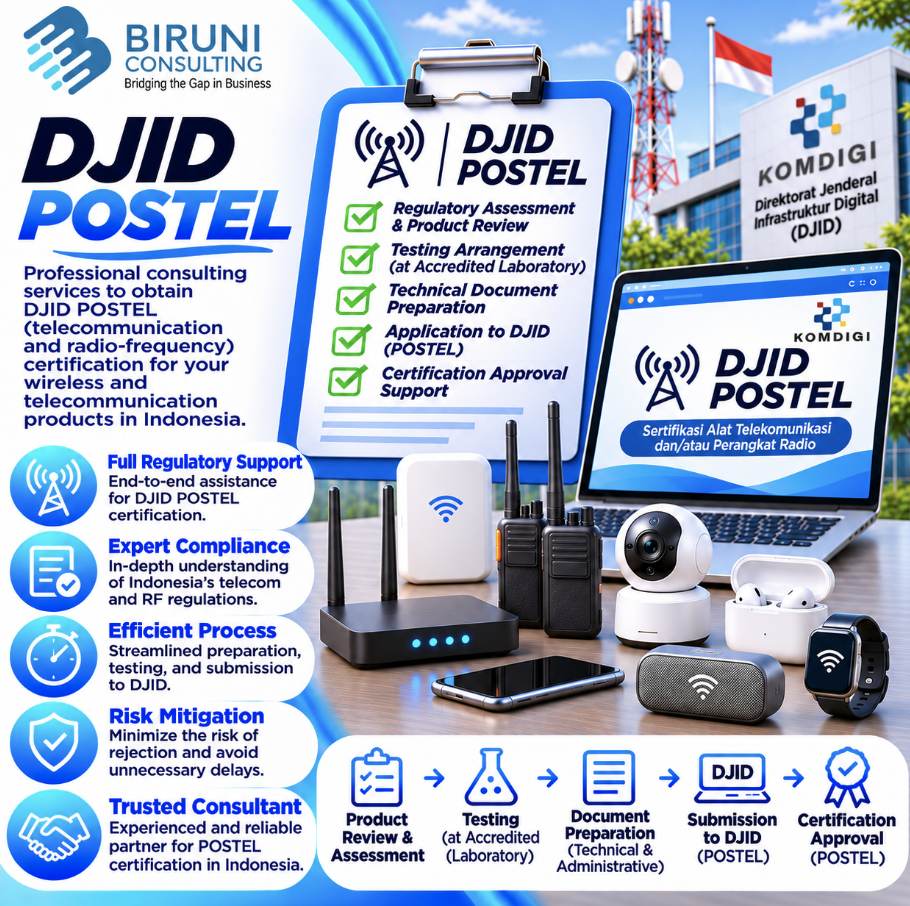
Guide to DJID, Postel, SDPPI, and telecommunications equipment certification in Indonesia
DJID Postel is a term frequently used by importers, distributors, manufacturers, trademark owners, and compliance professionals when discussing Indonesian telecommunications equipment approval.
In commercial communication, the terms Postel, SDPPI, and DJID are still frequently used interchangeably. They do not, however, represent three separate Certificates that a product must obtain.
The current institutional name is the Directorate General of Digital Infrastructure, or DJID, within Indonesia’s Ministry of Communication and Digital. The organisational restructuring from the former SDPPI to DJID was established under Minister of Communication and Digital Regulation Number 1 of 2025. JDIH Kemkomdigi
“Postel” remains a familiar market term for telecommunications equipment certification.
DJID, SDPPI, and Postel
SDPPI was the former Directorate General of Resources and Equipment of Post and Information Technology.
Following the restructuring of Indonesia’s Ministry of Communication and Digital, these functions were reorganised under the Directorate General of Digital Infrastructure.
DJID officially describes this change as a nomenclature and organisational restructuring from Ditjen SDPPI to DJID. Infradigital
SDPPI Certification and DJID Certification should therefore not be interpreted as two independent approvals required for the same product.
Why Is “Postel” Still Used?
Postel has been used in the Indonesian telecommunications industry for many years.
Manufacturers and overseas suppliers may still request a “Postel Certificate”, “SDPPI approval”, or “Indonesia telecom certificate”.
While DJID is the current institutional nomenclature, Postel Certification remains a useful commercial expression that is widely understood by international suppliers and importers.
This is why the term Postel/DJID Certification remains common in practical compliance discussions.
New Certificates Use DJID
The transition can be seen directly in Indonesia’s official certification database.
The e-Sertifikasi portal describes its database as containing valid SDPPI/DJID Komdigi telecommunications-equipment Certificates. Certificates displayed for November 24, 2026 use numbers such as 129272/DJID/2026. e-Sertifikasi NextGen
DJID is therefore the nomenclature used for newly issued Certificates, while the SDPPI terminology remains visible for continuity with earlier certification records.
What About Existing SDPPI Certificates?
The organisational change does not automatically invalidate Certificates issued previously under the SDPPI nomenclature.
The official portal continues to present SDPPI and DJID Certificates together as valid telecommunications-equipment Certificates. e-Sertifikasi NextGen
A company should therefore not assume that it needs a replacement Certificate simply because an older Certificate number contains /SDPPI/ rather than /DJID/.
The Certificate status and current regulatory conditions are more important than the nomenclature in the historical number.
Current Certification Framework
The principal certification regulation remains Minister of Communication and Informatics Regulation Number 3 of 2024 on Certification of Telecommunications Equipment. It replaced Regulation Number 16 of 2018. JDIH Kemkomdigi
The certification framework requires covered equipment to comply with applicable Indonesian Technical Standards based on testing.
For this reason, DJID assessment should focus on the actual technical and radio configuration rather than only the product’s commercial name.
Products Requiring DJID Assessment
Certification considerations are not limited to phones, modems, and routers.
Products incorporating Bluetooth, WiFi, cellular, Zigbee, Thread, NFC, proprietary RF, or other telecommunications functions may also require assessment.
The current official certification database includes products such as GNSS equipment, remote triggers, cellular routers, Bluetooth pens, mobile phones, switches, and other digital equipment. e-Sertifikasi NextGen
Smart appliances, IoT products, computer accessories, toys, automotive electronics, and industrial equipment may therefore also have DJID requirements.
Who Handles Equipment Certification?
Within DJID, the Directorate of Digital Infrastructure Services is responsible for functions including radio-spectrum licensing, radio-operator certification, special telecommunications services, and certification of telecommunications equipment and digital devices. Infradigital
DJID has also identified telecommunications equipment certification as one of its public services following the organisational restructuring. Infradigital
The equipment-certification functions historically associated with SDPPI/Postel are therefore now located within DJID.
OSS and e-Sertifikasi NextGen
New business applications currently use OSS and e-Sertifikasi NextGen.
The official portal lists NIB and OSS access among the general requirements. Applications also require an LHU/test report, technical specifications, a Declaration of Conformity, colour product photographs showing brand and model/type, and a declaration that the submitted information is complete and correct. e-Sertifikasi NextGen
Applicant and technical documentation should therefore be checked for consistency before submission.
LHU and Test Reports
The laboratory test report is one of the principal technical documents in a DJID/Postel project.
Current e-Sertifikasi guidance requires the LHU/test report to be issued by a designated Indonesian laboratory or a recognised overseas laboratory. e-Sertifikasi NextGen
The exact model, operating frequencies, transmitter power, radio modes, antennas, hardware, and relevant firmware should be compared with the laboratory evidence.
CE, FCC, and other international reports can be useful supporting documents, but they should not automatically be treated as Indonesian DJID Certificates.
Products Using Radio Modules
Many modern products incorporate pre-developed Bluetooth, WiFi, or multi-radio modules.
Where a module LHU is used, current e-Sertifikasi requirements include a block diagram, photographs showing the module location in the final product, and a module-use declaration linking the module brand/type with the final equipment brand, type, and variant. e-Sertifikasi NextGen
The existence of a module test report therefore does not automatically remove the need to assess the final product.
Antenna configuration, firmware, transmitter settings, and final integration remain relevant.
DJID Certificate Applicants
Current e-Sertifikasi guidance recognises both business and non-business applicants.
Business applicant categories include Indonesian registered trademark holders, representatives or distributors of trademark holders, manufacturers or assemblers for trademark holders, manufacturers or assemblers, and businesses using equipment for their own purposes. e-Sertifikasi NextGen
The certification structure should clearly connect the applicant, trademark owner, manufacturer, exact model, manufacturing country, and laboratory evidence.
An Indonesian company applying as an official distributor of an overseas trademark owner also needs the applicable appointment documentation. e-Sertifikasi NextGen
DJID/Postel Regulatory Labeling
Certificate issuance is followed by regulatory-labeling obligations.
Current e-Sertifikasi requirements state that Certificate holders must implement the Label, QR Code, and Warning Signon equipment and packaging and report implementation within 30 working days after Certificate issuance by uploading photographs of the marked equipment. e-Sertifikasi NextGen
Regulatory marking should therefore be considered during product-label and packaging design rather than only after mass production.
OEM and Private-Label Equipment
OEM and private-label equipment can require additional assessment because the laboratory model may differ from the commercial model.
One factory may supply similar hardware to several brands while using different model numbers, firmware, antennas, or wireless configurations.
The tested equipment should therefore be mapped against the final Indonesian commercial product before existing test reports are relied upon.
This helps reduce the risk of a mismatch between the certification documents and the product actually imported.
Why Pre-Import Assessment Matters
A global product family can include multiple regional SKUs with different radio modules, frequency configurations, antennas, firmware, or manufacturing countries.
Identical marketing names do not always mean identical technical products.
Pre-import DJID assessment helps determine the applicable Technical Standards, suitability of existing laboratory reports, applicant structure, and whether additional testing is needed before commercial shipment.
Conclusion
DJID Postel is a practical term used to describe telecommunications-equipment certification under Indonesia’s current regulatory structure.
Postel remains a widely recognised commercial term, while SDPPI was the previous institutional nomenclature. Following the restructuring under Minister of Communication and Digital Regulation Number 1 of 2025, the current organisation is the Directorate General of Digital Infrastructure, or DJID. JDIH Kemkomdigi
New Certificates now use /DJID/2026 numbering, while the official portal continues to maintain SDPPI/DJID Certificate records as valid certification information. e-Sertifikasi NextGen
For importers, distributors, manufacturers, and trademark owners, the most important issue is not simply whether the process is called Postel, SDPPI, or DJID. The exact model, radio technologies, operating frequencies, transmitter power, modules, antennas, applicant, manufacturer, manufacturing country, and laboratory evidence should all be assessed before certification.
Contact Us
Biruni Consulting assists with DJID/SDPPI assessment and certification for telecommunications equipment and various wireless products that will be imported or marketed in Indonesia.
Our services include:
- Assessment of DJID/SDPPI certification requirements.
- Transmitter and receiver assessment.
- RF specification review.
- Frequency and transmission power analysis.
- Technical document review.
- Certification document preparation.
- Testing coordination where required.
- DJID/SDPPI Certification assistance.
If you have a telecommunications device or wireless product, you can prepare product photos, brand, model, datasheet, RF specifications, and wireless module datasheet for an initial assessment of the Postel Certification requirements