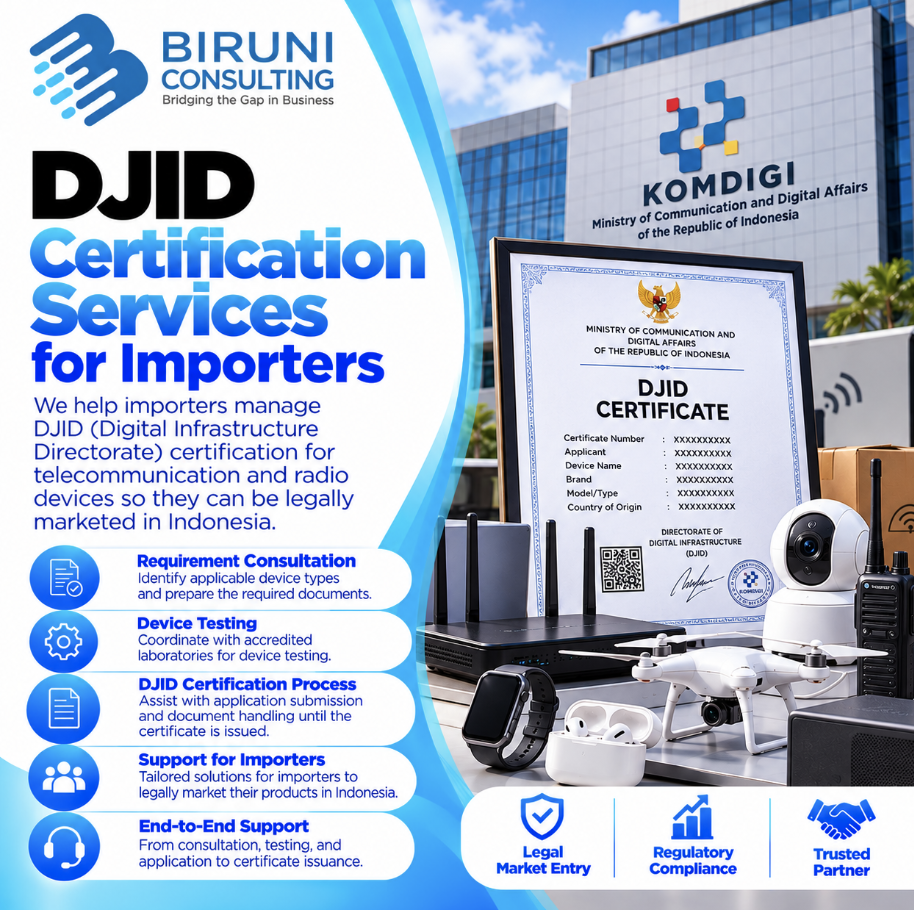
DJID Certification Services for Importers and Overseas Manufacturers
DJID Certification Services for Importers help companies ensure that telecommunications equipment and/or telecommunications devices intended for import into Indonesia comply with applicable Technical Standards and hold the required certification before being marketed or used in Indonesia.
DJID is the Directorate General of Digital Infrastructure under Indonesia’s Ministry of Communication and Digital Affairs. This nomenclature replaced the Directorate General of Resources and Equipment of Post and Information Technology, commonly known as SDPPI, during the Ministry’s organizational restructuring in 2025. As a result, the commercial terms DJID certification, SDPPI certification, and Postel certification can still appear in the market even though the current organization is DJID. Infradigital
Legally, the document is a Telecommunications Equipment and/or Telecommunications Device Certificate. Minister of Communication and Informatics Regulation No. 3 of 2024 concerning Certification of Telecommunications Equipment and/or Telecommunications Devices remains in force and provides a principal regulatory basis for certification. It applies to telecommunications equipment or devices made, assembled, or brought into Indonesia for trading and/or use and requires compliance with applicable Technical Standards. BPK Regulations
For Importers, certification should not begin only after goods reach the port. Product classification, applicant structure, Technical Standards, test reports, OSS, the DJID application, labeling, and customs readiness should be prepared before commercial shipment.
What Is DJID Certification?
DJID certification is the process used to demonstrate that a type of telecommunications equipment and/or telecommunications device complies with applicable Indonesian Technical Standards.
Regulation No. 3 of 2024 provides that compliance is assessed for each brand, equipment type, and country of manufacture through testing. Equipment complying with the Technical Standards based on testing is demonstrated through a Certificate. The same brand and type manufactured in different countries require separate certificates. JDIH Kemkomdigi
Certification should therefore not be assessed solely from a commercial product name. The model, brand, manufacturing country, radio technology, technical specifications, and actual hardware configuration need to be reviewed.
Why Do Importers Need DJID Certification?
Importers bringing telecommunications equipment into Indonesia for commercial distribution need to establish whether their products fall within mandatory technical-standard and certification requirements.
Products requiring assessment can include:
- smartphones and tablets;
- routers and access points;
- modems and gateways;
- Wi-Fi or Bluetooth devices;
- IoT devices;
- radio equipment;
- telecommunications network equipment; and
- other electronic products incorporating communications functions.
The presence of Wi-Fi, Bluetooth, or another radio feature should nevertheless be assessed against the actual configuration and applicable Technical Standards. Not every electronic product follows an identical certification pathway.
DJID, SDPPI, and Postel
DJID is the current institutional terminology.
In January 2025, the organizational restructuring changed Ditjen SDPPI into the Directorate General of Digital Infrastructure. DJID is currently an Echelon I unit under the Ministry of Communication and Digital Affairs with responsibilities in digital infrastructure. Infradigital
Companies can still encounter the terms SDPPI and Postel in older documentation and online searches. Certain formats originating under earlier regulations can also retain older terminology.
For market-entry planning, companies should use DJID as the current institutional reference while recognizing SDPPI/Postel certification as historical and SEO terminology associated with the same certification area or its predecessor framework.
Can an Importer Apply for a DJID Certificate?
Importer status alone is not sufficient.
Regulation No. 3 of 2024 provides that a Business Operator applying for certification can be a party that:
- owns a trademark registered in Indonesia;
- is appointed as a representative and/or distributor of the trademark owner;
- manufactures and/or assembles telecommunications equipment for the trademark owner;
- manufactures and/or assembles the equipment itself; or
- uses the equipment for its own purposes. JDIH Kemkomdigi
An Importer seeking to become the certificate applicant therefore needs to fit within one of the permitted applicant categories.
For imported commercial products, a common relevant structure is an Importer that is also appointed as representative and/or distributor of the trademark owner. The exact appointment arrangement should correspond with the commercial relationship and company documentation.
The Importer Is Not Automatically the Certificate Holder
A common mistake is assuming that the company performing customs clearance must automatically own the DJID Certificate.
That is not necessarily the case.
The Importer, Distributor, Representative, trademark owner, and Certificate Owner can perform different functions depending on the selected structure and applicant.
Because certificate ownership can affect product launches, distributor changes, re-certification, and regulatory control, an Overseas Manufacturer should decide at the beginning which party will apply for and own the Certificate.
NIB and OSS
For Business Operators, certificate applications are submitted through the OSS System integrated with the Directorate General’s Certification Service Facility. The Ministry’s public-service information also identifies NIB and OSS access among the general requirements for a new certification application. JDIH Kemkomdigi
Before the application begins, the Importer should confirm:
- the legal entity is active;
- the NIB is available;
- OSS access can be used;
- company data is consistent; and
- the relationship with the trademark owner can be demonstrated where required.
Regulatory data should be checked before test reports and the application package are finalized.
NIB/API for Importers
DJID certification and importer licensing represent separate compliance layers.
For general import activities, Minister of Trade Regulation No. 16 of 2025 requires an Importer to hold an NIB functioning as an API. That import framework has subsequently been amended, including through the second amendment under Minister of Trade Regulation No. 18 of 2026, effective June 4, 2026. BPK Regulations
Certificate-application readiness therefore does not automatically equal importer readiness.
A company can qualify as a DJID applicant while still needing to satisfy general and product-specific import requirements before shipment.
Product Regulatory Assessment
The first stage of DJID Certification Services for Importers should be regulatory assessment.
Information commonly reviewed includes:
- product name;
- brand;
- model/type;
- intended use;
- wireless technologies;
- frequency bands;
- output power;
- interfaces;
- power supply;
- country of manufacture; and
- existing test reports.
Assessment establishes whether the product falls within telecommunications-equipment certification requirements and which Technical Standards apply.
Device Model and Type
DJID certification is closely linked with the equipment type.
Companies should not assume that every model in one product family can automatically use the same certificate.
Different models can contain different chipsets, radio modules, antennas, frequency support, output power, firmware, or telecommunications functions.
Model mapping should therefore be completed before laboratory testing.
Country of Manufacture
Country of manufacture is an important certification factor.
Regulation No. 3 of 2024 requires Technical Standard compliance to be established for the brand, type, and country of manufacture. The same brand and type manufactured in different countries require separate Certificates. JDIH Kemkomdigi
This is particularly important for multinational manufacturers.
The same model produced in China and Vietnam, for example, should not automatically be assumed to use one Certificate without regulatory review.
DJID Technical Standards
Products need to be tested against the applicable Indonesian technical requirements.
Regulation No. 3 of 2024 provides that Technical Standards can be based on adoption or adaptation of international or regional standards and national technological development, while compliance for the brand, type, and country of manufacture is established through testing. JDIH Kemkomdigi
Having CE, FCC, IEC, ETSI, or another international report therefore does not automatically make a product approved in Indonesia.
International standards can support the testing basis, but compliance with Indonesian Technical Standards still needs to be demonstrated.
Laboratory Testing
Certification testing can use domestic or foreign laboratories that satisfy applicable requirements.
Regulation No. 3 of 2024 recognizes testing through domestic and foreign testing laboratories designated under applicable rules. The government has also designated foreign laboratories for telecommunications-equipment certification through Minister of Communication and Digital Affairs Decision No. 13 of 2025, which remains in force. JDIH Kemkomdigi
Before relying on a foreign test report, companies should review:
- laboratory recognition;
- accreditation scope;
- test standards;
- model/type consistency;
- manufacturer information; and
- covered technical parameters.
Not every report from an international laboratory can automatically be used.
Existing Foreign Test Reports
Overseas Manufacturers frequently already hold test reports from product development or certification in other markets.
Those reports should be reviewed before local testing is commissioned.
Where the report comes from an acceptable laboratory and covers the Indonesian technical requirements, it can potentially support the certification pathway under applicable rules.
Where it does not, additional testing or retesting can be required.
This approach helps avoid unnecessary testing while reducing the risk of application rejection.
Test Reports Owned by Another Party
Regulation No. 3 of 2024 also provides that where an applicant uses a test report belonging to another party, authorization from the owner of that report needs to be provided. JDIH Kemkomdigi
This becomes relevant where:
- the test report belongs to the manufacturer;
- the applicant is an Importer or Distributor;
- the report is issued in the name of another group company; or
- a common technical platform is owned by another entity.
Document ownership should therefore be resolved before submission.
Technical Documentation
A certification application requires an appropriate technical-document package.
Regulation No. 3 of 2024 includes the test report and technical specifications among the application requirements. Certain products can also require additional documentation, including evidence relating to TKDN where industrial regulations make such requirements applicable. JDIH Kemkomdigi
The Importer should maintain consistency among:
- the test report;
- technical specifications;
- product photographs;
- model/type;
- manufacturer;
- brand; and
- country of manufacture.
Documentation discrepancies can delay certification.
Manufacturer Appointment
Where the Importer applies as a party appointed by the trademark owner, the appointment relationship should be clear.
The manufacturer or brand owner should establish:
- the Indonesian legal entity;
- brands and models covered;
- authority for certification;
- distribution or representation scope; and
- validity of the appointment.
An overly generic commercial agreement can create questions when applicant eligibility is reviewed.
The appointment structure should also align with ownership of the Certificate after issuance.
Application Through OSS
Business Operators submit certification applications through OSS integrated with the Directorate General’s Certification Service Facility.
Regulation No. 3 of 2024 provides a regulatory verification period of up to one Day after a complete application has been received. JDIH Kemkomdigi
That one-Day period should not be treated as the total project lead time.
Before a complete application exists, regulatory assessment, documentation, testing, clarification, and corrections can still be required.
Certification Verification
DJID verifies the submitted application package.
Consistency is essential because applicants are required to provide accurate information and valid documents. JDIH Kemkomdigi
Areas to check before submission include:
- applicant identity;
- brand and model;
- manufacturer;
- manufacturing country;
- test reports;
- technical specifications; and
- relevant product photographs or supporting documentation.
Late changes in model names or manufacturing sources can require document revisions.
Certificate Issuance
For Business Operators, certificates are issued electronically through OSS under the process established by Regulation No. 3 of 2024. Certificates that have been issued are also announced through the Directorate General’s official platform. JDIH Kemkomdigi
DJID currently maintains an e-Certification service providing records of issued telecommunications-equipment certificates. e-Sertifikasi
The Importer should therefore verify that certificate information corresponds with the actual commercial product before mass shipment.
Period for Importing Under the Certificate
There is an important nuance concerning the certificate period.
Regulation No. 3 of 2024 states that the Certificate itself has no expiry date, but its owner may manufacture, assemble, or bring the equipment into Indonesia for trading and/or use for a maximum of three years from the date of Certificate issuance. If the equipment will continue to be manufactured, assembled, or imported after that period, Technical Standard compliance must again be demonstrated through testing and a new Certificate. JDIH Kemkomdigi
It is therefore not completely precise simply to say that a DJID Certificate “expires after three years.”
For importer planning, the key issue is the three-year period for continuing to bring products into Indonesia under that certificate.
Certification Labeling
Labeling also needs to be managed after certification.
The appendix to Regulation No. 3 of 2024 establishes a label format including the Certificate Number and PLG ID, together with a QR Code and applicable regulatory marking elements. JDIH Kemkomdigi
Importers should establish the labeling process before commercial shipment.
The company should determine how and where regulatory identification will be applied while maintaining compliance with the applicable rules.
PLG ID
The PLG ID is the registration identifier of the Certificate Owner within the certification database.
Certificate ownership therefore has an operational consequence.
If the Importer becomes Certificate Owner, its PLG ID is connected with the certification.
If a Distributor or Representative owns the Certificate, regulatory control resides with that party.
An Overseas Manufacturer should consider this before selecting the local applicant.
Importer vs Certificate Owner
Using the Importer as Certificate Owner can simplify operations because certification and importation are concentrated with one company.
The structure can nevertheless create dependency if the Importer later changes.
Alternatively, an eligible local Representative or Distributor can serve as Certificate Owner while the import structure is managed separately.
The appropriate option depends on distribution strategy, number of Importers, regulatory ownership, and long-term market plans.
Distributor vs Importer
A Distributor and Importer do not necessarily perform the same function.
The Importer focuses on bringing goods into Indonesia and satisfying customs obligations.
The Distributor focuses on domestic sales and distribution.
One company can perform both functions where its licensing and commercial structure allow, but an Overseas Manufacturer can also separate them.
For certification purposes, applicant eligibility should follow Regulation No. 3 of 2024 rather than merely identifying the party conducting customs clearance.
DJID Certificate and Customs Clearance
DJID certification does not replace customs requirements.
The Importer still needs an NIB/API and needs to satisfy applicable import regulations. Minister of Trade Regulation No. 16 of 2025 requires Importers to hold an NIB functioning as API, while the 2026 second amendment also regulates aspects of Import Business Licensing, Import Approvals, Import Customs Declaration documentation, and reporting. BPK Regulations
Conversely, holding an NIB/API does not replace the DJID Certificate where certification is required.
Both compliance layers need to be ready before shipment.
Supervision of Imported Products
Certification also interacts with import supervision.
The Directorate that is now DJID previously developed a telecommunications-device import monitoring system integrated with INSW data. Its import-supervision guidance required documentation for imported telecommunications devices subject to certification, including certification and device information. Infradigital
This reinforces the need to complete regulatory assessment before cargo departs rather than only after a customs or regulatory query arises.
Products Exempt from Normal Certification
Not every device entering Indonesia necessarily follows the normal commercial certification pathway.
Regulation No. 3 of 2024 contains specified exemptions. One example covers certain customer-premises equipment brought as personal baggage or delivered through a postal operator for personal, non-commercial use within a specified quantity. Other exemptions can apply to research and development and certain other purposes subject to their own conditions. JDIH Kemkomdigi
An exemption should not be applied to a commercial shipment without confirming eligibility.
Samples for Testing
An Importer or manufacturer can need to send samples to Indonesia for laboratory testing before certification has been completed.
The sample-import arrangement should be planned separately.
Companies need to determine:
- the purpose of the sample;
- quantity;
- destination laboratory;
- whether an exemption or supporting letter is required;
- consignee/importer arrangements; and
- treatment of the sample following testing.
Sending commercial quantities while describing them as “samples” is not an appropriate compliance strategy.
Devices with Multiple Wireless Technologies
Modern devices often incorporate several radio technologies.
A single product can support:
- 2.4 GHz Wi-Fi;
- 5 GHz or 6 GHz Wi-Fi;
- Bluetooth;
- cellular;
- GNSS;
- NFC; or
- proprietary radio technologies.
The assessment needs to map all relevant transmitting functions against applicable Technical Standards.
A test report covering only one radio technology may not be sufficient for the complete certification scope.
Embedded Modules
A product can incorporate a wireless module already supported by certification or testing documentation.
Manufacturers should not automatically assume that module-level approval always replaces assessment of the final product.
Final-product configuration, antenna, firmware, enclosure, interfaces, and certification scope need to be reviewed.
The DJID framework focuses on the applicable equipment/device type actually placed on the Indonesian market.
Module-based products therefore require case-by-case assessment.
Smartphones, Tablets, and Cellular Devices
Mobile phones, handheld computers, and tablets are subject to several specific provisions under Regulation No. 3 of 2024.
For these categories, the regulation provides that test reports used for certification must have been issued by a domestic and/or foreign testing laboratory no more than five years before the Certificate application date. JDIH Kemkomdigi
Cellular products can also be affected by separate requirements such as IMEI or industrial-policy obligations.
A DJID Certificate does not replace every other approval potentially applicable to the product.
TKDN and DJID
Certain telecommunications equipment can also be subject to Indonesian local-content requirements.
Regulation No. 3 of 2024 recognizes that where equipment is required to comply with TKDN provisions, the certification package needs documentation demonstrating compliance with the relevant industrial regulation. JDIH Kemkomdigi
Importers therefore need cross-regulatory assessment.
DJID certification is not necessarily the only approval required before product launch.
Multiple Models in One Project
Companies with numerous SKUs should create a model matrix.
The matrix can contain:
- commercial model;
- regulatory model;
- brand;
- manufacturer;
- country of manufacture;
- radio technologies;
- existing test reports;
- applicable Technical Standards; and
- certification status.
This helps determine which products can follow the same assessment strategy and which require separate certification treatment.
Multiple Manufacturing Countries
A global model can be manufactured in more than one country.
Regulation No. 3 of 2024 expressly connects compliance with the brand, type, and country of manufacture and requires separate certification when manufacturing countries differ. JDIH Kemkomdigi
Supply-chain and regulatory teams therefore need to coordinate.
Moving production from a factory in one country to another without regulatory assessment can result in a mismatch between the Certificate and the actual shipment.
Product Changes After Certificate Issuance
Product changes also require attention after certification.
Changes in model, hardware, wireless chipset, antenna, frequency capabilities, manufacturing country, or company data can affect certification.
Regulation No. 3 of 2024 also requires Certificate Owners to submit administrative changes where the Certificate Owner’s name or address changes. JDIH Kemkomdigi
Technical changes should undergo regulatory impact assessment before updated products are shipped.
Re-Certification
Where the Certificate Owner intends to continue manufacturing, assembling, or bringing the equipment into Indonesia after three years from Certificate issuance, Regulation No. 3 of 2024 requires Technical Standard compliance to be demonstrated again through testing and a new Certificate. JDIH Kemkomdigi
Importers therefore need certificate lifecycle planning even though the regulation states that the Certificate itself does not have an expiry date.
Re-certification should be planned before the three-year import period ends to protect supply continuity.
Regulatory Ownership
Selecting the Certificate Owner is a strategic decision.
An Overseas Manufacturer should understand:
- who owns the Certificate;
- who controls the PLG ID;
- who controls OSS access;
- who manages re-certification;
- who manages labeling;
- what happens if the Importer changes; and
- whether the structure supports additional Distributors.
DJID Certification Services for Importers should therefore address more than certificate issuance and should help create a structure that remains workable after product launch.
Changing the Importer
Where the Importer is also the Certificate Owner, changing the Importer can have broader regulatory consequences.
Where the Certificate is held by another party, changing the Importer still needs assessment from import licensing, appointment, customs, labeling, and commercial-document perspectives.
An Overseas Manufacturer should therefore establish a transition mechanism in its importer arrangement.
Regulatory ownership should not first be discussed only when the Importer relationship is ending.
Pre-Shipment Checklist
Before commercial shipment, companies should confirm:
- the product’s DJID scope has been assessed;
- a Certificate is available where required;
- brand, model, and country of manufacture correspond with the Certificate;
- the Importer has NIB/API and is ready to import;
- labeling has been prepared; and
- shipping and customs documents are consistent.
A pre-shipment review reduces the risk of product mismatches and regulatory questions after cargo arrives.
DJID Certification Services for Importers Timeline
There is no single timeline applicable to every product.
The total project duration depends on existing test reports, laboratory recognition, model complexity, applicant documentation, manufacturing country, and whether additional testing is required.
Although Regulation No. 3 of 2024 establishes a regulatory verification period for a complete application, that period is not the total time from product assessment through certification. JDIH Kemkomdigi
A realistic project schedule should be prepared after technical documentation and existing test reports have been reviewed.
DJID Certification Cost
A project can involve several cost components:
- regulatory assessment;
- test-report review;
- laboratory testing where required;
- certificate PNBP;
- document preparation;
- sample logistics;
- consulting services; and
- additional compliance work where other regulations apply.
Regulation No. 3 of 2024 provides that Certificate issuance is subject to PNBP under the applicable payment mechanism. BPK Regulations
The actual project cost should therefore be established after the product, testing pathway, and document readiness are known.
Common DJID Certification Mistakes by Importers
A common mistake is assuming that every international test report can automatically be used.
Other mistakes include:
- shipping before certification assessment;
- using an applicant that does not meet eligibility requirements;
- lacking a clear manufacturer appointment;
- incorrectly identifying the model/type;
- ignoring the country of manufacture;
- assuming CE or FCC automatically replaces DJID certification;
- assuming the Certificate replaces NIB/API and customs compliance; and
- changing manufacturing sources without regulatory review.
Most of these issues can be reduced through assessment before application and shipment.
Benefits of DJID Certification Services for Importers
Certification services can help Importers and Overseas Manufacturers coordinate several regulatory workstreams.
Benefits can include:
- Determining whether DJID certification is required.
- Establishing the applicant and Certificate Owner structure.
- Reviewing existing test reports and testing gaps.
- Preparing OSS and certification documents.
- Coordinating laboratory testing and application.
- Conducting pre-shipment compliance review.
A consultant does not replace DJID or the testing laboratory. Certificate issuance remains subject to the regulatory process and applicable requirements.
How to Select a DJID Certification Service
A service provider should understand certification together with imported-product structures.
Important capabilities include:
- product regulatory assessment;
- applicant-eligibility analysis;
- interpretation of applicable Technical Standards;
- review of foreign test reports;
- laboratory-testing coordination;
- understanding OSS and certificate ownership; and
- integration of certification with importer planning.
A service provider should also avoid guaranteeing approval before technical assessment because the final decision remains subject to the regulator and applicable requirements.
Conclusion
DJID Certification Services for Importers help ensure telecommunications equipment entering Indonesia meets applicable Technical Standards and has the correct certification structure before commercial shipment.
DJID, or the Directorate General of Digital Infrastructure, is the current organizational name of the unit previously known as Ditjen SDPPI. DJID certification, SDPPI certification, and Postel certification therefore continue to appear in market terminology, while the current regulatory organization sits within the Ministry of Communication and Digital Affairs. Infradigital
Minister of Communication and Informatics Regulation No. 3 of 2024 remains in force and requires Technical Standard compliance for each brand, type, and country of manufacture to be demonstrated through testing and a Certificate. Business Operators apply through OSS integrated with the Directorate General’s Certification Service Facility. JDIH Kemkomdigi
Importers also need to distinguish certification readiness from importer readiness. Indonesia’s general import framework requires an Importer to hold an NIB functioning as API, while the DJID certification framework has its own applicant requirements. BPK Regulations
By completing product classification, applicant assessment, test-report review, laboratory coordination, certification, labeling review, and pre-shipment compliance from the beginning, an Importer can reduce certificate mismatches, shipment delays, and regulatory restructuring after the product enters the Indonesian market.
Contact Us
Biruni Consulting assists companies with DJID Certification Services for Importers professionally and in accordance with applicable regulations in Indonesia.
Our services include:
- Regulatory consultation.
- Identification of applicable standards.
- Preparation of certification documents.
- Assistance with laboratory testing.
- Certification processing until certificate issuance.
Biruni Consulting assists Importers and Overseas Manufacturers with DJID regulatory assessment, applicant structures, test-report review, laboratory testing, OSS, certificate applications, labeling, NIB/API review, and compliance preparation before telecommunications equipment is imported and marketed in Indonesia.
Contact Us for DJID Certification Services for Importers, DJID Certification Indonesia, SDPPI Certification Indonesia, Postel Certification Indonesia, and telecommunications-device regulatory compliance assistance.