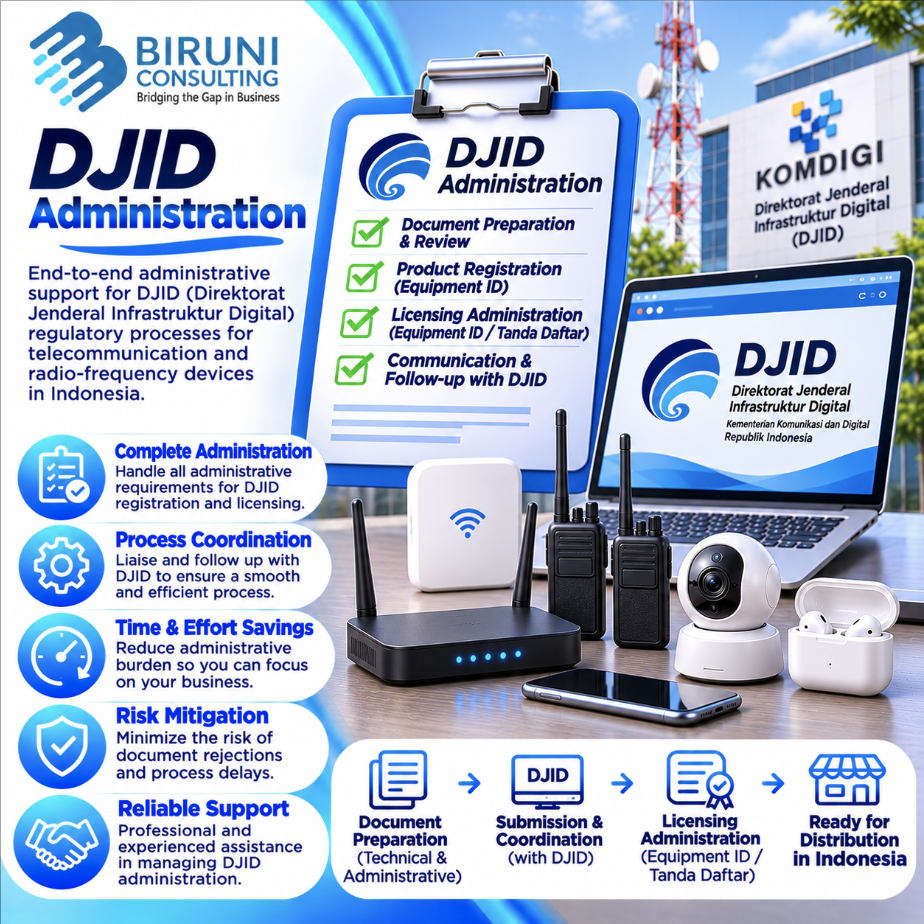
DJID/SDPPI Certification services for telecommunications equipment and wireless products in Indonesia
DJID certification services generally cover the process of obtaining Indonesian telecommunications-equipment certification for products that will be manufactured, assembled, imported, marketed, or used in Indonesia.
The terms Postel and SDPPI remain widely used commercially, while newly issued Certificates now use the DJID — Directorate General of Digital Infrastructure nomenclature.
Regulation Number 3 of 2024 requires telecommunications equipment manufactured, assembled, or imported for trade and/or use in Indonesia to comply with applicable Technical Standards. Compliance is established through testing and demonstrated by a Certificate. JDIH Kemkomdigi
The official e-Sertifikasi database also shows that newly issued Certificates in November 2026 use /DJID/2026 numbering. e-Sertifikasi
What Does DJID Certification Processing Cover?
The process involves more than submitting an application.
The first step is determining whether the exact product falls within the certification framework, identifying the applicable Technical Standards, mapping every radio interface, and determining whether existing laboratory reports can support the application.
Bluetooth, WiFi/RLAN, cellular, Short Range Devices, NFC, Zigbee, Thread, and proprietary RF systems can require different technical assessments.
Products That May Require DJID Certification
DJID Certification is not limited to smartphones and routers.
The current public Certificate database includes CPE equipment, wireless earphones, routers, modules, gaming controllers, smart switches, wireless keyboards, Bluetooth printers, and many other connected products. e-Sertifikasi
Consumer appliances, industrial products, toys, computer peripherals, IoT equipment, and automotive electronics can therefore require DJID assessment when relevant telecommunications functions are incorporated.
Pre-Certification Assessment
An effective project begins by identifying the exact commercial configuration.
The brand, model, manufacturer, manufacturing country, radio module, antennas, operating frequencies, transmitter power, firmware, and supported radio modes should be compared with the technical documentation and laboratory reports.
Regulation Number 3 of 2024 establishes conformity according to brand, equipment type, and manufacturing country. The same brand and type manufactured in different countries require separate certification evidence. JDIH Kemkomdigi
Manufacturing origin should therefore be confirmed before submission.
Applicant and OSS Structure
Business applications are submitted through OSS integrated with the certification service system. JDIH Kemkomdigi
Current e-Sertifikasi guidance recognises applicants including Indonesian trademark holders, representatives or distributors of trademark holders, manufacturers or assemblers, and businesses using equipment for their own purposes. e-Sertifikasi
The applicant role should therefore be established before certification documents are prepared.
DJID Certification Documents
Current general requirements for a new business application include:
- NIB and OSS access.
- LHU or laboratory test report.
- Technical specifications.
- Declaration of Conformity.
- Colour photographs showing the brand and model/type.
- Declaration that submitted information and documents are correct and complete. e-Sertifikasi
Additional documentation can apply depending on the applicant and product category.
For example, an Indonesian company officially appointed to represent or distribute a foreign-owned trademark needs the applicable appointment letter. e-Sertifikasi
Laboratory Report Review
The LHU/test report is a central certification document.
Regulation Number 3 of 2024 provides for testing by designated domestic or overseas laboratories in accordance with the applicable framework. JDIH Kemkomdigi Current e-Sertifikasi guidance requires an LHU from a designated Indonesian laboratory or recognised overseas laboratory. e-Sertifikasi
The report should be reviewed for the exact model, operating frequencies, transmission power, antennas, radio modes, laboratory status, test methods, and applicable Indonesian Technical Standards.
CE or FCC documentation can assist the assessment but does not automatically replace DJID Certification.
Using Module Test Reports
Many products incorporate Bluetooth, WiFi, cellular, or other pre-developed radio modules.
Where a module LHU is used, current e-Sertifikasi requirements include a block diagram, photographs showing the module location in the final equipment, and a declaration connecting the module brand/type to the final product brand, type, and variant. e-Sertifikasi
An existing module report therefore does not automatically cover every final device using the same wireless component.
Antennas, firmware, output settings, and final integration remain relevant.
OEM and Private-Label Products
OEM and private-label certification requires careful mapping between the tested equipment and final commercial model.
One factory may use similar hardware for several brands, while each commercial product has its own model identity and applicant arrangement.
The certification structure should clearly establish:
applicant → trademark owner → manufacturer → manufacturing country → model → RF configuration → laboratory report.
This helps identify model or documentation gaps before an application is submitted.
DJID Certification Process
The process normally begins with product and RF assessment, followed by review of the applicable Technical Standards, laboratory reports, applicant structure, brand/model information, and supporting documents.
Where existing reports are suitable, the certification documentation can be prepared for submission. Where gaps exist, additional documentation, technical clarification, or further testing may be required.
Business applications are then submitted through OSS and e-Sertifikasi under the current certification framework. e-Sertifikasi
Certificate Administrative Changes
DJID work can also involve administrative changes to existing Certificates.
Current e-Sertifikasi guidance provides procedures for changes to the Certificate holder’s name or address. Business applicants are instructed to ensure that the corresponding OSS information has already been updated. e-Sertifikasi
This can be relevant following a corporate-name change, relocation, or restructuring.
Labeling After Certification
Compliance work continues after Certificate issuance.
Current e-Sertifikasi requirements state that Certificate holders must implement the required Label, QR Code, and Warning Sign on the equipment and packaging and report implementation by uploading photographs of the marked product. The portal currently specifies a reporting deadline of 30 working days from Certificate issuance. e-Sertifikasi
Regulatory artwork should therefore ideally be planned before mass production.
DJID Today
DJID stands for the Directorate General of Digital Infrastructure within Indonesia’s Ministry of Communication and Digital.
Within DJID, the Directorate of Digital Infrastructure Services handles functions that include radio-frequency spectrum licensing and certification of telecommunications equipment and digital devices. Infradigital
The official e-Sertifikasi database available on November 14, 2026 shows current Certificates using /DJID/2026 numbering. e-Sertifikasi
Although Postel and SDPPI remain common market terminology, DJID is now the current institutional nomenclature.
Why Pre-Import Assessment Matters
A global product family may contain different regional models, radio modules, antennas, firmware, transmission settings, or manufacturing countries.
Products with the same marketing name are therefore not necessarily technically identical.
Completing the DJID assessment before a purchase order or commercial shipment helps identify whether the available test reports and supporting documents correspond to the exact product that will be imported.
Conclusion
DJID certification services help ensure that telecommunications equipment and wireless products comply with the applicable Indonesian Technical Standards and certification requirements.
Regulation Number 3 of 2024 requires covered equipment to comply with the applicable Technical Standards through testing and certification. JDIH Kemkomdigi For business applicants, the current process uses OSS and e-Sertifikasi and requires documentation including NIB, laboratory reports, technical specifications, a Declaration of Conformity, and product photographs. e-Sertifikasi
An effective certification project should begin by reviewing the exact model, radio technologies, operating frequencies, transmission power, modules, antennas, manufacturer, manufacturing country, applicant structure, and laboratory evidence before submission or importation.
Contact Us
Biruni Consulting assists with DJID/SDPPI assessment and certification for telecommunications equipment and various wireless products that will be imported or marketed in Indonesia.
Our services include:
- Assessment of DJID/SDPPI certification requirements.
- Transmitter and receiver assessment.
- RF specification review.
- Frequency and transmission power analysis.
- Technical document review.
- Certification document preparation.
- Testing coordination where required.
- DJID/SDPPI Certification assistance.
If you have a telecommunications device or wireless product, you can prepare product photos, brand, model, datasheet, RF specifications, and wireless module datasheet for an initial assessment of the Postel Certification requirements.