
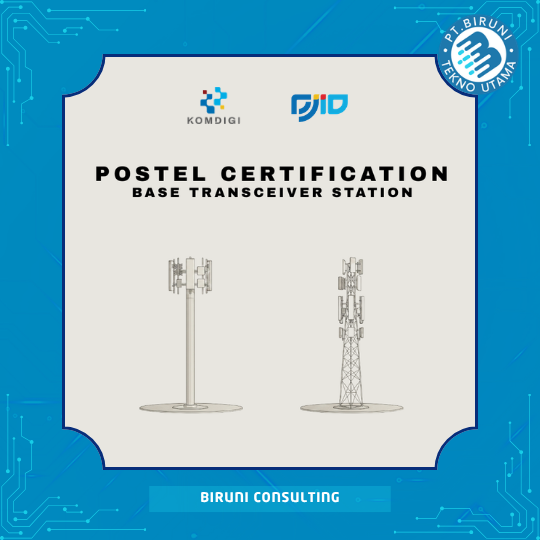
Guide to Base Transceiver Station (BTS) Postel Certification in Indonesia
A Base Transceiver Station (BTS) is a critical telecommunications infrastructure device that enables wireless communication between user equipment, such as smartphones, mobile phones, wireless modems, and the cellular network operated by mobile service providers. BTS equipment is responsible for transmitting and receiving radio signals that support voice calls, SMS, mobile broadband, and wireless data services across 2G, 3G, 4G LTE, and 5G networks.
Since BTS equipment operates using licensed radio frequency spectrum, it is subject to Indonesia’s telecommunications regulations. Manufacturers, importers, network operators, and infrastructure providers must ensure that Base Transceiver Station equipment complies with applicable technical standards and obtains DJID (formerly Postel/SDPPI) Certification before deployment or commercial distribution in Indonesia.
Understanding the certification process at an early stage helps companies accelerate regulatory approval, minimize project delays, and ensure compliance with Indonesian telecommunications requirements.
What Is a Base Transceiver Station (BTS)?
A Base Transceiver Station is a radio communication system forming part of a cellular network’s Radio Access Network (RAN). It provides wireless connectivity between mobile subscriber devices and the operator’s core network by transmitting and receiving radio signals within licensed frequency bands.
A BTS typically consists of radio transceivers, antennas, radio frequency amplifiers, filters, baseband processing units, transmission equipment, synchronization systems, and power supply components that work together to deliver reliable mobile communication services.
Modern BTS equipment supports multiple wireless technologies, including GSM, UMTS, LTE, LTE-Advanced, and 5G New Radio (NR), allowing operators to provide high-speed mobile connectivity and efficient spectrum utilization.
Does a Base Transceiver Station Require DJID (Postel) Certification?
Yes. Because a Base Transceiver Station transmits and receives radio frequency signals, it is generally mandatory to obtain DJID (Postel) certification before the equipment can be imported, installed, marketed, or operated in Indonesia.
During the certification process, DJID evaluates the product’s technical specifications, radio frequency characteristics, communication performance, electromagnetic compatibility, and compliance with Indonesian telecommunications standards.
In addition to equipment certification, BTS deployment must also comply with Indonesian spectrum licensing regulations applicable to telecommunications network operators.
Base Transceiver Station Certification Requirements
Companies applying for BTS certification generally prepare both administrative and technical documentation, including:
- Company legal documents.
- Business Identification Number (NIB).
- Technical product specifications.
- User Manual.
- Product Datasheet.
- Product Label.
- Product Photographs.
- System architecture and block diagrams.
- Accredited laboratory test reports.
- Additional supporting documentation required by DJID regulations.
Preparing complete documentation significantly improves certification efficiency and reduces unnecessary delays.
Base Transceiver Station Certification Process
The certification process begins by identifying the BTS category and supported wireless technologies, such as GSM, WCDMA, LTE, LTE-Advanced, or 5G NR.
Technical documentation is reviewed before laboratory testing is conducted where required. Testing may include Radio Frequency (RF), Electromagnetic Compatibility (EMC), Electrical Safety, protocol verification, and other applicable technical evaluations according to Indonesian regulations.
Once all technical and administrative requirements have been successfully fulfilled, DJID issues the certification authorizing legal commercialization and deployment of the BTS equipment in Indonesia.
Benefits of Base Transceiver Station Certification
Obtaining DJID certification provides significant advantages for manufacturers, telecommunications operators, and infrastructure vendors.
Key benefits include:
- Compliance with Indonesian telecommunications regulations.
- Support for importation and commercial distribution.
- Verification of technical conformity.
- Compatibility with Indonesian mobile networks.
- Reduced regulatory risks.
- Increased confidence among customers and business partners.
Certification also demonstrates commitment to product quality, network reliability, and long-term regulatory compliance.
Types of Base Transceiver Station Equipment That Commonly Require Certification
Examples of BTS equipment that commonly require DJID certification include:
- GSM Base Transceiver Stations.
- UMTS Base Stations.
- LTE eNodeB Systems.
- 5G gNodeB Systems.
- Indoor Base Stations.
- Outdoor Base Stations.
- Small Cell Base Stations.
- Micro Cell Base Stations.
- Pico Cell Base Stations.
- Remote Radio Units (RRU).
- Remote Radio Heads (RRH).
- Radio Access Network (RAN) Equipment.
- Baseband Units (BBU) with radio communication functionality.
- Other wireless telecommunications infrastructure equipment regulated in Indonesia.
Certification requirements vary depending on the equipment’s wireless technology, transmission capability, and applicable Indonesian technical regulations.
Contact Us
Biruni Consulting provides professional consulting services for DJID (Postel) certification of Base Transceiver Station equipment and other telecommunications infrastructure products in Indonesia.
We assist companies with:
- BTS regulatory analysis.
- Identification of applicable DJID certification requirements.
- Preparation of technical and administrative documentation.
- Coordination with accredited testing laboratories.
- End-to-end certification support until approval is granted.
With extensive experience in Indonesian telecommunications certification, we help manufacturers, importers, infrastructure vendors, and mobile network operators obtain certification efficiently while ensuring full regulatory compliance.
Contact us today for professional consultation regarding Base Transceiver Station (BTS) Postel certification and telecommunications equipment approval requirements in Indonesia.