
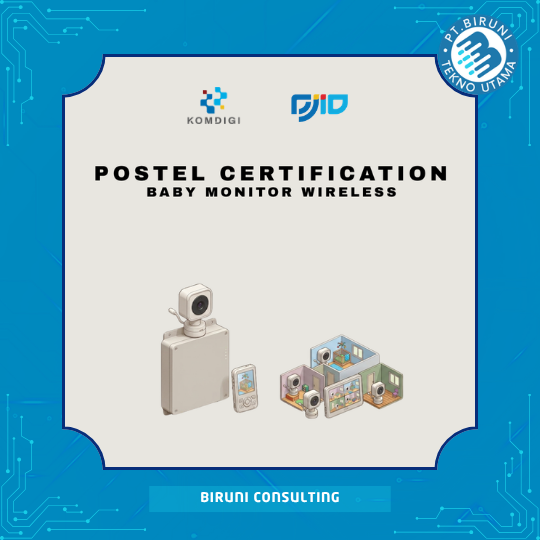
Guide to Baby Monitor Wireless Product Licensing in Indonesia
A Baby Monitor Wireless is an electronic monitoring device designed to help parents observe and monitor their baby remotely through wireless communication technology. A typical system consists of a camera or transmitter installed near the baby and a receiver or mobile application that allows parents to watch live video, listen to audio, and monitor their child’s condition from another room or even from a remote location through an internet connection.
Modern Baby Monitor Wireless products are increasingly equipped with wireless technologies such as WiFi, Bluetooth, DECT, and even cellular connectivity. Since these devices utilize radio communication technologies, they are generally subject to Indonesian telecommunications regulations and may require DJID (formerly Postel/SDPPI) Certification before they can be legally imported, distributed, or sold in Indonesia.
Manufacturers, importers, and distributors should identify the applicable regulatory requirements early in the product registration process to ensure smooth market entry and compliance with Indonesian technical standards.
What Is a Baby Monitor Wireless?
A Baby Monitor Wireless is a wireless monitoring system that transmits audio, video, or both from a baby’s room to a receiver or mobile device. It enables parents and caregivers to supervise infants without remaining physically present in the same room.
Today’s Baby Monitor Wireless products often include high-definition cameras, night vision, temperature monitoring, motion detection, crying detection, two-way audio communication, cloud recording, smartphone applications, and integration with smart home ecosystems.
Because these products incorporate wireless communication modules, they must be evaluated for compliance with Indonesian telecommunications regulations before commercial distribution.
Certifications Required for Baby Monitor Wireless Products
Certification requirements depend on the product’s technical specifications and communication technologies. In many cases, Baby Monitor Wireless products may require:
- DJID (Postel) Certification for WiFi, Bluetooth, DECT, Zigbee, Thread, NFC, or other wireless communication technologies.
- SNI Certification if the product falls under mandatory Indonesian National Standard regulations.
- TKDN compliance where required by government policy.
- EMC and Electrical Safety testing according to applicable technical standards.
- Import permits and supporting regulatory documentation where applicable.
Determining the applicable certification requirements early helps companies reduce approval time and avoid regulatory issues.
DJID (Postel) Certification for Baby Monitor Wireless
Most Baby Monitor Wireless devices utilize wireless communication technologies for transmitting audio and video, making DJID certification generally necessary before the products can be legally marketed in Indonesia.
The certification process includes technical document review, product specification evaluation, laboratory testing where applicable, and administrative assessment under DJID regulations. The objective is to ensure that wireless communication functions comply with Indonesian technical standards and do not interfere with other telecommunications equipment.
If the device supports multiple communication technologies such as WiFi and Bluetooth, each wireless interface is typically included within the certification assessment.
Common Documentation Requirements
Companies applying for Baby Monitor Wireless licensing generally prepare documentation including:
- Company legal documents.
- Business Identification Number (NIB).
- Technical product specifications.
- User Manual.
- Product Datasheet.
- Product Label.
- Product Photographs.
- Block diagrams and circuit schematics.
- Accredited laboratory test reports where applicable.
- Additional supporting documents required by Indonesian regulations.
Complete documentation contributes significantly to an efficient certification process.
Baby Monitor Wireless Licensing Process
The licensing process begins by identifying the product category and applicable regulatory requirements.
Technical documentation is reviewed before laboratory testing is conducted where required. Test reports and supporting documents are then submitted to DJID and other relevant authorities for evaluation.
Following successful technical and administrative assessment, certification is issued, allowing the product to be legally imported and marketed in Indonesia.
Certification timelines vary depending on product complexity, wireless technologies, laboratory testing requirements, and document completeness.
Why Product Licensing Is Important
Proper licensing confirms that Baby Monitor Wireless products comply with Indonesian technical and regulatory requirements before entering the market.
Regulatory compliance facilitates product importation, improves customer confidence, supports nationwide distribution, minimizes regulatory risks, and strengthens a company’s reputation in Indonesia’s growing consumer electronics market.
Obtaining certification early also helps companies accelerate product launches while ensuring full compliance with national telecommunications regulations.
Contact Us
Biruni Consulting provides professional consulting services for Baby Monitor Wireless licensing and certification in Indonesia.
We assist companies with:
- Regulatory analysis for Baby Monitor Wireless products.
- Identification of applicable DJID (Postel), SNI, TKDN, and other certification requirements.
- Preparation of technical and administrative documentation.
- Coordination with accredited testing laboratories.
- End-to-end licensing support until certification is completed.
With extensive experience in Indonesian telecommunications and product certification, we help manufacturers, importers, and distributors obtain approvals efficiently while ensuring full regulatory compliance.
Contact us today for professional consultation regarding Baby Monitor Wireless licensing and certification requirements in Indonesia