
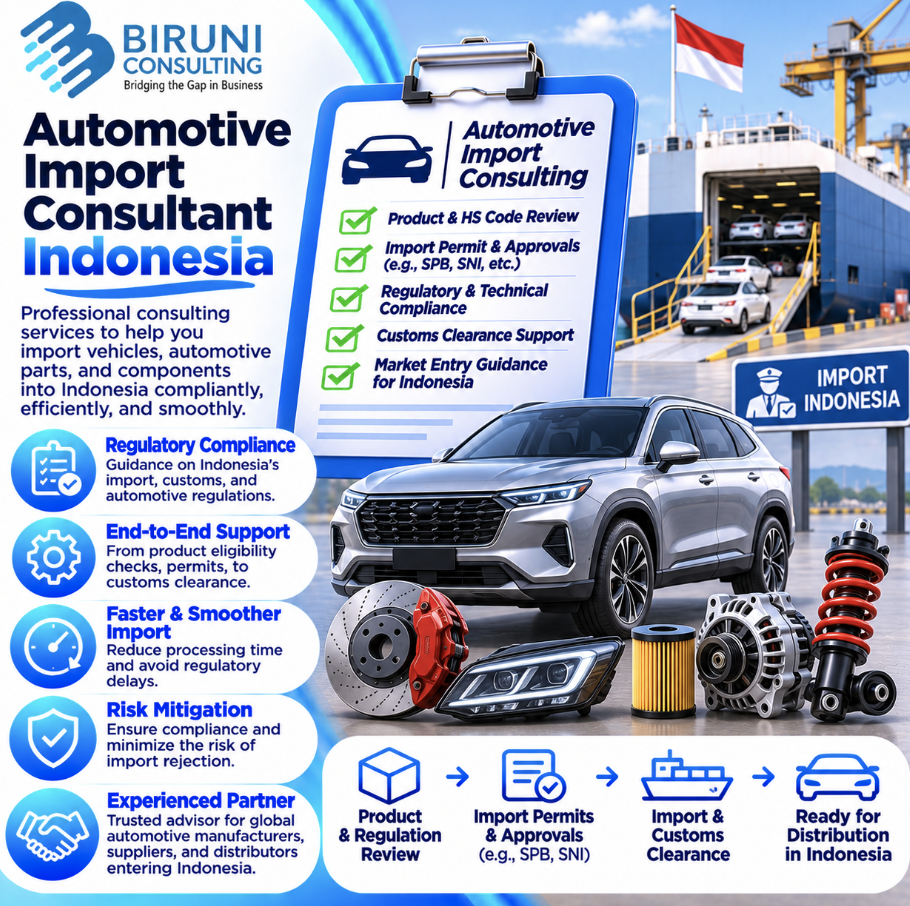
Automotive Import Consulting Services for Overseas Manufacturers
Automotive Import Consultant Indonesia helps Overseas Manufacturers, brand owners, component suppliers, and automotive companies plan Indonesian importation by connecting Importer eligibility, Business Licensing, customs, HS classification, SNI, Official Representatives, SIINas, LSPro, laboratory testing, and pre-shipment compliance.
Importing automotive products should not begin simply by selecting a freight forwarder or an Indonesian company willing to appear as the Importer. Under the current general import framework, an Importer is required to hold an NIB functioning as API. Minister of Trade Regulation No. 16 of 2025 became effective on August 29, 2025, and the framework has subsequently been amended, including through Minister of Trade Regulation No. 18 of 2026, the second amendment effective June 4, 2026. Database Peraturan | JDIH BPK
Automotive products can also be subject to separate product regulations. Tires, motor-vehicle safety glass, and lubricating oil are examples of categories currently governed by specific Mandatory SNI regulations. Database Peraturan | JDIH BPK
An Automotive Import Consultant Indonesia project should therefore begin with regulatory assessment before purchase orders, production allocation, and commercial shipment are finalized.
What Is an Automotive Import Consultant Indonesia?
An Automotive Import Consultant Indonesia helps companies understand and coordinate the regulatory pathway for importing vehicles, automotive components, spare parts, accessories, lubricants, and related products into Indonesia.
The consultant can help connect workstreams that are otherwise often handled separately, including import licensing, customs, product certification, local representation, and shipping documentation.
A consultant does not replace the regulator, Indonesia Customs, the Importer, LSPro, or Testing Laboratory. Each performs a different legal or conformity-assessment function.
Why Do Automotive Imports Require Regulatory Assessment?
Automotive portfolios can be extremely complex.
One manufacturer can operate thousands of part numbers, several manufacturing facilities, multiple trademarks, and different distribution channels.
Products can include:
- tires;
- safety glass;
- lubricants;
- brake components;
- filters;
- suspension components;
- bearings;
- hoses;
- engine parts;
- electrical components;
- electronic modules;
- sensors;
- aftermarket accessories; and
- other replacement parts.
Those products should not automatically be placed under one regulatory pathway.
Product Classification
Regulatory analysis begins by identifying the actual product.
The manufacturer should generally prepare:
- Product name.
- Intended use.
- Brand.
- Model or part number.
- Technical specifications.
- Materials or formulation.
- Manufacturing site.
- Manufacturing country.
- Proposed HS code.
- Existing Certificates and test reports.
A description such as “automotive spare part” is normally too broad for a complete Indonesian regulatory assessment.
HS Code Assessment
HS classification is important because it can affect tariffs, customs declarations, import restrictions, and additional documentation.
However, HS code alone does not establish the entire product-compliance pathway.
A Mandatory SNI regulation can rely on product definitions, technical characteristics, standards, intended uses, and tariff classification together.
A proper automotive import assessment should therefore go beyond an HS-code lookup.
Indonesian Importer
Commercial importation requires an Indonesian entity eligible to act as Importer.
Minister of Trade Regulation No. 16 of 2025 expressly requires an Importer to hold an NIB functioning as API, while API serves as the identification for the Importer function. Database Peraturan | JDIH BPK
A Distributor Agreement, manufacturer authorization, or Letter of Appointment does not itself establish Importer eligibility.
The proposed Importer should therefore undergo due diligence.
NIB Functioning as API
NIB/API is a fundamental part of the Importer structure.
However, checking that an Indonesian company has an NIB should not be the end of the assessment.
The manufacturer should establish whether the company has:
- an NIB functioning as API;
- appropriate Business Licensing;
- Customs Access;
- customs operational capability;
- understanding of relevant product restrictions; and
- adequate document controls.
Customs Access
Indonesia Customs explains that Importers are treated as satisfying Customs Registration requirements after holding an NIB functioning as TDP, API, and Customs Access. Customs Registration information is integrated with NIB information in OSS and Indonesian tax data. Beacukai
A manufacturer should therefore distinguish between a company that merely has an NIB and a company that is genuinely ready to operate as an Importer.
Business Licensing
The Importer also needs Business Licensing appropriate to its actual operations.
Government Regulation No. 28 of 2025 is Indonesia’s current Risk-Based Business Licensing framework. It became effective on June 5, 2025, revoked Government Regulation No. 5 of 2021, and covers Business Licensing, PB UMKU, OSS, supervision, evaluation, and sanctions. Database Peraturan | JDIH BPK
Where one company conducts importation, distribution, wholesale activities, warehousing, and other operations, those activities need to be mapped appropriately.
KBLI
KBLI classification forms part of Business Licensing analysis.
An Automotive Import Consultant should not merely confirm that a company describes itself as a trading business.
The actual activities need to correspond with appropriate business classifications and licensing.
Product-specific regulations can also use business classifications as eligibility requirements.
Current Import Regulations
Minister of Trade Regulation No. 16 of 2025 has applied since August 29, 2025. The framework has since been amended, including through Regulation No. 18 of 2026 as its second amendment. Database Peraturan | JDIH BPK
Regulation No. 18 of 2026 amended areas including Import Business Licensing, extensions of Import Approvals, Surveyor Reports, Import Customs Declaration documentation, import-realization reporting, and administrative sanctions. Database Peraturan | JDIH BPK
Automotive import planning should therefore rely on current requirements rather than legacy import checklists.
PIB
Imports for Use generally involve a PIB or Import Customs Declaration.
Indonesia Customs defines the PIB as a customs declaration prepared to fulfil import customs obligations. Beacukai
An Automotive Import Consultant can help ensure that product and regulatory data are consistent before the Importer prepares the customs declaration.
Supporting Customs Documents
Indonesia Customs identifies Supporting Customs Documents as including the Invoice, Packing List, Bill of Lading or Air Waybill, product-identification documents, evidence of compliance with import requirements, and other documents where required. Beacukai
For automotive shipments containing many SKUs, consistency between regulatory master data and shipping documentation becomes particularly important.
Customs Duties and Import Taxes
Importers should calculate landed cost after classification and applicable tariff treatment have been reviewed.
Customs cost can include Customs Duty and applicable Import Taxes.
A manufacturer should therefore avoid finalizing Indonesian selling prices solely from factory price and freight before the import classification is reasonably established.
Prohibitions and Restrictions
Indonesia Customs explains that an Importer conducting Imports for Use needs to submit the applicable customs documentation, satisfy applicable duty and tax obligations, and meet relevant prohibitions and restrictions. Website Bea Cukai Tual
Holding NIB/API therefore does not mean every automotive product can be imported without further requirements.
Specified products can remain subject to Import Approvals, Surveyor Reports, product certification, or other controls.
Goods Prohibited for Import
Minister of Trade Regulation No. 47 of 2025 concerning Goods Prohibited for Import became effective on January 1, 2026 and replaced the previous prohibited-import framework. Database Peraturan | JDIH BPK
This can be particularly relevant where a company intends to import used automotive goods or components in particular conditions.
New and used products should not automatically be assumed to follow the same pathway.
Mandatory SNI Assessment
One of the most important Automotive Import Consultant Indonesia services is determining whether a product falls within a Mandatory SNI scope.
Not every automotive part requires Mandatory SNI certification.
The Ministry of Industry explains that Mandatory SNI refers to standards made compulsory by government regulation, and applications for Ministry of Industry Mandatory SNI products are submitted through SIINas. BBSPJIKKP
The correct question is therefore not merely:
“Is there an SNI for this product?”
It is:
“Has that SNI been made mandatory for this exact product?”
SNI for Tires
Tires provide a clear automotive Mandatory SNI example.
Minister of Industry Regulation No. 9 of 2025 makes SNI mandatory for tires, has applied since July 24, 2025, and remains in force. Database Peraturan | JDIH BPK
A tire manufacturer or Importer should establish the product category, certification status, manufacturing site, models, and local-party structure before commercial shipment.
SNI for Motor-Vehicle Safety Glass
Motor-vehicle safety glass has a separate Mandatory SNI framework under Minister of Industry Regulation No. 15 of 2025.
The regulation became effective on October 25, 2025 and remains in force. It addresses Mandatory SNI scope, conformity assessment, responsibilities, transitional provisions, and related requirements. Database Peraturan | JDIH BPK
Windshields and other safety-glass products should therefore undergo Indonesian regulatory assessment rather than relying only on overseas test reports.
SNI for Lubricating Oil
Lubricating oil also operates under a separate Mandatory SNI framework.
Minister of Industry Regulation No. 8 of 2025 became effective on July 24, 2025 and remains in force. Database Peraturan | JDIH BPK
Manufacturers of engine oils, motorcycle lubricants, diesel lubricants, transmission oils, and related products need to establish the correct product classification and application before certification begins.
Motorcycle Helmets and the Automotive Aftermarket
Motorcycle helmets also have a Mandatory SNI framework under Minister of Industry Regulation No. 59 of 2024, which remains in force. Database Peraturan | JDIH BPK
Although helmets are not mechanical vehicle components, motorcycle-accessory Importers should include them in product-compliance planning.
Automotive Components Outside Mandatory SNI
Brake components, bearings, filters, hoses, suspension components, body parts, engine components, electrical parts, and other automotive products should not automatically be treated as Mandatory SNI products.
They should also not automatically be considered unregulated.
A product assessment can determine that:
- Mandatory SNI applies;
- SNI exists but is voluntary;
- no product-specific Mandatory SNI applies;
- another Indonesian approval applies; or
- further classification is required.
This avoids both unnecessary certification and under-compliance.
SNI Certification and Importation Are Separate Workstreams
A frequent mistake is assuming that an SNI Certificate completes the import process.
It does not.
SNI readiness can involve the LSPro, SIINas, testing, factory assessment, Certificates, marking, and surveillance.
Importer readiness involves NIB/API, Business Licensing, Customs Access, Import Licensing, customs documents, and applicable restrictions.
The two workstreams should progress in parallel.
SIINas
SIINas or the National Industrial Information System plays an important role in Ministry of Industry Mandatory SNI certification.
The Ministry of Industry states that applications for products within its Mandatory SNI schemes are processed through SIINas. BBSPJIKKP
Ministry guidance also shows Overseas Manufacturers using an Official Representative within the Mandatory SNI certification structure where applicable. Kemenperin
SIINas planning should therefore begin early.
Official Representative
Certain product-specific schemes require an Overseas Manufacturer to maintain an Official Representative in Indonesia.
The Representative can be involved in:
- SIINas;
- certification administration;
- trademark documentation;
- communication with the LSPro;
- warehousing requirements;
- Importer coordination; and
- continuing regulatory administration.
The exact role remains product specific.
The Representative Is Not the Same as the Importer
The Official Representative and Importer are not automatically the same entity.
The Representative performs a role arising from product-specific regulation.
The Importer performs importation and needs to meet Indonesia’s general import and customs requirements.
Where the Representative will also import, it still needs the appropriate NIB/API, Business Licensing, and Customs Access. Database Peraturan | JDIH BPK
The Importer Is Not Automatically the Representative
The reverse is also true.
An Indonesian company holding NIB/API and Customs Access does not automatically become the Official Representative.
Manufacturer appointment and applicable product-regulation eligibility still need to be established.
Distributor Is Different from Importer
The Distributor focuses on domestic commercial distribution.
The Importer focuses on importation.
Possible structures can include:
Overseas Manufacturer → Importer → Distributor
or:
Overseas Manufacturer → Official Representative → Importer → Distributor
or:
Overseas Manufacturer → Official Representative + Importer + Distributor
The available structure depends on the applicable product regulation, Business Licensing, and commercial strategy.
SNI Certificate Holder
The Automotive Import Consultant should also help determine the SNI Certificate ownership structure.
The Importer is not automatically the SNI Certificate Holder.
The Official Representative is not automatically the Certificate Holder either.
Certificate ownership is determined by the applicable product regulation and conformity-assessment scheme.
This should be established before the manufacturer signs long-term Importer or Distributor agreements.
SPPT SNI
The SNI Certificate should also be distinguished from SPPT SNI.
Under applicable Ministry of Industry schemes, the SNI Certificate results from conformity assessment, while SPPT SNI concerns approval to use the SNI Mark.
The manufacturer should identify:
- SNI Certificate Holder.
- Official Representative.
- SPPT SNI party.
- Importer.
- Distributor.
Those functions can be allocated differently.
LSPro
An LSPro or Product Certification Body performs conformity assessment under its applicable scope.
The Ministry of Industry explains that product certification assesses whether a company has implemented an appropriate quality system and is capable of consistently producing products in conformity with the applicable standard. Qualifying companies receive a Product Certificate from the LSPro. BBSPJIKKP
The consultant can coordinate the certification project but does not replace the LSPro.
Selecting the LSPro
LSPro selection should be based on the relevant product and standard.
The manufacturer should review:
- accreditation;
- regulator designation where required;
- product scope;
- testing arrangements;
- Overseas Manufacturer experience; and
- factory-audit capabilities.
Current Ministry of Industry guidance specifically recommends checking the LSPro’s accreditation scope and, for Mandatory SNI, any required regulator designation. BSPJI Pontianak
Laboratory Testing
The testing pathway should be determined after the applicable standard and LSPro are known.
Existing international reports can first undergo a test-report gap analysis considering:
- test standard;
- methods;
- parameters;
- laboratory status;
- sample identity;
- manufacturing site;
- models; and
- configuration.
This can reduce unnecessary testing while identifying evidence that cannot support the intended Indonesian certification.
Factory Audit
Depending on the product and scheme, certification can involve document review, audits, sampling, testing, review, and a certification decision. BSPJI Pontianak
Where factory assessment applies, the manufacturer should prepare relevant production and quality controls.
Audit preparation can cover incoming inspection, production processes, calibration, testing equipment, final inspection, nonconforming-product controls, traceability, corrective action, and quality records.
ISO 9001 and IATF 16949
Many automotive manufacturers already maintain ISO 9001 or IATF 16949 certification.
These can support factory readiness and demonstrate quality-management maturity.
They do not automatically replace Indonesian product certification where Mandatory SNI applies.
Manufacturing Site
The manufacturing site is an important element of regulatory assessment.
The same model can be produced at several factories, but an Indonesian approval should not automatically be assumed to cover every production location.
A factory matrix should therefore form part of the initial project information.
Multiple Manufacturing Sites
The factory matrix can identify:
- Factory legal name.
- Factory address.
- Country.
- Products or models.
- Existing Certificates.
- Testing status.
- Indonesian approval status.
A change in production source should undergo regulatory impact assessment before shipments from a new factory begin.
Multiple Models and Part Numbers
Automotive companies can manage hundreds or thousands of SKUs.
A product master matrix can link:
- part number;
- model;
- product family;
- HS classification;
- manufacturing site;
- Mandatory SNI status;
- Certificate;
- Importer;
- sales channel; and
- launch status.
This helps prevent products that are not yet compliant from entering commercial shipments.
OEM Automotive Components
OEM components still require product-specific assessment.
Supply to a vehicle assembly plant does not itself create a universal exemption from import or product-certification requirements.
The applicable regulation should be reviewed for any industrial-input mechanism, special treatment, or specific exemption.
Aftermarket Automotive Components
Aftermarket components can be sold through Distributors, dealers, workshops, retailers, and marketplaces.
The sales channel does not determine whether a mandatory product requirement applies.
If the product falls within a Mandatory SNI scope, that requirement remains relevant for aftermarket sales.
Automotive Electronics
Modern automotive components increasingly contain wireless and electronic functions.
Telematics units, connected head units, wireless cameras, GPS trackers, smart sensors, and radio-enabled products can require regulatory review beyond traditional automotive product rules.
The consultant should therefore assess technical functionality rather than relying only on the product’s automotive marketing category.
Batteries and Electrical Products
Battery systems, chargers, lighting products, converters, and other electrical components can also involve separate regulatory layers.
The manufacturer should provide full specifications so the assessment is not limited to a commercial catalogue description.
New and Used Automotive Products
New and used products should be assessed separately.
Minister of Trade Regulation No. 47 of 2025 concerning Goods Prohibited for Import has applied since January 1, 2026. Database Peraturan | JDIH BPK
The Importer should therefore assess product condition, HS classification, intended use, and import restrictions before shipping used automotive components.
Commercial Invoice
The Commercial Invoice should accurately describe the actual goods.
Generic descriptions such as “automotive parts” may be insufficient where the individual components can be identified more precisely.
Part numbers, models, brands, manufacturers, quantities, country of origin, and other relevant information should remain consistent across the shipment documentation.
Packing List
The Packing List should also correspond with regulatory master data.
For mixed-SKU shipments, regulatory status can be reviewed before cargo consolidation.
This helps prevent products still undergoing compliance work from being shipped together with approved goods.
Bill of Lading or Air Waybill
Importer and consignee arrangements should ideally be finalized before transportation documents are issued.
Changing the Importer after shipment can create additional customs and regulatory complexity.
Where a certification or Official Representative structure is also involved, the impact can extend beyond shipping documentation.
Country of Origin
Country of origin is different from the country of shipment.
The trademark owner can be located in one country, the goods can ship from another, and the production facility can be in a third.
Customs and certification records should use consistent actual manufacturing data.
Product Labeling
Labeling should be reviewed before mass packaging production.
Applicable requirements can arise from:
- Mandatory SNI regulations;
- product marking;
- consumer information;
- product-specific rules; or
- other Indonesian requirements.
Correcting artwork before printing is generally more efficient than relabeling commercial inventory.
Sample Importation
Certification can require samples for formal testing.
Samples should ideally be dispatched only after the LSPro, applicable standard, laboratory pathway, model, and manufacturing site have been confirmed.
Sending samples too early can result in testing the wrong configuration or using the wrong certification pathway.
Do Not Ship Commercial Goods Too Early
Commercial shipments should not begin simply because an Importer has been identified.
Where Mandatory SNI applies, Importer readiness does not replace certification.
Likewise, a product Certificate does not replace Importer and customs requirements.
Both workstreams need to be ready.
Pre-Shipment Compliance Review
A pre-shipment review can cover:
- HS classification.
- Importer eligibility.
- NIB/API.
- Customs Access.
- Business Licensing.
- Import restrictions.
- Mandatory SNI status.
- Certificate and SPPT SNI where applicable.
- Official Representative structure.
- Models and manufacturing sites.
- Product labeling.
- Invoice and Packing List.
Indonesia Customs treats customs documentation, applicable duties and taxes, and prohibitions and restrictions as core obligations for Imports for Use. Website Bea Cukai Tual
Importer Due Diligence
An Automotive Import Consultant can support due diligence on the proposed Importer.
Areas can include:
- legal entity;
- NIB/API;
- Business Licensing;
- Customs Access;
- product experience;
- compliance resources;
- warehousing and logistics;
- documentation capability;
- regulatory cooperation; and
- transition mechanisms.
Importer selection should not be based solely on customs-clearance price.
Distributor Due Diligence
Distributor evaluation has a different focus.
Manufacturers can assess:
- sales network;
- dealer coverage;
- warehousing;
- automotive experience;
- technical support;
- after-sales capability;
- financial stability;
- regulatory cooperation.
The strongest Distributor may not necessarily be the most suitable Importer or Official Representative.
Regulatory Ownership
An Overseas Manufacturer should establish a regulatory ownership map before market entry.
Important questions include:
- Who holds the SNI Certificate?
- Who acts as Official Representative?
- Who controls SIINas?
- Who manages SPPT SNI?
- Who is the Importer?
- Who is the Distributor?
- Who owns the trademark?
- Who retains test reports?
- Who manages surveillance?
- What happens when a commercial partner changes?
Clear ownership helps preserve long-term market flexibility.
Changing the Importer
An Importer can change because of pricing, commercial performance, supply-chain strategy, or other reasons.
However, replacing the Importer should not be treated only as a contractual change.
The manufacturer should assess whether Importer information appears in Certificates, appointments, Import Approvals, SIINas records, or other regulatory documentation.
Changing the Distributor
Changing a Distributor can be easier where that Distributor does not control every regulatory asset.
The Overseas Manufacturer should retain appropriate access to:
- Certificates;
- regulatory correspondence;
- test records;
- SIINas information;
- trademark documentation; and
- Official Representative agreements.
A commercial transition mechanism should therefore be planned from the beginning.
Changing the Official Representative
Replacing the Official Representative can have more significant consequences than replacing an ordinary Distributor because the Representative can be integrated into a product-specific certification structure.
A regulatory impact assessment should therefore occur before an appointment is terminated.
Product Changes
Automotive products frequently undergo engineering changes.
Changes can involve:
- raw materials;
- suppliers;
- dimensions;
- design;
- formulations;
- software;
- hardware;
- manufacturing processes;
- tooling;
- factories;
- model numbers; or
- trademarks.
A change-control process should determine whether Certificates, testing, labeling, classification, or regulatory records need to be updated.
Product Traceability
Manufacturers and Importers should maintain traceability connecting:
- factory;
- model;
- part number;
- batch or lot;
- Certificate;
- Invoice;
- PIB;
- Importer;
- Distributor; and
- customer channel.
Traceability supports surveillance, customs reviews, complaints, warranty investigations, corrective actions, and recalls.
Post-Import Compliance
Compliance does not necessarily end after customs clearance.
Mandatory SNI certification can have a lifecycle involving maintenance, suspension, restoration, scope changes, and withdrawal. The Ministry of Industry maintains procedures covering those certification activities. BBSPJIKKP
The manufacturer, Official Representative, and Importer should therefore allocate continuing compliance responsibilities clearly.
Regulatory Monitoring
Indonesia’s import and product regulations can change.
Regulation No. 16 of 2025 has already been amended through Regulation No. 18 of 2026, while the current Mandatory SNI frameworks for tires, safety glass, and lubricating oil are also relatively recent. Database Peraturan | JDIH BPK
Recurring automotive import programs therefore require regulatory monitoring rather than a one-time assessment.
Regulatory Gap Analysis
An Automotive Import Consultant Indonesia can identify gaps before the formal import project begins.
Typical gaps include:
- HS classification not finalized;
- Importer not eligible;
- NIB/API incomplete;
- Customs Access not ready;
- Mandatory SNI status unknown;
- LSPro not selected;
- foreign reports not assessed;
- factory not audit-ready;
- Official Representative not established;
- SIINas not ready;
- labeling incomplete; or
- regulatory ownership unclear.
Each gap can then become a defined implementation action.
Initial Documents for Automotive Import Consultant Indonesia
An Overseas Manufacturer can prepare:
- Product Catalogue.
- Technical Data Sheet.
- Model and part-number list.
- Proposed HS codes.
- Manufacturer legal information.
- Factory addresses.
- Existing Certificates.
- Existing laboratory reports.
- ISO or IATF Certificates.
- Trademark documents.
- Proposed Importer.
- Proposed Distributor.
- Intended sales channels.
- Estimated annual shipment volume.
These documents provide a practical basis for regulatory mapping before major commercial commitments are made.
Automotive Import Consultant Indonesia Roadmap
A typical project can follow:
- Product portfolio classification.
- HS-code assessment.
- Mandatory SNI and other product-approval assessment.
- Importer due diligence.
- Business Licensing and Customs Access review.
- Determine the Official Representative where required.
- Determine the SNI Certificate ownership structure.
- Select the LSPro and testing pathway.
- Complete certification and SIINas requirements.
- Complete applicable import licensing.
- Review product labeling.
- Review commercial and shipping documentation.
- Conduct pre-shipment compliance verification.
- Complete customs clearance.
- Maintain surveillance and regulatory monitoring.
The precise sequence remains product specific.
Automotive Import Consultant Indonesia Timeline
There is no universal timeline for all automotive import projects.
Products requiring no product-specific certification can have a much shorter preparation pathway than Mandatory SNI products requiring laboratory testing, factory audits, an LSPro, SIINas, and an Official Representative.
Timing can also depend on:
- product volume;
- number of models;
- number of factories;
- Importer readiness;
- existing test reports;
- certification scheme;
- laboratory availability;
- corrective actions; and
- shipment planning.
The project schedule should therefore follow regulatory gap analysis.
Automotive Import Consultant Indonesia Cost
Total project costs can include:
- regulatory assessment;
- HS-code review;
- consulting services;
- Importer services;
- Official Representative services;
- LSPro;
- laboratory testing;
- factory audits;
- auditor travel;
- certification;
- SIINas administration;
- sample shipments;
- warehousing;
- customs brokerage;
- freight;
- customs duties and import taxes;
- labeling; and
- surveillance.
Manufacturers should evaluate total compliance and landed cost rather than Importer or customs-brokerage fees alone.
Common Automotive Import Mistakes
Common mistakes include:
- appointing an Importer before product assessment;
- using an unverified supplier HS code;
- assuming an NIB alone is sufficient;
- failing to verify Customs Access;
- ignoring product restrictions;
- assuming every automotive part requires SNI;
- assuming every automotive part is outside Mandatory SNI;
- testing before selecting the LSPro;
- assuming foreign test reports are automatically accepted;
- ignoring production sites;
- confusing the Importer and Official Representative;
- shipping before certification is complete; and
- giving all regulatory assets to the Distributor.
Early regulatory planning can reduce most of these risks.
Benefits of Automotive Import Consultant Indonesia Services
An Automotive Import Consultant helps coordinate regulatory workstreams and parties that would otherwise operate separately.
Benefits can include:
- Identifying requirements before shipment.
- Reducing the risk of an unsuitable Importer structure.
- Distinguishing Mandatory and non-Mandatory SNI.
- Avoiding unnecessary laboratory testing.
- Supporting LSPro and certification-pathway selection.
- Preparing factory and technical documentation.
- Establishing the Official Representative structure.
- Connecting certification with customs readiness.
- Conducting pre-shipment reviews.
- Supporting continuing regulatory monitoring.
A consultant cannot guarantee regulatory approval because final decisions remain with the competent authorities and conformity-assessment bodies.
How to Select an Automotive Import Consultant Indonesia
An Overseas Manufacturer should select a consultant that understands more than customs clearance.
Useful capabilities include:
- Import regulation.
- Automotive product classification.
- Mandatory SNI assessment.
- Business Licensing.
- NIB/API and Customs Access.
- LSPro and laboratory coordination.
- Official Representative structuring.
- SIINas.
- Pre-shipment compliance.
- Regulatory monitoring.
For manufacturers with many SKUs and factories, the ability to build and maintain a regulatory portfolio is particularly valuable.
Conclusion
Automotive Import Consultant Indonesia helps Overseas Manufacturers integrate Importer eligibility, customs, Business Licensing, automotive product certification, local representation, and market-entry planning before commercial shipment.
Indonesia’s current general import framework requires an Importer to hold an NIB functioning as API under Minister of Trade Regulation No. 16 of 2025. That framework has subsequently been amended, including through Minister of Trade Regulation No. 18 of 2026, effective June 4, 2026. Database Peraturan | JDIH BPK
The Importer also needs customs readiness. Indonesia Customs explains that an Importer is treated as satisfying Customs Registration requirements after holding an NIB functioning as TDP, API, and Customs Access. For Imports for Use, the Importer also needs to satisfy customs documentation, duties and taxes, and applicable prohibitions and restrictions. Beacukai
Automotive products then require product-specific assessment. Tires are governed by Minister of Industry Regulation No. 9 of 2025, motor-vehicle safety glass by Regulation No. 15 of 2025, and lubricating oil by Regulation No. 8 of 2025; each remains listed as in force. Database Peraturan | JDIH BPK
For Ministry of Industry Mandatory SNI products, applications are submitted through SIINas, and certification can involve the LSPro, document review, audits, sampling, testing, review, and a certification decision according to the applicable scheme. BBSPJIKKP
By completing product classification, HS-code assessment, Importer due diligence, Mandatory SNI review, Official Representative structuring, LSPro selection, SIINas, customs readiness, and pre-shipment compliance before cargo moves, an Overseas Manufacturer can reduce shipment delays, unnecessary testing, regulatory restructuring, and unnecessary dependence on a single commercial partner.
Contact Us
Biruni Consulting assists companies with Automotive Import Consultant Indonesia professionally and in accordance with applicable regulations in Indonesia.
Our services include:
- Regulatory consultation.
- Identification of applicable standards.
- Preparation of certification documents.
- Assistance with laboratory testing.
- Certification processing until certificate issuance.
Biruni Consulting assists Overseas Manufacturers with product classification, HS-code assessment, Importer structures, NIB/API, customs readiness, Mandatory SNI, Official Representative structures, SIINas, LSPro, laboratory testing, and pre-shipment compliance for automotive products and components.
Contact Us for Automotive Import Consultant Indonesia, Automotive SNI Certification Indonesia, SNI Automotive Parts Indonesia, Automotive Representative Indonesia, and automotive-import regulatory compliance assistance.