
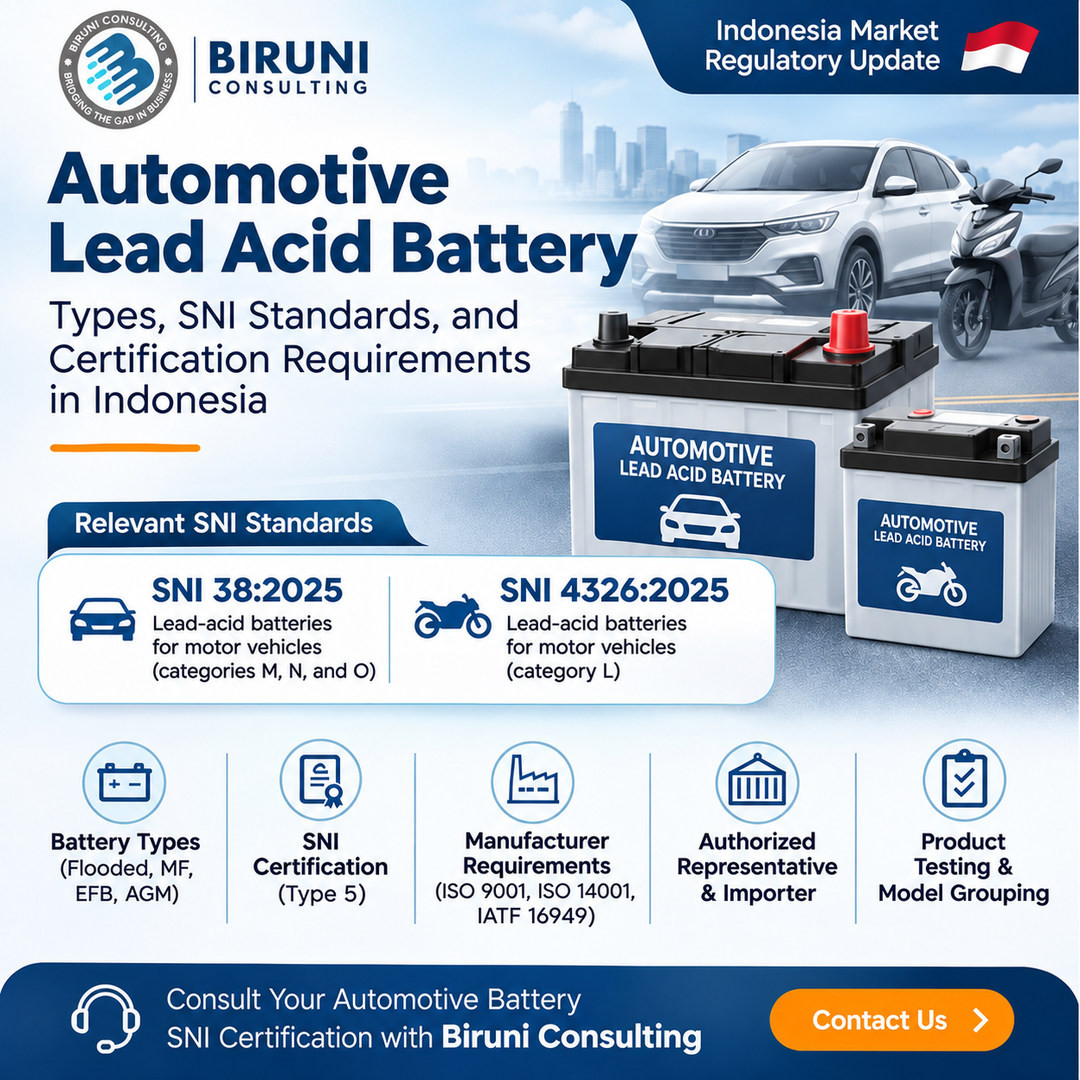
An automotive battery aftermarket importer brings in batteries as replacement parts for vehicles. Indonesia's proposed lead-acid battery SNI framework treats this route separately from importing batteries as components for vehicle-assembly factories, with different eligibility requirements.
Aftermarket KBLI business classifications
The draft identifies KBLI 46620 for wholesale car parts and accessories and KBLI 46633 for wholesale motorcycle parts. Importers should verify the current codes on their NIB and OSS data, including conversions from earlier classifications.
A wholesale-parts KBLI does not, by itself, satisfy every requirement for appointment as an SNI automotive battery importer.
Formal appointment by the AR
An aftermarket importer is proposed to be appointed by an Authorized Representative through an authentic deed before an Indonesian notary. Company registration, trading authorization, warehouse control and a SIINas account are also listed.
The AR retains a distinct compliance role even if another entity physically imports the products.
Distribution agreement as a critical condition
The proposed aftermarket route requires a notarized distribution agreement with the vehicle trademark owner or an entity appointed or authorized by that vehicle brand owner.
A purchase or distribution agreement signed only with the battery manufacturer is not necessarily equivalent. Independent aftermarket distributors should seek regulatory clarification before relying on this route.
Difference from vehicle-assembly importers
The separate vehicle-assembly route requires industrial KBLI 29100 and/or 30911 and restricts resale or transfer of batteries imported as production inputs.
An ordinary wholesaler holding KBLI 46620 or 46633 should not assume qualification for vehicle-assembly import arrangements.
Extra checks for independent distributors
An independent aftermarket distributor should identify exactly which party signs the distribution agreement. If the only contract is with an independent battery brand, do not assume that document satisfies a draft provision referring to the vehicle trademark owner.
Useful questions for the regulator include whether a battery-manufacturer agreement alone can qualify, whether an OEM vehicle-brand relationship is required and how ordinary aftermarket wholesalers are treated. Until clarified, these issues should be disclosed as regulatory uncertainty.
Frequently Asked Questions
Is KBLI 46620 alone sufficient?
No. AR appointment, warehouse, SIINas and distribution-agreement requirements must also be assessed.
Does an aftermarket importer need an industrial KBLI?
Not under the proposed aftermarket route; an industrial KBLI belongs to the separately regulated vehicle-assembly route.
Related Reading
- SNI Certification Services for Car and Motorcycle Batteries in Indonesia
- SNI 38:2025 Car Battery Requirements in Indonesia
- SNI 4326:2025 Motorcycle Battery Requirements in Indonesia
Automotive Battery SNI Consultation
For an initial assessment, prepare a model list and specifications, manufacturer identity, management-system certificates, trademark documents and your proposed Authorized Representative/importer arrangement. Biruni Consulting can review the documentation and identify the next regulatory steps.
Regulatory status: SNI 38:2025 and SNI 4326:2025 are BSN technical standards. Draft mandatory-SNI provisions must be verified against the enacted regulation, if any. Certification outcomes and timelines are not guaranteed.