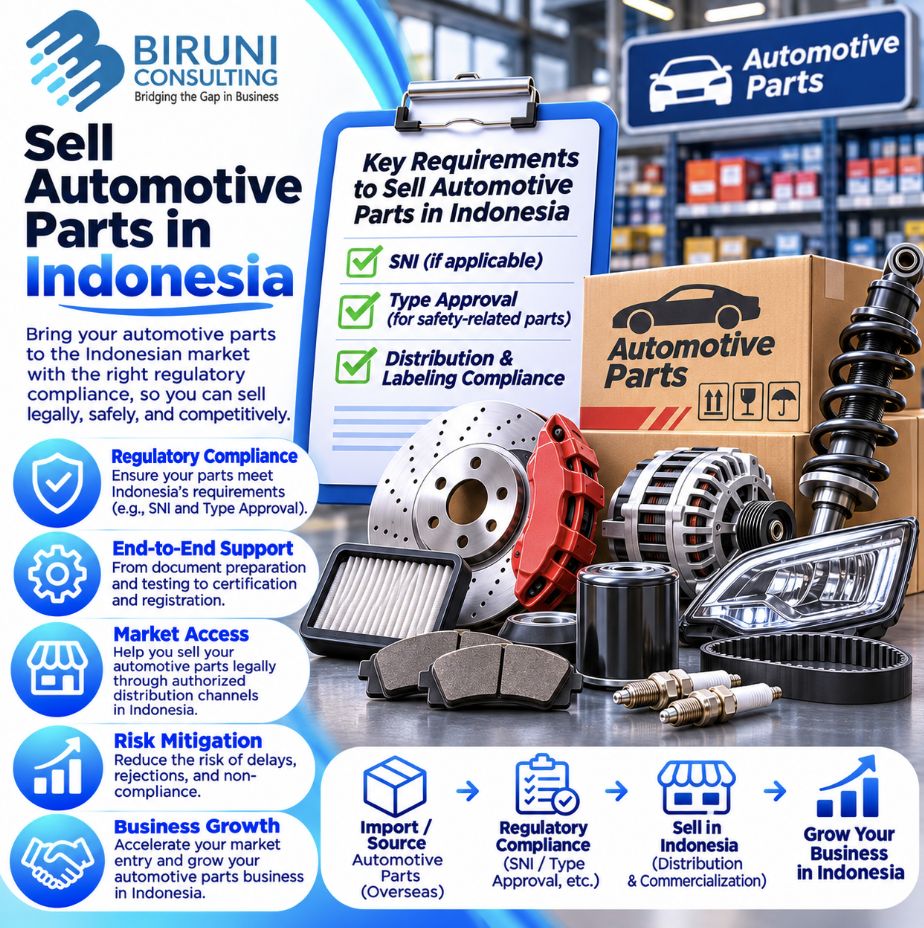
Guide for Overseas Manufacturers Selling Automotive Parts in Indonesia
Sell Automotive Parts in Indonesia requires more than finding an Importer, Distributor, dealer, or online marketplace. An Overseas Manufacturer needs to establish the appropriate Indonesian business structure, Business Licensing, import pathway, product classification, Mandatory SNI status, labeling, manufacturing-site scope, and regulatory ownership before commercial sales begin.
Indonesia currently uses Risk-Based Business Licensing under Government Regulation No. 28 of 2025. The regulation has applied since June 5, 2025, revoked Government Regulation No. 5 of 2021, and requires Business Operators to hold the appropriate Business Licensing for their activities. Database Peraturan | JDIH BPK
Imported products are also subject to Indonesia’s general import framework. Minister of Trade Regulation No. 16 of 2025 requires an Importer to hold an NIB functioning as an API. The regulation became effective on August 29, 2025 and has subsequently been amended, including through the second amendment under Minister of Trade Regulation No. 18 of 2026, effective June 4, 2026. Database Peraturan | JDIH BPK
Automotive product compliance then needs to be assessed product by product. Tires, motor-vehicle safety glass, lubricating oil, and certain other automotive products are covered by specific Mandatory SNI frameworks, while many other spare parts should not automatically be treated as Mandatory SNI products merely because they are used in a vehicle. Database Peraturan | JDIH BPK
A Sell Automotive Parts in Indonesia strategy should therefore begin with regulatory mapping before commercial launch.
What Does Sell Automotive Parts in Indonesia Mean?
Selling automotive parts in Indonesia can involve several different activities:
- importation;
- wholesale;
- distribution;
- dealer supply;
- workshop supply;
- OEM supply;
- aftermarket sales;
- online sales; and
- direct supply to industrial customers.
The legal and regulatory structure can depend on which company imports the goods, holds inventory, performs distribution, and invoices the customer.
The supply-chain structure should therefore be established before market launch.
Appointing a Distributor Is Not Enough
A Distributor appointment is a commercial arrangement and does not necessarily complete the regulatory structure.
The Distributor can be different from the:
- Importer.
- Official Representative.
- SNI Certificate Holder.
- SPPT SNI party.
- SIINas controller.
One Indonesian company can perform several functions where the applicable regulation and Business Licensing permit, but those functions should not be assumed automatically.
Product Classification Comes First
Regulatory assessment should start with the exact product.
Descriptions such as:
- automotive part;
- spare part;
- replacement component;
- OEM component; or
- automotive accessory
are too broad to establish the applicable requirements.
The manufacturer should provide the product name, intended use, trademark, model, part number, technical specifications, materials or formulation, manufacturing site, country of origin, and proposed HS code.
HS Code Is Important but Not Sufficient
HS classification is essential for customs and import analysis.
However, a mandatory product regulation can use a combination of HS classification, product definitions, technical characteristics, and intended use.
Two components that appear commercially similar can therefore have different regulatory treatment.
Regulatory assessment should not rely solely on an HS code appearing on a supplier’s Invoice.
Business Licensing for Selling Automotive Parts
An Indonesian Business Operator needs Business Licensing corresponding with its actual activities.
Government Regulation No. 28 of 2025 provides the current Risk-Based Business Licensing framework, including Business Licensing, PB UMKU, OSS, supervision, evaluation, and sanctions. Database Peraturan | JDIH BPK
Where one Indonesian company performs importation, wholesale activities, distribution, warehousing, or other business activities, its licensing structure needs to support the activities actually performed.
The existence of a company and NIB alone does not establish every product and activity requirement.
Importer for Automotive Parts
For products supplied from overseas, the manufacturer needs to determine which Indonesian party will act as Importer.
Minister of Trade Regulation No. 16 of 2025 requires the Importer to hold an NIB functioning as API. API serves as the Importer’s identification. Database Peraturan | JDIH BPK
A manufacturer authorization letter or Distributor Agreement does not replace Importer eligibility.
Before shipment, an Overseas Manufacturer should therefore verify the proposed Importer’s legal and operational structure.
Import Rules Changed in 2026
The current import framework is no longer simply the original version of Regulation No. 16 of 2025.
Minister of Trade Regulation No. 18 of 2026 is the second amendment and changed provisions concerning areas including Import Business Licensing, amendments and extensions to Import Approvals, Surveyor Reports, Import Customs Declaration documentation, reporting, and administrative sanctions. It became effective on June 4, 2026. Database Peraturan | JDIH BPK
Importer assessments should therefore use the rules in force at the time of shipment.
Customs for Automotive Parts
Once the Importer structure is ready, customs obligations still need to be completed.
Indonesia Customs explains that Imports for Use generally involve a PIB and require the Importer to satisfy applicable duties, taxes, and prohibitions or restrictions. Beacukai
A PIB is therefore more than a logistics document. The Importer assumes responsibility for customs declarations and supporting information.
Import Documentation
Indonesia Customs explains that Supporting Customs Documents can include:
- Invoice;
- Packing List;
- Bill of Lading or Air Waybill;
- product-identification documents;
- evidence of compliance with import requirements; and
- other required documentation. Beacukai
For automotive shipments containing many SKUs, consistency between commercial documentation and regulatory master data is particularly important.
Commercial Invoice
The Commercial Invoice should normally describe the goods in sufficient detail.
A generic description such as “auto parts” can be inadequate where the actual components can be identified more specifically.
Part numbers, models, product descriptions, brands, quantities, manufacturers, and country of origin should remain consistent with the goods and other documents.
Packing List
The Packing List should correspond with the Invoice and actual shipment.
For manufacturers managing hundreds of part numbers, each SKU should ideally have a regulatory status before the cargo is consolidated.
This reduces the risk that components not yet approved are mixed into a shipment of compliant products.
Mandatory SNI for Automotive Parts
One of the most important questions before selling automotive components is:
Does the product require Mandatory SNI?
The answer cannot be determined merely because the component is used in a vehicle.
Mandatory SNI applies where a standard has formally been made compulsory for the defined product scope.
Current automotive-related examples include tires, motor-vehicle safety glass, and lubricating oil. Database Peraturan | JDIH BPK
Not Every SNI Is Mandatory
BSN maintains numerous current automotive-related standards.
For example, the BSN catalogue lists SNI 1896:2008 for M, N, and O motor-vehicle wheels together with various other standards relating to transmissions, suspensions, and automotive components. Pesta
The existence of a technical standard does not by itself establish that every related product requires Mandatory SNI certification.
The applicable regulation still needs to be identified.
SNI for Tires
Minister of Industry Regulation No. 9 of 2025 currently governs Mandatory SNI for tires.
The regulation became effective on July 24, 2025, remains in force, and revoked the previous Mandatory SNI tire regulation. Database Peraturan | JDIH BPK
Companies selling tires in Indonesia should confirm the tire category, applicable standard, certification status, manufacturing site, and model before commercial distribution.
SNI for Motor-Vehicle Safety Glass
Motor-vehicle safety glass is subject to a Mandatory SNI framework under Minister of Industry Regulation No. 15 of 2025.
The regulation became effective on October 25, 2025, remains in force, and replaced Regulation No. 80 of 2015. Database Peraturan | JDIH BPK
Windshields and other automotive safety-glass products should therefore be assessed before the Importer or Distributor begins commercial sales.
SNI for Lubricating Oil
Where the product portfolio includes motor oils, transmission oils, or other lubricants, Minister of Industry Regulation No. 8 of 2025 needs to be considered.
The regulation makes SNI mandatory for lubricating oil, has applied since July 24, 2025, remains in force, and replaced Regulation No. 25 of 2018. Database Peraturan | JDIH BPK
Lubricants are not mechanical spare parts in the narrow sense, but they form a significant part of the automotive aftermarket.
Motor-Vehicle Wheels
Motor-vehicle wheels are another automotive category requiring separate SNI assessment.
BSN currently lists SNI 1896:2008 for M, N, and O motor-vehicle wheels as in force and also lists SNI 4658:2015 for category L wheels. Pesta
Before commercial launch, the relevant mandatory framework and certification scope should be checked in addition to the status of the technical standard itself.
Brake Parts, Filters, Bearings, and Suspension Components
It would be incorrect to assume that all brake pads, filters, bearings, suspension components, hoses, bushings, engine parts, and other spare parts require Mandatory SNI.
It would also be incorrect to assume that all such parts are unregulated.
Product-specific assessment should determine whether:
- Mandatory SNI applies;
- Voluntary SNI is available;
- import restrictions apply;
- another sector approval applies; or
- no product-specific mandatory certification currently applies.
Automotive Electronics
Modern automotive products increasingly include wireless and electronic functions.
Products such as:
- connected head units;
- GPS trackers;
- telematics units;
- wireless cameras;
- TPMS devices;
- smart sensors; and
- other connected accessories
can require additional regulatory assessment outside the traditional automotive SNI framework.
Classification should therefore consider technical functionality rather than merely the automotive marketing category.
OEM Parts and Aftermarket Parts
OEM and aftermarket components can follow different commercial channels.
An OEM component can be supplied to a vehicle assembly plant, while an aftermarket component can be distributed through Distributors, dealers, workshops, retailers, or marketplaces.
OEM status itself does not automatically remove applicable regulatory obligations.
The relevant product regulation should be reviewed for any industrial-use mechanism, special treatment, or exemption.
After-Sales Service Parts
Components supplied into an authorized after-sales network should also be assessed product by product.
“Service part” is a commercial description and does not itself create a regulatory exemption.
Manufacturers should distinguish among:
- replacement parts;
- warranty parts;
- repair components;
- industrial inputs; and
- general aftermarket products.
New and Used Automotive Parts
The condition of imported goods can also affect the import pathway.
Companies selling used automotive components should not simply apply the same assumptions used for new products.
Minister of Trade Regulation No. 47 of 2025 concerning Goods Prohibited for Import has applied since January 1, 2026 and replaced the previous prohibited-import framework. Database Peraturan | JDIH BPK
The actual product, condition, HS classification, and intended use should therefore be reviewed before shipment.
SNI Certificate
Where Mandatory SNI applies, certification needs to follow the applicable conformity-assessment scheme.
The Certificate should not be treated merely as a customs document.
SNI certification can involve:
- an LSPro;
- technical documentation;
- factory assessment;
- laboratory testing;
- corrective action;
- certification decisions; and
- continuing surveillance.
The exact process remains product specific.
LSPro
An LSPro or Product Certification Body carries out conformity assessment within its applicable scope.
A Distributor, Importer, consultant, or Official Representative does not replace the LSPro.
Manufacturers should normally determine the appropriate LSPro before formal testing so that sample selection, laboratory pathways, and certification scope remain aligned.
Laboratory Testing
International test reports can support technical assessment but should not automatically be treated as replacements for Indonesian conformity assessment.
The manufacturer should compare:
- test standards;
- test methods;
- laboratory status;
- tested models;
- manufacturing sites;
- product configurations; and
- the applicable Indonesian scheme.
A test-report gap analysis can reduce unnecessary repeat testing.
Factory Audits
Certain Mandatory SNI schemes use Type 5 certification involving factory assessment in addition to product testing.
Manufacturers may therefore need to prepare production controls, quality systems, incoming inspection, process controls, calibration, final inspection, nonconforming-product controls, traceability, and corrective actions.
Certification planning should begin before the manufacturer is ready to ship commercial inventory.
Overseas Manufacturer
An Overseas Manufacturer should establish its Indonesian local-party structure early.
Depending on the product regulation, an Official Representative can be required.
The Representative is not automatically the Importer or Distributor.
Responsibilities for certification administration, SIINas, importation, distribution, warehousing, and post-market compliance should therefore be allocated clearly.
Official Representative
An Official Representative can be required by a product-specific regulation.
The role can involve certification administration and local regulatory responsibilities.
Manufacturers should therefore avoid selecting their Representative solely because that company has the largest sales network or happens to be the intended Distributor.
Long-term regulatory continuity should also be considered.
The Importer Is Not Automatically the Official Representative
The Importer performs the import function.
The Official Representative performs a function established by a specific product regulation.
Although one company can perform both roles where permitted, holding NIB/API does not automatically make the Importer an Official Representative.
Likewise, appointment as Official Representative does not automatically provide Importer eligibility. Regulation No. 16 of 2025 continues to require an Importer to hold an NIB functioning as API. Database Peraturan | JDIH BPK
The Distributor Is Not Automatically the Importer
The Distributor also does not necessarily need to act as Importer.
Possible structures can include:
Overseas Manufacturer → Importer → Distributor → Dealer
or:
Overseas Manufacturer → Official Representative + Importer + Distributor
or:
Overseas Manufacturer → Official Representative → Importer → Multiple Distributors
The available arrangement depends on product regulations, Business Licensing, and commercial strategy.
The SNI Certificate Holder Is Not Automatically the Importer
The SNI Certificate Holder should also be distinguished from the Importer and Distributor.
The applicable product-certification regulation determines the legal Certificate party.
An Overseas Manufacturer should therefore understand Certificate ownership before giving a Distributor extensive regulatory control simply because it performs the first commercial import.
SPPT SNI
The SNI Certificate and SPPT SNI are also different concepts under applicable Ministry of Industry schemes.
Manufacturers need to determine whether approval to use the SNI Mark is required after certification.
SNI marking and packaging artwork should not be finalized before the applicable Certificate and marking structure are confirmed.
SIINas
SIINas can be used for certification administration under applicable Ministry of Industry Mandatory SNI schemes.
An Overseas Manufacturer should therefore establish:
- who controls the account;
- who submits applications;
- who retains regulatory records;
- who handles amendments; and
- how access will be transitioned if the commercial relationship ends.
SIINas control is part of regulatory ownership rather than merely an administrative convenience.
Brands and Trademarks
Automotive components can be sold under:
- manufacturer brands;
- OEM brands;
- private labels;
- Distributor brands; or
- related-company trademarks.
The trademark owner, manufacturer, SNI Certificate Holder, Official Representative, Importer, and Distributor do not necessarily need to be the same company.
The brand structure should be finalized before certification and distribution agreements are completed.
Multiple Models and Part Numbers
Automotive companies commonly maintain large numbers of SKUs.
One product family can contain dozens or hundreds of individual part numbers.
Before launch, a regulatory matrix should identify:
- Part number.
- Product family.
- HS code.
- SNI applicability.
- Certificate status.
- Manufacturing site.
- Importer.
- Distributor.
- Launch status.
The matrix allows the sales team to distinguish products that are ready for sale from those still undergoing compliance work.
Multiple Manufacturing Sites
One part number can be manufactured at several factories.
The regulatory team needs to know which factory actually supplies the Indonesian market.
Where certification is connected with a manufacturing site, products from another factory should not automatically be treated as covered.
Supply-chain flexibility should therefore be incorporated into certification strategy.
Country of Origin
Country of origin should also be distinguished from the country of shipment and the location of the brand owner.
Invoices, Certificates of Origin where applicable, production records, and shipping documents should contain consistent information.
Conflicting factory or origin information can create regulatory and documentation issues.
Product Labeling
Labeling should be reviewed before mass production.
Requirements can arise from:
- Mandatory SNI schemes;
- product-specific regulations;
- Indonesian consumer-information requirements;
- packaging requirements; or
- another sector-specific rule.
Manufacturers should avoid mass-printing Indonesian packaging before compliance review is complete.
Selling Through Marketplaces
Online marketplaces can expand distribution but do not remove product-compliance requirements.
A product subject to Mandatory SNI remains subject to the applicable certification requirements even when sold online.
Using a marketplace also does not replace Importer, Business Licensing, or labeling requirements that otherwise apply.
Selling Through Dealers
A dealer network is a commercial sales channel.
A dealer does not automatically become the Importer, Official Representative, or SNI Certificate Holder.
Manufacturers should structure regulatory approvals at an appropriate level so that changing dealers does not unnecessarily require certification restructuring.
Selling Through Workshops
Workshops can function as downstream customers or sales channels for replacement parts.
However, product compliance should be resolved before components reach the workshop.
The workshop should not become the first point at which the company discovers that an imported product is subject to an unmet mandatory requirement.
Selling to OEMs
Direct supply to an automotive assembler can involve customer-specific requirements in addition to government regulation.
An OEM can impose engineering approvals, supplier qualifications, PPAP, IATF, traceability, testing, and other quality requirements.
Those customer requirements do not automatically replace Indonesian regulatory obligations.
OEM approval and regulatory compliance should therefore be managed separately.
IATF 16949 Does Not Replace SNI
Automotive suppliers commonly hold IATF 16949 or ISO 9001 certification.
Those certifications can support quality-management capability but do not automatically replace Mandatory Indonesian product certification.
Where the actual component falls within a Mandatory SNI scheme, the applicable Indonesian conformity-assessment process still needs to be completed.
Pre-Launch Regulatory Review
Before launching a product, the manufacturer should review:
- Product classification.
- HS classification.
- Mandatory SNI status.
- Other technical approvals.
- Certificate status.
- Official Representative.
- Importer.
- Business Licensing.
- Product marking.
- Distributor and sales channels.
This review should ideally occur before commercial pricing and launch schedules are locked.
Pre-Shipment Review
The actual shipment should then be reviewed again before departure.
Indonesia Customs requires the Importer to complete the applicable PIB or customs documentation, duties and taxes, and prohibitions or restrictions for Imports for Use. Beacukai
The shipment checklist can include the model, part number, factory, Invoice, Packing List, Importer identity, Certificates, and relevant product approvals.
Do Not Sell Before Compliance Is Ready
Launching a product first and resolving certification later can create inventory, commercial, and enforcement risk.
Sales teams should accept orders only for products whose regulatory status is clear.
Large portfolios can use statuses such as:
- approved;
- certification in progress;
- assessment required;
- outside Mandatory SNI scope; or
- not ready for sale.
Product Traceability
Automotive parts benefit from strong traceability.
Records should connect:
- manufacturer;
- factory;
- part number;
- batch or lot;
- Importer;
- customs entry;
- Certificate;
- Distributor; and
- customer channel.
Traceability supports surveillance, complaints, warranty investigations, corrective actions, and recalls.
Product Changes After Launch
Engineering changes can affect regulatory compliance.
Changes involving:
- materials;
- dimensions;
- formulations;
- suppliers;
- tooling;
- production processes;
- factories;
- model numbers;
- trademarks; or
- packaging
should undergo regulatory impact assessment before revised components are sold in Indonesia.
Changing the Importer
Replacing the Importer can affect the product-specific regulatory structure.
The Importer is not automatically the Certificate Holder, but Importer information can still be relevant to certifications, appointments, or Import Approvals under certain schemes.
A regulatory impact assessment should precede the use of a new Importer.
Changing the Distributor
Changing the Distributor can be easier where the Distributor does not control every regulatory asset.
An Overseas Manufacturer should therefore retain appropriate control over:
- Certificates;
- SIINas records;
- Official Representative arrangements;
- testing reports;
- regulatory correspondence; and
- product master data.
A commercial exit strategy should be designed before the market launch.
Regulatory Ownership
Before beginning sales, an Overseas Manufacturer should establish a regulatory ownership map identifying:
- Manufacturer.
- SNI Certificate Holder.
- Official Representative.
- SPPT SNI party.
- SIINas controller.
- Importer.
- Distributor.
- Trademark owner.
- Manufacturing site.
- LSPro and Testing Laboratory.
This structure helps preserve market continuity when commercial partners change.
Post-Market Compliance
Compliance does not necessarily end after the first sale.
Mandatory SNI products can remain subject to surveillance, Certificate maintenance, change control, marking, reporting, and other continuing requirements.
The manufacturer, Importer, Official Representative, and Distributor should clearly allocate each post-market responsibility.
Regulatory Monitoring
Regulations can change while products remain on the Indonesian market.
The general import framework has already been amended through Minister of Trade Regulation No. 18 of 2026, while current Mandatory SNI frameworks for tires, safety glass, and lubricating oil are also relatively recent. Database Peraturan | JDIH BPK
Companies with recurring sales therefore need regulatory monitoring rather than a one-time market-entry assessment.
Regulatory Gap Analysis
Before launch, regulatory gap analysis can identify issues such as:
- product classification incomplete;
- HS code not finalized;
- Mandatory SNI status uncertain;
- Certificate unavailable;
- factory outside Certificate scope;
- Importer not ready;
- Business Licensing incomplete;
- Official Representative not established;
- labeling incomplete; or
- regulatory ownership unclear.
Those gaps can then be converted into a practical market-entry action plan.
Initial Documents for Sell Automotive Parts in Indonesia
An Overseas Manufacturer can prepare:
- Product Catalogue.
- Technical Data Sheet.
- Model and part-number list.
- Proposed HS codes.
- Manufacturer information.
- Factory addresses.
- Existing Certificates.
- Existing test reports.
- Trademark information.
- Proposed Importer.
- Proposed Distributor.
- Intended sales channels.
This information provides a practical basis for regulatory assessment before significant launch investment begins.
Sell Automotive Parts in Indonesia Roadmap
A practical roadmap can include:
- Product classification.
- HS-code assessment.
- Mandatory SNI and other approval assessment.
- Determine the Certificate Holder and Official Representative where required.
- Review Business Licensing.
- Appoint and verify the Importer.
- Complete SNI certification and other approvals.
- Prepare product marking and documentation.
- Appoint Distributors and sales channels.
- Conduct pre-shipment review.
- Complete customs clearance.
- Begin domestic distribution.
- Manage surveillance and regulatory changes.
The exact sequence remains product specific.
Timeline
There is no universal timeline for beginning automotive-part sales in Indonesia.
Products outside Mandatory SNI or other approval scopes can require substantially less preparation than products requiring SNI certification, factory audits, laboratory testing, and Official Representative arrangements.
The launch schedule should therefore be prepared after regulatory assessment rather than solely from shipping lead time.
Cost
Market-entry costs can include:
- regulatory assessment;
- certification;
- laboratory testing;
- factory audits;
- LSPro;
- auditor travel;
- Official Representative services;
- Importer services;
- customs brokerage;
- duties and taxes;
- warehousing;
- labeling;
- Distributor margins; and
- post-market surveillance.
Pricing strategy should therefore consider total landed and compliance costs rather than factory price and freight alone.
Common Sell Automotive Parts in Indonesia Mistakes
Common mistakes include:
- appointing the Distributor before regulatory assessment;
- assuming the Distributor automatically qualifies as Importer;
- using an unverified supplier HS code;
- assuming every automotive component requires SNI;
- assuming every spare part is outside Mandatory SNI;
- assuming CE, E-mark, JIS, SAE, or international testing automatically replaces Indonesian SNI;
- ignoring the manufacturing site;
- printing packaging before labeling review;
- shipping before certification is complete;
- giving the Distributor control of every regulatory asset; and
- beginning compliance assessment only after products are already being sold.
Why Use a Regulatory Consultant?
A regulatory consultant can help connect product classification, SNI assessment, LSPro, testing, factory audits, Official Representative arrangements, SIINas, the Importer, customs preparation, labeling, and commercial-launch planning.
For automotive manufacturers with large SKU portfolios, a consultant can also help establish a regulatory portfolio so that products can be prioritized according to commercial importance and compliance status.
A consultant does not replace the regulator, LSPro, Testing Laboratory, Importer, or another government authority and cannot guarantee approval.
How to Select a Partner to Sell Automotive Parts in Indonesia
An Overseas Manufacturer should evaluate more than the size of a potential partner’s sales network.
Important areas can include:
- Business Licensing.
- Importer eligibility.
- Customs capability.
- Automotive product experience.
- Regulatory knowledge.
- Warehousing and logistics.
- Dealer or distribution network.
- Documentation control.
- Post-market support.
- Transition and exit mechanisms.
The appropriate partner should support commercial growth without creating unnecessary regulatory dependency.
Conclusion
Sell Automotive Parts in Indonesia requires integrated planning across Business Licensing, importation, product certification, and domestic distribution.
For business activities, Indonesia’s current Risk-Based Business Licensing framework is established under Government Regulation No. 28 of 2025. For imported products, Minister of Trade Regulation No. 16 of 2025 requires an Importer to hold an NIB functioning as API, and that import framework has subsequently been amended, including through Minister of Trade Regulation No. 18 of 2026. Database Peraturan | JDIH BPK
Automotive product compliance then needs to be determined from the actual product. Tires fall under the Mandatory SNI framework of Minister of Industry Regulation No. 9 of 2025, motor-vehicle safety glass under Regulation No. 15 of 2025, and lubricating oil under Regulation No. 8 of 2025. Not every automotive part automatically requires Mandatory SNI, so product-specific assessment remains the starting point. Database Peraturan | JDIH BPK
For imported goods, the Importer also needs to complete applicable customs obligations involving the PIB, duties and taxes, and prohibitions or restrictions. Supporting documentation can include the Invoice, Packing List, Bill of Lading/Air Waybill, product-identification documentation, and evidence of compliance with import requirements. Beacukai
An Overseas Manufacturer should therefore establish the product classification, Mandatory SNI status, Certificate Holder, Official Representative, Importer, Distributor, Business Licensing, manufacturing-site scope, labeling, and regulatory ownership before the first commercial sale.
Contact Us
Biruni Consulting assists companies with Sell Automotive Parts in Indonesia professionally and in accordance with applicable regulations in Indonesia.
Our services include:
- Regulatory consultation.
- Identification of applicable standards.
- Preparation of certification documents.
- Assistance with laboratory testing.
- Certification processing until certificate issuance.
Biruni Consulting assists Overseas Manufacturers with product classification, Mandatory SNI assessment, Automotive SNI Certification, Official Representative structures, Importer structures, NIB/API review, LSPro, laboratory testing, SIINas, labeling, and market-entry compliance before automotive parts are sold in Indonesia.
Contact Us for guidance on Sell Automotive Parts in Indonesia, SNI Automotive Parts Indonesia, Automotive SNI Certification Indonesia, Automotive Representative Indonesia, and automotive-product regulatory compliance assistance.