
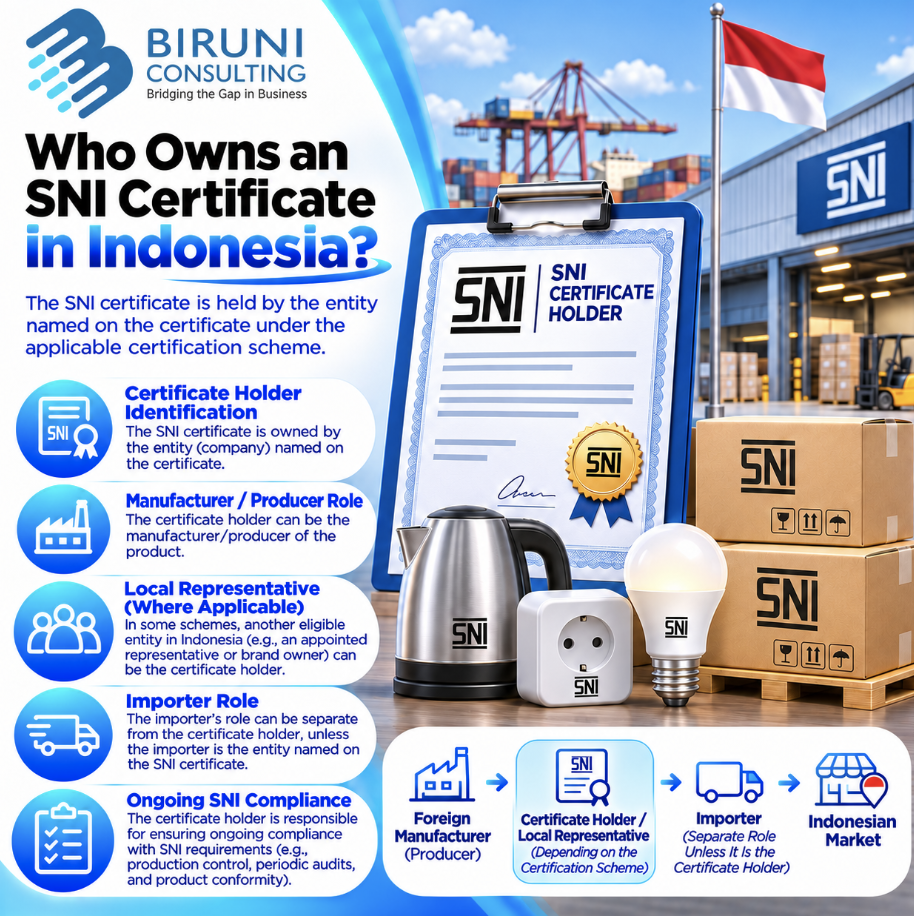
Who Legally Owns an SNI Certificate in Indonesia?
Who Owns SNI Certificate Indonesia? The answer is not automatically the Importer, Distributor, or Official Representative. The legal holder of an SNI Certificate is determined by the applicable product regulation and certification scheme.
Under several relatively recent Ministry of Industry Mandatory SNI regulations, an SNI Certificate is expressly issued for an Industrial Company or Overseas Manufacturer. Minister of Industry Regulation No. 8 of 2025, for example, defines the lubricating-oil SNI Certificate as a certificate issued by an LSPro for an Industrial Company or Overseas Manufacturer capable of manufacturing the product in compliance with the Mandatory SNI requirements. Database Peraturan | JDIH BPK
A similar structure appears under Mandatory SNI for motor-vehicle safety glass. Minister of Industry Regulation No. 15 of 2025 defines the SNI Certificate as a certificate issued by an LSPro for an Industrial Company or Overseas Manufacturer capable of producing safety glass in accordance with the Mandatory SNI requirements. Database Peraturan | JDIH BPK
Companies should therefore not use the term “SNI holder” merely according to which party imports the product or manages the certification process. The legal holder needs to be verified from the product regulation, certification scheme, application structure, and actual SNI Certificate.
What Is an SNI Certificate Holder?
SNI Certificate Holder is practical terminology for the party legally holding the SNI Certificate under the applicable conformity-assessment scheme.
For Mandatory SNI, the holder should not be determined merely through a commercial agreement.
The applicable scheme can determine:
- who can apply for certification;
- which party is named on the SNI Certificate;
- which manufacturing sites are covered;
- which trademarks or brands are covered;
- surveillance obligations; and
- how changes to companies, Representatives, Importers, or factories affect certification.
Certificate ownership is therefore a regulatory issue, not merely a contractual matter.
Who Issues an SNI Certificate?
SNI product certificates are issued through an LSPro or Lembaga Sertifikasi Produk / Product Certification Bodyaccording to its applicable scope and certification scheme.
BBSPJIKKP explains that product certification is a conformity-assessment process used to determine whether a company can consistently produce products satisfying applicable standards and that qualifying companies receive product certificates issued by the LSPro. Ministry of Industry Mandatory SNI applications are submitted through SIINas. bbkkp.kemenperin.go.id
The distinction is therefore:
LSPro = the body issuing the Certificate following conformity assessment.
Certificate Holder = the party legally receiving or holding that Certificate.
The LSPro does not own the commercial product or trademark merely because it issues the Certificate.
Does the Manufacturer Own the SNI Certificate?
Under many product-specific Mandatory SNI schemes, the manufacturer is the central certification party.
For lubricating oil under Regulation No. 8 of 2025, the definition expressly identifies the Industrial Company or Overseas Manufacturer as the party for whom the SNI Certificate is issued. Database Peraturan | JDIH BPK
For motor-vehicle safety glass, Regulation No. 15 of 2025 uses the same structure: the SNI Certificate is issued by the LSPro for an Industrial Company or Overseas Manufacturer meeting the requirements. Database Peraturan | JDIH BPK
Under those schemes, the manufacturer can therefore be the SNI Certificate Holder.
Can an Overseas Manufacturer Own the SNI Certificate?
Yes, where the applicable product-specific scheme expressly permits it.
The lubricating-oil framework shows that an Overseas Manufacturer can be the party for whom the SNI Certificate is issued. The regulation separately defines the Overseas Manufacturer, Importer, and Official Representative as distinct legal roles. Database Peraturan | JDIH BPK
The safety-glass framework similarly allows the Overseas Manufacturer to be the certificate party while the application is submitted through an Official Representative. Database Peraturan | JDIH BPK
This is important because the existence of a local Representative does not necessarily transfer Certificate ownership to that Representative.
Does the Official Representative Own the SNI Certificate?
Not automatically.
The Official Representative is the Indonesian entity representing an Overseas Manufacturer where the applicable product regulation requires local representation.
Under the safety-glass regulation, the Official Representative is legally distinguished from the Overseas Manufacturer, while the SNI Certificate is separately defined as a Certificate for the Industrial Company or Overseas Manufacturer. Database Peraturan | JDIH BPK
The Overseas Manufacturer’s application is indeed submitted through the Official Representative using SIINas, but functioning as the application channel or local regulatory Representative does not automatically make that company the Certificate Holder. Database Peraturan | JDIH BPK
Does the Importer Own the SNI Certificate?
Not automatically.
The Importer performs a different function from Certificate ownership.
Under Regulation No. 8 of 2025, an Importer is defined as an Indonesian party responsible for importing lubricating oil, while the SNI Certificate is defined as a Certificate issued for an Industrial Company or Overseas Manufacturer. Database Peraturan | JDIH BPK
A company can therefore perform commercial importation without being the legal SNI Certificate Holder.
Importer and Certificate Holder Can Be Different
A possible imported Mandatory SNI structure is:
Overseas Manufacturer → SNI Certificate Holder
Official Representative → regulatory representative
Importer → commercial/customs importer
Distributor → domestic sales
Those four functions can be performed by separate companies where the regulation permits.
Alternatively, several functions can be combined within one entity where the applicable regulatory and licensing framework allows it.
Official Representative and Importer Can Be the Same Company
Although the Representative is not automatically the Certificate Holder, it can simultaneously act as Importer under certain product regulations.
Under the lubricating-oil framework, the Official Representative can perform the Importer function. Where the Representative does not import directly, it can appoint up to five Importers. Database Peraturan | JDIH BPK
That arrangement still does not change the rule concerning the SNI Certificate Holder.
It demonstrates why each regulatory role should be described precisely.
SNI Certificate Is Different from SPPT SNI
A frequent misunderstanding is treating the SNI Certificate and SPPT SNI as the same instrument.
The SNI Certificate results from conformity assessment and certification.
SPPT SNI is approval to use the SNI Mark under Ministry of Industry schemes that use that instrument.
Under the lubricating-oil regulation, SPPT SNI applications are submitted electronically through SIINas by the Industrial Company or Official Representative according to the applicable structure. Database Peraturan | JDIH BPK
Accordingly:
SNI Certificate Holder ≠ automatically SPPT SNI applicant or holder.
Certificate Holder Is Different from Trademark Owner
Trademark ownership is also different from SNI Certificate ownership.
A trademark can be owned by the manufacturer, parent company, affiliated entity, or another party under an appropriate legal arrangement.
The certification regulation then determines how that trademark relationship interacts with the applicant and Certificate Holder.
Companies should therefore not assume:
trademark owner = automatically SNI Certificate Holder.
The actual regulatory and certification structure needs to be reviewed.
Certificate Holder Is Different from Distributor
A Distributor normally manages domestic sales, dealer networks, customer relationships, and commercial distribution.
Those activities do not automatically provide ownership of the SNI Certificate.
The Distributor can also perform an Importer or regulatory-representation function where permitted, but each function needs independent assessment.
Commercial distribution rights and certification ownership are different concepts.
Example: Lubricating-Oil SNI Certificate
Minister of Industry Regulation No. 8 of 2025 currently governs Mandatory SNI for motor-vehicle lubricating oil and has been effective since July 24, 2025. Database Peraturan | JDIH BPK
The regulation defines the SNI Certificate as a certificate issued by an LSPro for an Industrial Company or Overseas Manufacturer capable of producing lubricating oil in accordance with Mandatory SNI requirements. Database Peraturan | JDIH BPK
For imported products, the structure can therefore be:
Overseas Manufacturer = Certificate Holder
Official Representative = Indonesian Representative
Importer = the Representative itself or another permitted Importer
This is a clear example where the Certificate Holder and Importer do not need to be the same entity.
Lubricating Oil and Manufacturing Sites
Certification also involves more than the company name.
Under the lubricating-oil scheme, where an Industrial Company or Overseas Manufacturer operates more than one production location, applications need to address each production location. The regulation also provides for Certificates to be issued to the Industrial Company or Overseas Manufacturer under the specified structure. Database Peraturan | JDIH BPK
Certificate ownership therefore does not give the manufacturer unrestricted freedom to source from any factory.
The approved manufacturing-site scope still matters.
Example: Motor-Vehicle Safety-Glass SNI Certificate
Minister of Industry Regulation No. 15 of 2025 governs Mandatory SNI for motor-vehicle safety glass.
The regulation defines the Certificate for an Industrial Company or Overseas Manufacturer. For an Overseas Manufacturer, the application is submitted through the Official Representative via SIINas. Database Peraturan | JDIH BPK
Again, the framework separates the:
manufacturer/certificate party from the local Representative/application channel.
Safety Glass and Multiple Production Sites
For safety glass, where the Industrial Company or Overseas Manufacturer has more than one production location, the SNI Certificate application needs to address each production location. Database Peraturan | JDIH BPK
This is particularly important for multinational manufacturers operating factories in several countries or multiple facilities within one country.
One global brand does not automatically mean all production sites are covered by one Certificate.
Applicant and Certificate Holder Can Be Operationally Different
The word “applicant” should also be used carefully.
For an Overseas Manufacturer, a regulation can treat the manufacturer as the relevant certification party while requiring the submission to be made through an Official Representative.
Operational submission by an Indonesian company does not automatically change the identity of the manufacturer covered by the Certificate.
Companies should therefore distinguish:
- the applicant in the regulatory sense;
- the party conducting the electronic submission;
- the Certificate Holder;
- the Official Representative; and
- the Importer.
Can a Local Representative Be Called the SNI Certificate Holder?
Only where the actual product regulation and Certificate truly identify that local entity as the holder.
It is not sufficient merely because the Representative:
- manages SIINas;
- pays certification costs;
- communicates with the LSPro;
- controls a warehouse;
- coordinates testing; or
- acts as Importer.
Legal ownership needs to be verified from the actual certification structure.
How to Verify Who Owns the Certificate
The safest approach is to review several documents together:
- Applicable Mandatory SNI regulation.
- LSPro certification scheme.
- Certification application documents.
- Issued SNI Certificate.
- SPPT SNI where applicable.
- Official Representative appointment.
- Importer documentation.
- Trademark documentation.
Companies should not rely only on a consultant invoice or Distributor agreement.
Names Appearing on the Certificate
The legal entity identified on the Certificate is an important starting point.
Companies should also review:
- manufacturing site;
- brand;
- model/type;
- SNI number;
- production location;
- Official Representative information where stated; and
- Certificate validity and scope.
The Certificate should therefore not be interpreted merely by looking at the most prominent company name.
Certificate Ownership and Manufacturing Sites
Many certification schemes connect the Certificate with the production site.
The same manufacturer can consequently need more than one Certificate or application where the product is manufactured at multiple locations.
Current lubricating-oil and safety-glass regulations provide examples of production-location-based structures. Database Peraturan | JDIH BPK
Factory acquisitions or relocations can therefore have regulatory consequences.
Certificate Ownership and Brands
A manufacturer can operate several brands, private labels, or trademark arrangements.
Certificate coverage of those brands needs to be reviewed under the applicable regulation.
The lubricating-oil regulation includes specific provisions concerning brand cooperation and contract manufacturing and addresses the party receiving the SNI Certificate under those arrangements. Database Peraturan | JDIH BPK
Factory ownership, trademark ownership, and SNI Certificate ownership should therefore be mapped separately.
Brand Cooperation and Contract Manufacturing
Contract-manufacturing or private-label arrangements can make Certificate ownership more complex.
Regulation No. 8 of 2025 provides that under specified brand-cooperation or contract-manufacturing structures, the SNI Certificate can be issued to the Industrial Company or Overseas Manufacturer acting as the receiving manufacturer under the arrangement, subject to the regulatory conditions. Database Peraturan | JDIH BPK
Companies therefore should not use a simplistic rule that “the brand owner always owns the Certificate.”
The manufacturing and contractual structure remains relevant.
Who Controls SIINas?
Control of SIINas should also be distinguished from Certificate ownership.
Applications for Ministry of Industry Mandatory SNI products are submitted through SIINas. bbkkp.kemenperin.go.id
For an Overseas Manufacturer structure, the Official Representative can perform the operational submission and regulatory administration.
However, SIINas access itself does not automatically prove that the Representative owns the SNI Certificate.
Who Is Responsible for Surveillance?
Product certification does not necessarily end when the Certificate is issued.
BBSPJIKKP explains that certification procedures include maintenance, suspension, restoration, scope reduction or extension, and withdrawal of certification. bbkkp.kemenperin.go.id
The Certificate Holder and manufacturer therefore need to maintain continuing conformity.
The Official Representative can coordinate the process, but responsibilities need to follow the applicable scheme and contractual structure.
What Happens If the Official Representative Changes?
Changing the Representative can have major consequences even where the Representative is not the Certificate Holder.
Under the lubricating-oil regulation, if the Overseas Manufacturer replaces its Official Representative before the SNI Certificate expires, the Certificate is deemed to expire. Database Peraturan | JDIH BPK
The Mandatory SNI safety-glass regulation similarly provides that replacing the Official Representative before Certificate expiration causes the SNI Certificate to expire. Database Peraturan | JDIH BPK
This demonstrates that Certificate ownership and regulatory dependency are separate issues.
What Happens If the Importer Changes?
The Importer can also change without being the Certificate Holder, but such changes can still affect Certificate administration.
Under the lubricating-oil regulation, a change in the Importer or its information before Certificate expiration requires the Official Representative to apply for an amendment to the SNI Certificate. Database Peraturan | JDIH BPK
The fact that the Importer does not own the Certificate therefore does not mean that Importer information has no regulatory relevance.
Can an SNI Certificate Be Transferred to a New Importer?
This should not be assumed.
An SNI Certificate is not an ordinary commercial document that can automatically be transferred through a private agreement.
Where the Certificate Holder, manufacturer, factory, trademark arrangements, Official Representative, or other Certificate information changes, the impact needs to be assessed under the applicable regulation and LSPro procedure.
Some changes can potentially be handled through amendments, while others can require a new application or certification.
Can a Distributor Take Over the Certificate?
Not automatically.
Changing a Distributor does not itself transfer SNI Certificate ownership.
Where the Distributor is also the Official Representative or another party integrated into the certification structure, changing it can nevertheless create regulatory consequences.
Overseas Manufacturers should avoid describing the Certificate as the Distributor’s “property” without first verifying the legal structure.
Regulatory Ownership for Overseas Manufacturers
An Overseas Manufacturer should prepare a regulatory ownership map before certification begins.
The map can identify:
- SNI Certificate Holder.
- Official Representative.
- SPPT SNI applicant/holder.
- Importer.
- Distributor.
- Trademark owner.
- SIINas controller.
- Manufacturing site.
- LSPro.
- Testing Laboratory.
This makes clear which party controls each regulatory asset and responsibility.
Why Does Certificate Ownership Matter?
The ownership structure can affect:
- changing Distributors;
- changing Importers;
- replacing the Official Representative;
- relocating factories;
- supply-chain changes;
- surveillance;
- certification renewal;
- post-market compliance; and
- exit strategy.
Where the structure is not understood from the beginning, the manufacturer can become unnecessarily dependent on a local commercial partner.
Risks of Treating the Importer as Certificate Holder
Misunderstanding the structure can cause:
- incorrect contractual descriptions;
- manufacturers believing a Certificate cannot continue without a particular Distributor;
- Importers claiming control they do not legally have;
- delayed Certificate amendments;
- shipments from unapproved factories or models; and
- difficult transitions to new partners.
The actual regulation and Certificate should remain the primary references.
Risks of Treating the Representative as Certificate Holder
The same problem can occur with the Official Representative.
The Representative can have significant regulatory responsibilities while still not legally owning the Certificate.
Without a clear distinction, the manufacturer can misunderstand control over:
- the Certificate;
- SIINas;
- SPPT SNI;
- trademark licensing;
- warehousing;
- Importer appointments; and
- surveillance.
Role mapping reduces these risks.
SNI Certificate Holder for Multiple Products
One company can hold several SNI Certificates covering different product categories, standards, models, or production locations.
There is no general rule that one Certificate can cover every product made by the same manufacturer.
Each product family needs assessment against:
- applicable SNI;
- Mandatory SNI regulation;
- certification scheme;
- production location; and
- product scope.
SNI Certificate Holder for Multiple Factories
Global manufacturers frequently operate several production sites.
Where certification is site specific, each approved production location needs to be properly covered.
Current lubricating-oil and safety-glass regulations provide examples where multiple production locations require separate application treatment. Database Peraturan | JDIH BPK
The Importer should know which factory is covered before commercial shipment.
SNI Certificate Holder for Multiple Importers
The Certificate Holder does not necessarily need to be the Importer.
Under the lubricating-oil framework, an Official Representative that does not import directly can appoint up to five Importers while the underlying certification remains connected with the manufacturer structure. Database Peraturan | JDIH BPK
One Certificate-owner structure can therefore coexist with several import channels where the regulation expressly permits it.
Pre-Shipment Verification
Before commercial shipment, companies should perform Certificate verification.
Important points include:
- Certificate Holder.
- Certificate number and status.
- Applicable SNI.
- Brand.
- Model/type where relevant.
- Manufacturing site.
- Official Representative.
- Importer.
- SPPT SNI.
- Labeling or marking.
This helps prevent the assumption that one existing Certificate automatically covers every shipment.
Product Changes
Manufacturers should maintain change control over:
- specifications;
- formulations;
- materials;
- models;
- brands;
- factories;
- manufacturing processes; and
- corporate identity.
A change that appears minor commercially can still affect certification scope.
The Certificate Holder should therefore seek regulatory or LSPro review before changed products are supplied.
Regulatory Gap Analysis
Before certification begins, gap analysis can identify:
- the legal Certificate Holder;
- whether the Overseas Manufacturer is eligible;
- whether an Official Representative is required;
- whether the trademark structure is appropriate;
- which manufacturing sites need coverage;
- who controls SIINas;
- who will be the Importer;
- who receives SPPT SNI; and
- what happens when a commercial partner changes.
This reduces the need for restructuring after certification has already been issued.
Who Owns SNI Certificate Indonesia Roadmap
A company can generally use the following roadmap:
- Product classification.
- Mandatory SNI assessment.
- Identify the product-specific regulation.
- Determine which party is eligible to become the SNI Certificate Holder.
- Establish the Official Representative where required.
- Determine manufacturing-site scope.
- Determine trademark and brand structure.
- Select the LSPro and testing pathway.
- Complete certification.
- Establish SPPT SNI, Importer, and distribution structures.
- Conduct pre-shipment verification.
- Manage surveillance and regulatory changes.
The exact pathway remains subject to the regulation applicable to the product.
Common Who Owns SNI Certificate Indonesia Mistakes
Common mistakes include:
- assuming the Importer automatically holds the Certificate;
- assuming the Distributor automatically holds the Certificate;
- assuming the Official Representative automatically holds the Certificate;
- treating the SNI Certificate and SPPT SNI as identical;
- treating trademark ownership and Certificate ownership as identical;
- ignoring production locations;
- assuming one Certificate covers every factory;
- assuming the Certificate can be transferred through a commercial agreement alone; and
- failing to plan regulatory ownership before certification.
Each assumption should be checked against the actual regulation and Certificate.
How to Determine Who Really Owns the SNI Certificate
The main questions are:
- Which product regulation applies?
- Who is legally permitted to be the applicant or Certificate party?
- Which legal entity is identified as the Certificate Holder?
- Who is the actual manufacturer?
- Which production sites are covered?
- Who is the Official Representative?
- Who applies for or receives SPPT SNI?
- Who is the Importer?
- Who is the Distributor?
- Who controls SIINas and certification records?
Answering all of these questions provides a much more accurate understanding of Certificate ownership than simply identifying the local commercial partner.
Conclusion
Who Owns SNI Certificate Indonesia? SNI Certificate ownership is determined by the applicable product-specific regulation and certification scheme, not automatically by the Importer, Distributor, or Official Representative.
Under Mandatory SNI for lubricating oil in Minister of Industry Regulation No. 8 of 2025, the SNI Certificate is defined as a Certificate issued by an LSPro for an Industrial Company or Overseas Manufacturer capable of manufacturing in accordance with the mandatory requirements. Database Peraturan | JDIH BPK
Mandatory SNI for motor-vehicle safety glass under Regulation No. 15 of 2025 follows the same principle: the Certificate is issued for an Industrial Company or Overseas Manufacturer, while an Overseas Manufacturer submits the application through its Official Representative via SIINas. Database Peraturan | JDIH BPK
The LSPro performs conformity assessment and issues the product Certificate under the applicable scheme, while the Official Representative, Importer, Distributor, trademark owner, and SPPT SNI party can perform different functions. bbkkp.kemenperin.go.id
An Overseas Manufacturer should therefore establish the Certificate Holder, Official Representative, SPPT SNI party, Importer, Distributor, trademark structure, SIINas control, and manufacturing-site scope before certification begins. A properly structured approach helps preserve regulatory continuity and reduces unnecessary dependence on a single Indonesian commercial partner.
Contact Us
Biruni Consulting assists companies with Who Owns SNI Certificate Indonesia professionally and in accordance with applicable regulations in Indonesia.
Our services include:
- Regulatory consultation.
- Identification of applicable standards.
- Preparation of certification documents.
- Assistance with laboratory testing.
- Certification processing until certificate issuance.
Biruni Consulting assists Overseas Manufacturers with determining the SNI Certificate Holder, Official Representative, SPPT SNI, SIINas, LSPro, manufacturing-site scope, Importer, Distributor, and regulatory ownership before products are certified and marketed in Indonesia.
Contact Us for guidance on Who Owns SNI Certificate Indonesia, SNI Certificate Holder Indonesia, SNI Official Representative Indonesia, SNI Importer Indonesia, and SNI product regulatory compliance assistance.