
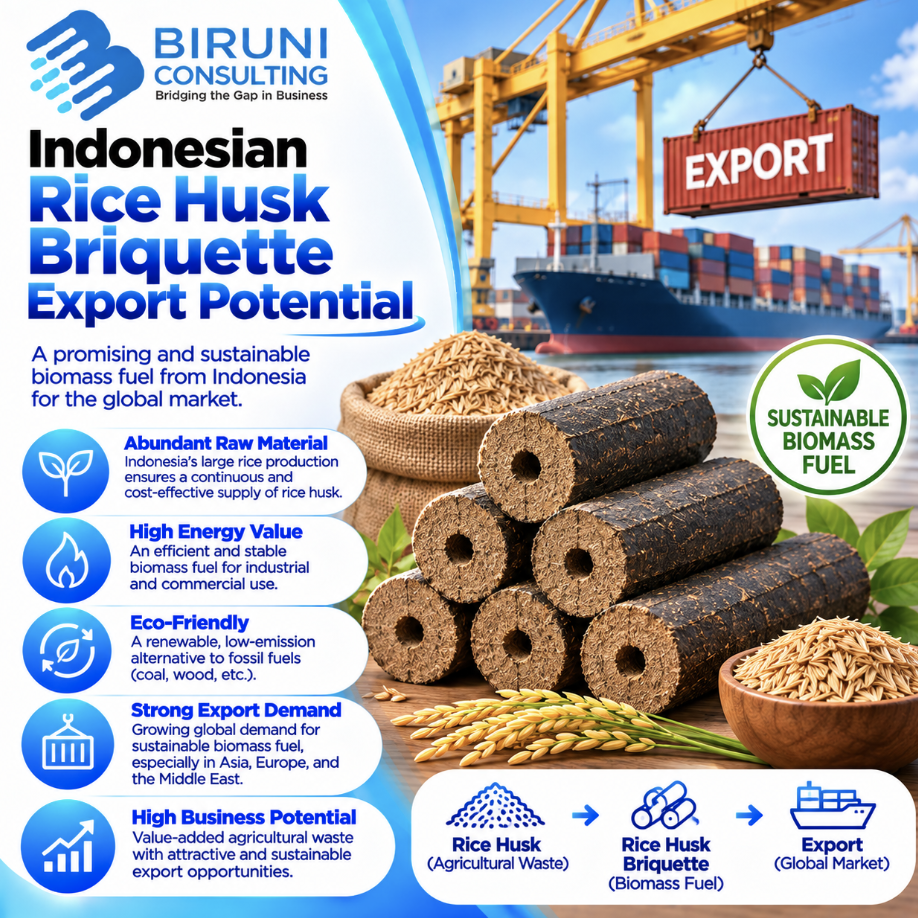
Indonesian Rice Husk Briquettes for the Global Market
Indonesia has a substantial feedstock base for developing rice husk briquettes.
BPS-Statistics Indonesia reported approximately 60.21 million metric tons of dry unhusked paddy production in 2025, an increase of 13.29% from 2024. BPS
Rice husk is one of the primary by-products of milling. Indonesia’s Ministry of Agriculture notes that husk can account for approximately 20–30% of the initial paddy weight, although actual yields vary according to milling conditions. Pustaka BPPSDMP
This combination of large paddy production and extensive milling activity provides Indonesia with a significant potential feedstock base.
For export markets, rice husk gains additional commercial value when processed and densified into briquettes that are easier to store, handle, and transport than loose material.
This creates opportunities to supply international biomass traders, distributors, and industrial users requiring solid fuel for boilers, dryers, furnaces, and process heating.
Why Rice Husk Briquettes Have Export Potential
Loose rice husk has relatively low density, making long-distance transportation less efficient.
Briquetting compresses the material into a more consistent fuel form.
Key advantages include:
- More efficient storage and transportation.
- Easier handling and container loading.
- More consistent fuel dimensions.
- Clearer technical specifications.
- Additional value from agricultural residues.
The export proposition therefore involves more than selling rice husk.
It involves supplying a processed industrial fuel supported by specifications, packaging, quality control, and reliable logistics.
Indonesia’s Feedstock Base
Indonesia’s 60.21 million tons of paddy production in 2025 demonstrates the scale of the country’s potential feedstock base. BPS
However, not all rice husk generated during milling is commercially available for briquetting.
Rice husk has competing uses, while collection economics depend on rice-mill locations, drying, storage, and transportation.
Export-oriented suppliers therefore need relationships with multiple rice mills rather than depending entirely on a single feedstock source.
Raw-material inventory and backup sourcing can also improve long-term supply reliability.
Turning Agricultural Residue Into an Export Product
Rice husk is generated as a by-product of rice milling.
In loose form, it has limited long-distance logistics efficiency.
Densification allows suppliers to create a product with:
higher density + more consistent dimensions + structured packaging + clearer technical specifications.
Indonesia’s Ministry of Agriculture has also documented rice husk briquetting as a way to add value to milling residues. Pustaka BPPSDMP
This value-added processing is one of the key reasons briquettes are more relevant to international trade than loose rice husk.
Solid Biofuel Development in ASEAN
Regional energy trends also support growing interest in solid biomass.
The IEA reports that ASEAN solid-biofuel power capacity increased from approximately 6 GW in 2015 to almost 10 GW in 2025. Indonesia and Thailand represented almost 80% of this capacity, using agricultural, forestry, and industrial residues including rice husks, palm residues, bagasse, and wood waste. IEA
This does not mean all future regional biomass demand will be supplied by Indonesian rice husk briquettes.
It does demonstrate that agricultural residues are increasingly relevant to energy diversification and security across Southeast Asia. IEA
Export Buyers Need More Than a Low Price
International biomass procurement involves more than comparing FOB prices.
Long-term buyers generally require:
competitive pricing + consistent specifications + sufficient volume + reliable logistics + accurate documentation.
A low-price supplier can become expensive when fuel quality changes significantly between shipments.
High moisture, excessive ash, physical breakage, or unreliable shipment schedules can eliminate the initial price advantage.
Indonesia’s export competitiveness therefore depends on both product quality and supply-chain performance.
Rice Husk Briquettes as Non-Woody Biomass
Rice husk originates from cereal crops and falls within the non-woody biomass category.
ISO 17225-7:2021 establishes fuel-quality classes and specifications for graded non-woody briquettes, including herbaceous biomass and by-products from cereal production or processing. As of November 2026, the standard remains published and is undergoing systematic review. ISO
It can provide a useful reference when specifying non-carbonized rice husk briquettes.
However, ISO states that thermally treated biomass briquettes are outside the scope of ISO 17225-7, so carbonized or other thermally treated products require separate evaluation. ISO
Specifications International Buyers Review
Technical information should normally be available before commercial negotiations begin.
| Parameter | Information to Provide |
|---|---|
| Raw Material | Rice husk / actual composition |
| Product Type | Carbonized / non-carbonized |
| Calorific Value | GCV/HHV and/or NCV/LHV |
| Moisture | Percentage and reporting basis |
| Ash | Percentage and reporting basis |
| Proximate Analysis | Volatile matter and fixed carbon |
| Dimensions | Diameter, length and shape |
| Physical Quality | Density, strength or fines |
| Packaging | Bags, jumbo bags or other format |
| Available Capacity | MT per month |
Suppliers with clear specifications and representative laboratory data generally have a stronger basis for international qualification.
Calorific Value
Calorific value is one of the first fuel parameters reviewed.
Suppliers need to clarify whether the reported figure represents:
GCV / HHV
or:
NCV / LHV.
The reporting basis should also be identified.
Dry-basis values cannot simply be compared with as-received results.
For professional export transactions, complete laboratory data are more useful than a single advertised kcal/kg figure.
Moisture Control for Export Supply
Moisture affects useful energy as well as product condition.
Export briquettes may remain in warehouses and containers for several weeks.
The product should therefore be adequately dried before packaging and protected against water during storage and container loading.
A maximum moisture value can be included in the agreed specification.
Consistent moisture control also helps preserve physical quality throughout transportation.
Ash Characteristics
Rice husk has different mineral characteristics from woody biomass.
Industrial buyers should therefore not assume that rice husk briquettes will produce ash behavior similar to wood pellets.
Ash can influence cleaning, residue handling, maintenance, and actual combustion performance.
The commercial evaluation should consider:
calorific value + ash + operating performance.
For certain boilers, additional ash chemistry or melting analysis may also be appropriate.
Physical Strength and Fines
Export products experience multiple handling stages.
The supply chain may include:
factory → warehouse → truck → port → container → ocean freight → destination warehouse → end user.
Poor mechanical strength can result in excessive breakage and fines.
Manufacturers therefore need to control compression, density, dimensions, and packaging.
A trial container provides useful evidence of how physical quality changes after actual international transportation.
Certificate of Analysis
A Certificate of Analysis or CoA is commonly useful during supplier qualification.
It can contain:
- Calorific value and reporting basis.
- Moisture and ash.
- Volatile matter and fixed carbon.
- Contract-specific parameters.
- Batch or sample identification.
Buyers should check whether the report is recent and representative of commercial production.
Historical test results do not necessarily represent every future shipment.
Production Capacity for Export Contracts
International buyers frequently require recurring monthly supply.
Suppose a buyer needs:
500 MT/month.
A manufacturer with 700 MT/month nominal production capacity may still be unable to fulfill the contract if much of that capacity is already committed.
Professional buyers therefore focus on available monthly capacity, not simply machine capacity.
For long-term export contracts, consistency over six or twelve months can be more important than producing one trial container quickly.
Feedstock Security
Reliable briquette production requires dependable rice-husk sourcing.
Suppliers can reduce sourcing risk through multiple rice-mill relationships, raw-material storage, and backup suppliers.
Indonesia has a large national paddy-production base, but individual exporters still need to demonstrate that enough feedstock is actually accessible to support their contracts.
Clear sourcing networks can strengthen buyer confidence in long-term supply.
Batch-to-Batch Consistency
International buyers need repeatable quality.
A successful first shipment is not enough when the next container has materially different moisture or ash.
Recurring contracts may therefore establish:
minimum calorific value + maximum moisture + maximum ash + dimensional tolerance + agreed testing methods.
These acceptance criteria make quality expectations clearer for both parties.
Consistent production can become a major competitive advantage for Indonesian exporters.
Samples, Trial Shipments and Boiler Tests
Supplier qualification can begin with a small sample for laboratory and physical evaluation.
A larger quantity or trial container can follow once the basic specification is accepted.
For industrial applications, boiler trials can evaluate:
- Fuel consumption and useful heat output.
- Feeding and combustion stability.
- Ash generation.
- Cleaning requirements.
- Total operating cost.
Actual trial performance often provides more useful procurement information than calorific value alone.
FOB Pricing and Export Competitiveness
FOB prices can include several costs beyond manufacturing.
A simplified cost structure is:
Product + Packaging + Inland Transportation + Export Handling + Port-Related Costs + Documentation
Production location relative to the port can therefore influence competitiveness.
A low factory price can lose some of its advantage when inland transportation costs are high.
Efficient logistics are an important part of successful export pricing.
FOB, CFR and CIF
Export quotations should state their commercial terms clearly.
For example:
USD XXX/MT – FOB Tanjung Priok, Indonesia
or:
USD XXX/MT – CIF Port Klang, Malaysia.
FOB, CFR, and CIF allocate costs and responsibilities differently.
International buyers need the Incoterm and named port to calculate landed cost accurately.
A generic “export price” is usually insufficient for professional comparison.
Container Loading
Densification improves shipping practicality compared with loose rice husk.
Actual container payload, however, depends on density, packaging, palletization, container type, and weight restrictions.
Suppliers should therefore provide an estimated loading quantity based on the proposed configuration.
International buyers should distinguish between net product weight, gross cargo weight, and total container gross weight.
Efficient container utilization can reduce ocean-freight cost per metric ton.
Export Packaging
Rice husk briquettes can be supplied in woven bags, big bags, jumbo bags, or buyer-specific packaging.
Labels may include product name, net weight, country of origin, production or batch identification, and other agreed information.
Private-label packaging can also support distributor markets.
Customized packaging, however, affects material costs and loading efficiency and should therefore be discussed during quotation.
Indonesian Export Procedures
Administrative readiness is an essential part of export capability.
Indonesian Customs requires commercial exports to follow the applicable Pemberitahuan Ekspor Barang (PEB)process and related customs procedures.
Since August 3, 2026, specified PEB supporting documents must also be uploaded electronically. Invoice and packing list are required during initial submission, while relevant transport documents such as the Bill of Lading follow the prescribed supporting-document mechanism. Beacukai
International buyers should therefore consider documentation capability when qualifying exporters.
Certificate of Origin
A Certificate of Origin, known in Indonesia as Surat Keterangan Asal or SKA, provides evidence of Indonesian origin.
Indonesia’s e-SKA system distinguishes between preferential and non-preferential certificates. Preferential SKA can support reduced or exempt import tariffs where the goods satisfy the applicable Rules of Origin and trade-agreement requirements. e-ska.kemendag.go.id
A Certificate of Origin does not automatically guarantee zero duty.
The parties still need to verify tariff classification, the applicable agreement, Rules of Origin, and the correct certificate type.
HS Classification Requires Verification
Rice husk briquettes should not automatically use the same tariff classification as wood briquettes merely because both are densified fuels.
Classification can depend on actual material composition, carbonized or non-carbonized status, manufacturing process, and applicable customs rules.
HS classification can affect customs declarations, import duties, origin documentation, and destination requirements.
It should therefore be resolved before recurring commercial shipments begin.
Destination-Country Requirements
Indonesian export clearance covers only the Indonesian side of the transaction.
The importer must also satisfy destination-country rules.
Depending on the market, requirements can involve customs classification, import permits, biosecurity or treatment where applicable, labeling, packaging, and product specifications.
Exporters should request a destination-country document checklist before commercial shipment.
Problems identified after vessel departure can result in significant delays and additional cost.
Sustainability and Traceability
Sustainability is becoming increasingly relevant in international biomass markets.
The IEA identifies sustainable solid biofuels as a complementary domestic energy resource for ASEAN while emphasizing the importance of secure supply and credible sustainability frameworks. IEA
Rice husk has the advantage of being an agricultural by-product.
Exporters may still need to address feedstock traceability, processing energy, logistics distances, and buyer-specific sustainability requirements.
Claims such as “carbon neutral” should be supported by appropriate methodology and evidence.
Competition With Other Biomass Fuels
Rice husk briquettes compete with wood pellets, wood briquettes, palm kernel shells, wood chips, and other agricultural biomass fuels.
Industrial buyers generally compare:
price + energy value + ash + handling + storage + availability + total operating cost.
Rice husk briquettes therefore need to compete as a reliable industrial fuel, not simply as a low-cost biomass product.
Consistent quality and supply can be as important as the initial quotation.
Regional and Global Market Opportunities
Southeast Asia represents one relevant environment for solid-biofuel development.
The IEA’s 2026 review shows increasing regional interest in sustainable solid biofuels as ASEAN addresses rising energy requirements and supply-security challenges. IEA
Potential customers can include power and industrial-heat users, food processors, agricultural processors, and factories with compatible biomass boilers.
However, each market may have different import and technical requirements.
Exporters should therefore develop destination-specific strategies rather than use one specification for every buyer.
Manufacturer, Trader or Aggregator?
International customers may source from manufacturers, traders, or aggregators.
Manufacturers control production directly.
Traders can offer sourcing flexibility.
Aggregators may combine output from several facilities to meet larger requirements.
No structure is automatically superior.
Buyers generally focus on:
traceability + specification consistency + available capacity + documentation + delivery performance.
Transparency regarding actual production sources becomes more important as contract volumes increase.
Improving Indonesia’s Export Competitiveness
Indonesia already has significant feedstock potential.
The next challenge is converting that potential into dependable export supply.
Important priorities include:
- Standardized specifications and quality control.
- Reliable feedstock sourcing and available monthly capacity.
- Representative Certificates of Analysis.
- Efficient packaging and container loading.
- Correct classification and export documentation.
- Proven performance through samples and trial shipments.
The strongest commercial proposition is not simply rice husk briquettes, but reliable industrial biomass supply from Indonesia.
Information Exporters Need From Buyers
Exporters also need clear information from potential customers.
A professional RFQ should ideally contain:
product type + technical specification + trial volume + monthly demand + destination port + packaging + Incoterm + inspection/document requirements.
A request asking only for the “best price” does not provide enough information for accurate costing.
Clear buyer requirements allow exporters to evaluate technical feasibility, production capacity, and logistics before quoting.
How Global Buyers Evaluate Indonesian Suppliers
Supplier qualification can follow several practical stages.
1. Technical Screening
Review specifications, CoA, feedstock, samples, and physical quality.
2. Capacity Verification
Confirm actual production, available capacity, raw-material sourcing, and storage.
3. Trial Shipment
Use a representative trial quantity or container.
4. Commercial Evaluation
Compare FOB or CIF prices with actual fuel performance.
5. Long-Term Supply
Move to recurring contracts after the supplier demonstrates consistent quality and delivery.
A staged process helps reduce technical and supply-chain risks for both parties.
Long-Term Export Contracts
Recurring contracts should cover more than unit price.
Important areas include:
technical specification + monthly volume + Incoterm + payment terms + shipment schedule + sampling + inspection + off-specification procedure.
Longer agreements may also include price-review mechanisms where feedstock, trucking, or freight costs change materially.
Suppliers should maintain enough operational flexibility so routine production interruptions do not immediately cause missed shipments.
Challenges for Indonesian Rice Husk Briquette Exports
The export opportunity remains subject to several challenges.
Feedstock variations can influence quality. Rice-husk ash differs from woody-biomass ash. Inland transportation can reduce competitiveness when production facilities are far from ports. Destination-country requirements also vary.
Production capacity is also of limited value without secure feedstock and consistent quality control.
Export development should therefore be treated as a complete supply-chain opportunity, not simply an abundance of rice husk.
Outlook for Indonesian Rice Husk Briquettes
Indonesia’s 60.21 million tons of paddy production in 2025 creates a substantial base for utilizing rice-milling by-products. The Ministry of Agriculture notes that rice husk can generally represent approximately 20–30% of initial paddy weight. BPS
On the demand side, the IEA shows that solid biofuels, including rice-husk-based resources, are increasingly relevant within ASEAN’s energy system. IEA
Indonesia therefore has meaningful export potential where feedstock can be converted into products meeting technical specifications, quality consistency, competitive economics, sustainability expectations, logistics requirements, and export compliance.
Conclusion
Indonesian rice husk briquettes have potential to develop further as a solid biomass fuel for international markets.
Indonesia benefits from a large rice-production base, agricultural residues across multiple regions, and opportunities to create additional value through densification.
Feedstock abundance alone, however, is not enough.
Competitive exporters need to provide:
consistent product quality + reliable monthly capacity + competitive landed economics + accurate documentation + dependable shipment performance.
For international industrial buyers, this combination is ultimately more important than simply obtaining the lowest FOB quotation.
Contact Us
Biruni Consulting can assist companies that require information and support regarding product requirements, documentation, and compliance processes related to product importation, marketing, or use according to business requirements in Indonesia.
The services that can be supported include:
- Consultation on product requirements for industrial needs.
- Initial assessment of product specifications and applications.
- Technical document review.
- Review of product specifications and information.
- Consultation on applicable regulatory requirements according to the product type and business activities.
- Assistance in preparing required documents.
- Consultation on certification or licensing processes when required based on the product characteristics and intended use.
Contact Biruni Consulting for information regarding product requirements, documentation, certification, and compliance needs to support business activities and product marketing in Indonesia.