
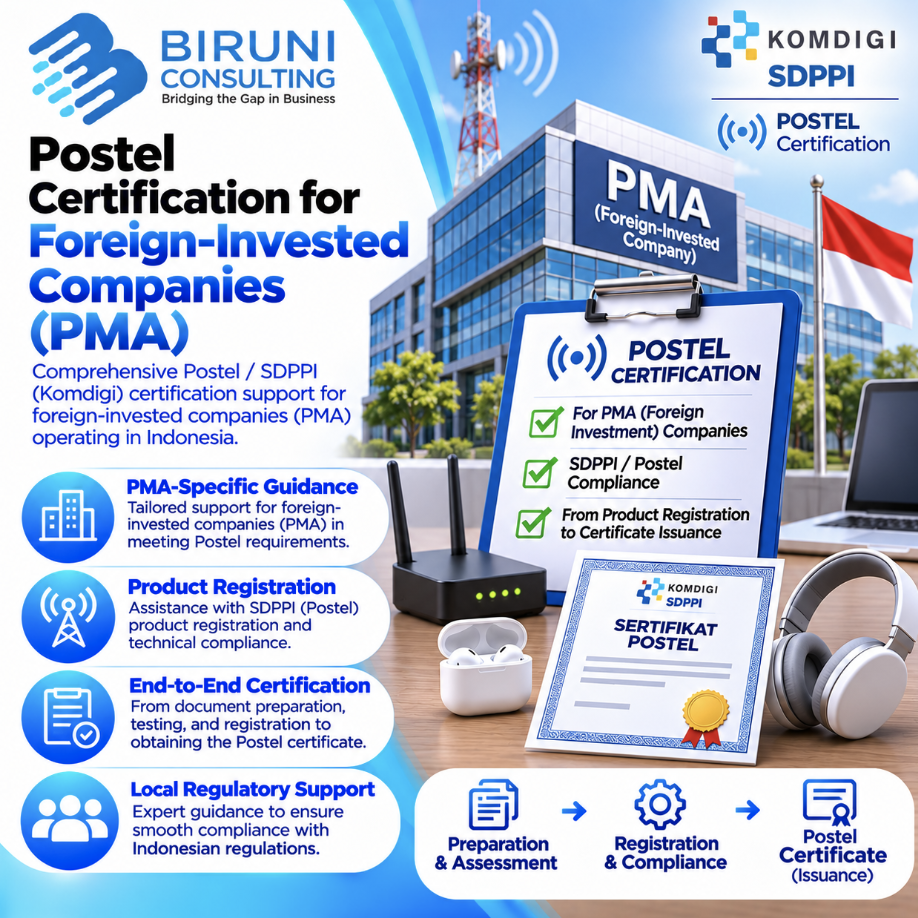
A guide to DJID/SDPPI Certification for foreign investment companies importing or marketing wireless equipment in Indonesia
An Indonesian foreign investment company, commonly referred to as a PMA company, may import, distribute, manufacture, or use a wide range of telecommunications and wireless products. These can include routers, Bluetooth equipment, IoT devices, wireless printers, smartwatches, modems, smart appliances, and computer peripherals.
Foreign ownership itself does not automatically prevent an Indonesian PMA company from becoming a Certificate applicant. The more important issue is whether the Indonesian business entity falls within one of the recognised applicant categories, has the required NIB and OSS access, and has a clearly documented relationship with the equipment and trademark.
Regulation Number 3 of 2024 defines eligible business applicants according to their relationship with the trademark, manufacturing, distribution, or use of the equipment rather than distinguishing them as domestic-investment or foreign-investment companies. JDIH Komdigi
Can a PMA Company Apply for Postel Certification?
In principle, yes.
Eligible business applicants include an Indonesian registered trademark holder, an appointed representative or distributor of a trademark holder, a manufacturer or assembler working for a trademark holder, a manufacturer or assembler itself, and a business using the equipment for its own purposes. JDIH Komdigi
A PMA company’s role in relation to the product should therefore be established before the application is prepared.
An Indonesian PMA Company Is an Indonesian Business Entity
An Indonesian PMA entity should be distinguished from its foreign shareholder or overseas parent company.
Indonesia’s investment framework uses an Indonesian limited-liability-company structure for foreign investment companies, and the OSS system records the investment status of a PT as PMA or PMDN. Invest Indonesia
An overseas parent company and its Indonesian PMA subsidiary are therefore not interchangeable legal entities.
The Indonesian applicant information used in OSS and e-Sertifikasi should correspond to the actual entity applying for the Certificate.
NIB and OSS Access
Business applications for telecommunications Certificates are submitted through OSS integrated with the certification service system.
DJID’s current e-Sertifikasi requirements list a valid NIB and OSS service access among the general requirements for a new Certificate. JDIH Komdigi
Before certification begins, the PMA company should therefore make sure that its OSS business profile and administrative information are current.
Indonesia’s broader risk-based business-licensing framework is currently governed by Government Regulation Number 28 of 2025 and the corresponding 2025 investment/OSS implementing regulation. jdih.bkpm.go.id
PMA Company as Distributor of a Foreign Brand
A common structure involves an Indonesian PMA subsidiary acting as the distributor or representative of an overseas trademark owner.
For example:
Brand Owner: Japanese company
Manufacturer: Chinese factory
Indonesian Applicant: Indonesian PMA company
Current e-Sertifikasi requirements specify an appointment letter from the foreign trademark owner where an Indonesian business entity applies as its officially appointed representative or distributor. e-Sertifikasi NextGen
The relationship between the overseas brand owner and Indonesian Certificate applicant should therefore be documented clearly.
PMA Company as Trademark Owner
An Indonesian PMA company may also own a trademark registered in Indonesia.
Where an Indonesian legal entity applies as the trademark owner, current e-Sertifikasi requirements request documentation demonstrating compliance with Indonesian trademark-ownership requirements. e-Sertifikasi NextGen
The trademark should remain consistent across the product, Certificate application, photographs, technical documents, and commercial labeling.
Foreign investment status does not change this requirement.
Overseas Parent and Indonesian Subsidiary
A multinational corporate structure requires particular care.
For example:
Global Brand Owner: ABC Electronics Ltd.
Indonesian Subsidiary: PT ABC Electronics Indonesia
Even where both companies belong to the same corporate group, they remain different legal entities.
Where the Indonesian PMA company applies as the foreign brand owner’s representative or distributor, the certification documentation should reflect that relationship correctly.
Corporate affiliation alone should not automatically be assumed to replace the documentation required for the selected applicant category.
PMA as Manufacturer or Assembler
Some foreign investment companies manufacture or assemble telecommunications equipment in Indonesia.
Regulation Number 3 of 2024 recognises manufacturers and assemblers, including manufacturers or assemblers working for a trademark owner, among the eligible business-applicant categories. JDIH Komdigi
The manufacturer, trademark owner, model, technical configuration, and country of manufacture should remain consistent across the application documentation.
Country of manufacture is especially important because the regulation provides for separate Certificates where the same brand and type originate from different countries. JDIH Komdigi
Equipment Imported for the Company’s Own Use
A PMA company may import equipment for internal operations rather than commercial distribution.
Examples can include wireless industrial equipment, IoT gateways, communications terminals, or equipment used in a factory or office.
Businesses using telecommunications equipment for their own purposes are also recognised as an applicant category under Regulation Number 3 of 2024. JDIH Komdigi
Current e-Sertifikasi requirements specify a declaration that such equipment will be used only for the applicant’s own purposes. e-Sertifikasi NextGen
Internal use and commercial distribution should therefore be distinguished early in the certification project.
General Certification Documents
Current requirements for a new Certificate include:
- NIB and OSS access.
- Laboratory test report or LHU.
- Technical specifications.
- Declaration of Conformity.
- Colour photographs showing the brand and model/type.
- A declaration that submitted information and documents are correct and complete. e-Sertifikasi NextGen
Additional documents depend on the applicant structure and equipment category.
The PMA company should therefore determine its applicant role before preparing the full certification package.
Reports Supplied by Headquarters or Overseas Manufacturers
Multinational companies often obtain laboratory reports from their global headquarters or overseas factories.
These may include CE, FCC, ETSI, Bluetooth, WiFi, cellular, or other RF reports.
Indonesia’s current e-Sertifikasi requirements require the LHU/test report to come from a designated domestic laboratory or recognised overseas laboratory. e-Sertifikasi NextGen
The laboratory status, tested model, RF configuration, frequency, transmission power, antennas, and Indonesian Technical Standard therefore still need to be reviewed.
Using Module Test Reports
A product imported by a PMA company may use a Bluetooth, WiFi, cellular, or other RF module with an existing test report.
Current e-Sertifikasi requirements for a module LHU include a block diagram, a photograph showing the installed module, and a declaration linking the module brand/type to the brand, type, and variant of the final equipment. e-Sertifikasi NextGen
An existing module report therefore does not automatically cover every final device in which the module is installed.
Final-product integration remains relevant.
OEM Products Imported by PMA Companies
PMA companies may also sell OEM or private-label products.
Manufacturing can be performed by an overseas affiliated company or an independent OEM factory while the Indonesian PMA entity owns or distributes the commercial brand.
The certification structure should clearly establish:
applicant → trademark owner → manufacturer → country of manufacture → model → RF configuration → laboratory report.
Regulation Number 3 of 2024 also makes clear that a telecommunications Certificate is not evidence of trademark ownership or agency appointment. JDIH Komdigi
Trademark and commercial relationships therefore remain separate from equipment conformity certification.
Certification and Import Licensing Are Different
Being a Certificate holder and being properly authorised to conduct the relevant import or trading activity are related but separate compliance matters.
DJID Certification addresses conformity with telecommunications Technical Standards.
The company’s commercial activities must separately remain consistent with its NIB, business activities, risk-based licensing, and applicable import requirements.
Indonesia’s current business-licensing framework is based on Government Regulation Number 28 of 2025 and the current OSS implementing rules. jdih.bkpm.go.id
A Postel Certificate therefore does not replace the company’s broader business or import licensing obligations.
Brand, Model, and Manufacturing Country
Multinational supply chains frequently use several manufacturing locations.
The same brand and commercial model may be produced in China, Vietnam, Thailand, or another country.
Regulation Number 3 of 2024 provides that the same brand and equipment type originating from different countries requires separate evidence of conformity through different Certificates. JDIH Komdigi
A PMA company should therefore confirm the manufacturing country before establishing its certification strategy.
Changing factories or sourcing countries should trigger a regulatory review.
Keep OSS Data Consistent
Administrative information in OSS should remain current.
The e-Sertifikasi portal specifically instructs business applicants to ensure that OSS information has been updated where the Certificate holder’s name or address changes. e-Sertifikasi NextGen
This is particularly relevant for multinational companies undergoing corporate restructuring, office relocation, or legal-entity changes during a product’s lifecycle.
Labeling Obligations
After certification, the PMA company acting as Certificate holder also becomes responsible for certification labeling.
Current e-Sertifikasi requirements state that Certificate holders must implement the Label, QR Code, and Warning Signand report implementation within 30 working days after Certificate issuance. e-Sertifikasi NextGen
Where the product is manufactured overseas, regulatory artwork should be coordinated with the factory before commercial shipment.
The Certificate number and PLG ID should correspond to the correct Indonesian Certificate holder.
Certificate Period and Recurring Imports
Under Regulation Number 3 of 2024, the Certificate itself is not time-limited.
However, the Certificate holder may manufacture, assemble, or import the certified equipment for trade and/or use in Indonesia for up to three years from the Certificate issuance date. Continued activity after that period requires renewed compliance with the Technical Standards and a new Certificate. JDIH Komdigi
PMA companies making recurring imports should therefore include Certificate dates in their regulatory and product-lifecycle planning.
Define the Structure Before Applying
Before certification begins, a PMA company should establish several points.
Is the Indonesian entity acting as the trademark owner, official distributor, manufacturer, or end user? Is the brand owned by the Indonesian company or its overseas parent? Who manufactures the equipment? Which manufacturing country and exact product model will be imported? Do the test reports correspond to that configuration?
The company should also verify that its NIB and OSS profile are correct because business applications are processed through the integrated OSS certification route. JDIH Komdigi
Defining these points early can prevent administrative problems after testing has already been completed.
Why Pre-Import Assessment Matters
A multinational company may have access to extensive global compliance documentation, but those documents do not automatically establish Indonesian compliance.
A global product family can contain different regional models, factories, antennas, wireless modules, firmware, and frequency configurations.
Pre-import assessment helps confirm the applicant, trademark owner, manufacturer, exact model, country of manufacture, test reports, modules, antennas, frequencies, transmission power, and applicable Indonesian Technical Standards.
This reduces the risk of discovering certification inconsistencies after commercial production or shipment.
Conclusion
An Indonesian PMA company can apply for Postel/DJID Certification where it falls within one of the applicant categories established by Regulation Number 3 of 2024. The certification rules classify business applicants according to their relationship with the trademark, manufacturing, distribution, or use of the equipment rather than according to PMA or PMDN status. JDIH Komdigi
New applications require NIB and OSS access together with laboratory reports, technical specifications, a Declaration of Conformity, product photographs, and other applicable supporting documents. e-Sertifikasi NextGen
Where the Indonesian PMA company represents or distributes a foreign-owned brand, an official appointment letter is relevant. Where it owns the Indonesian trademark itself, trademark documentation becomes applicable. e-Sertifikasi NextGen
Defining the applicant structure, trademark ownership, manufacturer, model, manufacturing country, and laboratory evidence before importation can make the DJID/SDPPI Certification process significantly more structured.
Contact Us
Biruni Consulting assists with DJID/SDPPI assessment and certification for foreign investment companies in Indonesia and various wireless products that will be imported or marketed in Indonesia.
Our services include:
- Assessment of DJID/SDPPI certification requirements.
- Transmitter and receiver assessment.
- RF specification review.
- Frequency and transmission power analysis.
- Technical document review.
- Certification document preparation.
- Testing coordination where required.
- DJID/SDPPI Certification assistance.
If you have a wireless product through an Indonesian PMA company, you can prepare product photos, brand, model, datasheet, RF specifications, and wireless module datasheet for an initial assessment of the Postel Certification requirements.