
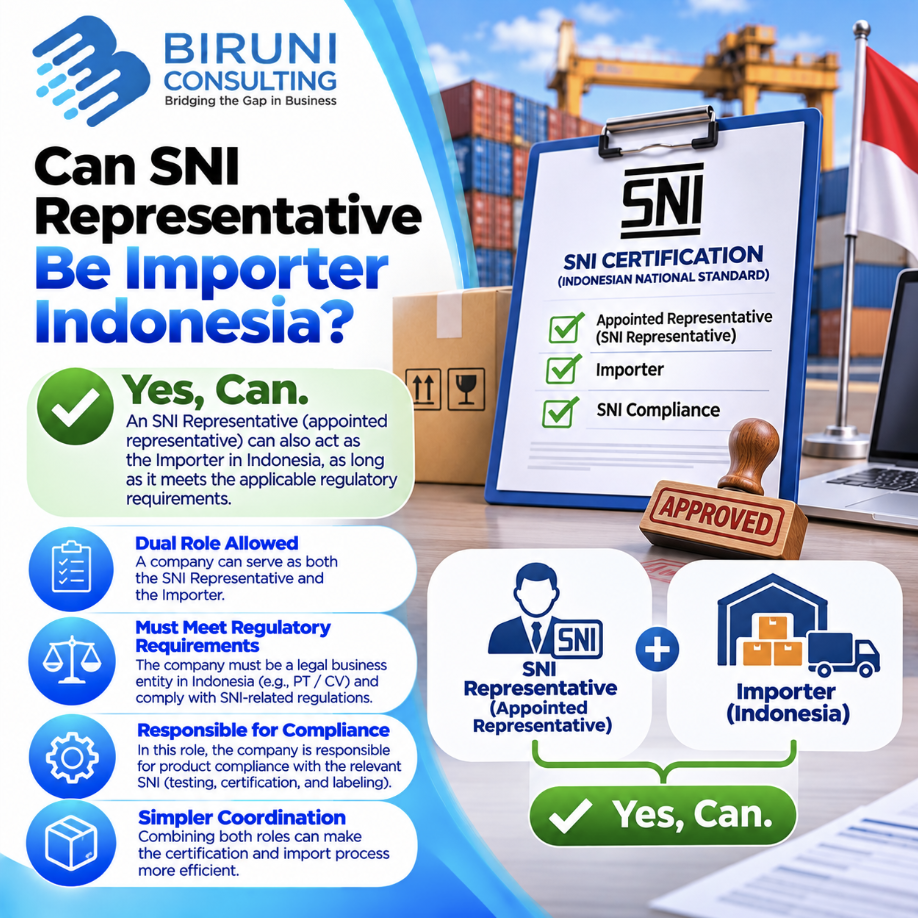
Can an SNI Official Representative Also Act as an Importer in Indonesia?
Can SNI Representative Be Importer Indonesia? Yes, but not automatically and not under the same rules for every SNI product. An Official Representative of an Overseas Manufacturer can also act as an Importer where the applicable product-specific regulation permits the arrangement and the Indonesian company separately satisfies all requirements applicable to an Importer.
The distinction is important because an Official Representative and an Importer perform different regulatory functions. The Official Representative generally exists under a specific Mandatory SNI regulation to represent an Overseas Manufacturer for certification and compliance. The Importer brings goods into the Indonesian customs territory and performs import and customs obligations.
Under Indonesia’s general import framework, Minister of Trade Regulation No. 16 of 2025 requires an Importer to hold an NIB functioning as an API. The regulation became effective on August 29, 2025 and has subsequently been amended, including through the second amendment under Minister of Trade Regulation No. 18 of 2026, effective June 4, 2026. Database Peraturan | JDIH BPK
Appointment as an SNI Representative therefore does not automatically create the legal ability to conduct commercial importation. Importer eligibility remains a separate compliance issue.
What Is an SNI Representative Indonesia?
An SNI Representative Indonesia or Official Representative is an Indonesian company appointed by an Overseas Manufacturer where the applicable Mandatory SNI regulation requires a local representative.
The role is product specific. Not every imported product or every product associated with an SNI requires an Official Representative.
Depending on the scheme, responsibilities can include:
- Representing the Overseas Manufacturer during certification.
- Managing applications through SIINas.
- Managing appointment and trademark-licensing documentation.
- Maintaining required warehousing arrangements.
- Managing SPPT SNI and continuing compliance.
The actual responsibilities need to be established from the applicable product regulation.
What Is an Importer Indonesia?
An Importer Indonesia is the party carrying out importation into Indonesia.
Minister of Trade Regulation No. 16 of 2025 expressly requires the Importer to hold an NIB functioning as an API. Certain goods can also require specific Import Business Licensing before entering Indonesia. Database Peraturan | JDIH BPK
The Importer therefore has legal and operational responsibilities that are distinct from those of the Official Representative.
Short Answer: Can SNI Representative Be Importer Indonesia?
Yes. An SNI Representative can act as the Indonesian Importer where the product regulation permits the arrangement and the Representative satisfies the Importer requirements.
A particularly clear example is the Mandatory SNI regulation for lubricating oil. Minister of Industry Regulation No. 8 of 2025 expressly states that the Official Representative can act as Importer for lubricating oil manufactured by the Overseas Manufacturer it represents. Database Peraturan | JDIH BPK
This should not, however, be treated as a universal rule for every Mandatory SNI product.
Product-Specific Regulation Is the Main Basis
Official Representative status does not arise from Indonesia’s general import regulation.
It comes from regulations that impose Mandatory SNI on specified product categories.
Minister of Industry Regulation No. 8 of 2025 regulates Mandatory SNI for lubricating oil and has been effective since July 24, 2025. Minister of Industry Regulation No. 15 of 2025 regulates Mandatory SNI for motor-vehicle safety glass and has been effective since October 25, 2025. Both remain in force. Database Peraturan | JDIH BPK
The local-party structure should therefore be designed only after the applicable product regulation is identified.
Lubricating Oil Example
Minister of Industry Regulation No. 8 of 2025 provides one of the clearest examples of the relationship among an Overseas Manufacturer, Official Representative, and Importer.
An Overseas Manufacturer of lubricating oil needs an Official Representative. The regulation requires that Representative, among other matters, to:
- be appointed by the Overseas Manufacturer;
- maintain the specified trademark-licensing responsibility;
- control a warehouse;
- be able to act as Importer; and
- maintain a SIINas account. Database Peraturan | JDIH BPK
One Indonesian legal entity can therefore perform the roles of Official Representative + Importer where all applicable requirements are satisfied.
Structure Where the Representative Is Also Importer
For lubricating oil, a possible structure is:
Overseas Manufacturer → Official Representative + Importer → Distributor
The same Indonesian company performs regulatory representation and physical importation.
The principal benefit is a reduced number of parties requiring coordination.
The regulatory and importer responsibilities nevertheless remain legally distinct.
The Representative Does Not Have to Be the Importer
The Official Representative does not always need to import directly.
Regulation No. 8 of 2025 states that where the Official Representative does not act as Importer for lubricating oil, it can appoint up to five Importers. Database Peraturan | JDIH BPK
Another possible structure is therefore:
Overseas Manufacturer → Official Representative → Importer A / Importer B / Importer C
This approach can provide additional commercial flexibility.
One Representative with Multiple Importers
Multiple Importers can be useful where an Overseas Manufacturer operates several distribution channels.
The Official Representative can retain the regulatory relationship with the manufacturer while physical imports are conducted by several eligible Importers where the regulation permits.
The five-Importer limit under the lubricating-oil regulation is product specific.
It should not automatically be applied to other Mandatory SNI products. Database Peraturan | JDIH BPK
Changing the Importer for Lubricating Oil
Although the Importer is not necessarily the SNI Certificate Holder, changing the Importer can still affect certification.
Under Regulation No. 8 of 2025, a change to the Importer or its information before the SNI Certificate expires requires the Official Representative to apply for an amendment to the issued Certificate. Database Peraturan | JDIH BPK
An Overseas Manufacturer should therefore not replace the Importer through a commercial agreement alone without regulatory review.
Changing the Official Representative
Changing the Official Representative can have even more significant consequences.
For lubricating oil, if the Overseas Manufacturer replaces the Official Representative before the SNI Certificate expires, the Certificate is deemed to expire. Database Peraturan | JDIH BPK
Selecting an Official Representative is therefore a long-term regulatory decision rather than merely a logistics arrangement.
Motor-Vehicle Safety Glass Example
Minister of Industry Regulation No. 15 of 2025 provides another example where an Official Representative can perform the Importer function.
The regulation states that the Official Representative can act as Importer for motor-vehicle safety glass manufactured by the Overseas Manufacturer it represents. Database Peraturan | JDIH BPK
The regulation also contains a specific alternative importer structure, making it different from the lubricating-oil framework.
Separate Importer for Motor-Vehicle Safety Glass
For safety glass imported as raw material for four-wheeled or larger motor-vehicle assembly activities under KBLI 29101, Regulation No. 15 of 2025 allows the Official Representative to appoint an Importer.
That Importer needs additional qualifications, including appropriate industrial Business Licensing, appointment by the Official Representative, a specified subsidiary/parent/affiliate relationship, and a joint warehousing arrangement. Database Peraturan | JDIH BPK
This demonstrates that Importer eligibility for Mandatory SNI products can be significantly more specific than simply holding an NIB/API.
Not Every SNI Product Uses the Same Structure
One major mistake is applying one product regulation to every Mandatory SNI product.
Minister of Industry Regulation No. 9 of 2025 for tires, Regulation No. 8 of 2025 for lubricating oil, and Regulation No. 15 of 2025 for motor-vehicle safety glass are separate product-specific regulations with their own conformity-assessment and local-party requirements. Database Peraturan | JDIH BPK
The first question should therefore always be:
What is the product and which regulation applies to it?
SNI Representative vs Importer Indonesia
The main differences can be summarized as follows:
| Area | SNI Representative | Importer |
|---|---|---|
| Main function | Represents the Overseas Manufacturer in the regulatory structure | Imports goods |
| Legal basis | Product-specific SNI regulation | Import and customs framework |
| Manufacturer appointment | Generally required | Depends on the structure |
| NIB/API | Required if also acting as Importer | Required |
| SIINas | Often relevant under certain Mandatory SNI schemes | Not automatic |
| SNI Certificate | Not automatically the holder | Not automatically the holder |
| PIB | Not automatic | Part of Importer responsibility |
| Customs duties/import taxes | Not automatic | Part of Importer responsibility |
| Warehouse | Can be required by product regulation | Depends on the structure |
| SPPT SNI | Can have a specific role | Not automatic |
| One legal entity can perform both functions, but the requirements applicable to each function remain separate. |
NIB/API Is Still Required
Official Representative appointment does not replace Importer requirements.
Minister of Trade Regulation No. 16 of 2025 requires Importers to hold an NIB functioning as an API. Database Peraturan | JDIH BPK
Accordingly:
Appointment as Official Representative ≠ automatic authority to import.
Where the Representative intends to conduct importation, its Importer eligibility needs separate review.
API-U and API-P
Regulation No. 16 of 2025 distinguishes an NIB functioning as an API into API-U and API-P and requires the Importer to use the structure corresponding with its activities. Database Peraturan | JDIH BPK
The Importer structure needs to correspond with the company’s actual business activities and use of imported goods.
Product-specific regulations can impose additional requirements.
Business Licensing
A company acting as both Representative and Importer also needs Business Licensing supporting all activities it actually conducts.
Government Regulation No. 28 of 2025 currently governs Risk-Based Business Licensing. It became effective on June 5, 2025, replaced Government Regulation No. 5 of 2021, and covers Business Licensing, PB UMKU, OSS, supervision, evaluation, and sanctions. Database Peraturan | JDIH BPK
The existence of a legal entity and NIB alone does not necessarily satisfy every activity performed by the company.
KBLI
KBLI should correspond with the company’s actual activities.
Where the Official Representative also conducts wholesale trading, importation, distribution, warehousing, or specified industrial activities, the relevant KBLI and Business Licensing need to support those functions.
The motor-vehicle safety-glass regulation demonstrates how a product regulation can impose a specific requirement such as KBLI 29101 for a particular appointed Importer. Database Peraturan | JDIH BPK
KBLI assessment should therefore occur before appointment.
Customs Access
An Official Representative acting as Importer also needs customs operational readiness.
Indonesia Customs explains that Importers/Exporters are treated as satisfying Customs Registration requirements after holding an NIB functioning as TDP, API, and Customs Access. Customs registration information is integrated with OSS NIB and taxpayer information. Beacukai
The ability to serve as Official Representative therefore does not itself mean the company’s customs setup is ready.
PIB
The Importer has responsibilities concerning the Import Customs Declaration or PIB.
For Imports for Use, the Importer prepares the PIB from Supporting Customs Documents. These documents can include the Invoice, Packing List, Bill of Lading or Air Waybill, product-identification records, and documentation demonstrating compliance with import requirements. Beacukai
Where the Official Representative also acts as Importer, it performs these functions in addition to regulatory representation.
Customs Duty and Import Taxes
Indonesia Customs uses a self-assessment approach for Imports for Use.
The Importer is responsible for calculating, paying, and depositing applicable Customs Duty, Excise, and/or Import Taxes based on the PIB. Beacukai
An Official Representative that does not act as Importer does not automatically assume those obligations.
This is one of the clearest distinctions between the two roles.
Prohibitions and Restrictions
The Importer is also responsible for satisfying applicable prohibitions and restrictions.
Restricted goods can only be released after the Importer complies with requirements imposed by the relevant authority, and the Importer is responsible for declaring applicable restrictions in the PIB. Indonesia Customs also recommends checking these requirements before shipment. Beacukai
For Mandatory SNI products, certification can represent one regulatory layer that needs to be resolved before commercial importation.
Importer Readiness and SNI Readiness Are Different
A company can be ready to import while product certification remains incomplete.
Conversely, the SNI Certificate can be available while the Importer structure is not yet ready.
Market-entry planning should therefore use two parallel workstreams:
- SNI readiness — product scope, LSPro, testing, factory audits, SNI Certificate, SPPT SNI, SIINas, and labeling.
- Importer readiness — NIB/API, Business Licensing, Customs Access, Import Business Licensing, PIB, restrictions, and shipping documents.
Commercial shipment should generally follow completion of both.
The Representative Is Not Automatically the SNI Certificate Holder
An Official Representative is also not automatically the SNI Certificate Holder.
Under the lubricating-oil regulation, the SNI Certificate is issued to an Industrial Company or Overseas Manufacturer. For imported products, the Certificate additionally identifies the Official Representative and its warehouse. Database Peraturan | JDIH BPK
The Representative can therefore appear on the Certificate without automatically becoming its legal holder.
The Importer Is Not Automatically the SNI Certificate Holder
The Importer is likewise not automatically the SNI Certificate Holder.
NIB/API establishes Importer eligibility rather than ownership of product certification.
The lubricating-oil structure demonstrates that certification remains connected with the Industrial Company or Overseas Manufacturer while the Representative and Importer perform separate functions. Database Peraturan | JDIH BPK
Statements that an “Importer owns the SNI” should therefore be checked against the actual Certificate and regulation.
SPPT SNI
The SNI Certificate also needs to be distinguished from SPPT SNI.
Under the lubricating-oil regulation, after the product has an SNI Certificate, use of the SNI Mark requires approval in the form of SPPT SNI. Database Peraturan | JDIH BPK
The applicable product regulation can determine a different applicant or holder for SPPT SNI.
The Representative, Importer, SNI Certificate Holder, and SPPT SNI party should therefore be mapped separately.
SIINas
SIINas or the National Industrial Information System plays an important role in many Ministry of Industry Mandatory SNI schemes.
For lubricating oil, the Overseas Manufacturer submits the SNI Certificate application through its Official Representative electronically through SIINas. Database Peraturan | JDIH BPK
This demonstrates a certification function belonging to the Representative that a separate Importer does not automatically perform.
LSPro
An LSPro or Lembaga Sertifikasi Produk / Product Certification Body conducts conformity assessment under the applicable certification scheme.
The Official Representative is not the LSPro.
The Importer is not the LSPro.
A consultant is also not the LSPro.
Combining the Representative and Importer roles does not change the independent conformity-assessment process.
Laboratory Testing
Mandatory SNI certification can require laboratory testing.
A Representative acting as Importer does not become the conformity-testing body.
Testing still needs to follow the applicable standard, sampling requirements, laboratory eligibility, and certification scheme.
Existing international test reports also need to be assessed under the relevant product rules before being relied upon.
Factory Audit
Certain Mandatory SNI schemes use Type 5 certification and include factory audits.
In those cases, the assessment concerns the manufacturing facility and quality-management system of the Overseas Manufacturer.
The Official Representative can coordinate the process, but the actual manufacturer and production site remain central to conformity assessment.
Manufacturing Site
The manufacturing site can also determine Certificate scope.
For lubricating oil, the Certificate is structured around the production location, and an Overseas Manufacturer with multiple production locations needs applications for each applicable site through its Official Representative. Database Peraturan | JDIH BPK
An Importer cannot simply use a Certificate for goods manufactured at another facility outside the approved scope.
Warehouse Requirements
Warehousing can be a direct regulatory obligation of the Official Representative.
Under the lubricating-oil regulation, the Representative needs to control a warehouse within the location requirements specified by the regulation. Imported lubricating oil also needs to enter the warehouse controlled by the Official Representative before distribution or transfer of ownership. Database Peraturan | JDIH BPK
The motor-vehicle safety-glass regulation also contains warehouse-related requirements. Database Peraturan | JDIH BPK
Warehousing should therefore not always be treated as merely a logistics issue.
Representative and Importer vs Distributor
The Distributor is another distinct role.
The Importer focuses on bringing goods into Indonesia and managing customs.
The Distributor focuses on sales and domestic distribution.
The Official Representative focuses on regulatory representation where the product regulation requires it.
One company can potentially act as:
Official Representative + Importer + Distributor
where the applicable regulations and Business Licensing permit all three functions.
The Overseas Manufacturer should nevertheless understand the dependency created by that arrangement.
Benefits of the Representative Also Acting as Importer
Combining the roles can provide:
- One local regulatory contact.
- Simpler certification and customs coordination.
- Centralized product information.
- Fewer contractual interfaces.
- Easier pre-shipment documentation coordination.
This can be appropriate for a manufacturer using one stable Indonesian partner and a relatively simple distribution structure.
Risks of the Representative Also Acting as Importer
Concentrating functions also creates risks.
Where one company acts as Official Representative, Importer, and possibly Distributor, the Overseas Manufacturer can become heavily dependent on a single partner.
Potential risks include:
- difficulty changing commercial partners;
- Certificate amendments;
- SIINas dependency;
- warehouse dependency;
- importer-transition issues;
- limited access to regulatory records; and
- disruption to recurring shipments.
The simplest structure is therefore not necessarily the strongest long-term structure.
Benefits of Separating the Representative and Importer
Separating the roles can provide greater commercial flexibility.
The Official Representative can preserve regulatory continuity while an Importer is selected or replaced according to logistics, commercial channels, or customer requirements where the product regulation permits.
Manufacturers can also use multiple Importers where a specific regulation provides that mechanism.
This can reduce dependency on one Distributor.
Risks of Separating the Representative and Importer
More parties create greater coordination requirements.
The Overseas Manufacturer needs consistency among:
- the SNI Certificate;
- SPPT SNI;
- Representative information;
- Importer information;
- SIINas;
- manufacturing site;
- models;
- Commercial Invoices;
- Packing Lists; and
- customs documentation.
Agreements between the parties should clearly allocate responsibilities.
Regulatory Ownership
The question Can SNI Representative Be Importer Indonesia is also a regulatory-ownership issue.
Before selecting the structure, an Overseas Manufacturer should establish:
- Who holds the SNI Certificate?
- Who is the Official Representative?
- Who applies for or holds SPPT SNI?
- Who is the Importer?
- Who is the Distributor?
- Who controls SIINas?
- Who maintains regulatory records?
- What happens when the commercial relationship ends?
Role mapping helps the manufacturer retain appropriate control over its Indonesian market-entry structure.
Trademark and the Official Representative
Certain Mandatory SNI regulations contain specific trademark requirements.
For lubricating oil, the Official Representative needs the specified licensing arrangement to use and assume responsibility for the manufacturer’s trademark. Database Peraturan | JDIH BPK
Importer status alone does not create trademark rights.
Trademark licenses, Official Representative appointments, Importer appointments, and Certificate ownership therefore need to be treated separately.
Sample Importation
Samples can be needed for certification testing.
A Representative that also acts as Importer can coordinate sample shipments, but formal sampling procedures still need to follow the LSPro and product-specific certification scheme.
Before samples are sent, companies should establish:
- Who selects or identifies the sample.
- Which laboratory will be used.
- Sample-import documentation.
- Whether an exemption route applies.
- Which models need testing.
Commercial shipments should not be used as substitutes for formal certification samples.
Multiple Models
One product family can contain numerous models and variants.
The Representative and Importer need to ensure that products brought into Indonesia fall within the approved scope.
Model information should remain consistent among:
- Certificates;
- test reports;
- SPPT SNI;
- Invoices;
- Packing Lists;
- labels; and
- actual goods.
Model mapping before shipment reduces certification and customs mismatches.
Multiple Manufacturing Sites
Multinational manufacturers commonly use several factories.
Where certification is site specific, the Representative/Importer needs to confirm the actual production facility supplying every shipment.
Supply-chain teams should not transfer production to another facility without regulatory impact assessment.
A manufacturing-source change can require additional certification action.
Multiple Brands
Manufacturers can also maintain several brands or private-label structures.
The trademark owner, manufacturer, Certificate Holder, Official Representative, and Importer do not necessarily need to be the same party.
Brand structures should be mapped before the certification application.
Importer appointment itself does not transfer Certificate or trademark ownership.
Product Changes
Changes after approval can affect compliance.
Changes can include:
- materials;
- formulations;
- technical specifications;
- models;
- manufacturing processes;
- manufacturing sites;
- trademarks; or
- packaging.
The Representative and Importer should receive advance notice before changed products are shipped to Indonesia.
Pre-Shipment Compliance Review
Before commercial shipment, the manufacturer and Representative/Importer should conduct a final compliance review.
A practical checklist can include:
- Mandatory SNI scope has been confirmed.
- The SNI Certificate is available where required.
- SPPT SNI is available where applicable.
- The Representative appointment remains valid.
- NIB/API and customs readiness are complete.
- Models and manufacturing sites correspond with approvals.
- Warehousing requirements are satisfied.
- Restrictions and shipping documents are ready.
Indonesia Customs recommends checking and satisfying applicable restrictions before shipment to reduce administrative problems and unnecessary costs. Beacukai
Commercial Invoice and Packing List
Commercial Invoices and Packing Lists should correspond with SNI approvals.
Overly generic descriptions can make product identification more difficult.
Manufacturer, brand, model, quantity, country of origin, manufacturing site, and HS classification should be reviewed before shipment.
Where the Representative also acts as Importer, the company is in an important position to keep regulatory and customs information aligned.
Bill of Lading or Air Waybill
Importer information should also correspond with transportation documents.
Where the Official Representative simultaneously acts as Importer and consignee, the structure should be finalized before the Bill of Lading or Air Waybill is issued.
Changing the Importer after shipment can create additional complexity, particularly where Importer information is also connected with certification or another approval.
Product Traceability
A Representative that also acts as Importer is well positioned to maintain product traceability.
Records can connect:
- SNI Certificate.
- SPPT SNI.
- PIB.
- Commercial Invoice.
- Batch or lot.
- Manufacturing facility.
- Distributor.
- Customer or distribution destination.
Traceability supports surveillance, complaints, inspections, and recalls.
Post-Market Compliance
Compliance does not necessarily end after customs release.
Mandatory SNI products can remain subject to surveillance, periodic testing, factory reviews, SPPT SNI renewal, reporting, labeling, and change-control requirements.
The Representative can have significant continuing regulatory obligations, while the Importer can maintain customs records and import-related reporting.
Where both functions sit with one company, internal responsibility should still be clearly allocated.
Regulatory Monitoring
Regulations can change while products remain on the Indonesian market.
The general import framework has already been amended after Regulation No. 16 of 2025, including through Regulation No. 18 of 2026 effective June 4, 2026, which amended provisions involving Import Business Licensing, Import Approvals, Surveyor Reports, customs-import documents, reporting, and administrative sanctions. Database Peraturan | JDIH BPK
Product-specific SNI regulations also require continuing monitoring.
Regulatory Gap Analysis
Before deciding that the Official Representative will also serve as Importer, companies should conduct a gap analysis.
Typical gaps can include:
- applicable product regulation not yet identified;
- Representative not yet eligible;
- unsuitable NIB/API;
- insufficient Business Licensing;
- Customs Access not ready;
- SIINas not ready;
- trademark documentation incomplete;
- warehouse requirements incomplete;
- SNI Certificate not issued;
- SPPT SNI unavailable; or
- unclear regulatory ownership.
Gap analysis helps establish whether the combined structure is genuinely workable.
When Should the Representative Also Be the Importer?
A combined structure can be suitable where:
- The product regulation permits it.
- The Representative has an appropriate NIB/API.
- Business Licensing supports importation.
- Customs Access and operational capability are available.
- Warehousing requirements are satisfied.
- The manufacturer uses one or relatively few commercial channels.
- The manufacturer is comfortable with the regulatory-ownership structure.
For initial market entry, this can provide operational simplicity.
When Should the Representative and Importer Be Separate?
Separating the roles can be more appropriate where:
- The product regulation permits a separate Importer.
- The manufacturer uses multiple distribution channels.
- Distributors can change over time.
- The manufacturer wants to maintain one stable regulatory representative.
- The manufacturer wants to reduce dependence on a single Indonesian company.
This approach requires more coordination but can provide greater strategic flexibility.
Can SNI Representative Be Importer Indonesia Roadmap
An Overseas Manufacturer can generally use the following roadmap:
- Product classification.
- Mandatory SNI assessment.
- Identify the applicable product regulation.
- Determine Official Representative requirements.
- Determine whether the Representative can act as Importer.
- Review NIB/API, KBLI, Business Licensing, and Customs Access.
- Establish the SNI Certificate Holder and SPPT SNI structure.
- Complete LSPro assessment, testing, factory audits, and certification.
- Complete import and customs requirements.
- Conduct pre-shipment compliance review.
- Begin commercial importation.
- Manage surveillance and regulatory monitoring.
The exact sequence remains dependent on the applicable product regulation.
Timeline
There is no universal timeline for establishing a Representative-Importer structure.
Timing can depend on:
- legal-entity readiness;
- NIB/API;
- Business Licensing;
- trademark licensing;
- warehousing;
- SIINas;
- LSPro;
- laboratory testing;
- factory audits;
- corrective actions;
- Certificate issuance; and
- Importer readiness.
The Official Representative should therefore normally be selected well before the planned commercial shipment.
Cost
Costs can arise from two main workstreams.
SNI-related costs can include regulatory assessment, LSPro, testing, factory audits, auditor travel, samples, Official Representative services, warehousing, SIINas preparation, and surveillance.
Import-related costs can include Importer services, customs brokerage, freight, duties, import taxes, Import Approvals, warehousing, and domestic delivery.
Manufacturers should request a transparent cost breakdown so Official Representative fees, Importer fees, certification costs, and government/customs charges remain distinguishable.
Common Mistakes
The most common mistake is assuming that every SNI Representative automatically has the legal ability to import.
Other mistakes include:
- failing to review the product-specific regulation;
- assuming every Mandatory SNI product uses the same structure;
- assuming the Representative automatically becomes the SNI Certificate Holder;
- assuming the Importer automatically holds SPPT SNI;
- failing to verify NIB/API;
- ignoring KBLI and Business Licensing;
- failing to establish the required warehouse;
- changing the Importer without assessing certification consequences;
- changing the Representative without assessing Certificate consequences; and
- giving all regulatory control to a Distributor without an exit mechanism.
How to Determine the Appropriate Structure
The appropriate structure should start with the regulation rather than with a company offering importer services.
An Overseas Manufacturer should determine:
- Which Mandatory SNI regulation applies?
- Who can legally hold the SNI Certificate?
- Is an Official Representative required?
- Can the Representative also act as Importer?
- Can separate or multiple Importers be used?
- Who receives SPPT SNI?
- Who controls SIINas?
- Who performs distribution?
Once the regulatory map is clear, the commercial agreements can be structured more safely.
Conclusion
Can SNI Representative Be Importer Indonesia? Yes. An Official Representative can act as Importer where the applicable product regulation allows it and the Indonesian company independently satisfies all Importer requirements.
Minister of Trade Regulation No. 16 of 2025 continues to require an Importer to hold an NIB functioning as API. Official Representative status alone does not replace Importer eligibility. The import framework has subsequently been amended, including through Minister of Trade Regulation No. 18 of 2026 effective June 4, 2026. Database Peraturan | JDIH BPK
Minister of Industry Regulation No. 8 of 2025 provides a clear example: the Official Representative can act as Importer for lubricating oil manufactured by the Overseas Manufacturer it represents. Where the Representative does not act as Importer, it can appoint up to five Importers. Changing an Importer can require an amendment to the SNI Certificate, while replacing the Official Representative before Certificate expiration causes the Certificate to expire under that scheme. Database Peraturan | JDIH BPK
Minister of Industry Regulation No. 15 of 2025 for motor-vehicle safety glass likewise permits the Official Representative to act as Importer while providing a special separate-Importer structure for specified vehicle-assembly raw-material imports. Database Peraturan | JDIH BPK
An Overseas Manufacturer should therefore distinguish the SNI Certificate Holder, Official Representative, SPPT SNI party, Importer, and Distributor from the beginning. Combining the Official Representative and Importer roles can simplify operations, while separating them can provide commercial flexibility where the applicable regulation permits.
Contact Us
Biruni Consulting assists companies with Can SNI Representative Be Importer Indonesia professionally and in accordance with applicable regulations in Indonesia.
Our services include:
- Regulatory consultation.
- Identification of applicable standards.
- Preparation of certification documents.
- Assistance with laboratory testing.
- Certification processing until certificate issuance.
Biruni Consulting assists Overseas Manufacturers with determining the Official Representative, Importer, SNI Certificate Holder, SPPT SNI, NIB/API, SIINas, LSPro, warehousing, and regulatory ownership before products are imported and marketed in Indonesia.
Contact Us for guidance on Can SNI Representative Be Importer Indonesia, SNI Official Representative Indonesia, SNI Importer Indonesia, Indonesia Importer Service, and imported SNI product regulatory compliance assistance.