
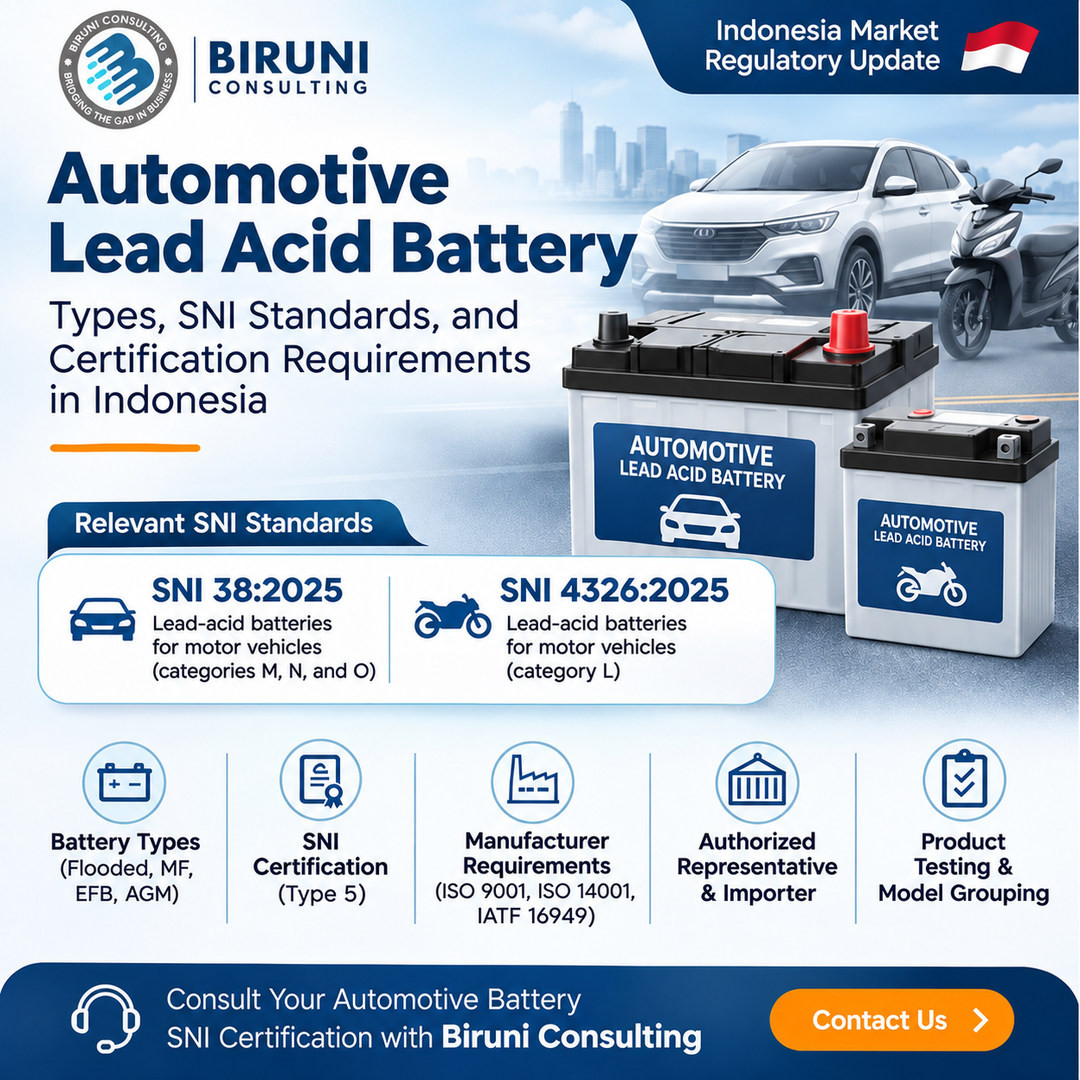
M1 covers passenger vehicles with no more than eight seats excluding the driver. A nominal 12 V lead-acid starter battery should be assessed against SNI 38:2025 scope. This guide helps manufacturers, importers and trademark owners assemble relevant evidence before choosing their Indonesian battery SNI compliance pathway.
Understanding SNI M1 passenger car battery
M1 covers passenger vehicles with no more than eight seats excluding the driver. A nominal 12 V lead-acid starter battery should be assessed against SNI 38:2025 scope.
Start any scope decision with the actual product rather than the invoice description alone. For motor-vehicle lead-acid batteries, confirm starting, lighting and ignition functions, vehicle category and nominal voltage. An identical HS code or voltage does not by itself establish the same standard.
How the draft requirements affect the assessment
The regulatory working text is a draft ministerial regulation, not a numbered enacted instrument. If the decision depends on effective dates, exclusions or revised scope, consult the final official Ministry publication before giving a client a compliance commitment.
Before saying a product is mandatory, exempt or fully compliant, compare the facts with the technical SNI and the enacted regulation. If the legal document is still a draft, make that status explicit to the client.
Practical initial checklist
Request these four evidence groups from the manufacturer or importer before selecting an application route:
- Verify vehicle use and its supporting document before choosing a certification route.
- Verify 12 V and its supporting document before choosing a certification route.
- Verify lead-acid chemistry and its supporting document before choosing a certification route.
- Verify type code and its supporting document before choosing a certification route.
Questions to ask during an inquiry
For SNI M1 passenger car battery, start by asking whether one or multiple production sites are involved, which legal entity is responsible, and whether all documentary evidence points to the same entity. Verify the answers against source documents rather than relying solely on a short commercial message.
For this specific topic, first verify vehicle use, followed by 12 V. A discrepancy may change the required documents or the appropriate consulting pathway.
Administrative risks and next actions
If lead-acid chemistry is not available, record it as unverified rather than assuming application readiness. Partner assurances must not be presented as approval from an authority or certification body.
Biruni Consulting can assist with an initial information review, identify documentation gaps and support coordination under the regulation actually in force. Testing outcomes, certification decisions, administrative validation and completion dates cannot be guaranteed in advance.
Frequently Asked Questions
What is most important about SNI M1 passenger car battery?
M1 covers passenger vehicles with no more than eight seats excluding the driver. A nominal 12 V lead-acid starter battery should be assessed against SNI 38:2025 scope.
Which documents should be prepared first?
Start with vehicle use, 12 V, lead-acid chemistry. Review original evidence instead of assuming compliance.
Can a certification decision or completion date be guaranteed?
No. The enacted regulatory status, product scope, factory documents and responsible-body decisions must all be verified.
Related Reading
- SNI Certification Services for Car and Motorcycle Batteries in Indonesia
- SNI 38:2025 Car Battery Requirements in Indonesia
- SNI 4326:2025 Motorcycle Battery Requirements in Indonesia
Automotive Battery SNI Consultation
For an initial assessment, prepare a model list and specifications, manufacturer identity, management-system certificates, trademark documents and your proposed Authorized Representative/importer arrangement. Biruni Consulting can review the documentation and identify the next regulatory steps.
Regulatory status: SNI 38:2025 and SNI 4326:2025 are BSN technical standards. Draft mandatory-SNI provisions must be verified against the enacted regulation, if any. Certification outcomes and timelines are not guaranteed.