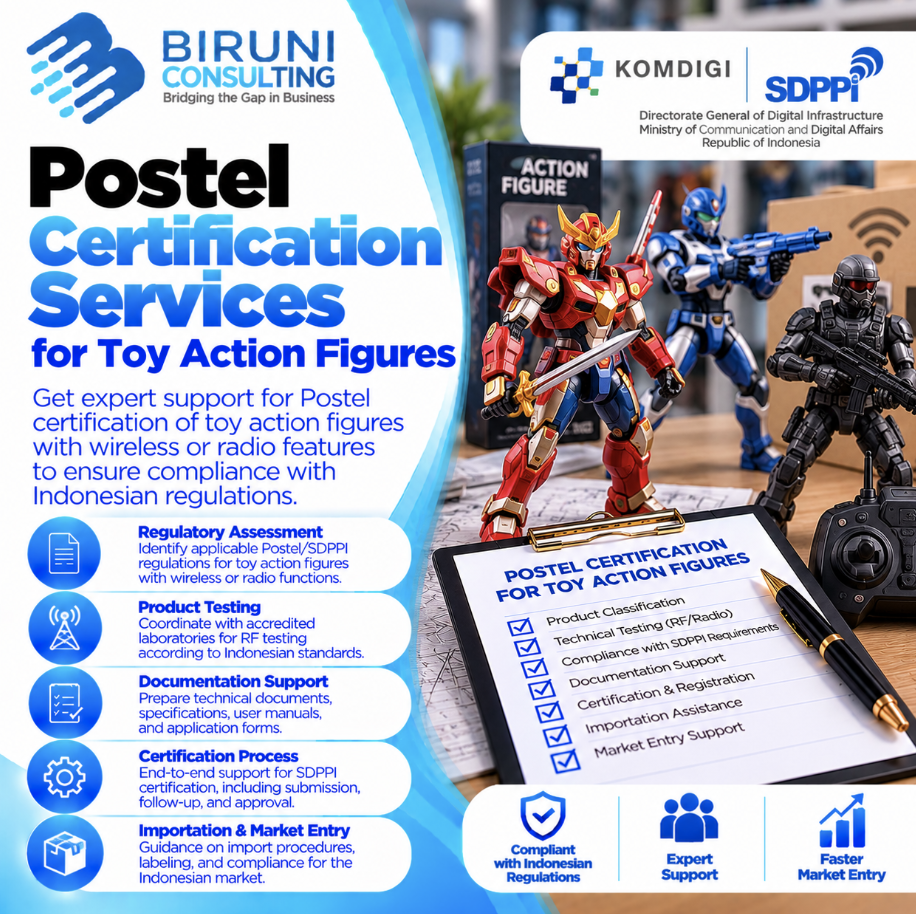
DJID/SDPPI certification services for action figures with Bluetooth, NFC, RFID, applications, and other wireless functions in Indonesia.
A conventional action figure may have no radio communication at all. However, modern interactive figures can incorporate Bluetooth, NFC, RFID, remote controls, smartphone applications, speakers, sensors, and other wireless technologies.
Where an action figure contains active telecommunications functions, its Postel/DJID Certification requirements should be assessed according to operating frequency, transmission power, wireless modules, transmitters, receivers, antennas, and the final product configuration.
Indonesia’s principal telecommunications-equipment certification framework remains Minister of Communication and Informatics Regulation Number 3 of 2024, which is currently in force and replaced Regulation Number 16 of 2018. JDIH Kemkomdigi
Do Action Figures Require Postel Certification?
Not every action figure has the same Postel requirements.
A figure containing only lights, speakers, buttons, motors, or locally stored audio has a different configuration from a product that communicates wirelessly with a smartphone, controller, accessory, or another device.
Postel assessment becomes relevant where the product contains Bluetooth, NFC, RFID, proprietary RF, WiFi, or another active radio technology.
The exact model and technical configuration should therefore be reviewed rather than relying only on the commercial description “action figure.”
Action Figures with Bluetooth
Bluetooth can enable an interactive figure to communicate with a smartphone or accessory.
Functions may include lighting and sound control, interactive gameplay, firmware updates, character configuration, or application-based features.
Minister of Communication and Informatics Decision Number 260 of 2024 continues to be listed in DJID’s official regulatory database as the Short Range Device Technical Standard. It defines Bluetooth IEEE 802.15.1 as short-range data communication operating in the 2400–2483.5 MHz band. Postel
The assessment should identify the Bluetooth version, module or chipset, operating frequency, transmission power, antenna, and enabled functions.
Action Figures with NFC
NFC can provide additional interaction between an action figure, accessory, base station, card, or smartphone.
For example, NFC may identify a character or activate specific digital content.
Decision Number 260 of 2024 includes Near Field Communication within the Short Range Device framework. Sertifikasi Postel
A currently valid 2026 DJID Certificate also demonstrates a device containing both Bluetooth and NFC, with each radio function listed according to its own technical parameters. Postel Certification
Where both Bluetooth and NFC are incorporated, both technologies should be included in the assessment.
Action Figures with RFID
RFID may be used to identify a figure or accessory automatically.
A compatible reader or game base can detect the figure and activate a character, sound, game feature, or other content.
Decision Number 260 of 2024 defines RFID as technology capable of identifying objects through radio communication without direct contact or over short distances. Sertifikasi Postel
RFID should therefore be assessed according to its actual frequency, reader or transmitter arrangement, tag configuration, and relevant technical characteristics.
Remote-Controlled Action Figures
Some interactive figures contain motors or other moving mechanisms controlled by a wireless remote.
Where RF remote control is used, the controller and action figure should be assessed as one radio system.
The remote commonly acts as a transmitter while the figure contains the receiver. Bidirectional products may contain transmitters on both sides.
Operating frequency, transmission power, modulation, radio chipsets, antennas, transmitters, and receivers should therefore be identified.
Action Figures with Smartphone Applications
A smartphone application may control lighting, sounds, character features, games, or interactive content.
The presence of an application alone does not determine Postel requirements.
The important issue is how the application communicates with the figure.
Bluetooth communication requires assessment of the Bluetooth radio, while WiFi-based functionality requires review of the RLAN interface.
Action Figures with WiFi
More advanced interactive toys may use WiFi for cloud connectivity, multimedia content, online interaction, or content downloads.
Where WiFi is incorporated, the assessment should identify the frequency band, operating mode, transmission power, antenna, module, and supported channels.
Minister of Communication and Digital Decision Number 12 of 2025 remains in force and establishes class-licensed spectrum and Technical Standards for Radio Local Area Network equipment. JDIH Kemkomdigi
Products containing both Bluetooth and WiFi should have each radio assessed separately.
Operating Frequency and Transmission Power
Operating frequency and transmission power are fundamental radio parameters.
However, they must always be considered in the context of the actual wireless technology.
A valid DJID Certificate issued in 2026, for example, lists Bluetooth at 2.4–2.4835 GHz and NFC at 13.553–13.567 MHz in the same device, with different technical power characteristics for the two radios. Postel Certification
A multi-radio action figure should therefore not be described using only one transmission-power value.
Action Figures and Short Range Devices
Bluetooth, NFC, RFID, and various other short-range technologies can fall within the Short Range Device framework.
Decision Number 260 of 2024 defines SRDs as telecommunications equipment presenting a relatively low risk of harmful interference and sets technical requirements for a range of short-range radio technologies. Sertifikasi Postel
Short communication range does not automatically create a Postel Certification exemption.
Frequency, transmission power, antennas, modulation, and actual radio functions should still be reviewed.
Does Low Transmission Power Mean an Exemption?
Not automatically.
Regulation Number 3 of 2024 contains a specific provision concerning certain other equipment with telecommunications features below 10 mW and only one identical telecommunications feature.
Under qualifying conditions, one Certificate may cover more than one variant.
This is a variant-coverage mechanism, not a general exemption for all low-power interactive toys. JDIH Kemkomdigi
Is a Tested Bluetooth Module Sufficient?
Not necessarily.
An action figure may use a Bluetooth or wireless module that already has an existing laboratory report.
That documentation can support the certification assessment, but the final product still needs to be linked to the tested module configuration.
DJID’s current e-Sertifikasi requirements state that equipment relying on a module test report should provide a block diagram, a photograph showing the installed module location, and a declaration identifying the module and the final equipment. Postel Certification
A module report should therefore not automatically be treated as covering every final action figure.
Documents for Postel Certification
For an initial assessment, businesses should generally prepare:
- Photographs of the action figure and wireless accessories.
- Brand, model, product datasheet, and user manual.
- Bluetooth, NFC, RFID, WiFi, or RF module datasheets.
- Operating frequency and transmission power.
- RF test reports, where available.
- Antenna, manufacturer, and country-of-manufacture information.
Where a wireless remote controller is supplied, its technical information should also be included.
DJID’s current requirements also list laboratory reports, technical specifications, Declaration of Conformity, and other supporting documents among the requirements for a new Certificate application. Postel Certification
RF Test Reports
An RF test report provides evidence of the radio configuration that has been tested.
It can include operating frequency, transmission power, occupied bandwidth, modulation, unwanted emissions, and other technical parameters.
For an interactive action figure, the report should correspond to the actual module, antenna, firmware, and enabled radio functions.
Where Bluetooth, NFC, RFID, or proprietary RF are combined, technical evidence for each relevant radio should be reviewed.
Overseas CE or FCC documentation may assist with technical assessment but does not automatically replace DJID/SDPPI Certification.
Can Several Action Figure Models Share One Certificate?
One product series may contain many characters with different colours, clothing, heads, accessories, or body designs.
Visual differences do not necessarily mean that the radio configuration has changed.
Conversely, two figures in the same product family may use different PCBs, modules, antennas, or firmware.
Model grouping should therefore compare wireless modules, operating frequencies, transmission power, antennas, firmware, wireless functions, brand, type, and the overall technical configuration.
Grouping should be based on technical similarity, not character appearance alone.
Our Postel Certification Process for Toy Action Figures
The process should begin with a technical assessment of the exact model intended for importation or commercial distribution.
Bluetooth, NFC, RFID, WiFi, proprietary RF, remote controllers, operating frequencies, transmission power, modules, and antennas are identified first.
Product datasheets and available RF test reports are then reviewed to establish the applicable Technical Standards and testing requirements.
Once the technical and administrative documents are prepared, the process can continue with document preparation, testing coordination where required, and DJID/SDPPI Certification assistance.
Labeling After Certification
Certified equipment is also subject to regulatory-marking requirements.
The annex to Regulation Number 3 of 2024 provides formats covering the Certificate number and PLG ID, QR Code, and Warning Sign. JDIH Kemkomdigi
Where an action figure has limited body space or a character-specific design, labeling should ideally be considered before mass production and final packaging.
Product, brand, type, and packaging information should remain consistent with the certified configuration.
Postel Certification and Toy Requirements
Postel/DJID Certification focuses on telecommunications and wireless functions incorporated into the action figure.
Toy-safety requirements address a separate area of product compliance.
DJID Certification for Bluetooth, NFC, RFID, WiFi, or RF functions therefore does not automatically replace applicable toy-safety requirements.
Likewise, toy-product compliance does not automatically replace Postel Certification for active wireless functions.
Why Pre-Import Assessment Matters
Action-figure product families can contain many characters and variants.
Manufacturers may also change modules, PCBs, antennas, firmware, or wireless accessories without making major changes to the external design.
Assessment before a large purchase order or shipment helps confirm the exact wireless technologies, operating frequencies, transmission power, modules, antennas, RF documentation, and potential model grouping.
This reduces the risk of inconsistencies between the actual product, technical documentation, packaging, and DJID/SDPPI Certificate.
Conclusion
Postel Certification services for toy action figures help businesses determine DJID/SDPPI requirements for interactive figures incorporating Bluetooth, NFC, RFID, remote controls, WiFi, smartphone applications, or other wireless technologies.
Not every action figure has the same certification requirements. Conventional non-wireless figures should be distinguished from interactive products containing active radio transmitters or receivers.
The assessment should identify operating frequency, transmission power, wireless modules, antennas, firmware, remote controllers, and supporting RF test reports.
A technical assessment before importation or mass production can help businesses prepare testing, technical documentation, model grouping, labeling, and DJID/SDPPI Certification more accurately.
Contact Us
Biruni Consulting assists with DJID/SDPPI assessment and certification for toy action figures and various wireless products that will be imported or marketed in Indonesia.
Our services include:
- Assessment of DJID/SDPPI certification requirements.
- Bluetooth module assessment.
- RF specification review.
- Frequency and transmission power analysis.
- Technical document review.
- Certification document preparation.
- Testing coordination where required.
- DJID/SDPPI Certification assistance.
If you have a toy action figure, you can prepare product photos, brand, model, datasheet, RF specifications, and wireless module datasheet for an initial assessment of the Postel Certification requirements.