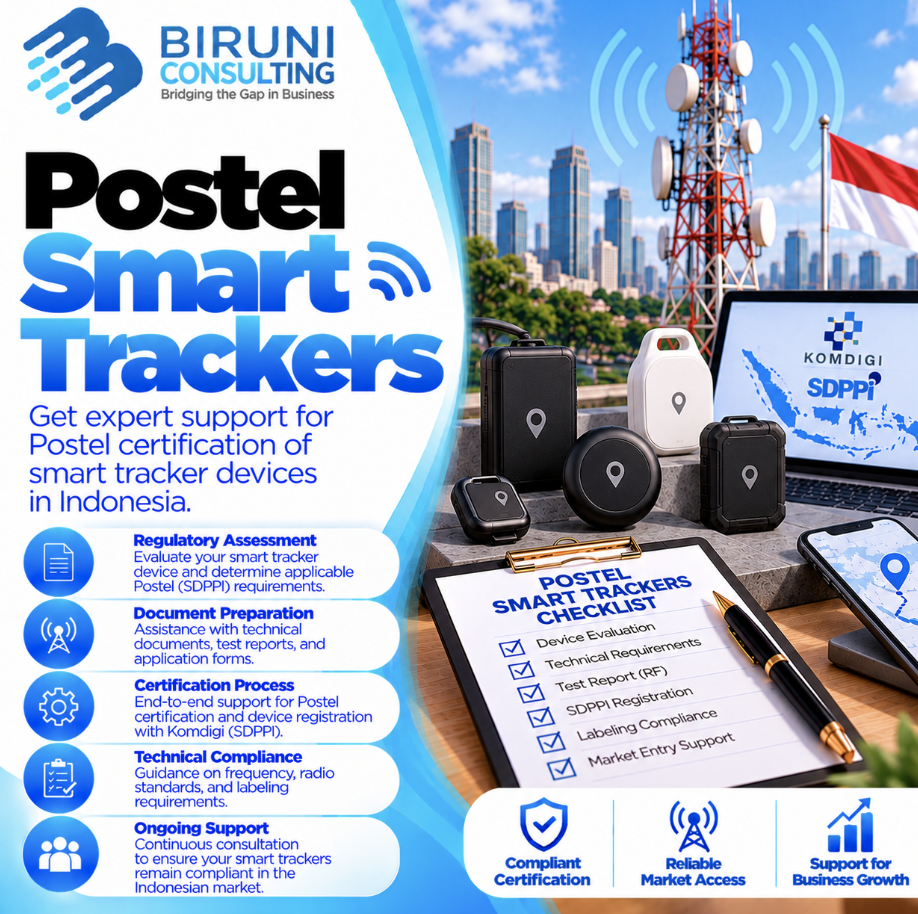
Guide to DJID/SDPPI Certification for smart trackers using Bluetooth, GPS/GNSS, UWB, cellular, WiFi, and other wireless technologies in Indonesia.
Smart trackers are used to identify the location, presence, or movement of assets, vehicles, equipment, and other objects. Depending on the product, they may use Bluetooth, GPS/GNSS, Ultra Wideband, cellular, WiFi, NFC, or several wireless technologies simultaneously.
Because smart trackers can have very different radio architectures, Postel/DJID requirements should not be determined simply from the fact that a product performs tracking.
The assessment should identify every active wireless technology, operating frequency, transmission power, module, antenna, supported cellular bands, and final-product configuration.
Indonesia’s principal certification framework remains Minister of Communication and Informatics Regulation Number 3 of 2024, which is currently in force. JDIH Kemkomdigi
Types of Smart Trackers
The term smart tracker covers several technically different product categories.
A compact item tracker may rely primarily on Bluetooth. A vehicle or asset tracker may contain GNSS together with a cellular modem. More advanced products can incorporate UWB for precision finding, NFC for short-range identification, or WiFi for additional connectivity.
Two products sold as “smart trackers” can therefore be subject to different Technical Standards.
Bluetooth Smart Trackers
Bluetooth is widely used for proximity and item tracking.
A tracker may pair with a smartphone and periodically communicate identification or status information over Bluetooth.
Minister of Communication and Informatics Decision Number 260 of 2024 includes Bluetooth IEEE 802.15.1 within the Short Range Device framework and requires SRD Technical Standard conformity to be demonstrated through certification. Sertifikasi Postel
The assessment should identify Bluetooth version, operating frequency, transmission power, module or chipset, antenna, and firmware configuration.
Smart Trackers with UWB
Some smart trackers incorporate Ultra Wideband to improve short-range positioning accuracy.
UWB can provide more precise ranging and directional information than signal-strength-based Bluetooth proximity alone.
Decision Number 260 of 2024 explicitly includes UWB among the Short Range Device technologies covered by the standard. Sertifikasi Postel
Where Bluetooth and UWB are both enabled, both radio functions should be assessed.
Smart Trackers with NFC
NFC may provide a secondary identification or interaction function.
For example, a user may place a smartphone close to the tracker to retrieve information or activate a specific function.
Decision Number 260 of 2024 also includes Near Field Communication within the SRD framework. Sertifikasi Postel
A product incorporating Bluetooth, UWB, and NFC should therefore have each radio interface identified separately.
GPS and GNSS Functions
GPS and other GNSS technologies provide positioning information by receiving satellite-navigation signals.
An important distinction is that a receive-only GNSS function is not the same as a radio transmitter used to send information out of the tracker.
A cellular tracker may receive GNSS signals to calculate its position and then transmit that position through LTE or another mobile technology.
The assessment should therefore identify both the positioning receiver and the communication technology used to deliver tracking data.
Non-Cellular GPS Trackers
Some devices record GNSS coordinates locally without providing real-time cellular communication.
This differs technically from a connected tracker that continuously transmits its location to a server.
If the device uses Bluetooth to retrieve stored information, however, the Bluetooth function still needs to be assessed.
The presence of GPS/GNSS alone therefore does not describe the complete Postel scope.
Cellular Smart Trackers
Vehicle, asset, logistics, personal, and industrial trackers commonly use SIM or eSIM connectivity to transmit position and telemetry data.
The product may support GSM, IMT-2000 technologies, LTE, or newer cellular implementations.
DJID’s current Technical Standard database lists Decision Number 45 of 2025 for GSM/IMT-2000 and Decision Number 569 of 2025 for LTE and IMT-2020. Both are currently listed as applicable standards. Postel Certification
Cellular tracker assessment should therefore identify the exact modem technology and supported frequency bands.
LTE and IoT Trackers
Modern IoT trackers often use cellular connectivity to transmit relatively small amounts of information such as coordinates, alerts, sensor values, or telemetry.
Low data volume does not remove the telecommunications function.
The assessment should review the cellular module, supported technologies and bands, antennas, laboratory documentation, and any additional radios such as Bluetooth or WiFi.
Each enabled wireless interface should be reviewed rather than relying only on the modem specification.
SIM Cards and eSIM
The presence of a SIM card or eSIM commonly indicates use of a mobile network.
However, the SIM itself does not define the radio configuration.
The modem or cellular module, supported bands, antennas, and RF implementation in the final product need to be assessed.
Manufacturers may also offer regional variants with different band configurations under similar commercial product names.
IMEI Considerations
A cellular tracker may use device identity mechanisms on a mobile network, but its administrative IMEI requirements should not automatically be treated as identical to those for mobile phones.
DJID’s current certification requirements specifically identify an IMEI security declaration requirement for cellular phones, handheld computers, and tablets. Postel Certification
A smart tracker therefore needs product-specific classification rather than automatically being treated as an HKT device.
Smart Trackers with WiFi
WiFi may be incorporated for configuration, data synchronisation, location assistance, or local network connectivity.
DJID’s current Technical Standard database lists Minister of Communication and Digital Decision Number 12 of 2025 as the applicable RLAN reference. Postel Certification
A tracker containing LTE, Bluetooth, and WiFi should therefore have all three radio systems identified.
Smart Trackers and Short Range Devices
Bluetooth, UWB, NFC, RFID, and other short-range technologies can bring a smart tracker within the SRD framework.
Decision Number 260 of 2024 includes Bluetooth, NFC, RFID, UWB, IEEE 802.15.4, certain low-power telecommunications devices, and other SRD categories. It also states that compliance with the SRD Technical Standards is demonstrated through equipment certification. Sertifikasi Postel
A product described as a “low-power tracker” or “short-range tracker” should therefore not automatically be treated as exempt from Postel Certification.
Are Trackers Below 10 mW Exempt?
Not automatically.
Regulation Number 3 of 2024 contains a specific rule for certain other equipment with telecommunications features below 10 mW and only one identical telecommunications feature.
Under qualifying conditions, this can allow one Certificate to cover more than one variant.
It is a variant-coverage provision, not a general rule that every device transmitting below 10 mW is exempt from DJID/Postel Certification.
Is a Tested Module Sufficient?
Smart trackers frequently use pre-tested Bluetooth, cellular, WiFi, or other wireless modules.
Module documentation can support certification, but the final product still needs to be connected clearly to the tested module configuration.
DJID’s current requirements for equipment relying on a module test report include a block diagram, a photograph showing the installed module location, and a module-use declaration identifying the module and final-product brand, type, and variant. Postel Certification
Antennas, firmware, enabled radio modes, and final integration therefore remain relevant.
Antennas in Smart Trackers
Trackers are often compact devices containing several antennas.
One product may include separate antennas for GNSS, cellular, Bluetooth, and UWB.
Antenna type, location, gain, PCB design, and enclosure integration can affect radio performance.
The module datasheet alone may therefore not fully describe the final RF configuration.
RF Test Reports
RF test reports provide evidence of the radio configuration that has actually been tested.
They may include operating frequencies, transmission power, supported bands, bandwidth, emissions, and other RF parameters.
DJID’s current e-Sertifikasi requirements require a test report issued by a designated domestic laboratory or recognised overseas laboratory for a new Certificate application. Postel Certification
Where an overseas RF report is submitted, the current requirements also specify an LHU summary declared to be correct and consistent. Postel Certification
Documents for Postel Certification
For an initial assessment, businesses should generally prepare:
- Photographs of the smart tracker and packaging.
- Brand, model, datasheet, and user manual.
- Bluetooth, UWB, WiFi, or cellular-module datasheets.
- Supported frequencies and transmission power.
- RF test reports, where available.
- Antenna, manufacturer, and country-of-manufacture information.
Current certification requirements also include NIB and OSS access for business applicants, test reports, technical specifications, a Declaration of Conformity, colour product photographs, and declarations concerning the submitted documentation. Postel Certification
Multiple Smart Tracker Variants
Manufacturers may sell several trackers with almost identical external enclosures but different wireless hardware.
One version may contain Bluetooth only, another Bluetooth and UWB, while another adds cellular connectivity.
Visual similarity therefore does not establish technical similarity.
Model-grouping assessment should compare modules, wireless technologies, operating frequencies, transmission power, antennas, firmware, brand, model/type, and country of manufacture.
Certificate Period and Import Activities
Under Regulation Number 3 of 2024, the Certificate itself is not time-limited.
However, the Certificate holder may manufacture, assemble, or import the equipment for trade and/or use in Indonesia for up to three years from the Certificate issuance date. JDIH Kemkomdigi
Importers making recurring shipments of the same tracker model should therefore monitor this period and the requirements applicable to continued commercial activity.
Postel Labeling for Smart Trackers
Certified devices are also subject to regulatory-marking requirements.
The annex to Regulation Number 3 of 2024 provides formats for the Certificate number and PLG ID, QR Code, and Warning Sign. JDIH Kemkomdigi
DJID’s current certification information also requires the Certificate holder to implement the prescribed marking and report its implementation within 30 working days after Certificate issuance. Postel Certification
Because smart trackers can be very small, labeling and packaging design should ideally be considered before mass production.
Why Pre-Import Assessment Matters
Smart trackers commonly have several regional variants.
Products carrying the same commercial name and enclosure can use different cellular bands, Bluetooth chipsets, UWB modules, antennas, or firmware for different markets.
An assessment before a large purchase order or shipment helps confirm the exact model, wireless technologies, supported bands, output power, modules, antennas, laboratory reports, and applicable Technical Standards.
This reduces the risk that the imported product differs from the configuration covered by certification.
Conclusion
Postel Certification for smart trackers depends on the wireless technologies actually incorporated into the device.
A smart tracker may contain Bluetooth, UWB, NFC, GPS/GNSS, cellular, WiFi, or several technologies at the same time. A receive-only GNSS function should be distinguished from the transmitter used to send location information to a smartphone, network, or server.
For Short Range Devices such as Bluetooth and UWB, Decision Number 260 of 2024 remains an important technical reference. DJID’s current database also lists Decision Number 45 of 2025 for GSM/IMT-2000 and Decision Number 569 of 2025 for LTE/IMT-2020 cellular equipment. Sertifikasi Postel
Technical assessment of the exact model, modules, supported frequencies, transmission power, antennas, and RF reports should therefore be completed before importation or DJID/SDPPI Certification.
Contact Us
Biruni Consulting assists with DJID/SDPPI assessment and certification for smart trackers and various wireless products that will be imported or marketed in Indonesia.
Our services include:
- Assessment of DJID/SDPPI certification requirements.
- Bluetooth module assessment.
- RF specification review.
- Frequency and transmission power analysis.
- Technical document review.
- Certification document preparation.
- Testing coordination where required.
- DJID/SDPPI Certification assistance.
If you have a smart tracker, you can prepare product photos, brand, model, datasheet, RF specifications, and wireless module datasheet for an initial assessment of the Postel Certification requirements.