
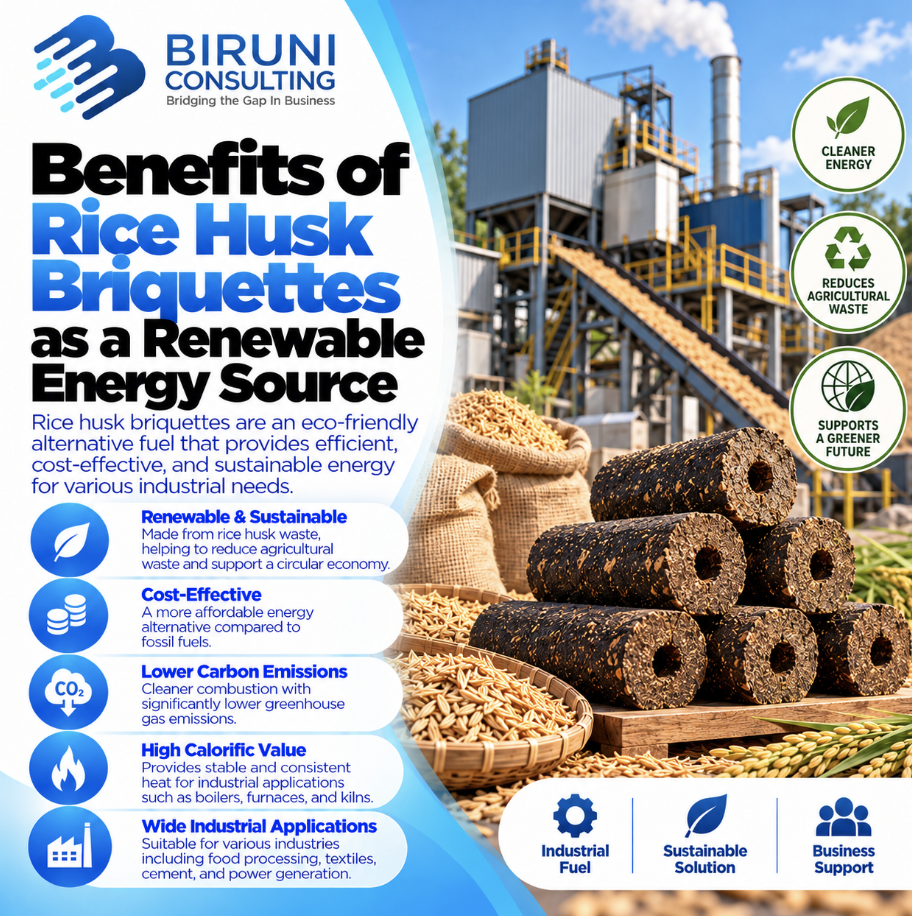
What Are Rice Husk Briquettes?
Rice husk briquettes are densified solid biomass fuels manufactured from rice husks generated during the rice-milling process.
Instead of being handled as lightweight loose biomass, rice husks are processed and compressed into a denser fuel form that can be easier to transport, store, and feed into compatible combustion equipment.
Indonesia’s BRMP post-harvest agency describes rice-residue briquetting as a densification process that improves physical characteristics and calorific value per unit volume while making the material easier to store and transport. Rice-residue briquettes are also identified as potential fuels for industrial energy applications. Pascapanen
For industrial users, rice husk briquettes may be considered for compatible boilers, furnaces, dryers, biomass burners, and other thermal-energy systems.
Why Are Rice Husk Briquettes Considered Renewable Energy?
Rice husk originates from agricultural biomass produced as part of the rice-growing cycle.
Biomass is recognized as a renewable-energy resource when feedstocks are replenished and the supply chain is appropriately managed.
Indonesian energy regulations also place biomass within the renewable-energy framework. Presidential Regulation No. 11 of 2023 addresses the supply and utilization of biomass as fuel under the renewable-energy sector, while Indonesia’s current National Energy Policy under Government Regulation No. 40 of 2025 includes biomass within the country’s renewable-energy strategy. JDih ESDM
Internationally, the IEA categorizes modern solid biomass as a renewable fuel. In 2023, modern solid bioenergy represented the largest component of global renewable-fuel consumption. IEA
However, being renewable does not mean that every biomass fuel is automatically carbon neutral or environmentally beneficial in all circumstances.
Lifecycle impacts depend on feedstock sourcing, processing, transportation, combustion efficiency, land management, and other supply-chain factors. The IEA notes that the environmental and climate benefits of biomass vary substantially depending on the source and the way it is used. IEA
Rice Husk as an Agricultural By-Product
Rice husk is produced when the outer protective layer of rice grain is separated during milling.
Because rice-processing activities continuously generate this material, rice husk can become a locally available biomass resource in rice-producing regions.
Converting the husk into briquettes creates an opportunity to transform a loose agricultural by-product into a more manageable solid fuel.
This can create additional value from agricultural processing while supplying thermal energy to compatible industrial operations.
Key Benefits of Rice Husk Briquettes
Rice husk briquettes can offer several environmental, operational, and commercial benefits when used under appropriate conditions.
1. Utilization of Rice-Milling Residues
One of the primary benefits is the productive use of rice-milling by-products.
Instead of leaving rice husks as an underutilized residue, they can be processed into fuel.
This supports a circular-resource approach in which a by-product from agricultural processing becomes an energy input for another activity.
Indonesia’s BRMP has developed briquettes and pellets from rice straw and rice husk as alternative biomass-energy products. Pascapanen
2. Potential to Reduce Fossil-Fuel Consumption
In compatible combustion systems, biomass briquettes can replace part of the fossil fuel used for producing industrial heat or steam.
Renewable fuels can be particularly relevant in industrial applications that are difficult to electrify completely.
The IEA identifies renewable fuels, including modern solid biomass, as an option for reducing emissions in sectors where direct electrification is more challenging. IEA
Indonesia has also adopted policies promoting biomass utilization as part of its energy transition. Ministerial Regulation of Energy and Mineral Resources No. 12 of 2023, for example, regulates biomass co-firing at steam power plants as part of efforts to increase renewable-energy use and reduce greenhouse-gas emissions. JDih ESDM
For individual industrial facilities, actual benefits still depend on boiler efficiency, fuel quality, and operating conditions.
3. Higher Value from Rice Husk Feedstock
Loose rice husk has relatively low bulk density.
Briquetting compresses the material, increasing the amount of biomass contained within a given volume.
BRMP lists increased energy value per unit volume as one of the benefits of densifying rice residues. Pascapanen
Densification does not create additional energy from nothing. Instead, it concentrates the existing biomass into a smaller physical volume, making storage and handling more practical.
4. More Efficient Storage
Loose rice husk can require substantial warehouse space.
After briquetting, the material becomes considerably more compact.
This can benefit factories with limited fuel-storage capacity.
Briquettes can also be easier to stack, package, and inventory than very lightweight loose husk.
5. Easier Transportation
Transport economics are an important consideration for biomass fuels.
Low-density biomass can occupy a large portion of a truck’s available volume while carrying comparatively little mass.
Densification allows more biomass to be transported within the same physical space.
BRMP specifically identifies easier transportation as one of the advantages of rice-residue briquettes. Pascapanen
This advantage becomes more important as the distance between the biomass source and industrial user increases.
6. More Uniform Fuel Dimensions
Briquetting produces a more standardized physical form compared with loose agricultural residue.
More consistent dimensions can support:
- Material handling.
- Warehousing.
- Inventory measurement.
- Boiler feeding.
- Fuel-consumption control.
BRMP also identifies more uniform size and quality as advantages of densified rice biomass. Pascapanen
Fuel dimensions still need to match the customer’s feeding equipment.
7. Industrial Thermal-Energy Applications
Where equipment is compatible, rice husk briquettes may be considered for:
- Steam boilers.
- Biomass boilers.
- Certain furnaces.
- Biomass burners.
- Industrial dryers.
- Agricultural drying.
- Process heating.
- Food-processing operations.
- Agricultural-processing facilities.
- Other industrial thermal applications.
Indonesia’s BRMP specifically identifies densified rice biomass as suitable for industrial energy applications. Pascapanen
8. Energy-Supply Diversification
Dependence on a single fuel can expose an industrial facility to supply and pricing risks.
Rice husk briquettes can form part of a diversified energy strategy where boilers are capable of handling multiple solid biomass fuels.
The IEA’s 2026 ASEAN Energy Security Review notes that locally sourced sustainable solid biofuels can diversify energy and industrial heat supply. Rice husk is among the agricultural residues already contributing to solid bioenergy development in ASEAN. IEA
Diversification may provide greater flexibility during disruptions in other fuel markets.
9. Potential Local Economic Benefits
The rice husk briquette supply chain can involve:
- rice mills,
- residue collectors,
- briquette manufacturers,
- warehouse operators,
- logistics providers,
- and industrial customers.
Where feedstock and production are located close to the final user, biomass utilization can support regional economic activity.
The IEA also identifies energy security and economic-development opportunities among the potential benefits of renewable fuels. IEA
10. Agricultural-Residue Management
Using rice husks as fuel provides an additional pathway for managing agricultural residues.
Modern bioenergy can be particularly attractive where it utilizes existing agricultural, forestry, or industrial residues rather than creating additional demand for dedicated resources.
The IEA identifies greater reliance on biomass residues as an important component of modern solid bioenergy development. IEA
Alternative uses of rice husk should still be considered when assessing the most appropriate use of the resource.
Are Rice Husk Briquettes Environmentally Friendly?
The answer requires a lifecycle perspective.
Rice husk briquettes use renewable biomass and may make productive use of agricultural residues.
Under appropriate conditions, this can provide environmental benefits compared with fossil-fuel use.
However, burning biomass still produces emissions.
Depending on the combustion system, these can include:
- particulate matter,
- nitrogen oxides,
- carbon monoxide,
- ash,
- and other combustion products.
Energy is also required to collect, dry, process, briquette, package, and transport the product.
For this reason, rice husk briquettes are better described as a renewable biomass fuel with potential environmental advantages when the feedstock is sustainably sourced and efficiently processed and used, rather than as an automatically zero-emission fuel.
The IEA similarly emphasizes that the contribution of sustainable solid biofuels depends on robust sustainability frameworks that verify emissions reductions and protect land, water, and biodiversity. IEA
Rice Husk Briquettes and Greenhouse-Gas Reduction
The potential climate benefit primarily comes from replacing fossil fuels and making use of agricultural residues.
The actual reduction cannot be calculated simply by knowing that the fuel is made from rice husk.
A proper lifecycle assessment may consider:
- Rice-husk collection.
- Raw-material transportation.
- Drying.
- Size reduction.
- Briquetting.
- Manufacturing electricity.
- Packaging.
- Delivery to the customer.
- Combustion efficiency.
- Residue management.
Shorter supply chains and efficient production can improve the overall energy and emissions profile.
Supporting Circular-Energy Concepts
Rice husk briquettes can illustrate a circular-resource pathway.
A simplified chain is:
Rice production → Milling → Rice husk → Briquette production → Thermal energy → Industrial process
The fuel uses an agricultural processing by-product as an energy resource.
Under some conditions, combustion ash may also have additional applications, but any reuse should depend on chemical testing, product-quality requirements, and relevant regulations.
Ash should not automatically be considered suitable for reuse without evaluation.
Standards for Biomass Briquettes
Renewable origin alone is not sufficient for industrial fuel procurement.
Fuel quality also matters.
ISO 17225-1:2021 establishes general fuel-quality classes and specifications for solid biofuels derived from forestry, agriculture, horticulture, and other biomass sources. ISO
ISO 17225-7:2021 covers graded non-woody briquettes, including herbaceous biomass and by-products of cereal production and processing. ISO
For thermally treated and densified biomass fuels intended for commercial and industrial use, ISO 17225-8:2023 establishes additional fuel-quality classes and specifications. ISO
Individual industrial customers may establish their own purchasing specifications, but these standards demonstrate the importance of defining fuel quality.
Important Technical Specifications
Several parameters should be evaluated before purchasing rice husk briquettes.
1. Calorific Value
Calorific value indicates how much energy the fuel contains.
Industrial buyers should obtain data from the actual supplier product.
They should also confirm whether the value is:
- GCV,
- NCV,
- as received,
- or dry basis.
2. Moisture Content
Water reduces the amount of fuel energy immediately available for useful heating because energy is required to evaporate it.
High or inconsistent moisture can increase consumption and change combustion performance.
3. Ash Content
Rice husk has mineral characteristics that require careful consideration.
Ash affects:
- ash handling,
- boiler cleaning,
- maintenance,
- residue disposal,
- and combustion behavior.
Calorific value should therefore never be evaluated in isolation.
4. Volatile Matter
Volatile matter can influence ignition and flame characteristics.
It forms part of the proximate analysis used to characterize solid fuel.
5. Fixed Carbon
Fixed carbon provides information on the solid carbon fraction of the fuel.
It can be particularly useful when comparing carbonized and non-carbonized briquettes.
6. Density
Density affects transportation, storage, and fuel handling.
7. Dimensions
Fuel dimensions must be compatible with hoppers, screw feeders, conveyors, and boiler grates.
8. Mechanical Strength
Weak briquettes can break during transportation and generate excessive fines.
Benefits for Industrial Boilers
For compatible boilers, briquettes can provide several practical advantages compared with loose rice husk.
The more compact and uniform fuel can:
- Simplify inventory management.
- Reduce storage volume.
- Improve transportation efficiency.
- Provide more consistent dimensions.
- Support more predictable feeding on compatible systems.
Boilers must still be capable of handling the ash characteristics of rice-husk-based fuels.
Engineering evaluation should be completed before bulk procurement.
Can Every Boiler Use Rice Husk Briquettes?
No.
A boiler that currently burns wood pellets, coal, palm kernel shells, gas, or another fuel cannot automatically switch to rice husk briquettes.
Industrial users should review:
- Fuel dimensions.
- Grate design.
- Feeding equipment.
- Combustion chamber.
- Air-to-fuel ratio.
- Furnace temperature.
- Ash-removal equipment.
- Dust collection.
- Boiler capacity.
- Emission-control systems.
Equipment modifications or operating adjustments may be required.
Rice Husk Briquettes vs. Loose Rice Husk
Both forms have potential advantages.
| Factor | Loose Rice Husk | Rice Husk Briquettes |
|---|---|---|
| Density | Low | Higher |
| Storage Requirement | Larger | More efficient |
| Transportation | High volume | More practical |
| Physical Uniformity | Limited | Higher |
| Processing Cost | Lower | Higher due to briquetting |
| Fuel Feeding | Requires husk-compatible system | Depends on briquette dimensions |
| Price | Can be low near rice mills | Usually reflects additional processing |
The better option depends on boiler design, logistics, storage, and total cost.
Rice Husk Briquettes vs. Wood Pellets
Both are densified biomass fuels but have different operating characteristics.
Wood pellets are generally smaller and highly uniform, making them particularly suitable for dedicated automatic pellet-feeding systems.
Rice husk briquettes are usually larger.
Quality wood pellets can also have lower ash levels than rice-husk-based fuels.
Rice husk briquettes, however, may provide a commercial advantage where rice residues are locally available and delivered costs are competitive.
Industrial users should compare:
- calorific value,
- moisture,
- ash,
- feeding compatibility,
- delivered price,
- supplier capacity,
- and fuel-to-steam ratio.
Renewable Energy Economics
The economic benefit of renewable biomass should not be calculated solely from the price per kilogram.
For example:
Briquette A
- Price: IDR 2,800/kg
- Consumption: 200 kg/ton steam
Cost:
IDR 560,000 per ton steam
Fuel B
- Price: IDR 3,200/kg
- Consumption: 165 kg/ton steam
Cost:
IDR 528,000 per ton steam
In this simplified example, the more expensive fuel per kilogram produces the lower fuel cost per ton of steam.
Actual decisions should use trial data.
Total Cost of Use
Industrial fuel evaluation should consider:
Fuel Price + Transportation + Storage + Handling + Fuel Consumption + Ash Handling + Maintenance + Downtime
A low-priced briquette may become less economical if it results in higher consumption, excessive ash, or frequent cleaning.
A slightly more expensive fuel can sometimes provide lower total operating costs.
Importance of Boiler Trials
A boiler trial provides actual performance data.
Useful measurements include:
- Fuel consumption per hour.
- Steam production.
- Fuel-to-steam ratio.
- Steam pressure.
- Furnace temperature.
- Combustion stability.
- Feeding performance.
- Ash volume.
- Ash characteristics.
- Deposits.
- Clinker formation.
- Cleaning frequency.
- Operator intervention.
- Fuel cost per ton of steam.
Trials should be conducted under representative operating conditions.
Certificate of Analysis
Industrial customers can request a Certificate of Analysis when available.
Useful parameters include:
- Gross Calorific Value.
- Net Calorific Value.
- Moisture.
- Ash.
- Volatile matter.
- Fixed carbon.
- Density.
- Dimensions.
- Sulfur where relevant.
- Chlorine where relevant.
The reporting basis and laboratory method should also be reviewed.
Quality Consistency
Renewable industrial energy requires more than a one-time supply of good fuel.
Quality needs to remain reasonably consistent over repeated deliveries.
Suppliers should control:
- moisture,
- ash,
- calorific value,
- dimensions,
- density,
- physical strength.
Long-term supply contracts can define acceptable specification ranges.
Energy-Security Benefits
Locally available biomass can help diversify industrial fuel supply.
A factory with access to regional agricultural biomass may be able to source part of its thermal-energy requirements closer to its operations.
The IEA’s 2026 ASEAN Energy Security Review notes that locally sourced sustainable solid biofuels can help diversify power and industrial heat supplies and can partly substitute fossil fuels in appropriate applications. IEA
This benefit depends on reliable supply and competitive logistics.
Supplier Capacity for Industrial Requirements
Industrial buyers should confirm that suppliers can meet recurring volume requirements.
For example:
4 tons/day × 25 operating days = 100 tons/month.
A primary supplier would need sufficient available capacity to provide approximately 100 tons every month.
Buyers can evaluate:
- Production capacity.
- Available capacity.
- Rice-husk sources.
- Supporting rice mills.
- Inventory.
- Warehouse capacity.
- Lead time.
- Transportation capacity.
- Backup feedstock.
- Long-term supply capability.
Sustainable Feedstock Supply
Renewable-energy benefits depend partly on the sustainability of the biomass supply chain.
Suppliers need reliable feedstock access without creating new supply-chain problems.
Industrial customers may consider:
- feedstock origin,
- transportation distance,
- quality consistency,
- alternative uses of the residue,
- and supplier documentation.
The IEA emphasizes that sustainable solid bioenergy requires responsible feedstock sourcing and broader environmental safeguards. IEA
Transportation and Lifecycle Impacts
Supplier location can influence both economic and environmental performance.
Long-distance transportation requires additional fuel and increases logistics costs.
One potential advantage of biomass is the ability to develop regional supply chains close to industrial users.
Buyers can compare:
Ex-Factory Price
The price at the supplier’s facility.
Delivered Price
The total price including delivery to the agreed customer location.
Delivered pricing provides a more realistic basis for procurement decisions.
Storage of Rice Husk Briquettes
Briquettes should be stored away from rain and excessive humidity.
Storage facilities should also follow appropriate procedures for combustible solid fuels.
Considerations may include:
- Covered warehousing.
- Dry flooring.
- Ventilation.
- FIFO inventory.
- Dust management.
- Inventory monitoring.
- Material handling.
- Fire safety.
- Safety stock.
Moisture absorption can reduce fuel performance and mechanical durability.
Determining Safety Stock
Suppose a factory consumes:
5 tons per day
and requires five days of fuel inventory.
Planned safety stock would be approximately:
5 tons × 5 days = 25 tons.
Actual inventory requirements should reflect warehouse capacity, supplier lead time, seasonal conditions, delivery risk, and alternative supply options.
How to Select Rice Husk Briquettes
A structured approach can be used.
Stage 1 – Evaluate the Boiler
Review:
- capacity,
- grate,
- feeder,
- fuel dimensions,
- ash handling,
- combustion controls.
Stage 2 – Define Fuel Specifications
Establish:
- minimum calorific value,
- maximum moisture,
- maximum ash,
- dimensions,
- density,
- carbonized or non-carbonized product.
Stage 3 – Evaluate Suppliers
Review:
- CoA,
- production capacity,
- feedstock sources,
- location,
- lead time,
- logistics.
Stage 4 – Obtain Samples
Conduct physical and laboratory evaluation where appropriate.
Stage 5 – Conduct a Boiler Trial
Compare actual performance with the existing fuel.
Stage 6 – Calculate Total Cost
Include:
- delivered price,
- kg fuel per ton steam,
- ash handling,
- maintenance,
- downtime.
Stage 7 – Establish Supply Terms
Define quality specifications and delivery schedules.
Information to Request from a Supplier
Industrial buyers can request:
- Feedstock type.
- Carbonized or non-carbonized product.
- Calorific value.
- GCV or NCV.
- Reporting basis.
- Moisture content.
- Ash content.
- Volatile matter.
- Fixed carbon.
- Density.
- Dimensions.
- Binder information where applicable.
- Certificate of Analysis.
- Monthly production capacity.
- Available supply.
- Minimum order quantity.
- Packaging.
- Lead time.
- Ex-factory price.
- Delivered price.
- Sample availability.
- Trial availability.
Are Rice Husk Briquettes Suitable as Renewable Energy for Industry?
Rice husk briquettes can be a relevant industrial renewable-energy option when agricultural residues are sourced responsibly, manufacturing is efficient, logistics are practical, and the combustion system can use the fuel effectively.
Potential benefits include agricultural-residue utilization, improved fuel density, easier storage and transportation, energy diversification, and the possibility of reducing fossil-fuel use.
These benefits should nevertheless be evaluated alongside ash characteristics, emissions, boiler compatibility, supply continuity, and maintenance requirements.
For industrial applications, the strongest decision is therefore based on a combination of sustainable feedstock sourcing, technical specifications, boiler performance, supplier capability, and total cost of use.
Contact Us
Biruni Consulting can assist companies that require information and support regarding product requirements, documentation, and compliance processes related to product importation, marketing, or use according to business requirements in Indonesia.
The services that can be supported include:
- Consultation on product requirements for industrial needs.
- Initial assessment of product specifications and applications.
- Technical document review.
- Review of product specifications and information.
- Consultation on applicable regulatory requirements according to the product type and business activities.
- Assistance in preparing required documents.
- Consultation on certification or licensing processes when required based on the product characteristics and intended use.
Contact Biruni Consulting for information regarding product requirements, documentation, certification, and compliance needs to support business activities and product marketing in Indonesia.