
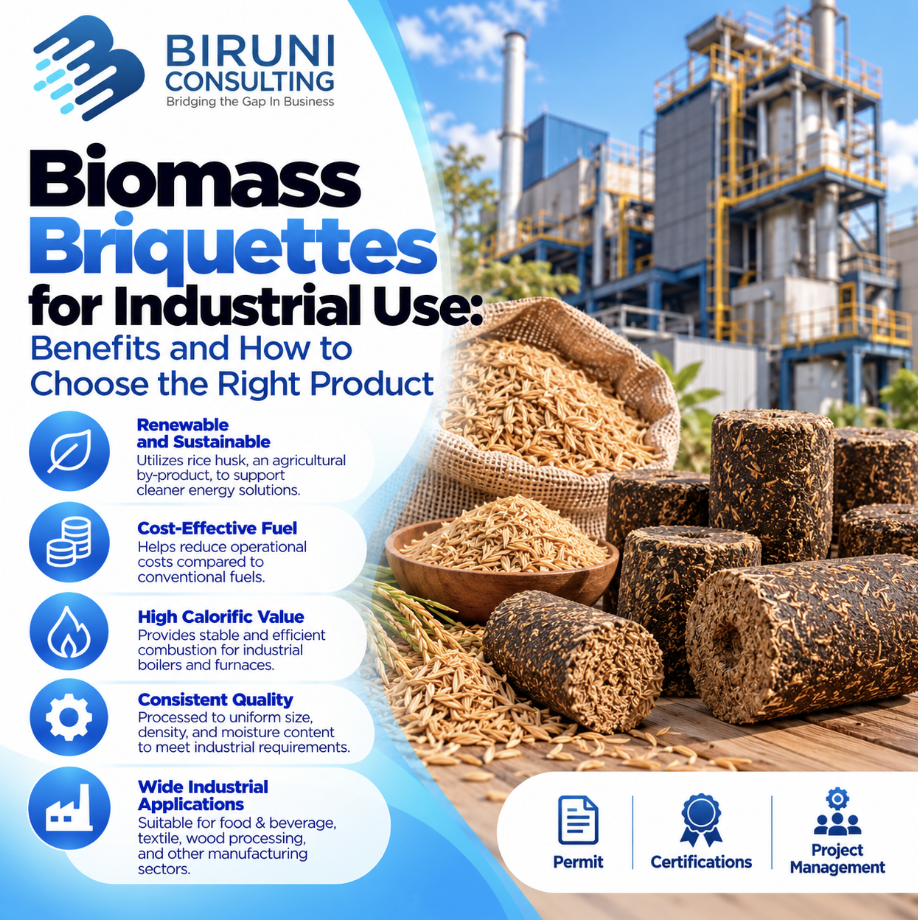
What Are Biomass Briquettes?
Biomass briquettes are solid fuels produced by compressing biomass materials into a denser and more manageable form.
Raw materials can include rice husk, sawdust, wood-processing residues, coconut shell, agricultural residues, crop-processing by-products, and blends of different biomass materials.
Densification increases bulk density and creates a more consistent physical form compared with loose biomass.
Indonesia’s BRMP post-harvest agency notes that densifying rice biomass into briquettes can improve physical properties and energy content per unit volume while making the material easier to store and transport. Pascapanen BRMP
For industrial users, biomass briquettes can be considered as fuel for compatible boilers, furnaces, dryers, biomass burners, and other thermal systems.
Biomass Briquettes as Industrial Fuel
Industrial facilities often require continuous thermal energy for production.
Steam boilers, for example, may provide steam for heating, drying, sterilization, washing, processing, and numerous other manufacturing activities.
Biomass briquettes can provide one solid-fuel option for these requirements.
However, the term biomass briquette covers many different products.
A rice husk briquette does not necessarily have the same fuel characteristics as a sawdust briquette.
Likewise, a non-carbonized briquette can differ substantially from a charcoal or carbonized briquette.
Industrial buyers should therefore evaluate the actual technical specifications rather than relying solely on the raw-material name.
Biomass Raw Materials Used for Briquettes
Briquettes can be manufactured from many biomass resources.
Examples include:
- Rice husk.
- Sawdust.
- Wood-processing residues.
- Coconut shell.
- Straw.
- Corn cobs.
- Sugarcane bagasse.
- Agricultural residues.
- Plantation residues.
- Biomass blends.
ISO 17225-1:2021 provides general fuel specifications and classification requirements for solid biofuels originating from forestry, agriculture, horticulture, and other biomass sources. ISO
For non-woody briquettes, ISO 17225-7:2021 specifies quality classes for graded non-woody briquettes manufactured from sources including herbaceous biomass, fruit biomass, and biomass blends or mixtures. ISO
Wood and Non-Wood Biomass Briquettes
Biomass briquettes can broadly be divided into woody and non-woody products.
Wood Briquettes
Wood briquettes can be produced from sawdust and residues from wood-processing operations.
ISO 17225-3:2021 specifically establishes fuel quality classes and specifications for graded wood briquettes from defined woody feedstocks. ISO
Woody biomass can have significantly different mineral and ash characteristics from many agricultural residues.
Non-Wood Briquettes
Non-woody briquettes may be manufactured from rice husk, straw, agricultural residues, fruit biomass, or mixtures of several biomass types.
Agricultural biomass can contain different mineral fractions from woody biomass, resulting in different ash levels and combustion behavior.
Fuel specifications should consequently be matched to the boiler or furnace design.
Carbonized and Non-Carbonized Biomass Briquettes
Industrial buyers should also determine whether a product is carbonized.
Non-Carbonized Briquettes
For non-carbonized products, biomass is typically dried, processed to the required particle size, and compressed directly.
Much of the original biomass structure and volatile material remains.
Carbonized Briquettes
For carbonized products, biomass undergoes thermal conversion into charcoal before briquetting.
Carbonization can change:
- fixed carbon,
- volatile matter,
- moisture,
- ash,
- calorific value,
- and combustion behavior.
A buyer should therefore confirm whether a supplier is offering a carbonized or non-carbonized briquette before comparing quotations.
Benefits of Biomass Briquettes for Industrial Applications
Depending on the product, location, and combustion system, briquettes can provide several practical benefits.
1. Utilization of Biomass Resources
Briquetting can transform loose biomass residues into a more manageable fuel.
Rice husk, for example, is generated during rice milling and can be converted into densified fuel. Indonesia’s BRMP describes rice-based biobriquettes as fuels that can be used for both household and industrial energy applications. Pascapanen BRMP
This creates another potential use for agricultural and industrial biomass residues.
2. Higher Density than Loose Biomass
One of the principal advantages of briquetting is densification.
Loose materials such as rice husk, sawdust, and agricultural residues can occupy significant storage volume.
Compression increases the quantity of biomass that can be stored within a given volume.
This can improve:
- Warehousing.
- Transportation.
- Loading.
- Unloading.
- Inventory management.
BRMP also identifies easier storage and transportation as benefits of densified biomass. Pascapanen BRMP
3. More Consistent Physical Form
Loose biomass can vary considerably in particle size and shape.
Briquetting creates more controlled dimensions.
Greater uniformity can support material handling and fuel feeding, particularly where conveyors and hoppers are used.
However, fuel dimensions still need to be compatible with the plant’s equipment.
A high-quality briquette that is too large for the feeder may still be unsuitable.
4. More Practical Transportation
Logistics can represent a substantial part of biomass-fuel costs.
Low-density biomass may fill a vehicle’s available volume before reaching its maximum payload.
Densification can make transportation more efficient because more material can be carried within a given space.
This advantage becomes increasingly relevant as delivery distance increases.
5. Applications Across Thermal Processes
Where combustion equipment is compatible, biomass briquettes can be considered for:
- Steam boilers.
- Hot-water boilers.
- Certain furnaces.
- Biomass burners.
- Industrial dryers.
- Agricultural drying.
- Process heating.
- Certain thermal-oil systems.
- Food processing.
- Agricultural processing.
- Wood processing.
- Other heat-intensive industrial operations.
Technical suitability should always be confirmed for the specific equipment.
6. Potential for Local Supply
Biomass is often available near the industries that generate it.
Rice husk briquettes may have supply advantages in rice-producing regions.
Sawdust briquettes may be easier to source near wood-processing clusters.
Reducing the distance between raw-material source, briquette manufacturer, and industrial customer can lower transportation requirements.
For this reason, procurement decisions should consider delivered cost, not simply the supplier’s factory price.
7. Improved Inventory Planning
A more consistent fuel form allows companies to monitor consumption more easily by weight.
Industrial buyers can calculate:
- daily consumption,
- weekly requirements,
- hourly fuel use,
- safety stock,
- and monthly purchasing volumes.
These data help procurement teams develop more reliable fuel-delivery schedules.
Important Biomass Briquette Specifications
A common procurement mistake is asking only:
“What is the price per ton?”
Technical specifications should be reviewed before commercial quotations are compared.
Important parameters include:
- Calorific value.
- Moisture content.
- Ash content.
- Volatile matter.
- Fixed carbon.
- Density.
- Dimensions.
- Mechanical durability.
- Fines.
- Feedstock composition.
Calorific Value
Calorific value indicates how much thermal energy a fuel can provide.
A higher value theoretically means more energy is available from each kilogram of fuel.
However, buyers should check how the value is reported.
Supplier documentation may show:
- Gross Calorific Value or GCV,
- Net Calorific Value or NCV,
- as-received values,
- dry-basis values,
- or other reporting bases.
Values reported on different bases should not be directly compared.
Moisture Content
Moisture influences how much of the fuel’s energy is available for useful heating.
Water contained in a briquette must first be heated and evaporated during combustion.
A literature review of biomass-briquette production also notes that moisture affects physical briquette quality; excessive moisture can contribute to fragile or lower-density briquettes and create handling and combustion problems. MDPI
Storage and transportation are equally important because biomass can absorb moisture when improperly protected.
Ash Content
Ash consists of the mineral residue remaining after combustion.
Ash can affect:
- Cleaning frequency.
- Ash-handling capacity.
- Residue volume.
- Boiler maintenance.
- Waste management.
- Deposit behavior under certain combustion conditions.
Agricultural biomass can have substantially different ash characteristics from woody biomass.
Research reviews show that ash content depends strongly on feedstock and formulation, with herbaceous biomass generally capable of producing higher ash levels than some woody fuels. MDPI
Industrial buyers should therefore request actual product data.
Volatile Matter
Volatile matter consists of components released when a fuel is heated.
It can influence ignition and flame development.
Different volatile-matter levels can result in different combustion characteristics.
Volatile matter is often evaluated together with fixed carbon in a proximate analysis.
Fixed Carbon
Fixed carbon represents the solid carbon fraction remaining after volatile components are accounted for.
For carbonized biomass briquettes, this parameter may be particularly useful for understanding combustion behavior.
Density
Density influences how much fuel can be stored in a particular volume.
Higher density may improve storage and transportation efficiency.
However, density alone does not determine fuel quality.
A briquette also needs sufficient mechanical strength and appropriate combustion characteristics.
Briquette Dimensions
Fuel dimensions need to be compatible with the feeding equipment.
Biomass briquettes may be:
- cylindrical,
- hexagonal,
- rectangular,
- pillow-shaped,
- or manufactured in other configurations.
Manual systems may tolerate a broader size range.
Automatic feeding systems generally require tighter dimensional consistency.
Industrial buyers should communicate acceptable fuel dimensions before ordering bulk quantities.
Mechanical Durability and Fines
Briquettes must survive:
- Packaging.
- Loading.
- Transportation.
- Unloading.
- Storage.
- Material handling.
- Fuel feeding.
Weak briquettes may generate excessive fines, or small broken particles.
High fines levels can create handling problems and inconsistent fuel feeding.
Physical durability should therefore be evaluated during supplier qualification and fuel trials.
How to Select Biomass Briquettes for a Boiler
Fuel selection should begin with the boiler rather than with the cheapest supplier.
Industrial users should identify:
- Boiler type.
- Boiler capacity.
- Grate design.
- Feeding system.
- Fuel-inlet dimensions.
- Combustion chamber.
- Combustion-air system.
- Ash-removal equipment.
- Dust collection.
- Emission-control system.
If the boiler currently uses another fuel, engineering teams should determine whether the briquette can be introduced without equipment modification.
Grate and Fuel-Feeding Compatibility
Different combustion systems require different fuel characteristics.
A fixed grate can have different fuel-size requirements from a moving grate.
An automatic screw feeder requires different physical properties from manual feeding.
Conveyors also have dimensional and loading limitations.
A product with excellent calorific value may therefore still be unsuitable if it cannot move reliably through the feeding system.
Do Not Select Fuel Based Only on the Highest Calorific Value
High calorific value is useful, but it does not automatically result in the lowest operating cost.
Consider:
Briquette A
- GCV: 5,000 kcal/kg
- Ash: 18%
- Price: IDR 3,500/kg
Briquette B
- GCV: 4,600 kcal/kg
- Ash: 7%
- Price: IDR 3,200/kg
It is not yet possible to determine which product is more economical.
The buyer still needs information about:
- actual consumption,
- ash behavior,
- feeding performance,
- boiler efficiency,
- maintenance,
- and delivered cost.
An operational trial can provide these data.
Industrial Biomass Briquette Prices
Briquette prices can vary according to:
- Raw material.
- Calorific value.
- Moisture.
- Ash.
- Carbonization process.
- Dimensions.
- Packaging.
- Order volume.
- Supplier location.
- Customer location.
- Delivery frequency.
- Available supply capacity.
Price per kilogram or ton represents only the initial fuel-purchasing cost.
Industrial companies should also calculate cost relative to useful output.
Fuel Cost per Ton of Steam
For steam boilers, one useful comparison is fuel cost per ton of steam.
Consider the following simplified example.
Briquette A
Price: IDR 3,000/kg
Consumption: 190 kg/ton steam
Cost:
190 × IDR 3,000 = IDR 570,000/ton steam
Briquette B
Price: IDR 3,400/kg
Consumption: 160 kg/ton steam
Cost:
160 × IDR 3,400 = IDR 544,000/ton steam
Briquette B is more expensive per kilogram but produces the lower fuel cost per ton of steam in this example.
These figures are illustrative only. Actual consumption should come from operating data or controlled trials.
Evaluate Total Cost of Use
Industrial fuel economics should include:
Fuel Price + Logistics + Handling + Storage + Actual Consumption + Ash Handling + Maintenance + Downtime
This provides a more complete Total Cost of Use.
A low-cost briquette can become more expensive overall if it:
- increases consumption,
- produces excessive ash,
- breaks easily,
- causes feeding problems,
- or requires frequent boiler cleaning.
Conversely, a more expensive fuel may deliver better economics if boiler performance is substantially improved.
Why Boiler Trials Are Important
A fuel trial is one of the most important steps before committing to a large supply contract.
A customer can purchase a sample or trial quantity and measure:
- Fuel consumption per hour.
- Fuel-to-steam ratio.
- Steam production.
- Steam pressure.
- Furnace temperature.
- Combustion stability.
- Ignition behavior.
- Feeding performance.
- Ash generation.
- Ash condition.
- Deposits.
- Clinker formation.
- Cleaning frequency.
- Operator intervention.
- Fuel cost per ton of steam.
Trials should be performed under operating conditions representative of normal production.
Certificate of Analysis
Industrial suppliers should provide adequate technical information.
Where available, buyers can request a Certificate of Analysis or CoA.
Useful parameters include:
- Gross Calorific Value.
- Net Calorific Value.
- Moisture content.
- Ash content.
- Volatile matter.
- Fixed carbon.
- Density.
- Sulfur where relevant.
- Chlorine where relevant.
- Product dimensions.
Buyers should also verify whether values are reported on an as-received or dry basis.
Comparing Biomass Briquette Suppliers
Procurement teams can create a technical-commercial comparison table.
| Parameter | Supplier A | Supplier B | Supplier C |
|---|---|---|---|
| Feedstock | Data | Data | Data |
| GCV | CoA | CoA | CoA |
| NCV | CoA | CoA | CoA |
| Moisture | CoA | CoA | CoA |
| Ash | CoA | CoA | CoA |
| Density | Data | Data | Data |
| Dimensions | Data | Data | Data |
| Price/Ton | Quotation | Quotation | Quotation |
| Delivered Cost | Quotation | Quotation | Quotation |
| Monthly Capacity | Data | Data | Data |
| Fuel-to-Steam Ratio | Trial | Trial | Trial |
This approach allows technical quality and commercial cost to be assessed together.
Supplier Capacity
Industrial fuel quality needs to be supported by sufficient supply capacity.
Suppose a plant requires:
4 tons/day × 25 operating days = 100 tons/month.
A primary supplier needs sufficient uncommitted production and supply capacity to support approximately 100 tons per month.
Buyers can evaluate:
- Daily production capacity.
- Monthly production capacity.
- Available capacity.
- Raw-material availability.
- Warehouse capacity.
- Average inventory.
- Lead time.
- Transportation capability.
- Existing commitments.
- Long-term contract capability.
A machine rated for 200 tons per month does not necessarily mean that 200 tons are available for a new customer.
Batch-to-Batch Consistency
A good initial sample is not sufficient for industrial procurement.
Suppliers also need to maintain consistent quality over recurring deliveries.
Large variations in:
- moisture,
- ash,
- calorific value,
- density,
- dimensions,
- and mechanical strength
can alter boiler performance.
Long-term contracts can therefore define acceptable specification ranges.
Raw-Material Supply
A reliable manufacturer also needs stable access to biomass feedstock.
A rice husk briquette supplier may depend on rice mills and other rice-processing sources.
A wood-briquette supplier depends on appropriate wood-processing residues.
Suppliers relying on only one raw-material source may have a different risk profile from those with diversified sourcing.
Raw-material continuity becomes particularly important for long-term fuel contracts.
Supplier Location and Delivery Cost
Transportation can represent a significant portion of total biomass-fuel cost.
A supplier located closer to the plant may therefore be commercially attractive even if its factory price is slightly higher.
Buyers should distinguish between:
Ex-Factory Price
The price at the supplier’s factory or warehouse.
Delivered Price
The price including transportation to the customer’s agreed location according to the commercial terms.
Delivered pricing generally provides a better basis for comparing suppliers located in different regions.
Packaging Options
Biomass briquettes may be supplied in:
- Sacks.
- Big bags.
- Jumbo bags.
- Other industrial packaging.
- Certain bulk-handling arrangements where suitable.
Packaging should be selected according to:
- unloading method,
- warehouse layout,
- forklift availability,
- conveyor design,
- feeding system,
- and cost targets.
Smaller packaging generally requires more material and handling.
Biomass Briquette Storage
Briquettes should be protected from rain and excessive moisture.
Storage arrangements should also comply with appropriate facility procedures for handling solid combustible materials.
Considerations may include:
- Covered warehouse.
- Dry flooring.
- Ventilation.
- FIFO inventory.
- Inventory monitoring.
- Material-handling access.
- Dust management.
- Fire safety.
- Safety stock.
Required storage capacity depends on fuel consumption and delivery frequency.
Determining Safety Stock
Suppose a factory consumes:
5 tons per day
and plans to maintain four days of safety stock.
Its planned safety inventory would be approximately:
5 × 4 = 20 tons.
Actual requirements should consider supplier lead time, warehouse capacity, transportation distance, weather risk, and possible logistics disruptions.
Biomass Briquettes vs. Wood Pellets
Both briquettes and wood pellets are densified biomass fuels, but their dimensions and handling systems differ.
Wood pellets are typically smaller and can be particularly suitable for automatic pellet feeders.
Briquettes are generally larger and may be more suitable for particular grate and feeding configurations.
Industrial users should compare:
- Calorific value.
- Ash.
- Moisture.
- Dimensions.
- Feeding compatibility.
- Delivered cost.
- Supplier capacity.
- Fuel-to-steam ratio.
Neither fuel form is automatically superior for every industrial facility.
Biomass Briquettes for Industrial Boilers
Boilers represent one important industrial application for biomass briquettes where the equipment is compatible.
Before use, buyers should confirm that:
- the grate accepts the briquette dimensions,
- the feeder can transport the fuel consistently,
- ash-removal capacity is sufficient,
- the air-to-fuel ratio can be controlled,
- and furnace conditions are appropriate.
Switching fuels without technical evaluation can reduce boiler performance.
How to Choose the Right Biomass Briquette
A structured selection process can reduce procurement risk.
Stage 1 – Define Boiler Requirements
Identify:
- boiler type,
- capacity,
- steam pressure,
- grate,
- feeding system,
- acceptable fuel dimensions,
- operating hours.
Stage 2 – Establish Target Fuel Specifications
Define:
- minimum calorific value,
- maximum moisture,
- maximum ash,
- dimensions,
- density,
- preferred feedstock.
Stage 3 – Evaluate Suppliers
Review:
- CoA,
- production capacity,
- available supply,
- feedstock sources,
- location,
- lead time.
Stage 4 – Obtain Samples
Conduct physical and laboratory evaluations where appropriate.
Stage 5 – Conduct a Boiler Trial
Evaluate actual performance.
Stage 6 – Calculate Total Cost
Include:
- cost per ton of steam,
- handling,
- ash,
- maintenance,
- logistics,
- downtime.
Stage 7 – Establish Supply Terms
Define specifications, monthly volume, delivery schedules, and quality-control procedures.
Information to Request from a Supplier
Before establishing recurring purchases, industrial buyers should request:
- Feedstock type.
- Carbonized or non-carbonized product.
- GCV.
- NCV where available.
- Moisture content.
- Ash content.
- Volatile matter.
- Fixed carbon.
- Density.
- Dimensions.
- Mechanical durability where available.
- Binder information where applicable.
- Certificate of Analysis.
- Production capacity.
- Available monthly supply.
- Minimum order quantity.
- Packaging.
- Lead time.
- Ex-factory price.
- Delivered price.
- Sample availability.
- Trial availability.
This information allows purchasing, engineering, production, and quality-control teams to perform a joint evaluation.
Which Biomass Briquette Is Best for Industrial Use?
There is no single biomass briquette that is automatically the best choice for every industrial facility.
The most appropriate product is one that achieves the right combination of:
boiler compatibility + technical specifications + supply continuity + delivered price + total operating cost.
The product with the highest calorific value is not necessarily the most economical.
The cheapest product per ton does not necessarily produce the lowest production cost.
For industrial procurement, the strongest decision normally comes from combining laboratory data, supplier capability, boiler-trial results, and actual operating-cost analysis.
Contact Us
Biruni Consulting can assist companies that require information and support regarding product requirements, documentation, and compliance processes related to product importation, marketing, or use according to business requirements in Indonesia.
The services that can be supported include:
- Consultation on product requirements for industrial needs.
- Initial assessment of product specifications and applications.
- Technical document review.
- Review of product specifications and information.
- Consultation on applicable regulatory requirements according to the product type and business activities.
- Assistance in preparing required documents.
- Consultation on certification or licensing processes when required based on the product characteristics and intended use.
Contact Biruni Consulting for information regarding product requirements, documentation, certification, and compliance needs to support business activities and product marketing in Indonesia.