
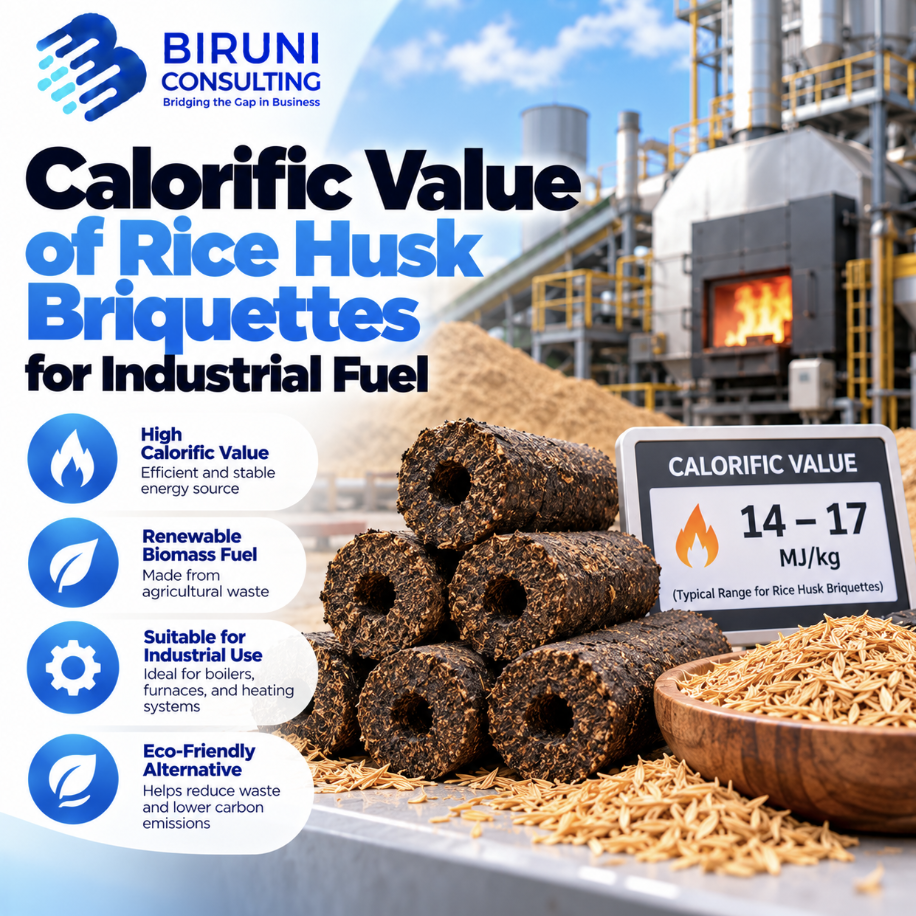
What Is the Calorific Value of Rice Husk Briquettes?
The calorific value of a rice husk briquette represents the amount of thermal energy that can be released when a specified quantity of fuel is burned.
For industrial users, this is one of the most important parameters when evaluating briquettes for boilers, furnaces, dryers, biomass burners, and other thermal systems.
Calorific value may be reported in cal/g, kcal/kg, MJ/kg, or other units.
In general, a higher calorific value means that each kilogram of fuel contains more potential thermal energy.
However, calorific value should never be the only specification used to select an industrial biomass fuel.
Moisture content, ash content, density, briquette dimensions, combustion characteristics, feeding performance, and boiler compatibility are also important.
What Is a Typical Rice Husk Briquette Calorific Value?
There is no single calorific value that applies to every rice husk briquette.
Test results can vary considerably because of raw-material characteristics, carbonization, moisture, ash, compaction pressure, binder type, and manufacturing method.
For example, research on rice husk wafer briquettes produced under different compaction pressures reported calorific values ranging from approximately 4,793.94 to 5,266.52 cal/g. The study also observed increasing calorific value as compaction pressure increased under the conditions investigated. UMMAT Scientific Journals
A 2025 study investigating charcoal briquettes containing rice husk and palm kernel shell reported the highest calorific value of 5,242.76 cal/g for its 100% rice husk formulation, although the study’s moisture and ash results also demonstrated why fuel quality needs to be assessed using several parameters rather than calorific value alone. eJournals Universitas Mulawarman
Meanwhile, a 2025 international study on non-carbonized rice husk composite briquettes produced calorific values ranging from approximately 13.54 to 18.74 MJ/kg, depending on the binder and production conditions. DOI
These differences illustrate why the term “rice husk briquette” alone cannot define the energy value of a commercial product.
Examples from Rice Husk Briquette Research
The following table illustrates how substantially calorific values can vary.
| Briquette Type / Process | Reported Calorific Value |
|---|---|
| Rice husk wafer briquette under different pressures | 4,793.94–5,266.52 cal/g |
| 100% rice husk charcoal formulation in one study | 5,242.76 cal/g |
| Non-carbonized rice husk composite briquettes | 13.54–18.74 MJ/kg |
| Rice husk charcoal briquettes with different shapes in a 2026 study | 2,796–3,314 cal/g |
| Rice husk and corn-cob briquette formulation | 4,232.71 cal/g |
A 2026 study involving rice husk charcoal briquettes with the same charcoal-to-tapioca ratio but different shapes reported values of approximately 2,796–3,314 cal/g. Jurnal UBT
This wide variation makes supplier-specific laboratory data particularly important for industrial procurement.
Understanding Calorific Value Units
Industrial documentation may use several units.
Common examples include:
- cal/g,
- kcal/kg,
- MJ/kg,
- kJ/kg.
For simple conversion:
1 cal/g = 1 kcal/kg
and:
1 cal/g ≈ 0.004184 MJ/kg.
Therefore:
| Calorific Value | Approximate MJ/kg |
|---|---|
| 3,000 kcal/kg | 12.55 MJ/kg |
| 4,000 kcal/kg | 16.74 MJ/kg |
| 4,500 kcal/kg | 18.83 MJ/kg |
| 5,000 kcal/kg | 20.92 MJ/kg |
| 5,500 kcal/kg | 23.01 MJ/kg |
Unit conversion allows purchasing and engineering teams to compare suppliers that use different reporting units.
The reporting basis, however, also needs to be checked before two numbers are directly compared.
Gross Calorific Value and Net Calorific Value
Fuel specifications may refer to:
Gross Calorific Value (GCV) or Higher Heating Value (HHV)
and:
Net Calorific Value (NCV) or Lower Heating Value (LHV).
These are not identical values.
ISO 18125:2017 specifies a method for determining the gross calorific value of solid biofuels using a calibrated bomb calorimeter and also provides calculations for net calorific value. ISO records the standard as current after confirmation in 2022. ISO
Gross calorific value assumes the water associated with combustion products is condensed.
Net calorific value reflects conditions in which this water remains as vapor, which is often closer to actual boiler operation.
For this reason, NCV can be particularly relevant when evaluating useful industrial fuel energy.
Do Not Directly Compare GCV with NCV
Consider two quotations:
Supplier A: GCV 4,800 kcal/kg
and:
Supplier B: NCV 4,600 kcal/kg.
It would be incorrect to conclude immediately that Supplier A provides a superior fuel.
The buyer should first confirm:
- Whether both figures are GCV or NCV.
- Moisture-reporting basis.
- Test method.
- Condition of the tested sample.
Supplier comparisons are more meaningful when values are reported on equivalent bases.
As-Received vs. Dry Basis
Fuel laboratory reports may also use different calculation bases.
As-Received Basis
An as-received value represents the material in the condition received by the laboratory, including its moisture.
This can be particularly useful when evaluating the fuel actually delivered to a factory.
Dry Basis
A dry-basis value removes the effect of moisture from the calculation.
Dry-basis calorific values therefore generally appear higher than corresponding as-received values.
Consequently:
5,000 kcal/kg GCV on a dry basis
should not automatically be considered superior to:
4,500 kcal/kg GCV on an as-received basis
without knowing the moisture levels and converting the values appropriately.
Factors Affecting Rice Husk Briquette Calorific Value
Several characteristics can influence the energy content and usable thermal performance of a briquette.
1. Moisture Content
Moisture is one of the most important factors.
Water does not generate combustion energy. Instead, heat is consumed to evaporate it.
Research on rice husk briquettes has demonstrated that controlling moisture can significantly affect physical and energetic properties. One study reported a maximum value of 17.688 MJ/kg at one of the moisture conditions investigated. MDPI
For industrial applications, moisture should remain reasonably consistent between deliveries.
2. Ash Content
Ash consists of non-combustible mineral material.
Rice husk naturally contains relatively high mineral content compared with several other biomass materials.
A 2025 study of non-carbonized rice husk composite briquettes recorded ash contents of approximately 13.33–16.50% for its formulations and noted the generally high-ash nature of rice husk feedstock. DOI
Ash therefore needs to be considered together with calorific value when assessing industrial fuel performance.
3. Carbonization
Rice husk briquettes may be manufactured as either carbonized or non-carbonized products.
Carbonization changes the fuel’s:
- volatile matter,
- fixed carbon,
- moisture,
- ash,
- and energy characteristics.
The resulting calorific value depends heavily on carbonization conditions and the final briquette formulation.
4. Fixed Carbon
Fixed carbon represents the solid carbon fraction remaining after volatile components have been accounted for.
For charcoal-based briquettes, this parameter can provide useful information regarding combustion behavior and energy characteristics.
5. Volatile Matter
Volatile matter consists of compounds released when a solid fuel is heated.
Fuel with high volatile matter can behave differently during ignition and combustion compared with fuel containing a greater fixed-carbon fraction.
For industrial boilers, this can influence flame characteristics and combustion control.
6. Binder Type and Quantity
Binders may be added to improve briquette strength.
Different binder materials and percentages can affect both physical durability and calorific value.
Recent studies demonstrate that binder selection and blending with other biomass materials can produce substantially different energy characteristics in rice-husk-based briquettes. DOI
7. Compaction Pressure
Briquetting pressure can also influence the final product.
In one rice husk wafer study, increasing compaction pressure from 20 PSI to 40 PSI was associated with an increase in density from approximately 0.453 to 0.500 g/cm³ and an increase in calorific value from approximately 4,793.94 to 5,266.52 under the tested conditions. UMMAT Scientific Journals
This does not mean higher pressure will always increase calorific value for every formulation, but it demonstrates that manufacturing conditions matter.
Calorific Value Is Not the Only Measure of Fuel Quality
A common mistake in biomass procurement is selecting the product with the highest calorific-value number without evaluating other parameters.
Consider:
Briquette A
- Calorific value: 5,100 kcal/kg
- Ash: 30%
Briquette B
- Calorific value: 4,700 kcal/kg
- Ash: 10%
Briquette A has the higher laboratory energy value, but actual boiler economics cannot be determined from that figure alone.
Industrial buyers should also evaluate:
- Moisture.
- Ash.
- Ash behavior.
- Dimensions.
- Density.
- Mechanical durability.
- Fines.
- Burning rate.
- Feeding performance.
- Delivered cost.
The best decision normally combines laboratory data with an operational trial.
Calorific Value and Boiler Fuel Consumption
In theory, a fuel with a higher calorific value provides more thermal energy per kilogram.
Actual boiler consumption, however, also depends on boiler efficiency.
A simplified relationship is:
Useful Energy = Fuel Energy × System Efficiency
Even a high-calorific-value fuel may perform poorly if combustion is incomplete or the boiler is not appropriately configured.
Energy losses can occur through:
- flue gases,
- incomplete combustion,
- unburned carbon,
- radiation,
- excessive moisture,
- and other system losses.
Actual operating data are therefore essential.
Energy Contained in One Ton of Briquettes
As a simplified illustration, assume a briquette has a calorific value of:
4,500 kcal/kg.
One metric ton theoretically contains:
4,500 kcal/kg × 1,000 kg = 4,500,000 kcal.
A second briquette with:
5,000 kcal/kg
would theoretically contain:
5,000,000 kcal per ton.
The difference is:
500,000 kcal per metric ton.
The amount converted into useful steam or process heat will still depend on boiler efficiency and operating conditions.
Comparing Fuel Cost by Energy Content
Consider two products.
Briquette A
Price: IDR 3,000/kg
Calorific value: 4,000 kcal/kg
Simplified cost per 1,000 kcal:
IDR 3,000 ÷ 4 = IDR 750 per 1,000 kcal
Briquette B
Price: IDR 3,500/kg
Calorific value: 5,000 kcal/kg
Simplified cost per 1,000 kcal:
IDR 3,500 ÷ 5 = IDR 700 per 1,000 kcal
Although Briquette B costs more per kilogram, its theoretical energy cost is lower in this illustration.
This simplified calculation does not include boiler efficiency, ash handling, logistics, maintenance, or other operating expenses.
Industrial customers should therefore avoid selecting biomass solely on price per ton.
Calorific Value and Fuel-to-Steam Ratio
For boiler operations, fuel-to-steam ratio can be a very useful performance indicator.
Suppose a boiler requires:
180 kg of briquettes to produce one ton of steam.
Its fuel-to-steam ratio is:
180 kg fuel/ton steam.
If another fuel reduces consumption to:
160 kg fuel/ton steam,
the second fuel may generate lower steam costs even if its purchase price per kilogram is higher.
Fuel-to-steam ratio depends on:
- Calorific value.
- Moisture.
- Boiler efficiency.
- Steam pressure.
- Feedwater temperature.
- Operating load.
- Combustion settings.
- Fuel quality.
- Blowdown.
- Boiler condition.
Trials should therefore be conducted under comparable operating conditions.
Bomb Calorimeter Testing
Fuel calorific value should not be estimated visually or simply assumed from the raw-material type.
A bomb calorimeter is used to determine gross calorific value under controlled laboratory conditions.
ISO 18125:2017 specifies determination of the gross calorific value of solid biofuels at constant volume using a calibrated bomb calorimeter. ISO
Industrial customers can request laboratory reports or Certificates of Analysis from prospective suppliers.
What to Check in a Calorific-Value Report
Do not evaluate a laboratory report using only the final number.
Check:
- Sample identification.
- Test date.
- Test method.
- Whether the result is GCV or NCV.
- Unit.
- Reporting basis.
- Moisture content.
- Ash content.
- Testing laboratory.
- Batch identification where available.
A complete report makes supplier comparisons more reliable.
Batch-to-Batch Variation
Biomass feedstocks naturally vary.
Rice husk from one source may differ from material collected from another mill.
Variation can also result from:
- production moisture,
- drying conditions,
- carbonization,
- raw-material blending,
- binder percentage,
- compaction pressure,
- and storage.
A good initial sample therefore does not automatically guarantee that every subsequent shipment will have the same calorific value.
Industrial contracts can define an acceptable calorific-value range.
Minimum Calorific Value in Supply Contracts
Companies can specify a minimum GCV or NCV according to engineering requirements and trial results.
However, calorific value should not be the only acceptance criterion.
Industrial specifications may also define:
- Maximum moisture.
- Maximum ash.
- Dimensions.
- Density.
- Maximum fines.
- Packaging.
- Sampling procedures.
- Laboratory methods.
- Acceptance criteria.
- Rejection procedures.
This provides more comprehensive fuel-quality control.
Carbonized vs. Non-Carbonized Rice Husk Briquette Calorific Value
Carbonized and non-carbonized rice husk briquettes have substantially different fuel structures.
Non-carbonized briquettes retain more of the original biomass volatile components.
Carbonized briquettes have undergone thermal treatment that alters their composition.
Carbonization, however, does not automatically guarantee higher calorific value.
A 2026 study of rice husk charcoal briquettes reported only 2,796–3,314 cal/g for the formulations tested. Jurnal UBT
Other rice husk charcoal formulations have achieved values above 5,000 cal/g. eJournals Universitas Mulawarman
This is why supplier-specific laboratory results remain essential.
Blending Rice Husk with Other Biomass Materials
Rice husk can also be blended with other biomass materials.
Potential objectives include:
- increasing calorific value,
- reducing ash,
- improving strength,
- improving ignition,
- and modifying combustion behavior.
A 2026 study involving carbonized rice husk blended with coconut shell or palm kernel shell found significant increases in energy value relative to the tested rice-husk formulations. A blend containing 40% rice husk and 60% coconut shell achieved approximately 5,277 kcal/kg, while a palm-kernel-shell blend achieved approximately 4,741 kcal/kg. ScienceDirect
Blended briquettes, however, are technically different products from 100% rice husk briquettes.
Buyers should confirm feedstock composition where this is important to procurement requirements.
Evaluate Calorific Value Together with Ash
High calorific value combined with high ash does not automatically deliver the lowest total operating cost.
Higher ash may increase:
- ash-removal requirements,
- cleaning frequency,
- waste handling,
- operator workload,
- and potentially downtime.
A fuel with slightly lower calorific value but better ash performance can sometimes be more practical.
Industrial evaluation should therefore consider multiple parameters simultaneously.
Comparing Suppliers
A procurement team can prepare a comparison table such as:
| Parameter | Supplier A | Supplier B | Supplier C |
|---|---|---|---|
| Price/Ton | Quotation | Quotation | Quotation |
| GCV | CoA | CoA | CoA |
| NCV | CoA | CoA | CoA |
| Moisture | CoA | CoA | CoA |
| Ash | CoA | CoA | CoA |
| Volatile Matter | CoA | CoA | CoA |
| Fixed Carbon | CoA | CoA | CoA |
| Density | Data | Data | Data |
| Delivered Cost | Quotation | Quotation | Quotation |
| Fuel-to-Steam Ratio | Trial | Trial | Trial |
This provides a much more useful basis for procurement than comparing price per ton alone.
Why Is a Boiler Trial Still Necessary?
A laboratory measures the fuel’s energy potential.
A boiler determines how efficiently that fuel performs under actual operating conditions.
A trial can measure:
- Fuel consumption per hour.
- Fuel-to-steam ratio.
- Steam generation.
- Steam pressure.
- Furnace temperature.
- Flame stability.
- Feeding performance.
- Ash quantity.
- Ash characteristics.
- Deposits or clinker.
- Cleaning frequency.
- Operator adjustments.
These data allow purchasing and engineering teams to determine whether the laboratory calorific value translates into an operational advantage.
What Calorific Value Is Suitable for Industrial Use?
There is no single number that is automatically suitable for every industrial plant.
Requirements depend on:
- boiler type,
- boiler capacity,
- steam pressure,
- combustion technology,
- fuel-feeding system,
- production process,
- operating load,
- and the fuel currently being used.
Rather than searching for the “highest calorific value,” companies should identify a fuel specification range that provides stable operation at a competitive total cost.
A lower-calorific-value fuel can still be commercially attractive if it offers favorable pricing, reliable supply, manageable ash, and good boiler performance.
How to Select Briquettes Based on Calorific Value
Industrial buyers can use a structured evaluation process.
Stage 1 – Request Technical Data
Request:
- GCV,
- NCV where available,
- moisture,
- ash,
- volatile matter,
- fixed carbon,
- density,
- dimensions.
Stage 2 – Verify the Reporting Basis
Confirm whether results are:
- as received,
- air dried,
- or dry basis.
Stage 3 – Compare Energy Cost
Do not compare IDR per ton alone.
Calculate the approximate cost per unit of energy as an initial screening measure.
Stage 4 – Conduct an Operational Trial
Test the product in the actual boiler under controlled conditions.
Stage 5 – Calculate Actual Operating Cost
Evaluate:
IDR per ton of steam
or:
IDR per unit of production
depending on the factory’s operation.
This approach makes calorific-value data more useful for procurement decisions.
Information to Request from a Supplier
Before purchasing rice husk briquettes for industrial use, buyers should request:
- Gross Calorific Value.
- Net Calorific Value where available.
- Reporting basis.
- Moisture content.
- Ash content.
- Volatile matter.
- Fixed carbon.
- Density.
- Briquette dimensions and shape.
- Carbonized or non-carbonized product type.
- Raw-material composition.
- Binder information where applicable.
- Certificate of Analysis.
- Monthly supply capacity.
- Trial availability.
- Price per ton.
- Delivered cost.
This information allows purchasing and engineering teams to perform a more complete technical and commercial evaluation.
Contact Us
Biruni Consulting can assist companies that require information and support regarding product requirements, documentation, and compliance processes related to product importation, marketing, or use according to business requirements in Indonesia.
The services that can be supported include:
- Consultation on product requirements for industrial needs.
- Initial assessment of product specifications and applications.
- Technical document review.
- Review of product specifications and information.
- Consultation on applicable regulatory requirements according to the product type and business activities.
- Assistance in preparing required documents.
- Consultation on certification or licensing processes when required based on the product characteristics and intended use.
Contact Biruni Consulting for information regarding product requirements, documentation, certification, and compliance needs to support business activities and product marketing in Indonesia.