
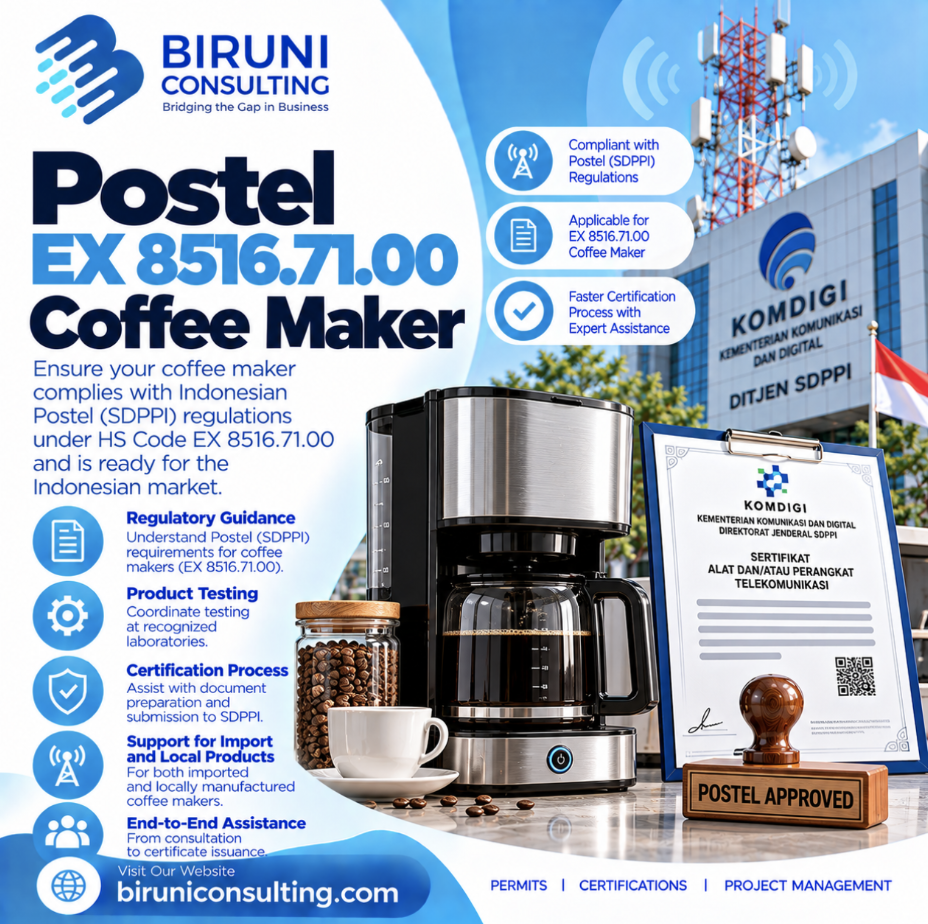
Guide to Postel/DJID requirements for wireless-enabled coffee makers in Indonesia.
HS Code 8516.71.00 covers coffee or tea makers under Indonesian tariff nomenclature.
For Postel purposes, however, the HS Code alone does not determine whether a coffee maker requires telecommunications certification. The main consideration is whether the product contains telecommunications or radio functions such as WiFi, Bluetooth, RF communication, or other wireless technologies.
A conventional coffee maker that only performs heating, brewing, timer, display, or electronic control functions will have a different Postel assessment from a smart coffee maker that connects to a smartphone, mobile application, router, or cloud platform.
Indonesia’s current telecommunications equipment and device certification framework is regulated under Minister of Communication and Informatics Regulation Number 3 of 2024.
Does an HS 8516.71.00 Coffee Maker Require Postel Certification?
Not every coffee maker classified under HS Code 8516.71.00 automatically requires Postel Certification.
The actual wireless functionality of the product needs to be reviewed. A standard coffee maker may only contain heating elements, internal sensors, digital displays, timers, and electronic controls without any radio communication.
A smart coffee maker, on the other hand, may include WiFi, Bluetooth, smartphone connectivity, mobile application control, or cloud connectivity.
When these features are incorporated into the product, the wireless specifications should be assessed to determine the applicable DJID/SDPPI Certification requirements.
Why the HS Code Alone Is Not Enough
HS Code 8516.71.00 identifies the product as a coffee or tea maker from a customs classification perspective.
Postel assessment focuses on a different aspect: the telecommunications functions incorporated into the product.
For example, one coffee maker may only have a digital timer, while another model under the same HS Code may include Bluetooth or WiFi.
Although the products can share the same tariff classification, their radio configurations may be different. Therefore, the product datasheet and wireless specifications should always be reviewed together with the HS Code.
Smart Coffee Makers with WiFi
WiFi is increasingly used in smart household appliances, including coffee makers.
A WiFi-enabled coffee maker may allow users to remotely start brewing, schedule operation, adjust settings, monitor machine status, or receive notifications through a mobile application.
For Postel assessment, important WiFi information generally includes:
- WiFi standard and frequency band.
- Transmission power and bandwidth.
- Wireless module.
- Antenna specification.
Indonesia currently regulates RLAN spectrum and technical requirements through applicable technical standards, including Minister of Communication and Digital Decision Number 12 of 2025.
The actual WiFi configuration of the coffee maker therefore needs to be compared with the applicable Indonesian requirements.
Coffee Makers with Bluetooth
Bluetooth may be used for initial pairing, local control, configuration, diagnostics, or communication between the coffee maker and a nearby smartphone.
Bluetooth IEEE 802.15.1 is included within Indonesia’s Short Range Device technical framework and generally operates in the 2400–2483.5 MHz band.
For a Bluetooth-enabled coffee maker, the assessment usually reviews the Bluetooth version, operating frequency, RF output power, module model, and antenna configuration.
The commercial description “Bluetooth coffee maker” alone is not sufficient to determine certification requirements. The actual technical specifications need to be reviewed.
Coffee Makers with Both WiFi and Bluetooth
Some smart coffee makers contain both WiFi and Bluetooth.
Bluetooth may be used during initial pairing, while WiFi is used for regular communication with a mobile application or cloud service.
For products with multiple wireless technologies, the assessment should identify each radio function, its frequency range, transmission power, module, and antenna configuration.
This is important because WiFi and Bluetooth may be subject to different technical standards even when they are integrated into the same wireless chipset.
Frequency and Transmission Power
Operating frequency and transmission power are two important parameters in a Postel assessment.
Frequency information can normally be found in the product datasheet, wireless module datasheet, user manual, RF specification, or test report.
Transmission power may appear as RF output power, maximum output power, conducted power, radiated power, or EIRP.
Indonesia’s class-license spectrum framework currently refers to Minister of Communication and Informatics Regulation Number 2 of 2023 as amended by Minister of Communication and Digital Regulation Number 2 of 2025.
The actual radio specifications should therefore be compared with the applicable frequency and power requirements.
Does Low Power Mean the Product Is Exempt?
Low transmission power does not automatically mean that a product is exempt from Postel Certification.
Regulation Number 3 of 2024 contains specific provisions for certain equipment incorporating telecommunications features with transmission power below 10 mW and only one identical telecommunications feature.
Under specified conditions, one Certificate may cover more than one product variant.
However, this is not a general exemption for all products below 10 mW. The complete technical configuration must still be assessed.
How to Identify Wireless Functions in a Coffee Maker
Wireless functionality is not always obvious from the external appearance of the product.
A coffee maker may contain an internal wireless module even when no external antenna is visible.
Companies should therefore check the product datasheet, user manual, mobile application information, manufacturer specifications, and wireless module details.
Terms such as WiFi enabled, Bluetooth enabled, smart control, app control, IoT, or cloud connected usually indicate that a telecommunications function may be present.
Does a Coffee Maker Without WiFi or Bluetooth Need Postel?
A coffee maker without telecommunications or radio communication functions needs to be distinguished from a wireless-enabled smart appliance.
Functions such as a touchscreen, timer, temperature sensor, automatic brewing system, grinder, or digital display do not by themselves indicate radio communication.
However, the product documentation should still be reviewed to confirm that no embedded wireless module is installed.
This is particularly important for products available in both standard and smart versions.
Is a Certified WiFi or Bluetooth Module Sufficient?
Not necessarily.
A module certificate can be useful supporting documentation, but it does not automatically mean that the complete coffee maker has fulfilled all certification requirements.
The assessment should confirm whether the same module, frequency, transmission power, antenna, firmware configuration, and wireless functions are used in the final product.
Changes to the antenna or RF configuration may affect the technical characteristics of the final appliance.
Therefore, the module documentation should always be compared with the actual coffee maker configuration.
Documents Required for Postel Assessment
For an initial assessment, companies should generally prepare:
- Product photos, brand, and model.
- Product datasheet and user manual.
- WiFi or Bluetooth module datasheet.
- Operating frequency and transmission power.
- Antenna specification.
- RF test report, if available.
The HS Code, country of manufacture, and manufacturer information should also be confirmed.
If the general product datasheet does not provide complete RF specifications, additional wireless module documentation should be requested from the manufacturer.
Can Several Coffee Maker Models Use One Certificate?
Possibly, but model grouping needs to be based on technical similarities.
Two coffee makers may look almost identical while using different wireless modules. Conversely, several models with different colors or capacities may use exactly the same wireless configuration.
The assessment should compare the product type, wireless module, frequency, transmission power, antenna, country of manufacture, and wireless functions.
Regulation Number 3 of 2024 contains specific provisions that may allow one Certificate to cover more than one variant when the applicable requirements are fulfilled.
Therefore, several coffee maker models should not automatically be grouped simply because they use the same HS Code or have similar external designs.
Postel Certification Process for Wireless Coffee Makers
The certification process generally begins with a technical assessment.
The main stages may include:
- Review of product and wireless documentation.
- Identification of WiFi, Bluetooth, or other radio technologies.
- Review of frequency, transmission power, module, and antenna.
- Identification of applicable Technical Standards.
- Determination of testing requirements.
- Preparation and submission of certification documents.
- Certificate issuance after the requirements are fulfilled.
The exact process may vary depending on the product configuration and the supporting test documentation available.
Testing Requirements
Testing requirements depend on the wireless technology and product configuration.
For example, a WiFi-enabled coffee maker needs to be assessed against the applicable RLAN technical requirements, while Bluetooth functions may need to be assessed against the relevant Short Range Device standards.
Existing RF test reports may be useful supporting documents, but their suitability still needs to be checked against the certification route and applicable Indonesian standards.
Therefore, the availability of a foreign test report does not automatically mean that no additional testing will be required.
Certificate Validity
Under Regulation Number 3 of 2024, the Certificate itself does not have an expiration date.
However, the Certificate holder may manufacture, assemble, or import the relevant telecommunications equipment or device for trade and/or use in Indonesia for up to three years from the Certificate issuance date.
If these activities continue after that period, the applicable provisions require renewed technical compliance and a new Certificate.
This distinction is important for companies planning to import the same coffee maker model over several years.
Postel Labeling Requirements
Products that have obtained certification also need to comply with applicable labeling requirements.
The regulated information includes the Certificate number, PLG ID, QR Code, and warning sign where applicable.
Label planning should be considered before commercial importation, especially when the wireless function is integrated into a household appliance with limited space for regulatory markings.
Importance of Assessment Before Importation
Postel assessment should ideally be conducted before the coffee maker is shipped to Indonesia.
This allows the importer to confirm whether the product contains WiFi, Bluetooth, or another radio technology and to identify the applicable certification requirements before commercial quantities arrive.
A pre-import assessment can help determine:
- DJID/SDPPI Certification requirements.
- Applicable frequency and transmission power.
- Testing and technical documentation requirements.
- Possibility of grouping several models.
- Postel labeling requirements.
It also helps importers request the correct technical documents from the manufacturer before beginning the certification process.
Postel Certification and Other Product Requirements
Postel/DJID Certification focuses on telecommunications and wireless functions incorporated into the product.
A coffee maker is also an electrical household appliance and may be subject to other product, safety, import, or compliance requirements depending on its technical characteristics and applicable Indonesian regulations.
Therefore, Postel Certification should not automatically be treated as replacing other product-compliance requirements.
Both the coffee maker itself and its wireless functions should be assessed separately.
Importance of Checking the Exact Product Model
Certification assessment should always refer to the exact model intended for importation.
Manufacturers may offer visually similar coffee makers in several versions, such as a standard version, Bluetooth version, WiFi version, or combined WiFi and Bluetooth version.
Different markets may also receive different wireless modules even when the commercial model name appears similar.
For this reason, the product model, module information, frequency, transmission power, antenna, and country of manufacture should be confirmed before determining the certification approach.
Conclusion
An HS Code 8516.71.00 coffee maker should be assessed for Postel/DJID requirements when it includes wireless communication functions such as WiFi, Bluetooth, RF, or other radio technologies.
The HS Code identifies the product category, but it does not by itself determine telecommunications certification requirements.
Wireless modules, frequency range, transmission power, antenna, application connectivity, and final product configuration are the main technical elements that should be reviewed.
Conducting an assessment before importation helps companies determine DJID/SDPPI Certification requirements, testing needs, technical documentation, model grouping, and labeling requirements more accurately.
Contact Us
Biruni Consulting assists with DJID/SDPPI assessment and certification for wireless-enabled coffee makers and various wireless products that will be imported or marketed in Indonesia.
Our services include:
- Assessment of DJID/SDPPI certification requirements.
- Bluetooth module assessment.
- RF specification review.
- Frequency and transmission power analysis.
- Technical document review.
- Certification document preparation.
- Testing coordination where required.
- DJID/SDPPI Certification assistance.
If you have a coffee maker under HS Code 8516.71.00, you can prepare product photos, brand, model, datasheet, RF specifications, and wireless module datasheet for an initial assessment of the Postel Certification requirements.