
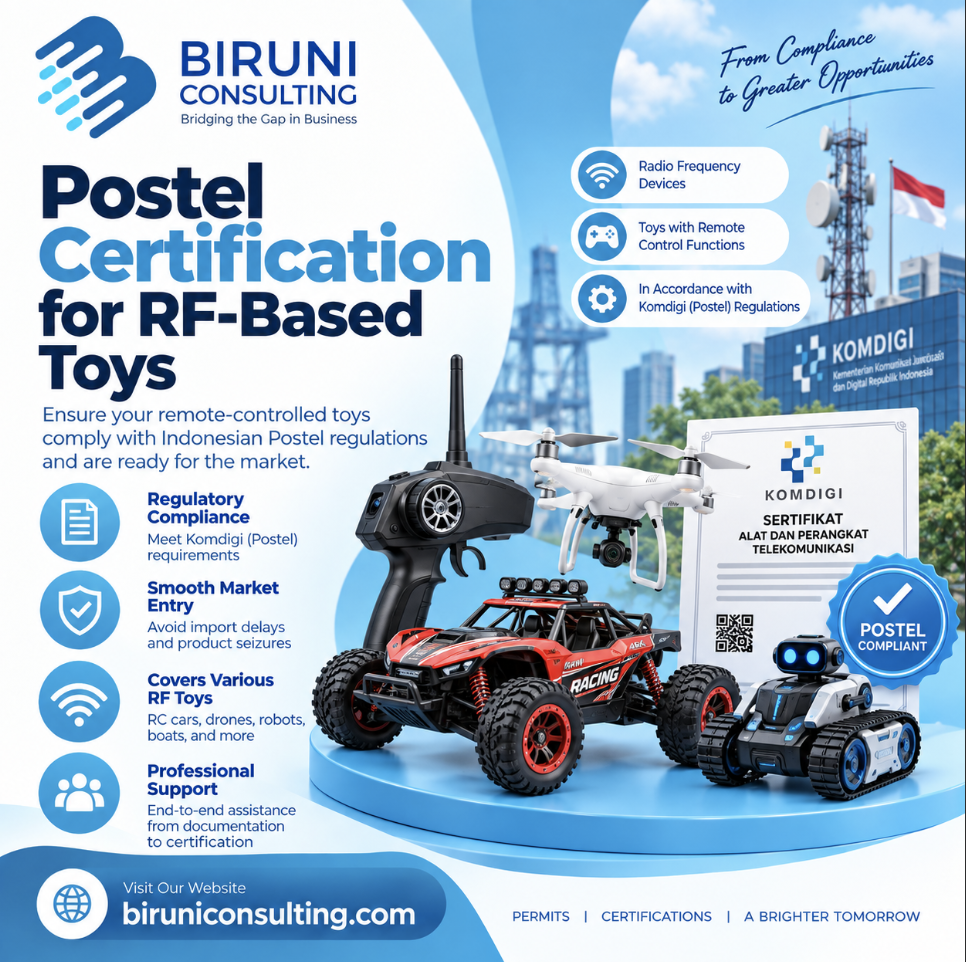
Guide to Postel/DJID Certification for remote control toys in Indonesia
Remote control toys use wireless communication between a controller and the toy unit. Examples include RC cars, toy robots, boats, airplanes, helicopters, and various other wireless toys using RF, Bluetooth, WiFi, or other radio technologies.
Because these products include wireless communication functions, Postel/DJID Certification requirements need to be assessed based on frequency, transmission power, transmitter, receiver, wireless module, antenna, and product configuration.
Are Remote Control Toys Required to Have Postel Certification?
The requirement for Postel Certification cannot be determined solely from the product name or design.
An assessment of the wireless system is required. Two similar remote control toys may have different requirements if they use different frequencies, transmission power levels, or wireless modules.
Important parameters include:
- Operating frequency.
- Transmission power.
- Transmitter and receiver.
- RF module.
- Bluetooth or WiFi, if available.
- Antenna.
- Bandwidth and modulation.
- Product brand and type.
A technical assessment before importation helps determine the applicable certification requirements.
Frequency and Transmission Power
Frequency and transmission power are important parameters for remote control toy assessment.
Frequency identifies the radio band used between the remote controller and toy, while transmission power indicates the power used by the transmitter to send signals.
Radio spectrum use based on class licensing is regulated under Minister of Communication and Informatics Regulation Number 2 of 2023 as amended by Minister of Communication and Digital Regulation Number 2 of 2025, including spectrum provisions for Short Range Devices.
Low transmission power does not automatically mean that a product is exempt from Postel Certification.
Remote Controllers and RF Systems
In many remote control toys, the controller contains the transmitter while the receiver is installed in the toy unit.
The assessment should therefore consider both parts.
Information generally required for the remote controller includes:
- Brand and model.
- Operating frequency.
- Transmission power.
- RF module.
- Antenna.
- Channels.
- Datasheet.
Reviewing both devices helps identify the complete wireless configuration.
Toys with Bluetooth or WiFi
Some remote control toys include Bluetooth or WiFi in addition to or instead of conventional RF remote control.
Bluetooth may be used for smartphone or application control, while WiFi may support applications, cameras, video streaming, or other wireless features.
The assessment should consider the frequency band, transmission power, wireless module, antenna, bandwidth, and product configuration.
A certified wireless module does not automatically mean that the complete final product is exempt from assessment.
Remote Control Toys and Short Range Devices
Many remote control toys use short-range radio communication and may fall within technical categories related to Short Range Devices or SRD.
However, short operating range or low transmission power does not automatically remove certification requirements.
Frequency, transmission power, wireless functions, and applicable technical standards still need to be reviewed.
Documents Required for Postel Assessment
For an initial assessment, companies should generally prepare:
- Product photos.
- Remote controller photos.
- Brand and model.
- Product datasheet.
- Remote controller datasheet.
- RF or wireless module datasheet.
- Operating frequency.
- Transmission power.
- Antenna specifications.
- User manual.
- RF test report, if available.
These documents help determine the wireless technology, testing requirements, and appropriate certification process.
Is a Certified Wireless Module Sufficient?
Not necessarily.
A module certificate can serve as supporting documentation, but the final product configuration still needs to be assessed.
Module integration may affect the antenna, output power, firmware, enclosure, or RF configuration.
Therefore, the module documentation should be compared with the actual final product configuration.
Can Several Models Use One Certificate?
The possibility of covering several models under one Certificate needs to be assessed based on their technical characteristics.
Similar design or color alone is not sufficient. Brand, type, wireless module, frequency, transmission power, and communication configuration need to be compared.
Under specific conditions, regulations provide provisions for devices with transmission power below 10 mW and one identical telecommunications feature that may allow one Certificate to cover more than one variant when all applicable requirements are fulfilled.
Postel Certification Process for Remote Control Toys
The process may generally include:
- Collecting product documents.
- Assessing the wireless technology.
- Reviewing frequency and transmission power.
- Reviewing transmitters, receivers, and modules.
- Identifying applicable technical standards.
- Determining testing requirements.
- Preparing certification documents.
- Testing when required.
- Submitting the certification application.
- Certificate issuance after the requirements are fulfilled.
The applicable certification regulation provides for compliance with Technical Standards through testing and certification.
Certification Validity and Labeling
Under Minister of Communication and Informatics Regulation Number 3 of 2024, a Certificate itself does not have an expiration date, although separate provisions apply to the period for manufacturing, assembling, or importing products under the Certificate.
Certified products also need to comply with labeling requirements. The regulated format includes the Certificate number and PLG ID, QR Code, and warning sign where applicable.
Importance of Assessment Before Importation
Pre-import assessment helps companies understand regulatory requirements before products are shipped to Indonesia.
An initial assessment can identify:
- DJID/SDPPI Certification requirements.
- Product frequency and transmission power.
- Testing requirements.
- Required documents.
- Possibility of grouping several models.
- Labeling requirements.
This is important because products with similar designs may use different wireless systems.
Difference Between Postel Certification and Toy Certification
Postel Certification and toy product requirements are different regulatory aspects.
Postel/DJID Certification relates to telecommunications or wireless functions, while toy requirements relate to safety and other standards applicable to toy products.
Therefore, Postel Certification does not replace toy safety requirements, and toy compliance does not automatically replace telecommunications certification requirements.
Conclusion
Postel Certification for remote control toys needs to be assessed based on the wireless technology used.
Frequency, transmission power, transmitter, receiver, RF module, Bluetooth, WiFi, antenna, and product configuration are important parts of the assessment.
By conducting an assessment before importation, companies can determine certification, testing, documentation, and labeling requirements more accurately.
Contact Us
Biruni Consulting assists with DJID/SDPPI assessment and certification for remote control toys and various wireless products that will be imported or marketed in Indonesia.
Our services include:
- Assessment of DJID/SDPPI certification requirements.
- Bluetooth module assessment.
- RF specification review.
- Frequency and transmission power analysis.
- Technical document review.
- Certification document preparation.
- Testing coordination where required.
- DJID/SDPPI Certification assistance.
If you have a remote control toy, you can prepare product photos, brand, model, datasheet, RF specifications, and wireless module datasheet for an initial assessment of the Postel Certification requirements.