
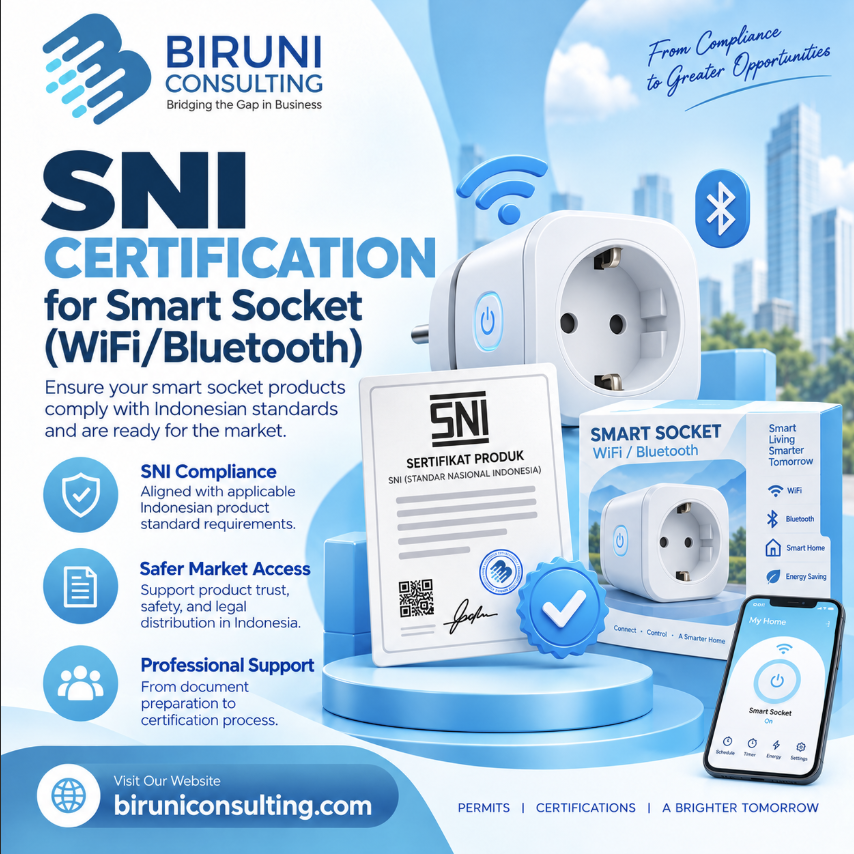
Standards and Certification for Smart Socket Outlets with WiFi and Bluetooth Technology in Indonesia
A smart socket is an evolution of a conventional socket outlet equipped with electronic functions and wireless connectivity. The product can be used to switch electrical devices on or off manually or through an application, and can connect to a smart home system using WiFi or Bluetooth.
Unlike a conventional socket outlet, a smart socket involves more than one aspect that needs to be considered. In addition to its main function as an electrical socket, the product contains electronic circuits, a power supply, communication modules, an antenna, a control system, and software supporting its smart functions.
Therefore, companies intending to manufacture or import WiFi/Bluetooth smart sockets into Indonesia need to review SNI requirements for the electrical portion while also assessing the wireless communication function.
For the socket outlet portion, SNI IEC 60884-1:2014 is one of the standards that needs to be reviewed for plugs and socket outlets for household and similar purposes. Its application still needs to be adjusted to the characteristics, construction, and specifications of the product.
Meanwhile, if the smart socket is equipped with WiFi or Bluetooth functions that perform radio communication, the telecommunications-device aspect also needs to be assessed according to the applicable telecommunications certification requirements.
What Is a WiFi/Bluetooth Smart Socket?
A smart socket is an electrical socket equipped with electronic circuitry that allows users to control or monitor electrical power through an electronic system.
A WiFi model can connect to a router or internet network, allowing users to control the device through a smartphone application or smart home platform.
A Bluetooth model can communicate directly with a user’s device within Bluetooth range. Some products also combine WiFi and Bluetooth in one module to provide more connectivity options.
A smart socket generally consists of several components:
- Socket outlet.
- Plug, when included as part of the product.
- WiFi and/or Bluetooth module.
- Antenna.
- Power supply or AC-DC converter.
- Relay or electronic switching component.
- PCB or printed circuit board.
- Manual button.
- Indicator light.
- Casing or housing.
- Electrical protection system.
- Firmware or control software.
The combination of electrical components and wireless communication is what makes the assessment of a smart socket more comprehensive than that of a conventional socket outlet.
SNI Standards Related to Smart Sockets
SNI IEC 60884-1:2014
For the socket outlet and plug portion, one of the main standards that needs to be reviewed is SNI IEC 60884-1:2014 – Plugs and socket-outlets for household and similar purposes – Part 1: General requirements.
This standard is one of the references for general requirements for plugs and socket outlets. However, the presence of a WiFi or Bluetooth module does not mean that the entire smart socket is assessed only under the socket outlet standard.
The electronic module and radio communication function need to be assessed separately according to the product characteristics and applicable technical requirements.
Is a Smart Socket Required to Have SNI?
The SNI requirement for a smart socket needs to be determined based on the product’s construction and characteristics.
For the socket outlet portion, electricity-sector standardization provisions cover plug and socket outlet product groups with certain characteristics. Therefore, a smart socket using household socket outlet construction needs to be assessed based on parameters such as rated voltage, rated current, installation method, earthing, terminal construction, protection against hazardous parts, and other characteristics.
In addition, when the product has WiFi or Bluetooth functions, the company also needs to review the telecommunications-device certification aspect.
Therefore, for a smart socket, the assessment should not only determine that the product is a socket outlet, but should also determine whether the product contains an active radio communication function.
Smart Socket with WiFi
A WiFi smart socket uses a wireless communication module to connect the device to a local network or the internet.
This function allows users to perform activities such as switching devices on or off through an application, scheduling electricity usage, monitoring device status, and integrating the smart socket with a smart home system.
From a certification perspective, the WiFi module is an important part of the assessment because the device has a radio communication function.
For assessment purposes, the company should prepare information regarding the wireless module, radio specifications, operating frequency, transmit power, antenna, chipset, and other technical information.
Smart Socket with Bluetooth
In addition to WiFi, Bluetooth is widely used in smart sockets for pairing, initial configuration, local communication, and integration with smart home devices.
Because Bluetooth is a short-range radio communication technology, its presence in a smart socket needs to be included in the telecommunications-device assessment.
Therefore, a Bluetooth smart socket should not be assessed only under the socket outlet standard. The Bluetooth module and radio function also need to be reviewed according to the applicable telecommunications technical requirements.
Are SNI and DJID Certification the Same?
SNI and telecommunications-device certification are two different aspects.
SNI for a smart socket concerns the electrical product aspect, particularly the construction and safety of the socket outlet and related electrical components.
Telecommunications-device certification, on the other hand, concerns the radio communication function contained in the WiFi or Bluetooth module.
For example, a smart socket may have:
- 220–240 V AC input.
- Rated current of 16 A.
- Household socket outlet.
- 2.4 GHz WiFi module.
- Bluetooth.
- Relay.
- Manual button.
- Smartphone application.
In such a case, the company needs to assess the electrical portion and wireless communication portion separately to identify all applicable requirements.
Product Specifications to Prepare
Before conducting the SNI assessment and telecommunications-device certification, companies should prepare complete product information.
The required information generally includes:
- Product name.
- Brand.
- Type or model.
- Product photographs from all sides.
- Rated voltage.
- Rated current.
- Rated frequency.
- Number of socket outlets.
- Socket outlet type.
- Grounding configuration.
- Plug type.
- Relay specification.
- Power supply specification.
- PCB specification.
- WiFi module.
- Bluetooth module.
- Chipset or module model.
- Operating frequency.
- Maximum transmit power.
- Antenna type.
- Antenna gain.
- Wireless module datasheet.
- Firmware.
- Application used.
- Country of origin.
- Manufacturer name and address.
This information is important because certification does not only consider the product name but also the type, model, configuration, and technology used.
Importance of WiFi and Bluetooth Module Datasheets
One of the most important documents for a smart socket is the WiFi/Bluetooth module datasheet.
The datasheet can provide information regarding the chipset, frequency, transmit power, modulation, antenna, interface, operating temperature, and other technical parameters.
If the wireless module is a module already used in other products, the company should also provide information about the module model and how it is configured in the smart socket.
Changes to the wireless module, antenna, certain firmware, or RF configuration may affect the assessment process. Therefore, companies should provide not only the smart socket datasheet but also the datasheet for the communication module used.
Smart Socket Testing
Smart socket testing needs to consider two main groups: the electrical portion and the wireless communication portion.
For the electrical side, testing may concern the requirements for plugs and socket outlets according to the applicable standards. SNI IEC 60884-1:2014 is one of the standards that needs to be reviewed for plugs and socket outlets for household and similar purposes.
Meanwhile, WiFi/Bluetooth testing concerns radio parameters and telecommunications technical requirements according to the technology used.
Because the two aspects are different, test reports for the electrical and radio portions also need to be reviewed according to their respective scopes.
Smart Socket with USB and WiFi/Bluetooth
Some smart sockets provide not only electrical outlets but also USB-A, USB-C, or other charging ports.
When a product contains a USB charger, internal power supply, WiFi, Bluetooth, and socket outlet within one housing, all of these configurations need to be included in the product specification.
For example, one product may have:
- 2 socket outlets.
- 1 USB-A.
- 1 USB-C.
- 2.4 GHz WiFi.
- Bluetooth.
- Remote control through an application.
- Energy monitoring.
- Overload protection.
The more complex the product configuration, the more important it is to conduct a product assessment before determining the applicable certification requirements.
Smart Sockets for Imported Products
Companies intending to import smart sockets into Indonesia should conduct an assessment before the product is manufactured in large quantities.
This is important because changes to specifications during production may affect the assessment results.
Documents from the manufacturer that should be prepared include:
- Product datasheet.
- Product photographs.
- User manual.
- Circuit diagram.
- PCB information.
- WiFi module datasheet.
- Bluetooth module datasheet.
- RF specification.
- Antenna specification.
- Power supply specification.
- Electrical rating.
- Plug and socket specification.
- Available test reports.
- Factory information.
- Brand and model information.
These documents can be used for an initial review of SNI and telecommunications-device certification requirements.
Stages of SNI and Smart Socket Certification
In general, the process can begin with a product assessment.
The first stage is to identify the product’s construction and specifications. The company needs to state whether the product has WiFi only, Bluetooth only, or both technologies.
The second stage is to determine the relevant standards for the electrical portion and identify the telecommunications requirements for the wireless function.
The third stage is to review the product documents and module specifications.
The fourth stage is to determine the testing requirements. For the socket outlet portion, testing follows the applicable standard scope. For WiFi/Bluetooth, testing is conducted according to the relevant telecommunications technical requirements.
The next stage is certification application through the appropriate certification body according to its certification scope.
For telecommunications-device certification, documents such as test reports, technical specifications, declaration of conformity, and photographs showing the device brand and type need to be prepared according to the applicable requirements.
Smart Socket Product Family
Companies often have several smart socket models that look similar but differ in module, number of outlets, rated current, USB functions, wireless technology, or other configurations.
Therefore, determining the product family is an important part of the assessment.
Parameters that should be compared include:
- Brand.
- Model.
- Rated voltage.
- Rated current.
- Number of outlets.
- Grounding configuration.
- Plug type.
- WiFi module.
- Bluetooth module.
- Chipset.
- Antenna.
- Transmit power.
- USB function.
- Relay.
- Power supply.
- Casing.
- Firmware.
Differences in these parameters may affect product grouping, so they should be reviewed before the company submits several models together.
Why Should SNI and DJID Assessment Be Conducted from the Beginning?
A smart socket combines electrical equipment and communication technology. Errors in determining the scope from the beginning may result in documents, samples, or product configurations that do not match certification requirements.
By conducting an assessment at an early stage, companies can determine whether the product requires SNI assessment for the socket outlet portion, telecommunications-device certification for WiFi/Bluetooth, or other requirements based on the additional functions included in the product.
This approach also helps companies ensure that the product specifications to be manufactured or imported are consistent with the configuration that will later be submitted for certification.
Hubungi Kami dan Contact Us
Biruni Consulting assists companies with the SNI assessment and certification process for smart sockets with WiFi/Bluetooth, including electrical standard review, wireless module assessment, RF specification review, testing, and certification assistance.
Our services include:
- Consultation on SNI requirements for smart socket products.
- Assessment of DJID/SDPPI certification requirements for WiFi and Bluetooth.
- Identification of applicable SNI standards and regulations.
- Product list and specification review.
- WiFi/Bluetooth module datasheet review.
- Frequency and transmit power review.
- Antenna and chipset specification review.
- Certification document preparation.
- Testing coordination where required.
- SNI and DJID/SDPPI certification assistance.
Contact Biruni Consulting for information regarding smart socket SNI services, WiFi smart socket certification, Bluetooth socket certification, DJID/SDPPI assessment, wireless device testing, and smart socket import requirements in Indonesia according to your product’s brand, model, module, specifications, and country of origin