
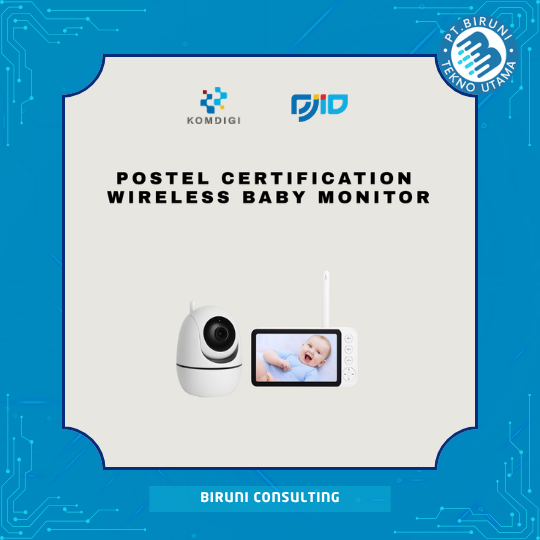
Complete guide to SDPPI certification for wireless baby monitor devices according to Indonesian telecommunication regulations
Postel certification is a mandatory approval process required for telecommunication devices before they can be marketed or used in Indonesia. One of the devices included in this requirement is the wireless baby monitor, a monitoring device that transmits audio or video signals wirelessly from the baby unit to the receiver unit.
Telecommunication device certification in Indonesia is managed by the Direktorat Jenderal Sumber Daya dan Perangkat Pos dan Informatika, which operates under the Kementerian Komunikasi dan Informatika Republik Indonesia.
This requirement is regulated under Peraturan Menteri Komunikasi dan Informatika Nomor 16 Tahun 2018 tentang Sertifikasi Alat dan/atau Perangkat Telekomunikasi, which states that telecommunication equipment manufactured, assembled, imported, or traded in Indonesia must comply with national technical standards.
Since wireless baby monitors use radio frequency or WiFi communication technologies, they must undergo technical testing to ensure they do not interfere with other communication systems.
Functions and Applications of Wireless Baby Monitor
Wireless baby monitors help parents supervise their babies from a distance, providing convenience and safety.
Common functions include:
- Remote audio monitoring
Allows parents to hear sounds from the baby’s room. - Real-time video monitoring
Many modern devices include cameras for visual monitoring. - Two-way communication
Some devices allow parents to speak to the baby through the monitor. - Room condition monitoring
Advanced models include temperature or environment sensors.
Because these devices use wireless communication technology, they must comply with Indonesian telecommunication regulations before distribution.
Types of Wireless Baby Monitor Requiring Certification
Several types of wireless baby monitor devices require Postel certification before entering the Indonesian market.
Examples include:
- Audio Wireless Baby Monitor
- Video Wireless Baby Monitor
- WiFi Smart Baby Monitor
- IoT Baby Monitoring Devices
- Portable Wireless Baby Monitor
All these devices must pass technical testing before obtaining certification.
Postel Certification Process for Wireless Baby Monitor
The certification process involves several stages that must be completed by manufacturers, importers, or brand owners.
1. Certification Document Preparation
Applicants must prepare required documents such as:
a. certification application letter
b. company legal documents
c. product manual
d. device technical specifications
e. device photos and labeling
f. declaration of conformity
2. Device Testing in Accredited Laboratories
Wireless baby monitors must undergo testing in accredited laboratories.
Typical testing includes:
- radio frequency testing
- transmitter power testing
- frequency stability testing
- electromagnetic compatibility testing
- safety testing
3. Certification Submission through SDPPI System
Applicants submit certification applications through the SDPPI online system with:
- laboratory test reports
- technical documentation
- company legal documents
4. Certificate Issuance
Once the device meets all requirements, SDPPI will issue a telecommunication equipment certificate confirming compliance with Indonesian regulations.
Contact Biruni Consulting
Obtaining Postel Certification for Wireless Baby Monitor often involves complex regulatory procedures and technical testing.
Biruni Consulting provides professional consulting services to assist companies in obtaining telecommunication device certification in Indonesia.
Our services include:
- Postel and SDPPI regulatory consultation
- certification documentation preparation
- laboratory testing coordination
- certification submission management
- technical compliance assistance
With extensive experience in telecommunication certification projects, Biruni Consulting helps companies obtain Postel certification efficiently and in accordance with Indonesian regulations.