
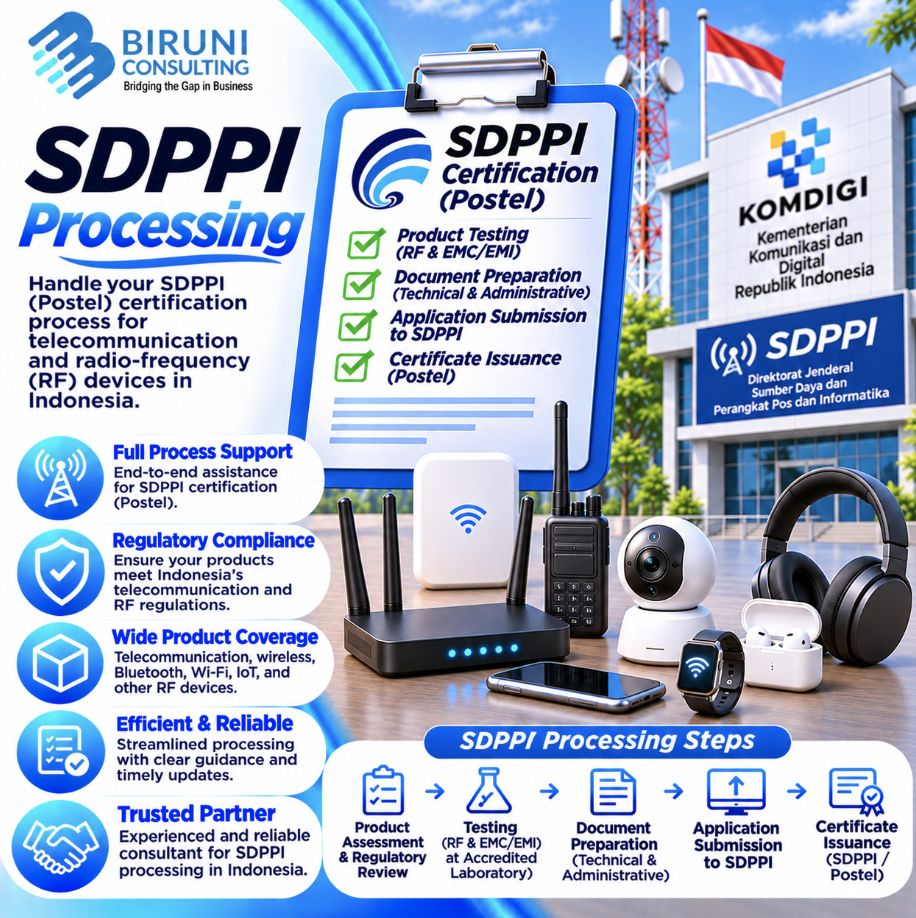
DJID/SDPPI certification assistance for telecommunications equipment and wireless products in Indonesia
SDPPI certification services assist importers, distributors, manufacturers, trademark owners, and equipment users with technical assessment, laboratory-report review, documentation, testing coordination, application preparation, and Indonesian telecommunications-equipment certification.
SDPPI remains a widely recognised commercial term, although Indonesia’s current institutional structure uses the Directorate General of Digital Infrastructure, or DJID. Under the current Ministry of Communication and Digital structure, the Directorate of Digital Infrastructure Services is responsible for functions including certification of telecommunications equipment and digital devices. Infradigital
The official certification database still describes its records as valid SDPPI/DJID Komdigi telecommunications-equipment Certificates, while Certificates issued in November 2026 use /DJID/2026 numbering. e-Sertifikasi
SDPPI and the Current DJID Structure
SDPPI was the former Directorate General of Resources and Equipment of Post and Information Technology and remains a familiar name among importers and overseas manufacturers.
Following the organisational restructuring of the Ministry of Communication and Digital, the relevant functions are now located within DJID.
This means that the terms SDPPI Certification, Postel Certification, and DJID Certification can still appear in commercial discussions without representing three separate approvals for the same equipment. Infradigital
For new applications, current Certificate records use DJID nomenclature. e-Sertifikasi
Certification Regulatory Framework
Minister of Communication and Informatics Regulation Number 3 of 2024 remains the principal regulation governing certification of telecommunications equipment.
It replaced the previous 2018 framework and covers Certificate applicants, applications, test reports, Certificate issuance, Certificate-holder obligations, and regulatory supervision. JDIH Kemkomdigi
An effective certification project therefore begins with technical assessment rather than simply uploading documents to the certification system.
The equipment, applicable Technical Standards, exact commercial model, laboratory evidence, and applicant structure should first be reviewed.
Products That May Require Assessment
SDPPI/DJID certification is not limited to smartphones, modems, or routers.
Products containing Bluetooth, WiFi/RLAN, cellular, NFC, Zigbee, Thread, proprietary RF, or other telecommunications functions may require assessment depending on their actual configuration and applicable standards.
The current official Certificate database includes a wide variety of products, including routers, wireless access points, WiFi modules, Bluetooth pens, TWS devices, smart displays, household products, TPMS equipment, and microwave radios. e-Sertifikasi
Smart appliances, IoT products, computer peripherals, industrial devices, toys, and automotive electronics may therefore also have certification requirements.
Technical Assessment Before Application
The assessment should be based on the exact commercial model intended for Indonesia.
Relevant information commonly includes the brand, model/type, manufacturer, manufacturing country, operating frequencies, transmission power, wireless modules, antennas, hardware, firmware, and all enabled radio interfaces.
Where the device contains several radio technologies, each interface should be assessed.
A product containing both WiFi and Bluetooth, for example, should not be reviewed only as a “WiFi product”. Its Bluetooth function should also be mapped to the relevant technical requirements.
Certificate Applicant Structure
Regulation Number 3 of 2024 recognises several business applicant categories.
These include an Indonesian registered trademark holder, an appointed representative or distributor of a trademark holder, a manufacturer or assembler for a trademark holder, a manufacturer or assembler, and a business using the equipment for its own purposes. JDIH Kemkomdigi
Current e-Sertifikasi guidance follows the same structure. e-Sertifikasi
A certification project should therefore establish a clear relationship between the:
applicant → trademark owner → manufacturer → manufacturing country → exact model → RF configuration → laboratory report.
Incorrect applicant mapping can cause administrative problems even when suitable technical evidence exists.
OSS and e-Sertifikasi NextGen
For business applicants, Regulation Number 3 of 2024 requires Certificate applications to be submitted through OSS integrated with the certification service facility. JDIH Kemkomdigi
Current e-Sertifikasi requirements also list NIB and OSS access as general application requirements. e-Sertifikasi
Applicant information, brand/model details, manufacturer information, and supporting technical documents should be checked for consistency before submission.
This is particularly important for foreign brands, OEM products, and private-label equipment.
Certification Documentation
Regulation Number 3 of 2024 requires supporting documents including an LHU/test report, technical specifications, a Declaration of Conformity signed by the applicant, and colour product photographs showing the brand and equipment type. JDIH Kemkomdigi
Current e-Sertifikasi guidance also includes operational requirements such as NIB/OSS access and confirmation that submitted information and documentation are correct and complete. e-Sertifikasi
For an initial assessment, businesses should also prepare product datasheets, user manuals, RF specifications, module documentation, antenna information, block diagrams, product labels, and available test reports.
LHU and Test Report Review
The LHU or laboratory test report is one of the most important technical documents in the certification process.
Current e-Sertifikasi guidance requires it to be issued by a designated Indonesian laboratory or a recognised overseas testing laboratory. e-Sertifikasi
A review should compare the tested model with the exact commercial model and examine operating frequencies, transmitter power, radio modes, antennas, test methods, relevant hardware and firmware, and laboratory scope.
An existing CE, FCC, or ETSI report can be useful but should not automatically be assumed to satisfy Indonesian certification requirements.
Using Module Test Reports
Many products incorporate pre-developed Bluetooth, WiFi, cellular, or multi-radio modules.
Where certification relies on a module LHU, current e-Sertifikasi requirements include a block diagram, photographs showing the module location inside the final device, and a module-use declaration linking the module brand/type to the final equipment brand, type, and variant. e-Sertifikasi
A module report therefore does not automatically cover every product incorporating that module.
Final antennas, firmware, transmitter settings, PCB integration, module installation, and the exact commercial configuration remain relevant.
OEM and Private-Label Products
OEM and private-label projects often need additional model mapping because the factory test report may use an internal model number that differs from the Indonesian commercial model.
The manufacturer, manufacturing country, tested model, final brand/model, wireless modules, antennas, PCB, firmware, and RF configuration should be compared.
Physical similarity or use of the same chipset alone is not enough to demonstrate that two products have identical radio configurations.
A pre-application assessment helps determine whether existing evidence can be used or whether clarification or additional testing is required.
Foreign Trademark Owners and Distributors
An Indonesian company can apply as an appointed representative or distributor of an overseas trademark owner.
Regulation Number 3 of 2024 requires the applicable appointment documentation for this applicant category. Postel Sertifikasi
Certification assistance should therefore review both technical evidence and the administrative relationship between the Indonesian applicant and the foreign trademark owner.
This should ideally be resolved before the Certificate application is submitted.
Certification Workflow
An efficient certification project should start with product assessment before laboratory testing or commercial shipment.
The exact model is identified first, followed by mapping of all active radio interfaces and the applicable Technical Standards. Existing laboratory reports are then reviewed for technical coverage and laboratory eligibility.
The applicant, trademark owner, manufacturer, manufacturing country, model, and supporting documents are subsequently checked.
Where gaps exist, clarification or additional testing can be arranged before the application proceeds through OSS and e-Sertifikasi.
Is Additional Testing Always Required?
No.
Existing reports can potentially support the application where their technical scope, laboratory eligibility, and relationship to the exact final product are suitable.
Additional testing may be needed where a radio interface is missing from the report set, relevant parameters were not tested, product mapping cannot be established, or the evidence does not sufficiently address Indonesian requirements.
For RF laboratory reports issued by overseas laboratories, current e-Sertifikasi guidance also requires an LHU summary declared correct and consistent. e-Sertifikasi
Reviewing available reports before commissioning new testing can therefore avoid unnecessary work.
Certificate and Commercial Activity Period
Regulation Number 3 of 2024 states that the Certificate itself has no expiry period.
However, the Certificate holder may manufacture, assemble, or import the certified equipment for trade and/or use in Indonesia for up to three years from Certificate issuance. Continued activity after that period requires compliance with the Technical Standards to be demonstrated again through testing and a new Certificate. JDIH Kemkomdigi
This distinction is particularly important for repeat imports and long product lifecycles.
Certificate issuance dates should therefore be included in regulatory planning.
Labeling and Post-Certification Compliance
Certificate issuance is followed by regulatory-marking requirements.
Regulation Number 3 of 2024 specifies marking elements including the Certificate number and PLG ID, QR Code, and Warning Sign. JDIH Kemkomdigi
Manufacturers and importers should also maintain change control for modifications to wireless modules, antennas, RF-related firmware, manufacturers, manufacturing countries, or other material technical configurations.
The objective is to ensure that production units continue to correspond to the technical basis of certification.
Why Start Before Importation?
Certification issues are often more difficult to correct after the product has already entered mass production.
A supplier may offer several regional SKUs using different radio modules, antennas, frequency settings, firmware, or manufacturing origins while maintaining the same marketing name.
A pre-import assessment can verify the exact SKU, applicant structure, trademark owner, manufacturer, manufacturing country, RF configuration, laboratory reports, and potential testing requirements before shipment.
This allows technical and administrative gaps to be addressed earlier in the commercial process.
Conclusion
SDPPI certification services today generally refer to telecommunications-equipment certification administered within the current DJID structure of Indonesia’s Ministry of Communication and Digital.
SDPPI remains a familiar commercial term, while new Certificates now use DJID numbering. The official certification database continues to describe its records as valid SDPPI/DJID Komdigi Certificates. e-Sertifikasi
Regulation Number 3 of 2024 remains the principal certification framework, and business applications are submitted through the OSS-integrated certification system. JDIH Kemkomdigi
A certification project should therefore begin with assessment of the exact model, radio technologies, operating frequencies, transmitter power, modules, antennas, applicant structure, trademark owner, manufacturer, manufacturing country, and available laboratory evidence before testing or importation.
Contact Us
Biruni Consulting assists with DJID/SDPPI assessment and certification for telecommunications equipment and various wireless products that will be imported or marketed in Indonesia.
Our services include:
- Assessment of DJID/SDPPI certification requirements.
- Transmitter and receiver assessment.
- RF specification review.
- Frequency and transmission power analysis.
- Technical document review.
- Certification document preparation.
- Testing coordination where required.
- DJID/SDPPI Certification assistance.
If you have a telecommunications device or wireless product, you can prepare product photos, brand, model, datasheet, RF specifications, and wireless module datasheet for an initial assessment of the Postel Certification requirements.