
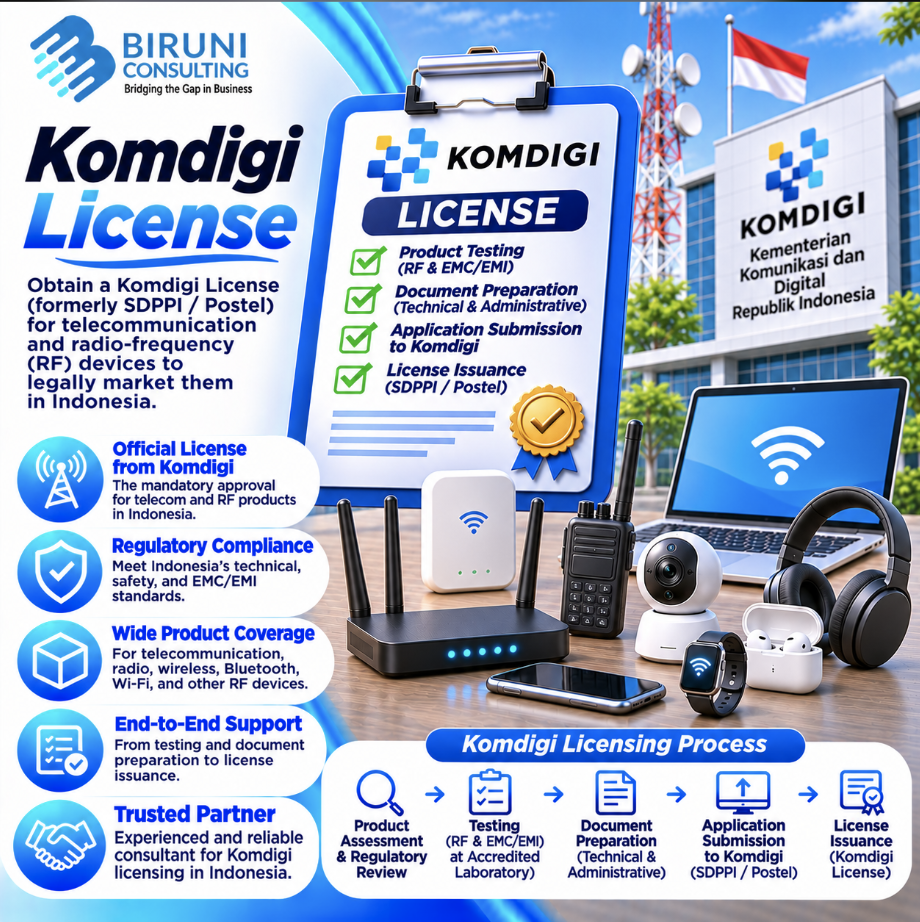
Guide to Komdigi/DJID certification and spectrum licensing for telecommunications and wireless equipment in Indonesia
The term Komdigi License is commonly used by importers, manufacturers, distributors, trademark owners, and overseas suppliers to describe regulatory approvals administered within Indonesia’s Ministry of Communication and Digital. However, there is no single universal “Komdigi License” that applies to every wireless product.
Depending on the equipment and the way it uses radio spectrum, compliance may involve a telecommunications equipment Certificate, operation under a Class License, or specific spectrum authorisation such as a Radio Station License (ISR) or Radio Frequency Band License (IPFR).
Government Regulation Number 46 of 2021 identifies IPFR, ISR, and Class License as forms of radio-frequency spectrum authorisation in Indonesia. JDIH Kemkomdigi
Within the current DJID structure, the Directorate of Digital Infrastructure Services handles functions covering both radio-spectrum licensing and certification of telecommunications equipment and digital devices. Infradigital
The correct pathway therefore needs to be determined from the actual equipment, radio technologies, frequencies, transmission power, and intended spectrum use.
Komdigi Approval for Wireless Equipment
When an overseas supplier requests a “Komdigi approval”, “Postel license”, “SDPPI approval”, or “DJID certificate”, the document they are seeking is often an Indonesian telecommunications equipment Certificate.
Minister of Communication and Informatics Regulation Number 3 of 2024 is the principal equipment-certification framework. JDIH Kemkomdigi
For business applicants, Certificate applications are submitted through OSS integrated with the certification service facility. JDIH Kemkomdigi
For commercial Bluetooth devices, WiFi appliances, IoT products, wireless accessories, routers, modems, trackers, and other connected equipment, DJID/Komdigi Certification is therefore often a more accurate description than a general “license”.
Equipment Certification and Spectrum Licensing
Equipment certification and spectrum authorisation perform different regulatory functions.
An equipment Certificate relates to compliance with applicable Technical Standards. Spectrum authorisation determines how radio-frequency spectrum may be used.
Government Regulation Number 46 of 2021 recognises IPFR, ISR, and Class License as the principal spectrum-authorisation mechanisms. JDIH Kemkomdigi
A DJID-certified product therefore does not automatically require an individual ISR. Likewise, a device operating under a Class License should not automatically be treated as exempt from equipment Technical Standards.
Product, Spectrum, and Operational Approvals
A regulatory assessment should distinguish several different compliance layers.
The first is equipment compliance: whether the product requires a DJID Certificate. The second is spectrum compliance: whether its radio operates under a Class License, ISR, IPFR, or another applicable spectrum mechanism. A third consideration can arise from the way the equipment is deployed or used as part of a telecommunications operation.
These areas should not be treated as interchangeable.
A professional radio can, for example, be technically certified as equipment while its actual frequency operation still requires separate spectrum assessment.
Class-Licensed Spectrum
A Class License provides a spectrum-use framework for groups of equipment operating according to specified technical conditions.
Regulation Number 2 of 2023 establishes Class License categories including RLAN, LPWAN, SRD, class-licensed IMT, and PMR. JDIH Kemkomdigi
That framework was amended by Minister of Communication and Digital Regulation Number 2 of 2025, which is currently in force. JDIH Kemkomdigi
A Class License should therefore not be interpreted as an equipment-certification exemption.
WiFi and Class Licensing
WiFi/RLAN equipment is one of the groups addressed by the Indonesian Class License framework.
Regulation Number 2 of 2023 includes RLAN and identifies IEEE 802.11-based WLAN equipment within the category. JDIH Kemkomdigi
Relevant products can include routers, access points, WiFi printers, smart appliances, smart-home controllers, IoT gateways, and industrial terminals.
A certification assessment should still identify supported frequency bands, transmitter power, modules, antennas, firmware, and available RF test reports.
A simple “WiFi enabled” statement is not enough to define the regulatory configuration.
Bluetooth and Short Range Devices
Bluetooth belongs to the Short Range Device or SRD category.
Regulation Number 2 of 2023 expressly includes Bluetooth IEEE 802.15.1 within SRD, together with technologies including NFC, RFID, UWB, and LR-WPAN IEEE 802.15.4. JDIH Kemkomdigi
Bluetooth equipment should therefore be assessed according to its actual radio configuration and the applicable Indonesian Technical Standards.
Low transmitter power or short operating range should not automatically be interpreted as a certification exemption.
When Can an ISR Be Required?
An ISR, or Radio Station License, is a spectrum authorisation and is different from an equipment Certificate.
Not every radio device requires an individual ISR. Equipment operating within applicable Class License conditions follows a different spectrum mechanism from a radio system operating on specifically assigned channels or frequencies. JDIH Kemkomdigi
ISR requirements should therefore be assessed from the actual radio service, frequency use, deployment, and operating conditions rather than from the commercial product name alone.
What Is an IPFR?
An IPFR, or Radio Frequency Band License, is another spectrum-authorisation mechanism recognised by Government Regulation Number 46 of 2021 and is distinct from ISR and Class License. JDIH Kemkomdigi
Its regulatory use differs from ordinary Bluetooth and WiFi consumer-device operation.
A smart-appliance importer should therefore not assume that an IPFR is required simply because the product includes a wireless transmitter.
The spectrum mechanism depends on how the frequencies are actually authorised and used.
Examples of Different Regulatory Scenarios
A WiFi-enabled smart fan may primarily require equipment certification assessment together with the applicable RLAN framework.
A Bluetooth tracker will normally require assessment of its SRD radio configuration. A professional radio network using particular assigned channels can involve additional ISR considerations. Other systems using dedicated spectrum can have another regulatory pathway entirely.
All of these products may be described generally as wireless equipment, but their compliance routes are not necessarily the same.
Technical configuration is therefore more important than the marketing category.
Komdigi/DJID Certification Documents
For a new Certificate, current e-Sertifikasi requirements include NIB and OSS access, an LHU/test report, equipment technical specifications, a Declaration of Conformity, colour photographs showing the brand and model/type, and a declaration that the submitted information is correct and complete. e-Sertifikasi
The laboratory report must be issued by a designated Indonesian testing laboratory or a recognised overseas laboratory under the applicable framework. e-Sertifikasi
For an initial assessment, businesses should also prepare datasheets, user manuals, RF specifications, wireless-module information, antenna details, and block diagrams.
Certificate Applicants
Regulation Number 3 of 2024 recognises several business applicant categories.
These include an Indonesian registered trademark holder, an appointed representative or distributor of a trademark holder, a manufacturer or assembler for the trademark holder, a manufacturer or assembler, and a business using the equipment for its own purposes. JDIH Kemkomdigi
The certification structure should therefore clearly connect the:
applicant → trademark owner → manufacturer → exact model → manufacturing country → laboratory evidence.
Incorrect applicant mapping can create administrative problems even where appropriate RF documentation already exists.
CE and FCC Are Not Komdigi Licenses
CE, FCC, ETSI, and other international RF reports can provide useful technical evidence.
However, they do not automatically constitute Indonesian Komdigi/DJID approval.
The exact commercial model, laboratory eligibility, frequencies, transmitter power, antennas, test methods, relevant hardware or firmware, and applicable Indonesian Technical Standards should still be reviewed.
The gap analysis may show that the existing documentation is sufficient, needs supporting clarification, or requires additional testing.
Products Using Wireless Modules
Many modern products incorporate pre-developed WiFi, Bluetooth, Zigbee, Thread, cellular, or multi-radio modules.
An existing module report can support the certification strategy, but a module report does not automatically cover every final product using the module.
Final antennas, module installation, firmware, RF settings, PCB integration, and the relationship between the tested module and the commercial product remain relevant.
This is particularly important for smart appliances, IoT devices, industrial products, and OEM/private-label equipment.
Initial Assessment Checklist
Before deciding which Komdigi approval is required, the business should ideally have the following basic information:
- Exact product brand and model/type.
- All enabled radio technologies.
- Operating frequencies and transmission power.
- Module/chipset and antenna specifications.
- Manufacturer and manufacturing country.
- Available LHU/RF test reports.
- Intended use of the equipment in Indonesia.
These details help distinguish equipment certification from Class License operation, ISR/IPFR requirements, or another applicable regulatory pathway.
Komdigi Approval for Importers
Regulatory assessment should ideally be completed before a purchase order, mass production, or commercial shipment.
A global product can have multiple regional variants with different frequency bands, modules, antennas, firmware, transmitter settings, or manufacturing countries.
If the assessment begins only after production, the importer may discover that the available laboratory report covers another regional SKU or RF configuration.
A pre-import review helps align the final product, applicant, spectrum use, laboratory evidence, and certification strategy from the beginning.
Compliance After Certificate Issuance
Regulatory obligations do not necessarily end when the Certificate is issued.
Current e-Sertifikasi guidance requires Certificate holders to implement the relevant Label, QR Code, and Warning Sign and report implementation within 30 working days after Certificate issuance by uploading photographs of the marked equipment. e-Sertifikasi
Compliance planning should therefore include product labeling and control of significant technical changes after certification, in addition to the pre-import approval process.
Conclusion
A Komdigi License is not one universal approval for every wireless product in Indonesia.
For commercial telecommunications equipment, the most commonly relevant document is a DJID/SDPPI telecommunications equipment Certificate. Regulation Number 3 of 2024 remains the principal certification framework, and business applications are submitted through the OSS-integrated certification system. JDIH Kemkomdigi
Indonesia’s spectrum framework separately recognises IPFR, ISR, and Class License mechanisms. JDIH KemkomdigiClass License categories include RLAN, LPWAN, SRD, class-licensed IMT, and PMR, with the framework subsequently amended by Regulation Number 2 of 2025. JDIH Kemkomdigi
The correct regulatory route should therefore be determined from the exact product model, radio technologies, operating frequencies, transmitter power, modules, antennas, intended spectrum use, manufacturer, manufacturing country, applicant structure, and laboratory evidence.
A pre-import assessment can help establish whether the equipment requires a DJID Certificate, operates under Class License conditions, needs an ISR/IPFR for its intended deployment, or involves a combination of regulatory requirements.
Contact Us
Biruni Consulting assists with DJID/SDPPI assessment and certification for telecommunications equipment and various wireless products that will be imported or marketed in Indonesia.
Our services include:
- Assessment of DJID/SDPPI certification requirements.
- Transmitter and receiver assessment.
- RF specification review.
- Frequency and transmission power analysis.
- Technical document review.
- Certification document preparation.
- Testing coordination where required.
- DJID/SDPPI Certification assistance.
If you have a telecommunications device or wireless product, you can prepare product photos, brand, model, datasheet, RF specifications, and wireless module datasheet for an initial assessment of the Postel Certification requirements.