
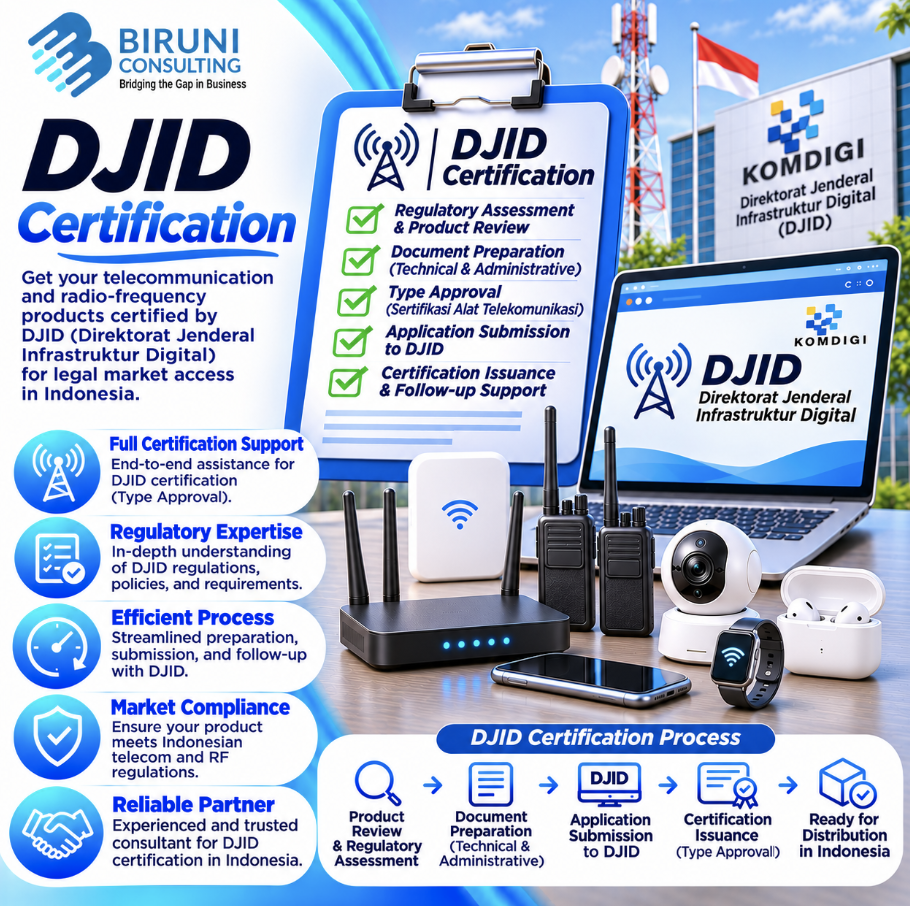
Guide to DJID/SDPPI Certification for telecommunications equipment and wireless products in Indonesia
DJID Certification is the Indonesian certification process used to demonstrate that telecommunications equipment complies with applicable Technical Standards. It is relevant to importers, distributors, manufacturers, trademark owners, and businesses placing telecommunications or wireless products on the Indonesian market.
The principal certification framework remains Minister of Communication and Informatics Regulation Number 3 of 2024 on Certification of Telecommunications Equipment. The Regulation replaced the previous 2018 certification rules and covers applicants, testing, Certificate issuance, labeling, Certificate-holder obligations, and regulatory supervision. JDIH Kemkomdigi
The terms Postel and SDPPI remain widely used commercially. However, the current organisational nomenclature is the Directorate General of Digital Infrastructure, or DJID, following the restructuring of the former SDPPI under the Ministry of Communication and Digital. Infradigital
DJID, SDPPI, and Postel Certification
In practical compliance discussions, DJID Certification, SDPPI Certification, and Postel Certification are often used to describe the same general telecommunications-equipment certification area.
The organisational change does not mean that a product now requires both an SDPPI Certificate and a separate DJID Certificate.
The official e-Sertifikasi portal currently describes its public database as containing valid SDPPI/DJID Komdigi telecommunications-equipment Certificates. Certificates issued on November 23, 2026 already use numbering such as 129213/DJID/2026. e-Sertifikasi NextGen
Products That May Require DJID Assessment
DJID Certification is not limited to smartphones, modems, and conventional telecommunications infrastructure.
Products incorporating Bluetooth, WiFi, cellular, Short Range Device radios, Zigbee, Thread, NFC, proprietary RF, or other communications technologies may require assessment depending on their technical configuration and applicable Indonesian standards.
The current official database includes wireless access points, WiFi modules, Bluetooth equipment, cellular CPE, routers, switches, and many other categories. e-Sertifikasi NextGen
A household appliance, industrial device, toy, computer peripheral, or IoT product can therefore have DJID implications when a relevant telecommunications function is incorporated.
Certification Follows the Actual Radio Configuration
Technical assessment should focus on the actual wireless configuration of the final product.
A smart appliance may contain WiFi for network access and Bluetooth for commissioning. Another product may use cellular, Zigbee, Thread, NFC, or a proprietary radio.
The assessment should identify operating frequencies, transmitter power, modules or chipsets, antennas, enabled radio modes, firmware, and available laboratory evidence.
The word “wireless” in marketing material is not sufficient to determine the certification scope.
Who Can Apply?
Regulation Number 3 of 2024 recognises several categories of applicants.
Business applicants include Indonesian registered trademark holders, appointed representatives or distributors of trademark holders, manufacturers or assemblers for trademark holders, manufacturers or assemblers, and businesses using the equipment for their own purposes. Government bodies, international organisations, and individuals can also apply under specified own-use conditions. JDIH Kemkomdigi
Current e-Sertifikasi guidance reflects the same applicant categories. e-Sertifikasi NextGen
The relationship between the applicant, trademark owner, manufacturer, model, and manufacturing country should therefore be established before submission.
OSS and e-Sertifikasi NextGen
For business applicants, Regulation Number 3 of 2024 requires Certificate applications to be submitted through OSS integrated with the certification service facility. JDIH Kemkomdigi
Current e-Sertifikasi guidance also states that new applications are submitted electronically through OSS and e-Sertifikasi NextGen.
NIB and OSS service access are part of the general requirements for business applicants. e-Sertifikasi NextGen
Applicant, product, and technical data should be checked for consistency before submission.
DJID Certification Documents
For a new Certificate, current e-Sertifikasi requirements include NIB and OSS access, an LHU/test report, equipment technical specifications, a Declaration of Conformity, colour photographs showing the brand and model/type, and a declaration confirming that submitted information is accurate and complete. e-Sertifikasi NextGen
Technical assessment will commonly also require datasheets, user manuals, RF specifications, antenna information, wireless-module documentation, and block diagrams.
Additional documents can apply depending on the equipment and applicant category.
LHU and RF Test Reports
The LHU or laboratory test report is a central component of the certification process.
Current e-Sertifikasi guidance requires the report to be issued by a designated Indonesian testing laboratory or an overseas laboratory recognised by the relevant minister. e-Sertifikasi NextGen
The report should be reviewed against the exact model, operating frequencies, transmission power, antennas, radio modes, hardware, relevant firmware, test methods, and laboratory scope.
Having an RF report is therefore not enough by itself; the report must be suitable for the product and certification scope being submitted.
CE and FCC Reports
Manufacturers frequently provide CE, FCC, ETSI, or other international compliance reports.
These documents can be valuable during DJID assessment, but they are not automatically equivalent to an Indonesian DJID Certificate.
The exact model, laboratory eligibility, operating frequencies, transmitter power, antennas, test scope, and applicable Indonesian Technical Standards still need to be checked.
Depending on the gap analysis, additional documentation or testing may be required.
Using Module Test Reports
Many connected products use pre-developed Bluetooth, WiFi, cellular, or multi-radio modules.
Where certification relies on a module LHU, current e-Sertifikasi requirements include a block diagram, photographs showing the module location inside the final equipment, and a module-use declaration identifying the module brand/type and linking it to the final equipment brand, type, and variant. e-Sertifikasi NextGen
A module test report therefore does not automatically cover every final product that incorporates the module.
Antenna configuration, firmware, RF settings, and final integration remain relevant.
OEM and Private-Label Products
OEM and private-label certification can require additional technical and documentary mapping.
The model listed in a laboratory report may be an internal factory model, while the Indonesian commercial product uses a different brand and model number.
The manufacturer, tested model, final model, modules, antennas, hardware, firmware, and manufacturing origin should be compared before the existing test report is relied upon.
Physical similarity alone does not establish that two models have the same RF configuration.
Overseas Trademark Owners and Indonesian Distributors
An Indonesian company can apply as the appointed representative or distributor of a foreign trademark owner.
Current e-Sertifikasi requirements specify an appointment letter from the trademark owner for this applicant category. e-Sertifikasi NextGen
The applicant relationship should therefore be established early in the project and aligned with the product brand used in the certification application.
Corporate affiliation should not automatically be assumed to replace the required supporting documentation.
DJID Certificate Period
Regulation Number 3 of 2024 states that the Certificate itself is not time-limited.
However, the Certificate holder may manufacture, assemble, or import the equipment for trade and/or use in Indonesia for a maximum of three years from the Certificate issuance date. Continued activities after that period require conformity with the Technical Standards to be demonstrated again through a new Certificate. JDIH Kemkomdigi
The Certificate issuance date is therefore important for long-term import and product-lifecycle planning.
Certificate Number, PLG ID, and QR Code
Certificate holders also have regulatory-marking obligations.
Regulation Number 3 of 2024 requires the label to display the Certificate number and PLG ID, QR Code, and Warning Sign. The certification system generates a QR Code for each issued Certificate. JDIH Kemkomdigi
Current e-Sertifikasi guidance additionally requires the Certificate holder to report implementation of the Label, QR Code, and Warning Sign within 30 working days after Certificate issuance by uploading photographs of the marked equipment. e-Sertifikasi NextGen
Regulatory artwork should ideally be prepared before mass production.
Existing SDPPI and New DJID Certificates
Companies may still encounter older Certificates containing /SDPPI/ in the Certificate number.
Newer Certificates use /DJID/.
This does not mean that two independent certification systems operate simultaneously. The official portal continues to maintain SDPPI and DJID records within the same database of valid telecommunications-equipment Certificates, while current 2026 Certificates use DJID numbering. e-Sertifikasi NextGen
The organisational nomenclature change by itself does not automatically invalidate an existing SDPPI-numbered Certificate.
Assessment Before Importation
DJID assessment should ideally be completed before a purchase order, mass production, or commercial shipment.
Global products can have different regional variants with different radio modules, antennas, frequency bands, transmitter settings, firmware, or manufacturing countries.
An identical marketing name does not necessarily indicate an identical technical configuration.
Pre-import assessment helps verify the exact model, radio technologies, frequencies, transmitter power, modules, antennas, applicant structure, manufacturer, manufacturing country, and laboratory reports before the goods are shipped.
Conclusion
DJID Certification demonstrates compliance of covered telecommunications equipment with applicable Indonesian Technical Standards. Regulation Number 3 of 2024 remains the principal certification framework. JDIH Kemkomdigi
DJID is the current institutional nomenclature following the restructuring of the former SDPPI. This organisational transition does not create a separate second certification requirement; the official system continues to maintain SDPPI/DJID Certificates together, while newly issued Certificates use /DJID/2026 numbering. Infradigital
For importers, distributors, manufacturers, and trademark owners, the certification project should begin by assessing the exact product model, radio technologies, operating frequencies, transmission power, modules, antennas, manufacturing origin, applicant structure, and laboratory evidence.
Contact Us
Biruni Consulting assists with DJID/SDPPI assessment and certification for telecommunications equipment and various wireless products that will be imported or marketed in Indonesia.
Our services include:
- Assessment of DJID/SDPPI certification requirements.
- Transmitter and receiver assessment.
- RF specification review.
- Frequency and transmission power analysis.
- Technical document review.
- Certification document preparation.
- Testing coordination where required.
- DJID/SDPPI Certification assistance.
If you have a telecommunications device or wireless product, you can prepare product photos, brand, model, datasheet, RF specifications, and wireless module datasheet for an initial assessment of the Postel Certification requirements.