
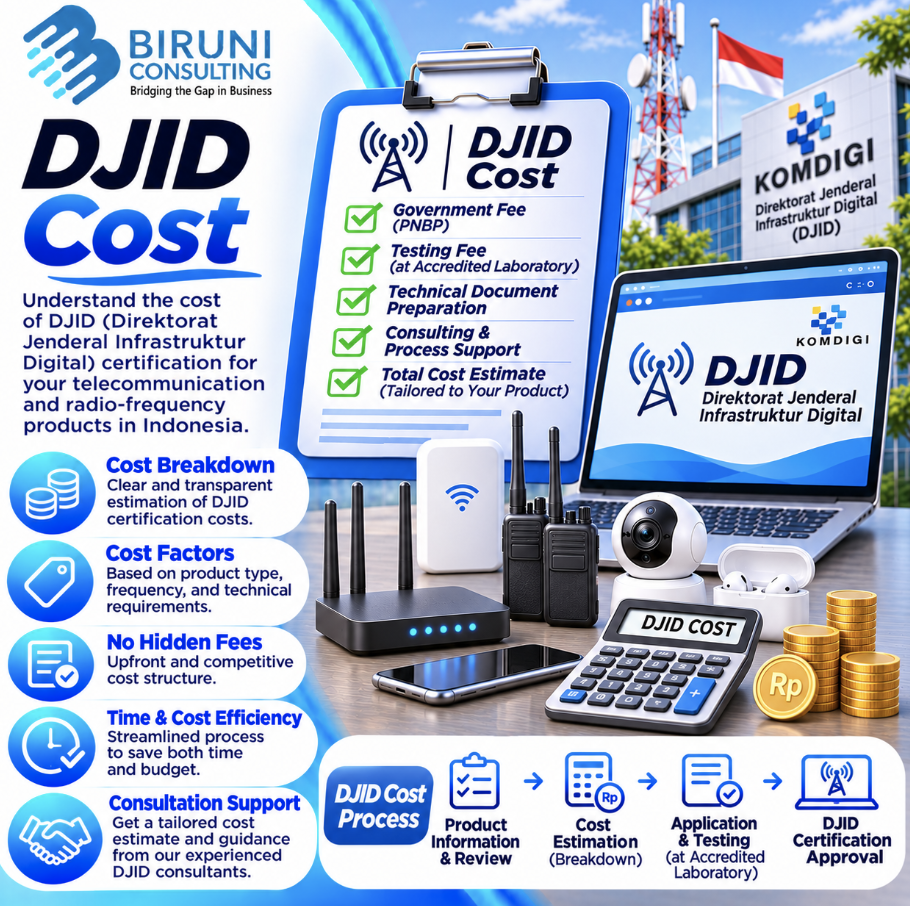
Guide to DJID/SDPPI Certification costs for telecommunications equipment and wireless products in Indonesia
DJID Certification cost is not a single fixed amount for every product. The Certificate fee depends primarily on the equipment category and the source of the LHU/test reports, including whether reports are issued by Indonesian laboratories, overseas MRA laboratories, overseas non-MRA laboratories, or a combination of these sources.
Regulation Number 3 of 2024 establishes that Certificate issuance is subject to a Non-Tax State Revenue (PNBP) fee. The Certificate fee is paid to the state through an automatic payment system, and fees already paid cannot be withdrawn. JDIH Kemkomdigi
A certification budget should therefore distinguish between the official Certificate fee, laboratory testing, samples and logistics, and professional consulting or certification-assistance costs.
Current DJID Certificate Fees
The current official DJID service page lists the following fees for new Certificates. SDPPI Services
| Certification Basis | Certificate Fee |
|---|---|
| HKT & Non-HKT – Indonesian laboratory reports | IDR 12,000,000 |
| Non-HKT – overseas MRA reports | IDR 50,000,000 |
| Non-HKT – overseas non-MRA reports | IDR 60,000,000 |
| Non-HKT – overseas MRA & non-MRA reports | IDR 60,000,000 |
| Non-HKT – Indonesian + overseas MRA reports | IDR 30,000,000 |
| Non-HKT – Indonesian + overseas non-MRA reports | IDR 40,000,000 |
| Non-HKT – Indonesian + MRA + non-MRA reports | IDR 40,000,000 |
| HKT – overseas MRA reports | IDR 60,000,000 |
| HKT – overseas non-MRA reports | IDR 80,000,000 |
| HKT – overseas MRA & non-MRA reports | IDR 80,000,000 |
These figures represent the Certificate issuance fee and should not automatically be treated as the total project cost.
HKT and Non-HKT Equipment
For tariff purposes, the regulations distinguish between HKT equipment and other telecommunications equipment.
HKT covers cellular phones, handheld computers, and tablet computers. Other equipment falls under the non-HKT group for this tariff structure. JDIH Kemkomdigi
WiFi appliances, Bluetooth accessories, IoT products, wireless peripherals, and many other products may therefore fall within the Non-HKT structure depending on their actual classification.
Indonesian Laboratory Reports
Where all supporting LHU/test reports are issued by designated Indonesian laboratories, the current official service page lists a new Certificate fee of IDR 12 million for both HKT and Non-HKT equipment. SDPPI Services
This does not mean that the complete certification project costs only IDR 12 million.
Where laboratory testing still needs to be performed, the testing charges must be added separately.
Overseas Test Reports
For Non-HKT equipment, the current Certificate fee is listed at IDR 50 million when relying on overseas MRA reports and IDR 60 million for overseas non-MRA reports. SDPPI Services
For HKT equipment, the listed fees are IDR 60 million for overseas MRA reports and IDR 80 million for overseas non-MRA or mixed MRA/non-MRA reports. SDPPI Services
The laboratory route can therefore have a substantial effect on the certification budget.
MRA and Non-MRA Laboratories
MRA means Mutual Recognition Arrangement.
Regulation Number 9 of 2023 distinguishes domestic test reports from overseas reports and further separates overseas laboratories into MRA and non-MRA categories for Certificate tariff determination. JDIH Kemkomdigi
The assessment should not rely on the laboratory name alone. Recognition status and the applicable testing scope should also be checked.
Combination of Laboratory Reports
Products with several radio technologies can require multiple test reports.
For example, a device may have WiFi and Bluetooth, with some evidence coming from an overseas laboratory and additional testing carried out in Indonesia.
For Non-HKT equipment, the current official page lists a Certificate fee of IDR 30 million for an Indonesian + overseas MRA combination and IDR 40 million when overseas non-MRA evidence is included. SDPPI Services
The origin of each supporting report therefore matters when estimating government fees.
Laboratory Testing Is a Separate Cost
Laboratory testing costs are separate from the Certificate issuance fee.
Indonesia Digital Test House states that testing fees are determined by the type and features of the equipment being tested and refer to the applicable PNBP tariff framework. Testing can involve laboratory or field testing depending on the equipment. idth.id
A simple Bluetooth device can therefore have a different testing scope from a multi-radio product incorporating WiFi, Bluetooth, cellular, NFC, or several frequency bands.
Can Existing Reports Reduce Testing Costs?
Potentially, yes.
Where the manufacturer already has suitable RF reports, those reports can be reviewed to determine whether they can support the Indonesian application.
The review should cover the exact model, hardware, relevant firmware, operating frequencies, transmitter power, antennas, standards, laboratory status, and relationship between the tested device and the final commercial product.
If significant gaps remain, additional testing may still be required.
Module Test Reports
IoT products and smart appliances often use pre-developed Bluetooth or WiFi modules.
A valid module report may support the certification strategy, but the relationship between the module and final product still needs to be established.
The final antennas, firmware configuration, module identity, and product integration can affect whether existing evidence is sufficient.
The lowest-cost route is therefore not necessarily the route with the fewest test reports; it must also be technically acceptable.
Multiple Product Models
A company importing several models should also consider whether each model requires a separate certification scope.
Products with similar enclosures or functions may nevertheless use different modules, antennas, firmware, output settings, manufacturers, or manufacturing countries.
Where separate Certificates or testing are required, the overall project budget will increase accordingly.
Model grouping should therefore be assessed before a final certification budget is approved.
PNBP and Consultant Fees Are Different
The Certificate tariff is an official government PNBP fee.
Regulation Number 3 of 2024 provides that Certificate fees are paid to the state through an automatic payment system and cannot be withdrawn after payment. JDIH Kemkomdigi
This government fee is separate from consultant fees, laboratory fees, sample preparation, logistics, document review, or other professional services.
A certification quotation should ideally identify these components separately.
Building a DJID Certification Budget
A realistic cost estimate should begin by identifying the exact product and every active radio interface.
Existing test reports can then be reviewed, laboratory recognition determined, testing gaps identified, and the appropriate Certificate tariff category selected.
This is particularly important because the official fee can vary substantially depending on whether the application relies on Indonesian, overseas MRA, overseas non-MRA, or combined laboratory reports. SDPPI Services
Assessment Before Testing
Technical assessment before laboratory testing can prevent unnecessary costs.
A manufacturer may already have usable technical evidence. Alternatively, an existing report may cover the wrong regional version, antenna, model, or RF configuration and therefore not support the intended Indonesian product.
Reviewing the documentation first helps determine whether to use existing reports, module evidence, Indonesian testing, or a combination of reports.
The objective should be a technically valid and cost-efficient certification strategy.
Conclusion
There is no single universal DJID Certification fee for every product.
The current official DJID service page lists a new Certificate fee starting at IDR 12 million where Indonesian laboratory reports are used, while configurations involving overseas or combined reports can result in Certificate fees of IDR 30 million, IDR 40 million, IDR 50 million, IDR 60 million, or IDR 80 million depending on the HKT/Non-HKT category and MRA/non-MRA status. SDPPI Services
Regulation Number 9 of 2023 confirms that Certificate tariff determination depends on both the equipment group and the source of the supporting test reports. JDIH Kemkomdigi
Laboratory testing, where required, is an additional cost and depends on the type and number of equipment features being tested. idth.id
The most reliable way to establish the budget is therefore to assess the exact model, radio technologies, available LHU/test reports, laboratory status, modules, antennas, and intended certification scope before submission.
Contact Us
Biruni Consulting assists with DJID/SDPPI assessment and certification for telecommunications equipment and various wireless products that will be imported or marketed in Indonesia.
Our services include:
- Assessment of DJID/SDPPI certification requirements.
- Transmitter and receiver assessment.
- RF specification review.
- Frequency and transmission power analysis.
- Technical document review.
- Certification document preparation.
- Testing coordination where required.
- DJID/SDPPI Certification assistance.
If you have a telecommunications device or wireless product, you can prepare product photos, brand, model, datasheet, RF specifications, and wireless module datasheet for an initial assessment of the Postel Certification requirements.