
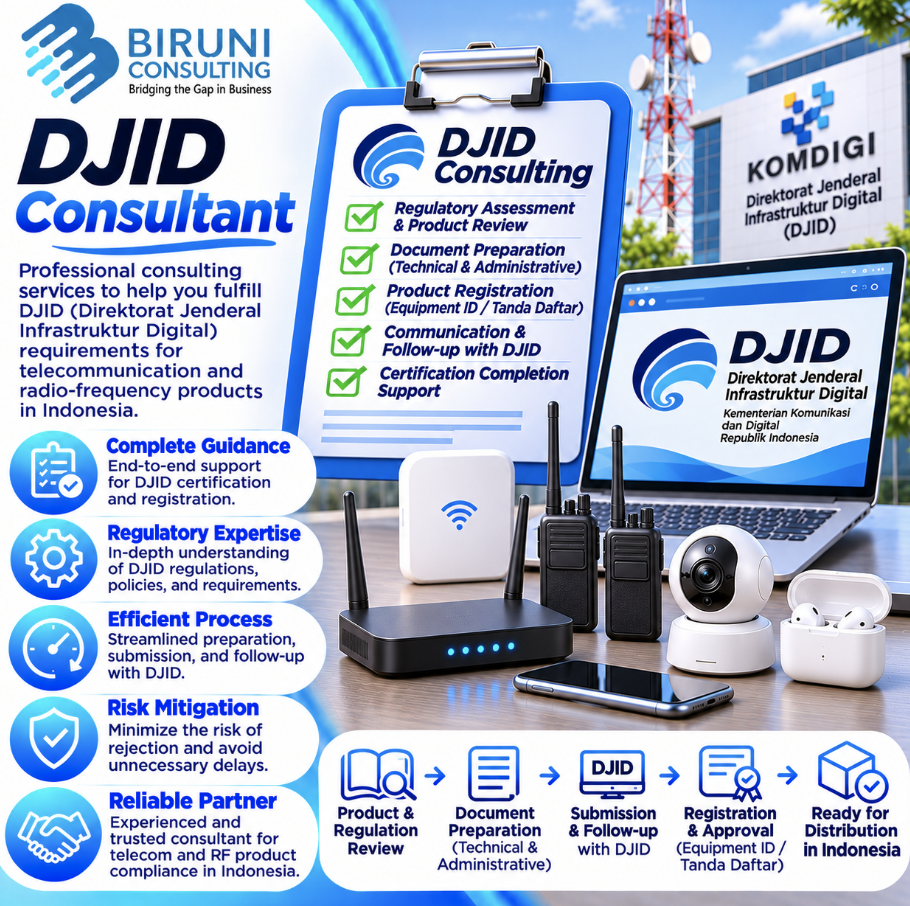
Consulting and certification assistance for telecommunications equipment and wireless products in Indonesia
A DJID consultant assists importers, distributors, trademark owners, manufacturers, and equipment users with understanding and managing Indonesian telecommunications-equipment certification requirements.
DJID is Indonesia’s Directorate General of Digital Infrastructure within the Ministry of Communication and Digital. Within DJID, the Directorate of Digital Infrastructure Services is responsible for functions that include certification of telecommunications equipment and digital devices. Infradigital
Minister of Communication and Informatics Regulation Number 3 of 2024 remains the principal framework governing telecommunications-equipment certification, including applicants, OSS applications, technical documentation, Certificate issuance, holder obligations, and regulatory supervision. JDIH Kemkomdigi
When Is a DJID Consultant Useful?
Consultation is particularly useful before a purchase order, mass production, or commercial shipment.
Products containing Bluetooth, WiFi/RLAN, cellular, NFC, Zigbee, Thread, proprietary RF, or other radio technologies can require different technical assessments.
An early review can identify the applicable certification scope, relevant Technical Standards, suitability of existing laboratory reports, and additional documentation required for the exact model.
Wireless Product Assessment
The assessment begins with the actual wireless configuration rather than the product’s marketing description.
The exact brand, model, manufacturer, manufacturing country, operating frequencies, transmission power, radio modules or chipsets, antennas, firmware, and active transmitter/receiver functions should be identified.
Where several radios are incorporated into one product, each enabled interface should be mapped.
Determining the Certificate Applicant
Applicant structure can have a major impact on the certification project.
Regulation Number 3 of 2024 recognises business applicants including Indonesian registered trademark holders, appointed representatives or distributors of trademark holders, manufacturers or assemblers for trademark holders, manufacturers or assemblers, and businesses using equipment for their own purposes. JDIH Kemkomdigi
The current e-Sertifikasi portal uses the same applicant categories. sertifikasi.postel.go.id
The relationship between the Indonesian applicant, trademark owner, manufacturer, and product should therefore be established before submission.
OSS and e-Sertifikasi
For business applicants, Certificate applications are submitted through OSS integrated with the certification service system. JDIH Kemkomdigi
Current e-Sertifikasi guidance also lists NIB and OSS access among the general requirements for a new Certificate application. sertifikasi.postel.go.id
A consultant can help ensure that the applicant structure and certification documentation are aligned before the application is submitted.
LHU and Test Report Review
The LHU or laboratory test report is a central technical document.
Regulation Number 3 of 2024 requires a test report and equipment technical specifications as part of the application. JDIH Kemkomdigi
Current e-Sertifikasi guidance states that the LHU/test report must be issued by a designated Indonesian laboratory or a recognised overseas laboratory. sertifikasi.postel.go.id
The review should consider the exact model, frequencies, RF output power, antennas, test methods, radio modes, relevant hardware/firmware, and laboratory scope.
CE and FCC Reports
CE, FCC, ETSI, and other international laboratory documentation can be useful supporting evidence.
However, they should not automatically be treated as equivalent to an Indonesian DJID Certificate.
The report needs to be compared against the exact commercial model, applicable Indonesian Technical Standards, frequencies, transmitter power, antenna configuration, and laboratory eligibility.
The result of the review may be that the report is usable, requires additional supporting documentation, or needs supplementary testing.
Module-Based Products
Many modern products integrate ready-made Bluetooth, WiFi, cellular, or multi-radio modules.
An existing module report can simplify the assessment, but the consultant should verify that the module installed in the final equipment is the same module represented by the technical evidence.
Antenna configuration, firmware, PCB integration, radio settings, and the final commercial model remain relevant.
A supplier’s statement that a module is “already certified” should therefore not automatically be interpreted as final-product certification.
OEM and Private-Label Certification
OEM/private-label projects often require additional documentation review because the tested model can differ from the commercial model.
A structured assessment should map:
applicant → trademark owner → manufacturer → manufacturing country → final model → RF configuration → test report.
This helps establish whether the manufacturer’s laboratory evidence can legitimately support the final branded product sold in Indonesia.
Multiple Models and Product Families
Manufacturers frequently use one wireless platform across several product variants.
The use of the same module does not automatically mean that every model can be treated identically.
The assessment should compare model/type, PCB, antennas, transmitter power, firmware, radio functions, manufacturer, and manufacturing country before deciding on the certification strategy.
Regulation Number 3 of 2024 ties conformity and certification to the relevant equipment identity and technical configuration. JDIH Kemkomdigi
Certification Documentation
For an initial assessment, companies can prepare product and label photographs, exact brand and model, datasheets, user manuals, RF specifications, module datasheets, antenna information, block diagrams, and available laboratory reports.
Current e-Sertifikasi requirements for a new Certificate include NIB and OSS access, an LHU/test report, and technical specifications, with additional documentation according to the applicant and equipment category. sertifikasi.postel.go.id
A consultant can help distinguish essential certification documents from general supplier documentation that does not directly support the application.
DJID Consulting Process
The consulting process normally starts with product and RF assessment.
The applicable Technical Standards, laboratory reports, applicant structure, brand/model data, manufacturer, manufacturing country, and supporting documentation are then reviewed.
If existing evidence is sufficient, the application package can be prepared. Where gaps are identified, clarification, supporting documents, or additional testing can be arranged.
Business applications use the OSS-integrated certification route. JDIH Kemkomdigi
Current DJID Certificates
The current DJID nomenclature is visible in newly issued Certificates.
As of November 23, 2026, the official e-Sertifikasi database lists current Certificates using numbers such as 129161/DJID/2026 and describes the database as containing valid SDPPI/DJID Komdigi telecommunications-equipment Certificates. sertifikasi.postel.go.id
“Postel” and “SDPPI” therefore remain common commercial terminology, while DJID is the current institutional naming used on newly issued Certificates.
Certificate Period and Ongoing Imports
Regulation Number 3 of 2024 states that the Certificate itself is not time-limited.
However, the Certificate holder may manufacture, assemble, or import the covered equipment for trade and/or use in Indonesia for up to three years from the Certificate issuance date. Continued activity beyond that period requires renewed Technical Standard conformity and a new Certificate. JDIH Kemkomdigi
Certificate dates should therefore be incorporated into long-term import and product-lifecycle planning.
Compliance After Certification
Certification work does not end when the Certificate is issued.
The product marketed in Indonesia needs to remain consistent with the technical configuration on which the Certificate is based. Regulation Number 3 of 2024 also provides administrative sanctions for equipment traded or used without the required Certificate or equipment that does not comply with the Technical Standards referenced by its Certificate. JDIH Kemkomdigi
Changes to radio modules, antennas, firmware, manufacturing origin, or other material technical configurations should therefore be reviewed before implementation.
Why Consult Before Importation?
Many certification problems result from assessment being performed too late.
A product may already have been manufactured when the importer discovers that the laboratory report covers another regional variant, the manufacturing country has changed, the final antenna differs from the tested configuration, or the Indonesian applicant documentation does not properly establish the relationship with the overseas trademark owner.
Pre-import consultation helps align the product, applicant, technical evidence, and certification strategy before commercial shipment.
Conclusion
A DJID consultant assists companies with both the technical and administrative aspects of Indonesian telecommunications-equipment certification, from initial product assessment and laboratory-report review to OSS/e-Sertifikasi preparation and post-certification compliance.
Regulation Number 3 of 2024 defines eligible applicants and requires business Certificate applications to use the OSS-integrated certification system. JDIH Kemkomdigi Current e-Sertifikasi guidance also identifies NIB/OSS access and an LHU/test report among the principal requirements for a new application. sertifikasi.postel.go.id
Assessing the exact model, radio technologies, frequencies, transmission power, modules, antennas, manufacturer, manufacturing country, applicant structure, and laboratory documentation before importation can significantly reduce certification risk.
Contact Us
Biruni Consulting assists with DJID/SDPPI assessment and certification for telecommunications equipment and various wireless products that will be imported or marketed in Indonesia.
Our services include:
- Assessment of DJID/SDPPI certification requirements.
- Transmitter and receiver assessment.
- RF specification review.
- Frequency and transmission power analysis.
- Technical document review.
- Certification document preparation.
- Testing coordination where required.
- DJID/SDPPI Certification assistance.
If you have a telecommunications device or wireless product, you can prepare product photos, brand, model, datasheet, RF specifications, and wireless module datasheet for an initial assessment of the Postel Certification requirements.