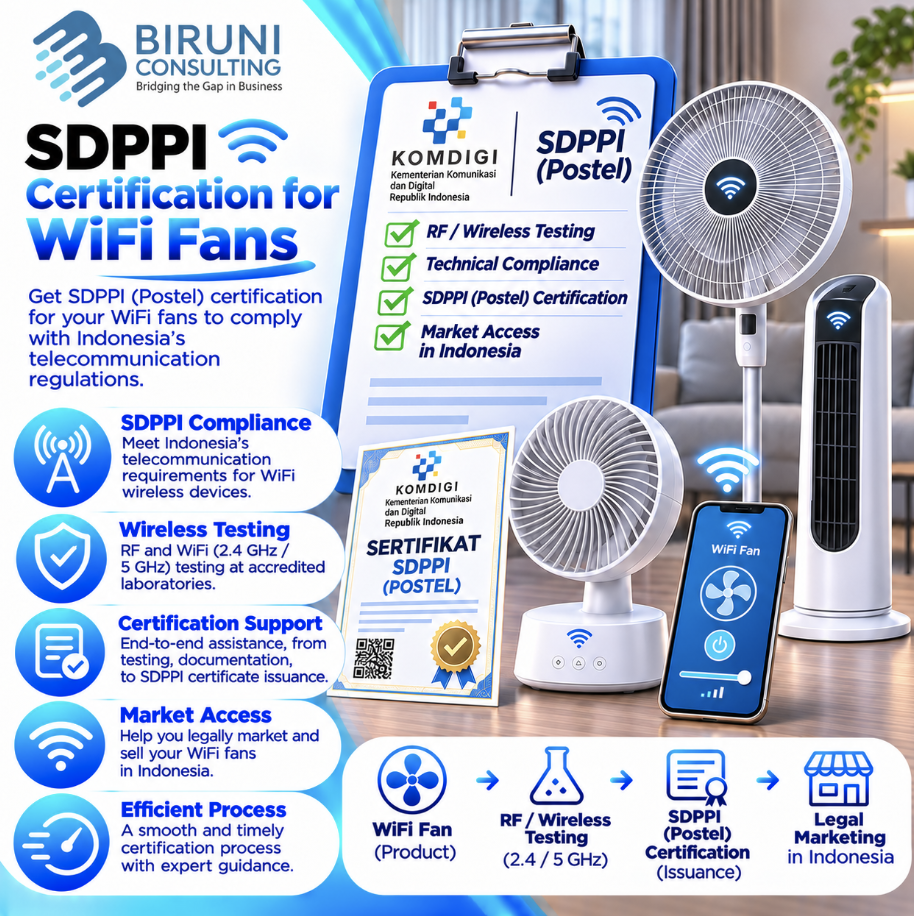
Guide to Postel/DJID Certification for smart fans incorporating WiFi and Bluetooth in Indonesia
A WiFi-enabled fan can be controlled or monitored through a smartphone application, smart-home platform, or local network. Depending on the model, users may control fan speed, timers, oscillation, operating modes, automation, and remote functions through an internet connection.
For Indonesian SDPPI/Postel Certification, the fan function itself is not the determining factor. The assessment focuses on the telecommunications features incorporated into the equipment, particularly WiFi, Bluetooth, and other active wireless radios.
Minister of Communication and Informatics Regulation Number 3 of 2024 remains the principal equipment-certification framework. Business applications are submitted through OSS integrated with the certification service facility. JDIH Kemkomdigi
Conventional Fans and WiFi Fans
A conventional fan may operate entirely through physical controls or a non-radio control arrangement.
A smart fan can contain WiFi to connect to a home network. Some models also include Bluetooth for setup or commissioning.
Two products with almost identical motors, enclosures, and airflow specifications can therefore have very different telecommunications configurations.
The certification assessment should follow the exact product model and enabled communications interfaces.
WiFi-Enabled Fans
WiFi allows the appliance to communicate with a router or access point and subsequently with an application or smart-home platform.
Indonesia’s current RLAN technical framework is established by Minister of Communication and Digital Decision Number 12 of 2025 on Class-Licensed Spectrum and Technical Standards for Radio Local Area Network Equipment. The official legal database currently lists the Decision as in force. JDIH Kemkomdigi
The assessment should therefore identify supported WiFi bands, frequencies, transmitter power, wireless modules, antennas, firmware, and RF test reports.
2.4 GHz WiFi Smart Fans
Many connected home appliances use 2.4 GHz WiFi.
However, a product description such as “2.4G WiFi” is not enough to establish technical compliance.
The manufacturer’s documentation and laboratory reports should describe the actual radio configuration. Where several versions exist within one product family, the relevant SKU should be confirmed before the certification approach is determined.
Fans with WiFi and Bluetooth
Some WiFi fans also include Bluetooth.
Bluetooth may support initial pairing, device discovery, commissioning, or WiFi provisioning.
Where Bluetooth is enabled, it should be assessed separately from WiFi. Minister of Communication and Informatics Decision Number 260 of 2024 includes Bluetooth IEEE 802.15.1 within Indonesia’s Short Range Device framework and requires conformity to be demonstrated through certification. Sertifikasi Postel
A WiFi laboratory report therefore should not automatically be assumed to cover an additional Bluetooth radio.
The Smartphone App Is Not the Main Certification Trigger
A smartphone application by itself does not determine the SDPPI certification scope.
The relevant issue is how the physical fan communicates.
Where the fan communicates using WiFi or Bluetooth, those radio interfaces become part of the technical assessment. Cloud services, automation rules, accounts, and user-interface functions should be distinguished from the physical radio hardware.
WiFi Modules in Smart Fans
Smart fans commonly use ready-made WiFi modules or WiFi/Bluetooth combination modules.
An existing module report can support certification, but it does not automatically establish conformity for every final appliance using the module.
Current e-Sertifikasi requirements state that products relying on a module LHU need a block diagram, photographs showing the module location, and a declaration linking the module brand/type to the final equipment brand, type, and variant. e-Sertifikasi
The final integration therefore remains relevant.
Antenna and Final-Product Integration
A WiFi module can use a PCB antenna, chip antenna, or another integrated antenna design.
The same module installed in several appliances does not automatically mean that all final products have identical RF configurations.
Antenna arrangement, enclosure, firmware, transmitter settings, and installation should be compared with the laboratory test configuration.
The module name alone is therefore not sufficient for a complete certification assessment.
RF Test Reports
An LHU or RF test report is a principal certification document.
Regulation Number 3 of 2024 requires a test report and technical specifications as part of the Certificate application. Current e-Sertifikasi requirements also state that the report must be issued by a designated Indonesian laboratory or a recognised overseas laboratory. JDIH Kemkomdigi
For a WiFi fan, the report should be checked against the exact model, wireless module, supported frequencies, transmission power, antennas, hardware, and firmware.
CE or FCC documentation can be useful supporting evidence, but it should be reviewed against Indonesian certification requirements before it is relied upon.
OEM and Private-Label Products
Smart fans are often supplied through OEM or private-label arrangements.
The laboratory report can therefore contain the manufacturer’s internal model number while the final commercial product uses a different brand and model.
This relationship should be established before submission.
The manufacturer, production country, wireless module, antennas, firmware, and technical configuration should also be compared to ensure that the laboratory evidence represents the final product.
Certification Documents
For an initial assessment, businesses should prepare:
- Product and label photographs.
- Exact brand and model/type.
- Datasheet and user manual.
- WiFi and Bluetooth specifications where applicable.
- Operating frequencies and transmission power.
- Wireless-module datasheets.
- Antenna information.
- Block diagram.
- Available RF test reports.
Current e-Sertifikasi requirements for new business applications also include NIB and OSS access, an LHU/test report, and technical specifications, together with additional documentation according to the applicant and equipment configuration. e-Sertifikasi
Certification Process
The process should ideally begin with an assessment of the exact product before commercial shipment.
WiFi bands, Bluetooth where applicable, transmitters and receivers, modules, antennas, output power, firmware, and existing laboratory reports are reviewed.
The applicable Technical Standards can then be identified and the existing test evidence assessed for suitability.
For business applicants, Regulation Number 3 of 2024 provides for applications through OSS integrated with the certification service system. JDIH Kemkomdigi
Certificate Period
Under Regulation Number 3 of 2024, the Certificate itself is not time-limited.
However, the Certificate holder may manufacture, assemble, or import the certified equipment for trade and/or use in Indonesia for a maximum of three years from the Certificate issuance date. JDIH Kemkomdigi
Businesses making recurring imports should therefore include the Certificate issuance date in their product-lifecycle and compliance planning.
Regulatory Labeling
Certificate holders are also subject to regulatory-marking requirements.
Regulation Number 3 of 2024 requires labeling containing the Certificate number and PLG ID, QR Code, and Warning Sign. Labeling is generally applied to both the equipment and its packaging. JDIH Kemkomdigi
The Certificate holder must also report evidence of implementation through the certification service system by uploading photographs of the labeled equipment. JDIH Kemkomdigi
A smart fan normally provides sufficient space on its rating label or packaging to plan Indonesian regulatory marking before mass production.
SDPPI Certification and Other Fan Compliance
SDPPI/DJID Certification addresses the telecommunications functions incorporated into the smart fan.
It should not automatically be treated as replacing all other electrical, product-safety, import, or commercial compliance requirements that may apply to the product.
Each regulatory area should be assessed according to the final product’s classification and specifications.
Why Pre-Import Assessment Matters
One fan family may contain a conventional model, a WiFi version, and a premium WiFi-plus-Bluetooth version.
Their external designs can be almost identical.
Reviewing the exact SKU before shipment helps ensure that the wireless modules, frequencies, transmitter power, antennas, test reports, model information, and certification documents correspond to the product actually being imported.
Conclusion
SDPPI Certification for WiFi fans is determined by the telecommunications functions incorporated into the final product, rather than its basic function as a fan.
A WiFi fan should be assessed under the applicable RLAN framework. Minister of Communication and Digital Decision Number 12 of 2025 is currently in force for class-licensed spectrum and RLAN Technical Standards. JDIH Kemkomdigi
Where Bluetooth is also incorporated, it should be included within the Short Range Device assessment. Sertifikasi Postel
Before certification and importation, the business should review the exact model, WiFi/Bluetooth configuration, operating frequencies, transmission power, modules, antennas, firmware, RF test reports, manufacturer, and manufacturing country.
Completing this assessment early can reduce the risk of a mismatch between the final smart fan and the laboratory or certification documentation.
Contact Us
Biruni Consulting assists with DJID/SDPPI assessment and certification for WiFi fans and various wireless productsthat will be imported or marketed in Indonesia.
Our services include:
- Assessment of DJID/SDPPI certification requirements.
- Transmitter and receiver assessment.
- RF specification review.
- Frequency and transmission power analysis.
- Technical document review.
- Certification document preparation.
- Testing coordination where required.
- DJID/SDPPI Certification assistance.
If you have a WiFi fan, you can prepare product photos, brand, model, datasheet, RF specifications, and wireless module datasheet for an initial assessment of the Postel Certification requirements.