
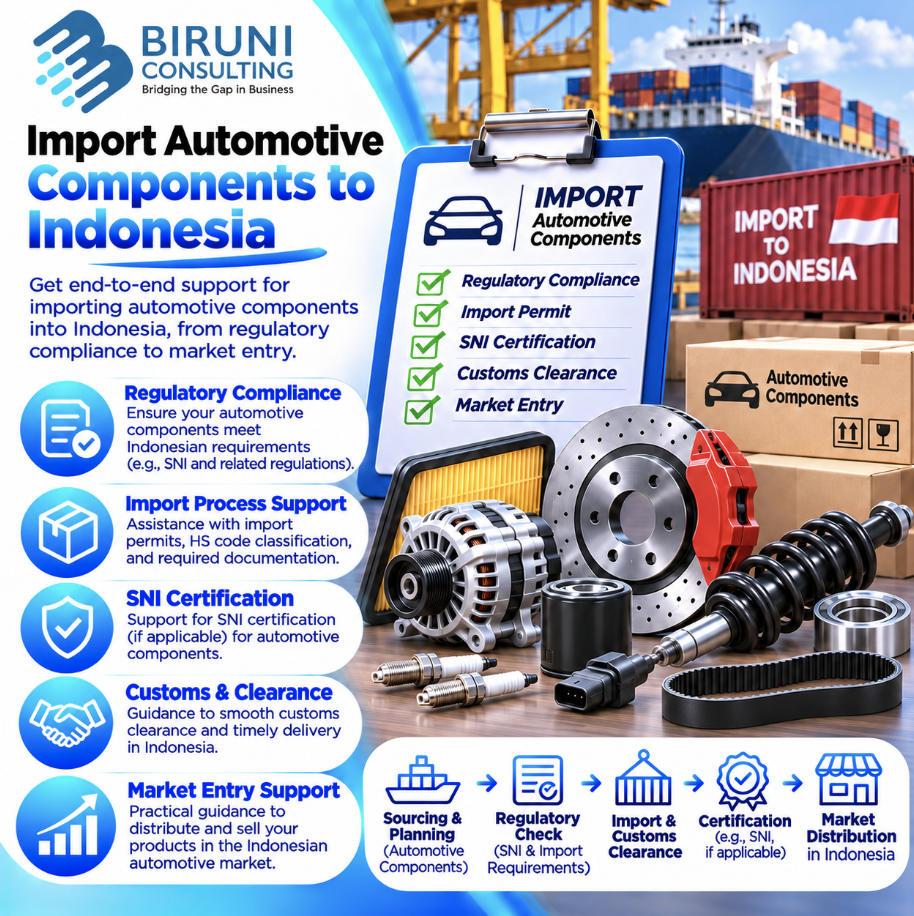
Guide to Importing Automotive Components into Indonesia for Overseas Manufacturers
Import Automotive Components to Indonesia requires more than selecting a freight forwarder, Importer, and HS code. An Overseas Manufacturer needs to confirm that the Indonesian company structure, NIB/API, Business Licensing, customs readiness, product classification, restrictions, and product-specific approvals are in place before commercial shipment.
Under Indonesia’s current general import framework, Minister of Trade Regulation No. 16 of 2025 requires an Importer to hold an NIB functioning as an API. The regulation became effective on August 29, 2025 and has subsequently been amended, including through the second amendment under Minister of Trade Regulation No. 18 of 2026, effective June 4, 2026. Database Peraturan | JDIH BPK
For automotive components, the import workstream then needs to be integrated with product-specific compliance. Products such as tires and motor-vehicle safety glass are subject to their own Mandatory SNI frameworks. Other components may have an SNI that is not mandatory, fall outside current Mandatory SNI scope, or require another regulatory assessment based on their technical functions. Database Peraturan | JDIH BPK
Regulatory assessment should therefore be completed before the purchase order and shipment, rather than after the cargo reaches Indonesia.
What Does Import Automotive Components to Indonesia Mean?
Import Automotive Components to Indonesia refers to bringing vehicle parts, components, accessories, consumables, or related automotive products into the Indonesian customs territory while satisfying all applicable import, customs, and product-compliance requirements.
Products can include:
- tires;
- wheels;
- safety glass;
- filters;
- brake components;
- suspension parts;
- bearings;
- hoses;
- lighting components;
- electrical parts;
- electronic modules;
- sensors;
- replacement parts;
- automotive accessories; and
- lubricants.
Those products do not necessarily follow the same regulatory pathway.
Product Classification Comes Before Importation
The first step is accurate product classification.
Commercial descriptions such as “auto parts,” “spare parts,” or “automotive accessories” are too broad for regulatory analysis.
Manufacturers should generally prepare:
- Product name.
- Intended use.
- Brand.
- Model or part number.
- Technical specifications.
- Materials or formulations.
- Manufacturing site.
- Country of origin.
- Proposed HS code.
- Existing Certificates and test reports.
The information can then be used to determine both import requirements and product-specific compliance.
HS Code Is Important
HS classification influences tariff treatment, customs declarations, and potential import restrictions.
However, the HS code is not the only basis for product compliance.
Mandatory SNI regulations can rely on a combination of technical product definitions, intended applications, referenced standards, and tariff classifications.
Regulatory analysis should therefore not consist merely of entering an HS code into a customs database.
Indonesian Importer
An Overseas Manufacturer generally needs an Indonesian party legally capable of performing importation.
Minister of Trade Regulation No. 16 of 2025 requires the Importer to hold an NIB functioning as API. The API identifies the company as an Importer, while the NIB is the Business Operator’s identity for conducting business activities. Database Peraturan | JDIH BPK
Appointing a Distributor or issuing a Letter of Authorization therefore does not automatically make an Indonesian company eligible to import.
NIB Functioning as API
NIB/API is a fundamental part of the Importer structure.
The Indonesian company’s actual activities also need to correspond with its applicable Business Licensing.
Government Regulation No. 28 of 2025 is the current Risk-Based Business Licensing framework. It became effective on June 5, 2025, revoked Government Regulation No. 5 of 2021, and covers Business Licensing, PB UMKU, OSS, supervision, evaluation, and sanctions. Database Peraturan | JDIH BPK
Importer due diligence should therefore go beyond asking whether the company merely has an NIB.
Customs Access
The Importer also needs customs operational readiness.
Indonesia Customs explains that Importers and/or Exporters are treated as satisfying Customs Registration requirements once they hold an NIB functioning as TDP, API, and Customs Access. Customs Registration data is integrated with OSS NIB and taxpayer information. Beacukai
Importer and Customs Access status should be verified before the first commercial shipment.
An Importer Is More Than a Consignee
A common mistake is treating the Importer merely as the name appearing on a Bill of Lading.
The Importer carries substantive responsibilities for customs declarations, import requirements, duties, taxes, and prohibitions or restrictions.
An Overseas Manufacturer should therefore perform due diligence before establishing the local Importer structure.
PIB for Automotive Components
Imports for Use generally involve a PIB or Import Customs Declaration.
Indonesia Customs explains that an Importer prepares the PIB based on Supporting Customs Documents and self-assesses applicable Customs Duty, Excise, and/or Import Taxes. Beacukai
The precise customs treatment remains dependent on the goods and applicable customs rules.
Supporting Customs Documents
Documents relevant to customs processing can include:
- Commercial Invoice;
- Packing List;
- Bill of Lading or Air Waybill;
- product-identification documentation;
- Certificate of Origin where applicable;
- product approvals; and
- documentation demonstrating compliance with import requirements.
Indonesia Customs expressly identifies the Invoice, Packing List, Bill of Lading/Air Waybill, product-identification records, and documentation demonstrating compliance with import requirements as examples of Supporting Customs Documents. Beacukai
Commercial Invoice
The Invoice should contain a sufficiently clear product description to identify the imported automotive component.
Generic descriptions such as “parts” or “sample” can be insufficient.
Information should remain consistent with:
- Product Catalogues;
- HS classification;
- Certificates;
- brands;
- models or part numbers;
- country of origin; and
- manufacturing sites.
Consistency supports both regulatory and customs review.
Packing List
The Packing List should show quantities, packaging structures, part numbers, weights, and identification consistent with the Invoice.
For shipments containing numerous automotive SKUs, a model matrix connecting the purchase order, Invoice, Packing List, and regulatory status can significantly reduce errors.
It also reduces the risk of uncertified products being mixed into a shipment of compliant goods.
Bill of Lading or Air Waybill
The Importer and consignee arrangement should be determined before transportation documents are issued.
Changing the Importer after the cargo has departed can create additional administrative complexity.
Where Importer information is also connected with product certification or appointment structures, the change can have consequences beyond logistics.
Customs Duties and Import Taxes
Automotive components can be subject to Customs Duty and Import Taxes according to their classification and applicable tariff treatment.
Under the Imports for Use mechanism, the Importer is responsible for completing customs declarations and applicable duty and tax obligations. Beacukai
Because tariff treatment can depend on HS classification and origin, landed-cost calculations should follow proper classification.
Prohibitions and Restrictions
Submission of a PIB alone does not necessarily allow the goods to be released.
Indonesia Customs states that an Importer needs to satisfy applicable prohibitions and restrictions as part of the Imports for Use process. Beacukai
Product certification, Import Approvals, technical requirements, or other documentation can form additional regulatory layers depending on the actual goods.
Prohibited Imports
Minister of Trade Regulation No. 47 of 2025 is the current regulation concerning Goods Prohibited for Import and has applied since January 1, 2026. Database Peraturan | JDIH BPK
Automotive Importers should therefore verify that goods are not prohibited and separately assess restrictions applying to their classification and condition.
This can be particularly important for used components, unusual materials, or technically specialized products.
Import Licensing Can Be Product Specific
Holding NIB/API does not mean every product can automatically be imported.
Regulation No. 16 of 2025 provides the general import framework, while specified products or sectors can involve Import Business Licensing, Import Approvals, Surveyor Reports, or other requirements.
Regulation No. 18 of 2026 amended provisions concerning Import Business Licensing, Import Approvals, Surveyor Reports, customs-import documentation, reporting, and administrative sanctions. Database Peraturan | JDIH BPK
The actual requirement therefore needs to be checked using the product description and HS classification.
Automotive Components and Mandatory SNI
One of the most important product-compliance layers is Mandatory SNI.
Not every automotive component requires Mandatory SNI certification.
The obligation applies where the government has made a particular SNI mandatory through an applicable regulation.
Current automotive-related examples include tires and motor-vehicle safety glass. Database Peraturan | JDIH BPK
SNI for Tires in Indonesia
Minister of Industry Regulation No. 9 of 2025 governs Mandatory SNI for tires.
The regulation became effective on July 24, 2025 and replaced the prior Mandatory SNI tire framework. Database Peraturan | JDIH BPK
A tire Importer therefore needs more than NIB/API and Customs Access where the product falls within the regulated Mandatory SNI scope.
SNI for Motor-Vehicle Safety Glass
Minister of Industry Regulation No. 15 of 2025 governs Mandatory SNI for motor-vehicle safety glass and became effective on October 25, 2025.
It replaced Minister of Industry Regulation No. 80 of 2015 and covers the Mandatory SNI scope, conformity assessment, responsibilities, transitional provisions, and other regulatory matters. Database Peraturan | JDIH BPK
Windshields and other automotive safety-glass products therefore require product-specific assessment before importation.
SNI for Lubricating Oil
Automotive market-entry planning can also involve lubricants.
Minister of Industry Regulation No. 8 of 2025 makes SNI mandatory for lubricating oil, has applied since July 24, 2025, and revoked Regulation No. 25 of 2018. Database Peraturan | JDIH BPK
Manufacturers and Importers of lubricants need to treat certification readiness and import readiness as separate but connected workstreams.
Motor-Vehicle Wheels
Motor-vehicle wheels are also subject to a Mandatory SNI framework under Minister of Industry Regulation No. 71 of 2024.
The framework applies product and vehicle-category requirements together with a conformity-assessment scheme.
Manufacturers should establish the wheel category, model, manufacturing site, and Certificate scope before commercial shipment.
Not Every Spare Part Requires Mandatory SNI
Brake parts, filters, bearings, suspension components, hoses, engine parts, body parts, accessories, and other spare parts should not automatically be treated as Mandatory SNI products.
Conversely, the existence of an SNI does not automatically mean certification is compulsory.
The applicable mandatory regulation remains decisive.
This prevents both unnecessary certification and noncompliant shipment of products that actually require approval.
SNI Readiness Before Shipment
Where Mandatory SNI applies, certification should be prepared before commercial cargo departs.
An SNI workstream can include:
- Applicable SNI identification.
- LSPro selection.
- Documentation.
- Factory audit.
- Laboratory testing.
- Corrective actions.
- SNI Certificate issuance.
- SPPT SNI where applicable.
- Product marking.
- Surveillance planning.
Shipping before the pathway is clear can create substantial customs and commercial risks.
LSPro
An LSPro or Lembaga Sertifikasi Produk / Product Certification Body performs product conformity assessment.
The Importer, Distributor, Official Representative, and consultant do not replace the LSPro.
Where Mandatory SNI applies, the manufacturer should verify that the selected LSPro has the applicable scope and eligibility for the relevant product standard.
LSPro selection should normally precede official testing.
Laboratory Testing
Automotive testing is highly product specific.
Tires, wheels, glass, lubricants, rubber components, and electrical products require different methods and technical capabilities.
Existing international test reports can provide useful technical evidence, but their acceptance should not be assumed.
A test-report gap analysis is generally preferable before samples are shipped for repeat testing.
Factory Audits
Certain Mandatory SNI schemes use Type 5 certification and can include factory audits.
In such cases, the assessment involves not only the final product but also the production process and quality controls.
An Overseas Manufacturer should therefore prepare quality-management documentation, manufacturing records, inspection, calibration, traceability, nonconformity handling, and corrective-action records.
Official Representative for an Overseas Manufacturer
Product-specific Mandatory SNI regulations can require an Official Representative for an Overseas Manufacturer.
The Official Representative is different from the Importer.
The Representative performs functions within the Indonesian regulatory and certification structure, while the Importer performs importation and customs functions.
Under certain schemes both roles can be performed by the same entity; under others, the structure can be different.
Official Representative Is Not Automatically the Importer
Appointment as Official Representative does not automatically provide Importer authorization.
Where the Representative will also import commercially, it still needs to satisfy general requirements including an NIB functioning as API and applicable customs requirements. Database Peraturan | JDIH BPK
An Overseas Manufacturer should map both functions before finalizing certification and commercial agreements.
The Importer Is Not Automatically the SNI Certificate Holder
The company clearing the products through customs does not automatically become the SNI Certificate Holder.
Certificate ownership is determined by the applicable product regulation and conformity-assessment scheme.
The manufacturer should therefore distinguish:
- SNI Certificate Holder.
- Official Representative.
- SPPT SNI party.
- Importer.
- Distributor.
Confusing these roles can create unnecessary dependence on one local commercial partner.
SIINas
For Ministry of Industry Mandatory SNI schemes, SIINas can be an important certification platform.
An Overseas Manufacturer should determine which Indonesian party is authorized to manage the applicable submissions and ongoing regulatory administration.
Control of SIINas should be addressed early because it can affect Certificate maintenance, regulatory changes, and transition to another local structure.
Automotive OEM Components
OEM components still require product-specific regulatory assessment.
The fact that a component is supplied to a vehicle-assembly plant should not automatically be treated as an exemption.
A product regulation can contain particular structures or treatment according to industrial use, but the relevant eligibility needs to be established from that regulation.
The manufacturer should clearly identify whether the goods are:
- assembly components;
- production materials;
- replacement parts;
- service parts; or
- aftermarket products.
Aftermarket Automotive Components
Aftermarket products can use different commercial channels from OEM components.
The Importer can also act as Distributor or supply dealers, workshops, marketplaces, or other downstream channels.
The commercial channel itself does not determine whether Mandatory SNI applies.
The regulatory status remains dependent on the product and applicable regulation.
Spare Parts for After-Sales Service
Parts used for after-sales service should be classified clearly before importation.
The Importer should establish whether the goods form part of general spare-parts supply, a captive service network, manufacturing needs, or another defined regulatory structure.
The description “service parts” should not automatically be treated as an exemption from SNI or import requirements.
Automotive Electronics
Modern automotive components increasingly contain electronic or wireless functions.
Head units, telematics modules, trackers, wireless cameras, TPMS devices, smart sensors, and connected accessories can require additional regulatory assessment beyond traditional automotive-product rules.
A portfolio should therefore not be assessed only because products are marketed as “automotive.”
Technical functionality can lead to another regulatory pathway.
Batteries and Electrical Components
Battery systems, chargers, power electronics, lighting products, electrical accessories, and other electrical components also require classification according to their actual technical functions.
Automotive application is not always the only regulatory factor.
Manufacturers should provide complete specifications rather than relying solely on commercial catalogues.
New vs Used Automotive Components
The condition of imported goods can also affect the import analysis.
Used products should not automatically be assumed to follow the same pathway as new products.
The current import framework and prohibition rules need to be assessed against the actual product, condition, HS classification, intended use, and Importer structure. Minister of Trade Regulation No. 47 of 2025 has governed prohibited imports since January 1, 2026. Database Peraturan | JDIH BPK
Country of Origin
Country of origin should correspond with the actual manufacturing source and customs documentation.
Origin can differ from the country of shipment or the location of the trademark owner.
Invoices, Certificates of Origin where used, factory records, and transportation documentation should therefore contain consistent information.
Manufacturing Site
The manufacturing site can be important for product certification.
An SNI Certificate connected with a specific production facility should not be assumed to cover goods transferred to another factory without regulatory assessment.
Supply-chain teams should therefore notify regulatory teams before changing production sources.
Multiple Manufacturing Sites
Global automotive suppliers often operate several factories.
The same part number can be manufactured in multiple countries.
Before Indonesian market launch, the manufacturer should determine which facilities will supply the market and whether certification or other approvals cover those sites.
The answer can affect testing, audits, Certificate scope, and shipping.
Multiple Models and Part Numbers
Automotive portfolios can contain hundreds or thousands of part numbers.
A model matrix can connect:
- part number;
- product family;
- technical model;
- HS code;
- manufacturing site;
- SNI applicability;
- Certificate number;
- Importer; and
- Indonesian launch status.
Without a controlled matrix, products that are not yet compliant can accidentally enter commercial shipments.
Brands and Trademarks
The brand owner, manufacturer, Importer, Distributor, and Official Representative do not necessarily need to be the same company.
Private-label and OEM arrangements can create additional complexity.
Trademark relationships should be assessed where the product-specific certification regulation connects the brand with the applicant, manufacturer, or Official Representative.
Labeling
Imported automotive components should also be reviewed for applicable labeling and marking requirements.
Global packaging should not automatically be finalized for Indonesian distribution without checking local requirements.
Mandatory SNI products can also be subject to SNI Mark or other certification-related identification requirements.
SNI Mark and SPPT SNI
The SNI Certificate does not necessarily represent the final step before use of the SNI Mark.
Under applicable Ministry of Industry schemes, SPPT SNI can provide approval relating to use of the SNI Mark.
Manufacturers should integrate the Certificate, SPPT SNI, Official Representative, marking, and commercial-shipment schedule.
Sample Importation
Certification can require formal samples before commercial shipment.
Sample imports should be planned together with the LSPro and laboratory pathway.
The manufacturer should ensure that the sample has the correct model, factory, material, configuration, and documentation.
Testing the wrong sample can result in repeated testing and certification delays.
Do Not Ship Commercial Quantities as Samples
Describing goods as “samples” does not automatically remove regulatory obligations.
Commercial quantities should not be shipped before the Importer and compliance pathway are understood.
Testing samples should be legitimately distinguishable from commercial inventory and remain subject to applicable customs and product rules.
Pre-Shipment Compliance Review
Before cargo departs, the manufacturer and Importer should review:
- HS classification.
- Importer eligibility.
- NIB/API and Customs Access.
- Import licensing and restrictions.
- Mandatory SNI status.
- SNI Certificate and SPPT SNI where applicable.
- Official Representative structure.
- Manufacturing site.
- Brand and model.
- Invoice, Packing List, and transportation documents.
Indonesia Customs requires the Importer to complete customs documentation, applicable duties and taxes, and prohibitions or restrictions for Imports for Use. Beacukai
Do Not Wait Until the Cargo Arrives
Conducting regulatory assessment only after goods arrive is one of the most expensive market-entry mistakes.
If additional approval is required, the Importer can face storage costs, administrative delays, or other consequences.
Assessment should ideally begin during quotation or purchase-order planning.
Importer Due Diligence
Before appointing a Local Importer, an Overseas Manufacturer should review:
- legal entity;
- NIB/API;
- Business Licensing;
- Customs Access;
- relevant product experience;
- documentation capability;
- regulatory cooperation; and
- transition mechanisms.
Importer selection should not be based solely on customs-clearance fees.
The Distributor Does Not Have to Be the Importer
Distributor and Importer functions can be performed by the same or different companies.
The Distributor focuses on commercial distribution, while the Importer assumes import and customs responsibilities.
Separating the functions can provide flexibility, although it also increases coordination requirements.
Product-specific local-party rules should remain part of the assessment.
The Importer Does Not Have to Be the Official Representative
Where a product scheme requires an Official Representative, the Importer and Representative functions also need to be mapped separately.
One company can potentially perform both roles where the regulation and Business Licensing permit.
Manufacturers should nevertheless avoid combining functions automatically only because the arrangement appears commercially convenient.
Regulatory Ownership
An Overseas Manufacturer should establish regulatory ownership before entering the Indonesian market.
The structure can identify:
- Product manufacturer.
- SNI Certificate Holder.
- Official Representative.
- SIINas controller.
- SPPT SNI party.
- Importer.
- Distributor.
- Trademark owner.
- Manufacturing site.
- LSPro and Testing Laboratory.
A clear structure preserves continuity where the Importer or Distributor later changes.
Changing the Importer
Changing the Importer is not always merely a commercial decision.
Product certifications, approvals, appointments, or customs arrangements can include Importer information.
Before using a new Importer, the manufacturer should assess whether applicable Certificates, SIINas data, appointments, or other records need to be amended.
Changing the Distributor
Changing the Distributor can be simpler where the regulatory structure is not fully controlled by that Distributor.
Manufacturers should therefore be cautious where one agreement gives the Distributor control over the Certificate, Official Representative appointment, SIINas, Importer arrangement, and trademark documentation at the same time.
An exit mechanism should be designed before market launch.
Product Changes After the First Import
Engineering changes should be communicated before subsequent shipments.
Changes to materials, specifications, formulations, suppliers, models, factories, packaging, or brands can affect classification or certification.
An Importer should not receive revised products based solely on an unchanged part number without regulatory review.
Product Traceability
Automotive Importers should maintain traceability connecting:
- manufacturer;
- production site;
- model or part number;
- batch or lot;
- Invoice;
- PIB;
- Certificate;
- Importer; and
- Distributor or customer.
Traceability supports customs audits, surveillance, complaints, corrective actions, and product recalls.
Customs Records
Importers need to maintain customs and supporting documentation in accordance with applicable requirements.
Product and regulatory information should also be managed in a structured way so that it can be reconciled with actual shipments.
Misalignment between supply-chain records and regulatory documentation is a common source of compliance problems.
Post-Import Compliance
Compliance does not necessarily end after customs release.
Mandatory SNI products can remain subject to surveillance, reporting, Certificate maintenance, change control, marking, and other continuing requirements.
Where the Importer and Official Representative are different entities, responsibilities for post-market compliance should be clearly allocated.
Regulatory Monitoring
Import and product regulations can change.
Minister of Trade Regulation No. 16 of 2025 has already been amended, including through the second amendment under Regulation No. 18 of 2026 effective June 4, 2026. Current Mandatory SNI regulations for tires, safety glass, and lubricating oil are also relatively recent. Database Peraturan | JDIH BPK
Recurring import programs therefore require regulatory monitoring rather than a one-time compliance review.
Regulatory Gap Analysis
Before the first shipment, regulatory gap analysis can identify:
- HS classification not finalized;
- unsuitable NIB/API;
- Customs Access incomplete;
- restrictions not assessed;
- Mandatory SNI status unknown;
- Certificate unavailable;
- Official Representative not established;
- SIINas incomplete;
- manufacturing-site mismatch;
- labeling incomplete; or
- inconsistent commercial documentation.
Each gap can then become an action item before the cargo moves.
Initial Documents for Import Automotive Components to Indonesia
Manufacturers can prepare:
- Product Catalogue.
- Technical Data Sheet.
- Model or part-number list.
- Proposed HS codes.
- Manufacturer information.
- Manufacturing-site details.
- Existing Certificates.
- Existing laboratory reports.
- Brand and trademark information.
- Proposed Importer information.
- Expected annual import volume.
- Intended use and distribution channels.
These documents provide a practical starting point for detailed regulatory mapping.
Import Automotive Components to Indonesia Roadmap
A project can generally follow:
- Product classification.
- HS-code review.
- Mandatory SNI and other approval assessment.
- Importer and Business Licensing review.
- Customs Access verification.
- Official Representative assessment where applicable.
- Certification, testing, and factory audits where required.
- Import licensing and restrictions assessment.
- Documentation and labeling review.
- Pre-shipment compliance review.
- PIB and customs clearance.
- Domestic distribution and post-market compliance.
The precise sequence depends on the product.
Timeline
There is no universal timeline for importing automotive components.
A product requiring no additional regulatory approval can have a much simpler preparation pathway than a Mandatory SNI product requiring laboratory testing, factory audits, an Official Representative, and certification.
Timing can also depend on:
- Importer readiness;
- product classification;
- LSPro;
- laboratory testing;
- factory audits;
- certification;
- shipping; and
- customs processing.
Commercial launch planning should therefore follow regulatory gap analysis.
Cost of Import Automotive Components to Indonesia
Total landed and compliance costs can include:
- regulatory assessment;
- Importer services;
- customs brokerage;
- freight;
- insurance;
- customs duties;
- import taxes;
- certification;
- LSPro;
- laboratory testing;
- factory audits;
- auditor travel;
- Official Representative services;
- warehousing;
- labeling; and
- domestic delivery.
A cost estimate based only on freight and customs-duty rates can substantially underestimate the true market-entry cost.
Common Import Automotive Components to Indonesia Mistakes
Common mistakes include:
- using an unverified HS code;
- appointing a Distributor that is not ready to act as Importer;
- assuming an NIB alone is sufficient;
- ignoring Customs Access;
- failing to assess restrictions;
- assuming all automotive parts are outside Mandatory SNI;
- assuming every automotive part requires SNI;
- shipping before certification is complete;
- assuming international Certificates automatically replace SNI;
- ignoring manufacturing sites;
- confusing the Importer with the Official Representative; and
- beginning regulatory assessment only after cargo arrives.
Early planning reduces most of these risks.
How to Select an Automotive Components Importer
A suitable Importer should have legal eligibility, customs readiness, documentation capabilities, and experience with the actual product category.
The manufacturer should also establish whether the Importer can work with a separate Official Representative, different Distributors, or multiple commercial channels.
Long-term flexibility should be considered together with first-shipment convenience.
Why Use a Regulatory Consultant?
A regulatory consultant can help connect product classification, Mandatory SNI assessment, Importer structures, certification, SIINas, customs preparation, and pre-shipment review.
The consultant can also identify gaps before the manufacturer incurs testing or shipping costs.
However, the consultant does not replace regulators, the LSPro, Testing Laboratory, Customs, or the Importer.
Conclusion
Import Automotive Components to Indonesia requires an integrated review of Importer eligibility, customs requirements, product classification, and product-specific compliance.
The current general import framework requires an Importer to hold an NIB functioning as API. Minister of Trade Regulation No. 16 of 2025 provides the general framework and has been amended, including through Regulation No. 18 of 2026 effective June 4, 2026. Database Peraturan | JDIH BPK
For customs clearance, the Importer submits the PIB and satisfies applicable duties, taxes, and prohibitions or restrictions. Supporting Customs Documents can include the Invoice, Packing List, Bill of Lading/Air Waybill, product-identification documents, and evidence of compliance with import requirements. Beacukai
Automotive product compliance then needs separate assessment. Tires fall under Mandatory SNI Regulation No. 9 of 2025, motor-vehicle safety glass under Regulation No. 15 of 2025, and lubricating oil under Regulation No. 8 of 2025. Not every automotive component, however, automatically requires Mandatory SNI. Database Peraturan | JDIH BPK
An Overseas Manufacturer should therefore complete product classification, HS-code review, Importer due diligence, Mandatory SNI assessment, certification, Official Representative structuring where applicable, and pre-shipment compliance review before commercial cargo departs.
Contact Us
Biruni Consulting assists companies with Import Automotive Components to Indonesia professionally and in accordance with applicable regulations in Indonesia.
Our services include:
- Regulatory consultation.
- Identification of applicable standards.
- Preparation of certification documents.
- Assistance with laboratory testing.
- Certification processing until certificate issuance.
Biruni Consulting assists Overseas Manufacturers with product classification, Mandatory SNI assessment, Importer structures, NIB/API review, customs readiness, LSPro, laboratory testing, SIINas, Official Representative structures, and pre-shipment compliance for automotive components entering Indonesia.
Contact Us for guidance on Import Automotive Components to Indonesia, Automotive SNI Certification Indonesia, SNI Automotive Parts Indonesia, Indonesia Importer Service, and automotive-product regulatory compliance assistance.