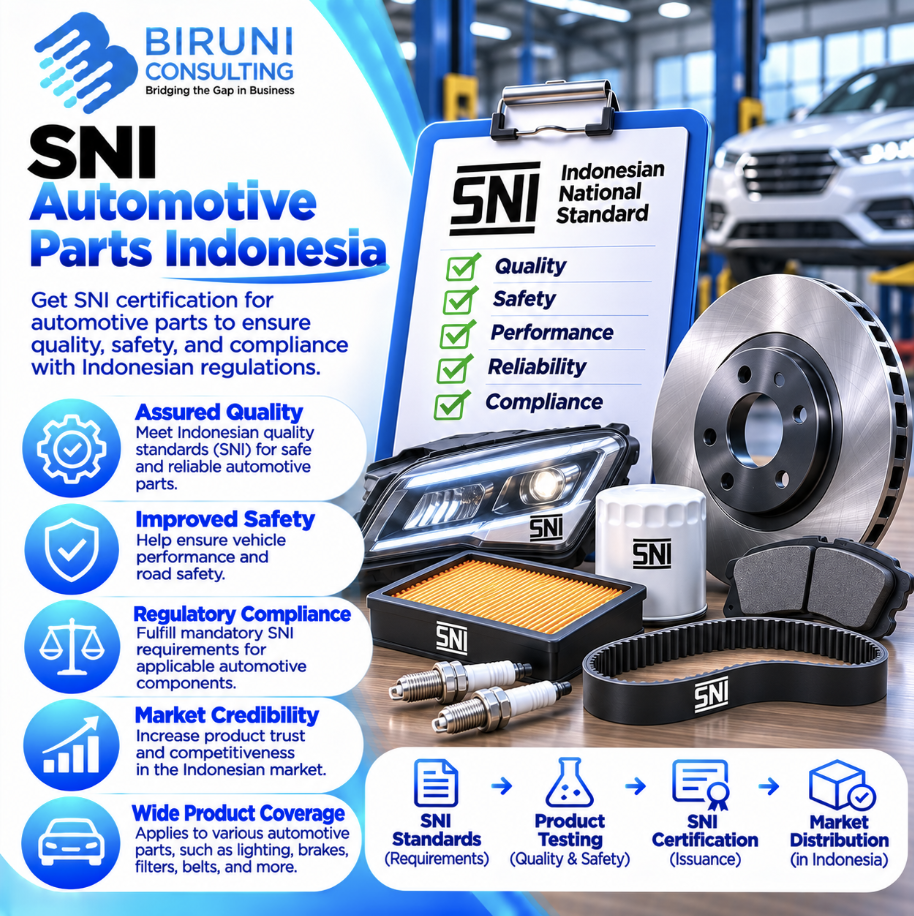
SNI Requirements for Automotive Components and Products in Indonesia
SNI Automotive Parts Indonesia is an important regulatory-compliance area for manufacturers, Importers, Distributors, and Overseas Manufacturers introducing automotive components or related products into the Indonesian market.
However, not every automotive part automatically requires SNI certification. Indonesia distinguishes between SNI that has been made mandatory and standards whose application is not compulsory. For products falling within Ministry of Industry Mandatory SNI schemes, the certification obligation arises because a specific regulation makes the relevant SNI mandatory, and applications are processed through SIINas. BBSPJIKKP
Current automotive-related product categories with specific Mandatory SNI frameworks include tires, motor-vehicle wheels, motor-vehicle safety glass, motor-vehicle lubricating oil, and motorcycle helmets. Each category has its own regulation, product scope, SNI references, certification scheme, and Overseas Manufacturer requirements. Database Peraturan | JDIH BPK
An Overseas Manufacturer should therefore not begin merely by searching for “SNI for automotive parts.” The company first needs to determine the exact product, function, model, manufacturing site, and regulation that applies.
What Is SNI Automotive Parts Indonesia?
SNI Automotive Parts Indonesia refers to the application of Indonesian National Standards to vehicle components, parts, accessories, consumables, and related automotive products falling within a particular standard or regulatory scope.
Automotive products are highly diverse. Tires, wheels, safety glass, lubricants, brake components, filters, bearings, lamps, electronic accessories, and replacement parts should not be assumed to follow the same certification pathway.
The existence of an SNI for a product also does not automatically make certification mandatory. Mandatory status needs to arise from an applicable regulation. BBSPJIKKP
Do All Automotive Parts Require SNI?
No.
This is one of the most important principles in SNI Automotive Parts Indonesia.
An automotive component can fall into one of several situations:
- It is covered by an SNI made mandatory by regulation.
- An SNI exists, but its application is not mandatory for the relevant commercial product.
- No directly applicable product-specific SNI exists.
- The product is subject to another regulatory or approval framework outside SNI.
A supplier should therefore not commission certification merely because it has found an SNI number that appears relevant.
Product Classification Comes First
Regulatory assessment should begin with product classification.
Information normally reviewed includes:
- product name and intended use;
- technical specifications;
- materials or formulation;
- brand and model;
- manufacturing site;
- vehicle application;
- proposed HS code;
- existing international standards; and
- available test reports.
Classification helps distinguish the actual regulated product from its commercial description.
Mandatory SNI and Voluntary SNI
The distinction between mandatory and voluntary SNI is fundamental.
BBSPJIKKP explains that Mandatory SNI refers to standards made compulsory by government regulation so products within the regulated scope must satisfy the requirements before they can be produced, traded, or circulated. It also provides certification services for both Mandatory and Voluntary SNI schemes. BBSPJIKKP
The correct question is therefore not simply:
“Does this product have an SNI?”
It is:
“Has that SNI been made mandatory for my exact product scope?”
Mandatory SNI for Tires
Tires are a clear automotive product category subject to Mandatory SNI.
Minister of Industry Regulation No. 9 of 2025, effective July 24, 2025, currently imposes Mandatory SNI requirements on tires and replaced the previous framework. Database Peraturan | JDIH BPK
The regulation covers:
- SNI 98:2019 for passenger-car tires.
- SNI 100:2019 for light-truck tires.
- SNI 99:2019 for truck and bus tires.
- SNI 101:2019 for motorcycle tires.
- SNI 6700:2012 for motor-vehicle inner tubes. Database Peraturan | JDIH BPK
Imported and domestically manufactured products falling within the regulatory scope need assessment against the specified standards, product definitions, and tariff classifications.
Tire SNI Uses Type 5 Certification
The current tire regulation uses Type 5 certification. Conformity assessment includes production-process and quality-management-system audits together with product conformity testing. The LSPro performs the audit, while testing is carried out through laboratories meeting the regulatory requirements. Database Peraturan | JDIH BPK
For an overseas tire manufacturer, certification therefore involves more than sending samples to a laboratory.
Factory readiness is also an essential part of the process.
SNI for Motor-Vehicle Wheels
Motor-vehicle wheels are another Mandatory SNI category.
Minister of Industry Regulation No. 71 of 2024 makes SNI mandatory for motor-vehicle wheels in categories M, N, O, and L. The applicable references are SNI 1896:2008 for categories M, N, and O and SNI 4658:2015 for category L. The regulation uses a Type 5 certification scheme. Peraturan
Manufacturers or Importers of alloy wheels, steel wheels, motorcycle wheels, and other products within the defined scope should therefore avoid relying only on a broad “automotive accessory” description.
Categories M, N, O, and L
Vehicle category matters under the wheel regulation.
The regulatory scope differentiates wheels for passenger vehicles, goods vehicles, trailers, and vehicles with fewer than four wheels. Regulation No. 71 of 2024 establishes the relevant M, N, O, and L scope and connects those categories with the applicable SNI standards. Peraturan
A manufacturer’s catalogue should therefore be mapped against the relevant vehicle categories before certification begins.
SNI for Motor-Vehicle Safety Glass
Motor-vehicle safety glass is governed by Minister of Industry Regulation No. 15 of 2025, effective October 25, 2025, which replaced Regulation No. 80 of 2015. Database Peraturan | JDIH BPK
The certification scheme uses SNI 8210:2018, Motor-Vehicle Safety Glass, under Type 5 certification. Database Peraturan | JDIH BPK
The regulation is therefore important for manufacturers of windshields, automotive glass panels, and other safety-glass products within its defined scope.
Factory Audit for Safety Glass
Mandatory SNI for safety glass uses conformity assessment involving a production-process and ISO 9001:2015 quality-system audit together with product testing against the applicable SNI. Database Peraturan | JDIH BPK
An Overseas Manufacturer therefore needs to prepare its production facility, quality documentation, testing records, and product controls before the factory audit.
An international glass test report alone does not complete Indonesian certification.
SNI for Motor-Vehicle Lubricating Oil
Automotive compliance can also cover consumables such as lubricants.
Minister of Industry Regulation No. 8 of 2025 makes SNI mandatory for motor-vehicle lubricating oil and has applied since July 24, 2025, replacing Regulation No. 25 of 2018. Database Peraturan | JDIH BPK
The current certification scheme covers several standards within the SNI 7069 series, including gasoline-engine oils, motorcycle oils, two-stroke oils, high-speed diesel oils, manual-transmission/differential oils, and automatic-transmission oils. Database Peraturan | JDIH BPK
The SNI 7069 Series
The regulatory scheme identifies:
- SNI 7069-1:2020 for four-stroke gasoline motor-vehicle engine oil.
- SNI 7069-2:2021 for four-stroke gasoline motorcycle oil.
- SNI 7069-3:2020 for air-cooled two-stroke gasoline engines.
- SNI 7069-4:2020 for water-cooled two-stroke gasoline engines.
- SNI 7069-5:2021 for high-speed diesel engines.
- SNI 7069-6:2021 for manual-transmission and differential gear oil.
- SNI 7069-7:2021 for automatic-transmission oil. Database Peraturan | JDIH BPK
Correct classification by actual application and lubricant type is therefore essential.
Lubricating Oil Also Uses Type 5
Regulation No. 8 of 2025 uses Type 5 certification involving a production-process audit, ISO 9001:2015 quality-system assessment, and conformity testing. Database Peraturan | JDIH BPK
An Overseas Manufacturer therefore needs to assess its factory, quality system, formulation, production lines, test capability, trademark structure, and Official Representative arrangements before submission.
Helmets Within the Automotive Regulatory Landscape
A motorcycle helmet is not strictly a vehicle component, but it is closely connected with the automotive aftermarket and motorcycle sector.
Minister of Industry Regulation No. 59 of 2024 makes SNI mandatory for motorcycle helmets and replaced the previous regulation. Database Peraturan | JDIH BPK
The certification scheme uses SNI 1811-2007 and SNI 1811-2007/Amd1:2010 and applies Type 5 certification. Database Peraturan | JDIH BPK
Motorcycle-accessory distributors should therefore treat helmets separately from ordinary vehicle components.
Automotive Parts Not Listed Above
The examples above do not mean that only those products require regulatory assessment.
Brake pads, filters, bearings, suspension components, lamps, electrical products, batteries, sensors, cables, body parts, mirrors, electronic modules, and other automotive parts still need product-specific review against current requirements.
Companies should nevertheless avoid assuming that every spare part automatically requires Mandatory SNI merely because it is used in a vehicle.
The distinction between Mandatory and Voluntary SNI remains the starting point. BBSPJIKKP
HS Code and SNI Automotive Parts Indonesia
HS classification is important, but it is not the only basis for determining SNI requirements.
Certain Mandatory SNI regulations use both product definitions and tariff classifications. The current tire regulation, for example, identifies the relevant tire types together with specified tariff/HS positions. Database Peraturan | JDIH BPK
Regulatory classification should therefore not be based on HS code alone.
Technical characteristics and intended use also need review.
SNI Certificate for Automotive Parts
For Mandatory SNI products, successful conformity assessment results in an SNI Certificate under the applicable scheme.
The current tire regulation defines the SNI Certificate as a certificate issued by an LSPro for an Industrial Company or Overseas Manufacturer capable of producing tires in accordance with the mandatory requirements. Database Peraturan | JDIH BPK
Regulation No. 71 of 2024 for motor-vehicle wheels likewise defines the Certificate in relation to an Industrial Company or Overseas Manufacturer. Peraturan
An Importer or Official Representative is therefore not automatically the SNI Certificate Holder.
LSPro for Automotive Parts
An LSPro or Lembaga Sertifikasi Produk / Product Certification Body performs conformity assessment and issues SNI Certificates according to its applicable scope and scheme.
The LSPro is not the Importer.
It is also not the Official Representative or consultant.
BBSPJIKKP explains that companies satisfying certification requirements receive a Product Certificate issued by the LSPro as evidence of conformity with the applicable SNI or other recognized standard. BBSPJIKKP
The LSPro should therefore be selected according to its accreditation, appointment, and product scope.
Laboratory Testing
Automotive SNI certification uses product-specific testing requirements.
Tires, wheels, safety glass, and lubricants have different technical parameters. Current tire, safety-glass, and lubricant schemes also contain requirements for domestic or foreign laboratories used in certification. Database Peraturan | JDIH BPK
Foreign test reports should therefore not automatically be assumed acceptable.
A test-report gap analysis should be completed before unnecessary repeat testing is commissioned.
Factory Audits
Several current Mandatory SNI automotive schemes use Type 5 certification, making factory audits an important part of certification.
The tire regulation includes process audits and ISO 9001:2015 or IATF 16949:2016 quality-system requirements, while safety-glass and lubricant schemes likewise use Type 5 conformity assessment involving factory-quality-system evaluation. Database Peraturan | JDIH BPK
Manufacturers should prepare relevant quality documentation, production controls, incoming inspection, process control, final inspection, nonconformity management, and records.
IATF 16949
IATF 16949 is widely used throughout the global automotive supply chain.
However, holding IATF 16949 does not automatically replace Indonesian SNI certification.
The current tire regulation, for example, recognizes ISO 9001:2015 or IATF 16949:2016 within its factory assessment but still requires product conformity testing and an SNI Certificate under the certification scheme. Database Peraturan | JDIH BPK
International quality-system certification and Indonesian product certification therefore remain separate compliance layers.
Overseas Manufacturers
Overseas Manufacturers have additional structuring issues to consider.
Current automotive SNI schemes such as tires, safety glass, wheels, and motorcycle helmets use the concept of an Official Representative for overseas manufacturers. Under the tire regulation, an Overseas Manufacturer can appoint only one Official Representative, and changing that Representative before Certificate expiration can cause the Certificate to expire. Database Peraturan | JDIH BPK
The safety-glass regulation likewise limits Representative appointment and requires an Overseas Manufacturer’s application to be submitted through the Official Representative using SIINas. Database Peraturan | JDIH BPK
Representative selection is therefore a regulatory decision rather than merely a Distributor appointment.
Official Representative Indonesia
An Official Representative is an Indonesian legal entity performing the functions established by the product regulation.
Depending on the scheme, those functions can include:
- Certification submission.
- SIINas administration.
- Trademark documentation.
- Warehousing requirements.
- LSPro coordination.
- Post-certification responsibilities.
The precise requirements differ among tires, wheels, safety glass, lubricants, helmets, and other product categories.
The Representative Is Not Automatically the Importer
The Official Representative and Importer are different functions.
The Representative manages product-specific regulatory representation, while the Importer conducts importation.
Under Indonesia’s general import framework, Minister of Trade Regulation No. 16 of 2025 requires an Importer to hold an NIB functioning as an API. The regulation became effective on August 29, 2025. Database Peraturan | JDIH BPK
Regulation No. 16 of 2025 has subsequently been amended, including through the second amendment under Minister of Trade Regulation No. 18 of 2026, effective June 4, 2026. Database Peraturan | JDIH BPK
Appointment as an Official Representative therefore does not automatically establish Importer eligibility.
Importers of Automotive Parts
Where products will be imported, Importer readiness should be assessed in parallel with SNI readiness.
The import workstream can include:
- NIB/API;
- appropriate Business Licensing;
- customs readiness;
- applicable Import Approvals;
- product restrictions;
- shipping documentation; and
- customs clearance.
An SNI Certificate does not replace Importer licensing.
Likewise, NIB/API does not replace product certification where Mandatory SNI applies.
SIINas for Mandatory Automotive SNI
SIINas is an important platform for Ministry of Industry Mandatory SNI certification.
BBSPJIKKP states that applications for Ministry of Industry Mandatory SNI products are submitted through SIINas. BBSPJIKKP
Under the current safety-glass scheme, an Overseas Manufacturer submits its application through the Official Representative electronically through SIINas. Where there is more than one production location, separate applications are required for each production location. Database Peraturan | JDIH BPK
Manufacturers should therefore establish the SIINas and Official Representative structure before certification submission.
Manufacturing Sites
The manufacturing site is frequently overlooked.
An SNI Certificate should not generally be assumed to be universal approval for every factory operated by the same company.
The safety-glass regulation expressly requires an application for each production location where the manufacturer has more than one production site. Database Peraturan | JDIH BPK
The wheel regulation likewise connects certification with the Overseas Manufacturer and defined product scope. Peraturan
Supply-chain relocation should therefore undergo regulatory impact assessment.
Multiple Models and Variants
Automotive components commonly have numerous sizes, variants, load ratings, materials, formulations, and design options.
One commercial product family does not automatically mean every variant falls within one certification scope.
Before application, the manufacturer should create a model matrix connecting:
- commercial model;
- regulatory model;
- part number;
- technical specifications;
- applicable SNI;
- manufacturing site;
- brand;
- testing status; and
- certification status.
This helps reduce duplicate testing and avoid missing required certification.
Brands and Trademarks
Automotive parts can be sold under manufacturer brands, aftermarket brands, private labels, or OEM customer brands.
Trademark arrangements can affect application documentation and Official Representative requirements.
The trademark owner, manufacturer, SNI Certificate Holder, Official Representative, Importer, and Distributor should therefore be mapped separately.
Trademark ownership does not automatically determine SNI Certificate ownership.
OEM Parts vs Aftermarket Parts
OEM and aftermarket supply structures also require careful assessment.
A component can be manufactured for a vehicle assembly line, replacement market, or both.
Regulatory treatment can depend on the product, Mandatory SNI regulation, intended use, and any exemption or special mechanism available.
The safety-glass regulation, for example, includes a specific structure for glass imported as raw material for a defined vehicle-assembly activity. Database Peraturan | JDIH BPK
OEM status should therefore not be assumed to create an automatic exemption.
Samples for SNI Testing
Certification can require formal samples for laboratory testing.
Before samples are shipped, manufacturers should establish:
- the LSPro;
- the applicable SNI;
- the correct sample model;
- the required sampling mechanism;
- an acceptable laboratory; and
- the applicable sample-import arrangement.
Commercial inventory should not be dispatched as “testing samples” without proper regulatory planning.
SPPT SNI
Under certain current Ministry of Industry schemes, use of the SNI Mark after certification also involves SPPT SNI, or approval to use the SNI Mark.
Regulation No. 71 of 2024 for motor-vehicle wheels, for example, provides that products holding an SNI Certificate are marked with the SNI Mark after obtaining SPPT SNI. API Law
The SNI Certificate and SPPT SNI should therefore not be treated as the same document.
SNI Mark and Product Marking
Automotive products falling within Mandatory SNI schemes can be subject to marking requirements established by the applicable regulation and certification scheme.
Marking should be considered before mass production or commercial shipment.
Manufacturers should confirm the applicable SNI Mark, electronic marking, label placement, packaging, and other required identification before finalizing the product.
Incorrect marking can create compliance issues even where testing has been successfully completed.
Surveillance
Type 5 certification generally involves continuing compliance after the initial Certificate is issued.
The current wheel regulation expressly requires surveillance by the LSPro after certification, while BBSPJIKKP also describes procedures for certification maintenance, suspension, restoration, scope changes, and withdrawal. CRPG Law Database
Manufacturers should therefore include surveillance in their long-term compliance schedules and budgets.
Product Changes After Certification
Automotive components frequently undergo engineering changes.
Changes can involve:
- materials;
- dimensions;
- designs;
- formulations;
- component suppliers;
- factories;
- tooling;
- production processes;
- model numbers; or
- brands.
Those changes should undergo regulatory impact assessment before updated products are supplied into Indonesia.
A commercially minor engineering change may still be relevant from a conformity-assessment perspective.
SNI and Complete-Vehicle Approval
SNI certification for automotive parts is different from approval of a complete motor vehicle.
Certification of a tire, wheel, safety glass, lubricant, or other component demonstrates conformity with the applicable product standard.
A complete-vehicle manufacturer still needs to review vehicle-specific requirements separately.
Conversely, complete-vehicle approval does not automatically replace Mandatory SNI where a component is independently regulated.
SNI Automotive Parts for Importers
Importers should complete compliance assessment before issuing purchase orders and shipping products.
The assessment should generally review:
- Exact product classification.
- Mandatory SNI status.
- Certificate availability.
- Manufacturing site.
- Official Representative.
- SPPT SNI.
- Brand and model.
- NIB/API.
- Import restrictions.
- Shipping documents.
Importation should follow regulatory readiness rather than trigger the certification process after cargo is already moving.
Pre-Shipment Compliance Review
A pre-shipment review confirms that the actual goods correspond with regulatory approvals.
Key information to compare includes:
- manufacturer;
- manufacturing site;
- brand;
- model or part number;
- applicable SNI;
- SNI Certificate;
- SPPT SNI;
- Official Representative;
- Importer;
- Invoice and Packing List.
A discrepancy identified only after cargo arrives can be much more difficult to correct.
Regulatory Ownership
An Overseas Manufacturer should establish who controls the regulatory structure.
Important questions include:
- Who holds the SNI Certificate?
- Who is the Official Representative?
- Who controls SIINas?
- Who receives SPPT SNI?
- Who is the Importer?
- Who is the Distributor?
- Who manages surveillance?
- Who retains testing records?
- What happens if the Importer changes?
- What happens if the Official Representative changes?
Clear regulatory ownership helps reduce dependency on one commercial partner.
Regulatory Gap Analysis
Before beginning certification, a regulatory gap analysis can identify issues such as:
- Mandatory SNI applicability not confirmed;
- incorrect standard identified;
- Certificate unavailable;
- LSPro not selected;
- unsuitable test report;
- factory not audit-ready;
- Official Representative requirements incomplete;
- SIINas not ready;
- Importer not eligible; or
- product marking not designed.
Those gaps can then be converted into a certification roadmap.
Initial Documents for SNI Automotive Parts Indonesia
Manufacturers can prepare:
- Product Catalogue.
- Technical Data Sheet.
- Part/model list.
- Drawings or specifications.
- Material or formulation information.
- Manufacturer information.
- Manufacturing-site details.
- ISO 9001/IATF documentation.
- Existing test reports.
- Trademark documents.
- Proposed Importer and Official Representative information.
A complete initial package allows regulatory assessment before testing expenses are committed.
SNI Automotive Parts Indonesia Roadmap
A typical project can follow:
- Product classification.
- Mandatory SNI assessment.
- Identification of the applicable regulation and standard.
- Mapping of product models and manufacturing sites.
- Determination of Certificate Holder and Official Representative.
- Selection of the appropriate LSPro.
- Document preparation.
- Factory audit and laboratory testing.
- Certification decision and SNI Certificate issuance.
- SPPT SNI where required.
- Importer and customs readiness.
- Pre-shipment review.
- Surveillance and product-change management.
The exact sequence should remain aligned with the applicable product regulation.
SNI Automotive Parts Indonesia Timeline
There is no universal certification timeline for automotive components.
Timing can depend on:
- product category;
- number of models;
- number of manufacturing sites;
- existing test reports;
- LSPro availability;
- laboratory scheduling;
- factory-audit readiness;
- corrective actions;
- Official Representative documentation; and
- SIINas processing.
A commercial launch date should therefore not be based only on laboratory-testing lead time.
SNI Automotive Parts Indonesia Cost
Total project costs can include:
- regulatory assessment;
- LSPro certification;
- laboratory testing;
- factory audits;
- auditor travel;
- samples and logistics;
- translation and documentation;
- Official Representative services;
- warehousing where required;
- SIINas coordination;
- SPPT SNI;
- surveillance; and
- Importer/customs costs.
The cost should be calculated after the product scope and number of required certification applications are known.
Common SNI Automotive Parts Indonesia Mistakes
Common mistakes include:
- assuming every automotive part requires SNI;
- assuming every SNI is mandatory;
- relying only on HS code;
- using an outdated or incorrect standard;
- commissioning testing before selecting the LSPro;
- assuming CE, E-mark, JIS, SAE, ISO, or international reports automatically replace Indonesian SNI;
- ignoring the manufacturing site;
- selecting the wrong Certificate Holder;
- assuming the Importer automatically becomes the Official Representative; and
- shipping commercial goods before certification is complete.
Early regulatory assessment can prevent many of these problems.
Benefits of Regulatory Assessment for Automotive Parts
Regulatory assessment establishes whether certification is actually required before the manufacturer incurs testing and audit costs.
It also allows a large portfolio to be separated into:
- Mandatory SNI;
- Voluntary SNI;
- outside regulated scope;
- already certified; and
- requiring additional approval.
For manufacturers with many automotive SKUs, this approach is considerably more efficient than treating every product in the same way.
How to Select an SNI Automotive Parts Indonesia Consultant
A consultant should understand automotive products together with Indonesian certification structures.
Useful capabilities include:
- Mandatory SNI identification.
- Product classification.
- Current regulatory review.
- LSPro coordination.
- Laboratory-testing assessment.
- Factory-audit preparation.
- Official Representative structuring.
- SIINas support.
- Importer coordination.
- Surveillance and product-change management.
A consultant does not replace the LSPro, Testing Laboratory, or regulator and cannot guarantee certification approval.
Conclusion
SNI Automotive Parts Indonesia is not one universal certification covering every automotive component. Mandatory SNI needs to be determined from the exact product and regulation making the applicable standard compulsory. The existence of an SNI does not itself mean certification is mandatory. BBSPJIKKP
Current automotive-related Mandatory SNI frameworks include tires under Minister of Industry Regulation No. 9 of 2025, motor-vehicle wheels under Regulation No. 71 of 2024, motor-vehicle safety glass under Regulation No. 15 of 2025, lubricating oil under Regulation No. 8 of 2025, and motorcycle helmets under Regulation No. 59 of 2024. Database Peraturan | JDIH BPK
Several current automotive schemes use Type 5 certification involving factory-quality-system assessment and product testing. Product-specific regulations for Overseas Manufacturers can also require an Official Representative and SIINas-based application. Database Peraturan | JDIH BPK
An Overseas Manufacturer should therefore map Mandatory SNI, LSPro, laboratory testing, factory audits, Certificate Holder, Official Representative, SIINas, SPPT SNI, manufacturing sites, Importer, and Distributorbefore commercial shipment. Importer readiness should also remain separate from SNI readiness because Indonesia’s current import framework requires an Importer to hold an NIB functioning as API. Database Peraturan | JDIH BPK
Contact Us
Biruni Consulting assists companies with SNI Automotive Parts Indonesia professionally and in accordance with applicable regulations in Indonesia.
Our services include:
- Regulatory consultation.
- Identification of applicable standards.
- Preparation of certification documents.
- Assistance with laboratory testing.
- Certification processing until certificate issuance.
Biruni Consulting assists Overseas Manufacturers with Mandatory SNI assessment, automotive product classification, LSPro, laboratory testing, factory audits, SIINas, Official Representative structures, SPPT SNI, manufacturing-site assessment, Importer structures, and post-certification compliance for automotive components and products.
Contact Us for guidance on SNI Automotive Parts Indonesia, Automotive SNI Certification, SNI Official Representative Indonesia, SNI Automotive Consultant Indonesia, and automotive-product regulatory compliance assistance.