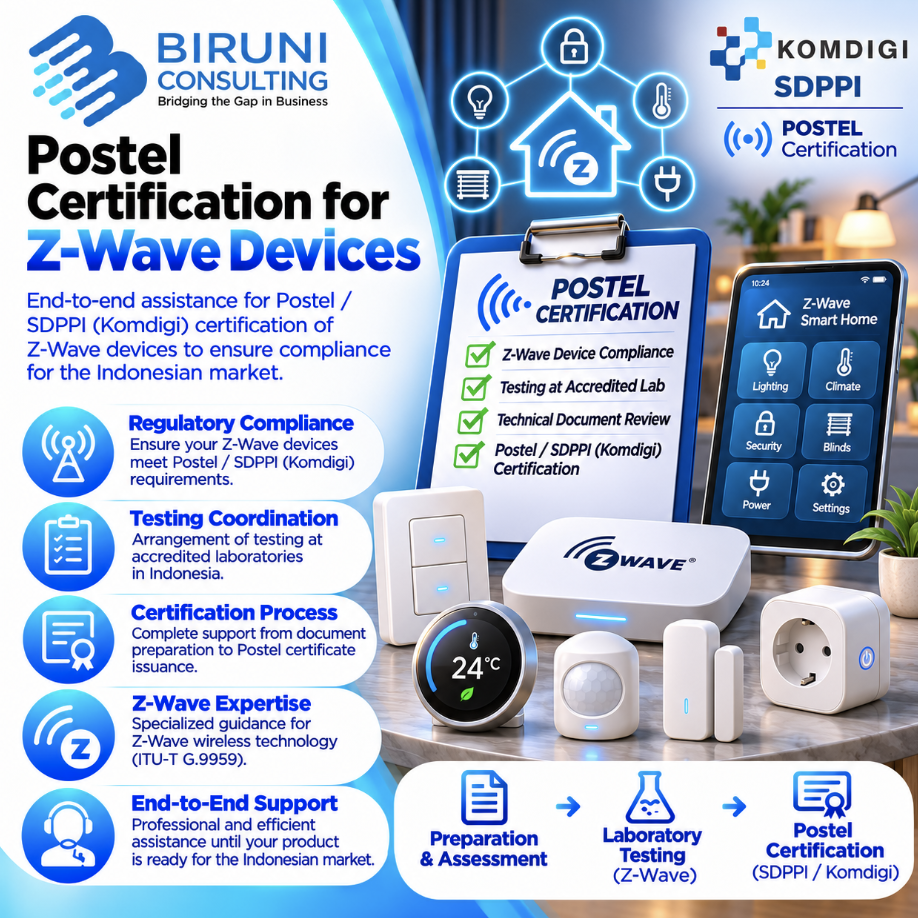
Guide to DJID/SDPPI Certification for Z-Wave gateways, controllers, sensors, and smart-home devices in Indonesia.
Z-Wave is widely used in smart homes, building automation, security systems, smart locks, sensors, lighting controls, thermostats, gateways, and other IoT equipment. Unlike Bluetooth or Zigbee, which commonly operate around 2.4 GHz, Z-Wave generally uses sub-GHz radio frequencies with different regional frequency plans.
This makes regional configuration particularly important when importing Z-Wave equipment into Indonesia. The exact model, frequency plan, transmission power, module, antenna, firmware, and RF laboratory reports should be identified before certification.
Minister of Communication and Informatics Decision Number 260 of 2024 remains listed by Indonesia’s Directorate General of Digital Infrastructure as the Technical Standard for Short Range Devices. Postel The overall equipment-certification process remains governed by Regulation Number 3 of 2024. JDIH Komdigi
Z-Wave Uses Regional Frequencies
Z-Wave does not use one universal radio frequency worldwide.
Current Silicon Labs regional information lists 919.8 MHz and 921.4 MHz for Indonesia, while European and North American configurations use different frequencies. silabs.com
A Z-Wave product intended for Europe or the United States should therefore not automatically be assumed to be suitable for Indonesia.
The exact regional SKU should be verified before commercial shipment.
Z-Wave Frequencies in Indonesia
Indonesia’s current Short Range Device Technical Standard contains several sub-GHz frequency provisions.
For telecommunications equipment operating below 10 mW, Decision Number 260 of 2024 lists the 919.5–923 MHz band with a limit of ≤10 mW ERP. Frequencies such as 919.8 MHz and 921.4 MHz therefore fall within this frequency range where the applicable technical conditions are satisfied. Postel Sertifikasi
The same Technical Standard also contains other SRD provisions for 920–923 MHz, including radio telemetry and telecommand applications with different technical limits. Postel Sertifikasi
Frequency alone is therefore not enough to determine the permitted configuration.
The “Z-Wave” Name Is Not Enough
A datasheet may describe a device as Z-Wave, Z-Wave Plus, Z-Wave Plus V2, or Z-Wave Long Range.
These descriptions do not by themselves establish Indonesian compliance.
The certification assessment should determine the exact operating frequencies, region settings, transmission power, modulation, wireless module or chipset, antenna configuration, firmware, and enabled radio modes.
Two visually identical Z-Wave products can have completely different RF configurations if they are intended for different markets.
European Z-Wave Models
European Z-Wave devices generally use a frequency plan different from that listed for Indonesia.
A European variant should therefore not be imported on the assumption that every Z-Wave radio is technically interchangeable worldwide.
Current industry regional information distinguishes the Indonesian plan from European and North American configurations. silabs.com
Importers should request the correct regional version and complete RF documentation before placing a purchase order.
Z-Wave Transmission Power
Transmission power is another key parameter.
Under the below-10-mW category of Decision Number 260 of 2024, the 919.5–923 MHz range is listed with a maximum of 10 mW ERP. Postel Sertifikasi
Other entries within the SRD Technical Standard apply different limits for specific applications in the 920–923 MHz range. For example, the radio telemetry and telecommand entry provides a separate limit of up to 400 mW EIRP. Postel Sertifikasi
This does not mean that every Z-Wave product may transmit at that level. The correct limit depends on the device category, application, radio mode, and Technical Standard mapping.
Controllers, Gateways, and End Devices
A Z-Wave network can include several different equipment types.
A controller or gateway manages the network, while end devices can include smart locks, motion sensors, door sensors, thermostats, switches, dimmers, sirens, and actuators.
For DJID Certification, each physical device should be assessed according to its own radio configuration.
A certified gateway does not automatically cover every Z-Wave sensor or accessory that can communicate with it.
Z-Wave Gateways with WiFi
Many smart-home hubs use Z-Wave for local device communication but use WiFi or Ethernet for internet connectivity.
Where WiFi is present, that radio needs a separate technical assessment under the applicable RLAN requirements.
Ethernet should be distinguished from WiFi because it is a wired communications interface.
A single gateway can therefore contain several communications technologies subject to different technical requirements.
Z-Wave and Bluetooth
Bluetooth is increasingly used alongside Z-Wave for onboarding or smartphone setup.
In such products, Bluetooth and Z-Wave remain separate radio functions even where they share a chipset or antenna.
The assessment should establish whether the radios use a multi-protocol chipset or separate modules, which antennas are used, what power levels are enabled, and whether the laboratory evidence covers each interface.
Z-Wave Long Range
Z-Wave Long Range requires additional technical attention.
Although it remains part of the Z-Wave ecosystem, its radio mode, frequency plan, transmission characteristics, and output-power configuration can differ from classic Z-Wave.
A global Z-Wave certification mark therefore does not automatically establish Indonesian telecommunications compliance.
The exact SKU and enabled RF modes should be reviewed against the applicable Indonesian requirements.
Using Z-Wave Modules
Manufacturers frequently integrate pre-developed Z-Wave modules into final products.
An existing module test report can support DJID Certification, but the final equipment still needs to be linked clearly to the tested module.
Current e-Sertifikasi requirements for equipment using a module LHU/test report include a block diagram, a photograph showing the installed module location, and a declaration identifying the module brand/type and the final equipment brand, type, and variant. e-Sertifikasi NextGen
The final integration therefore remains part of the certification assessment.
Antenna Configuration
Antenna configuration can materially affect RF performance.
Z-Wave modules may use PCB antennas, wire antennas, helical antennas, or other integrated designs.
Changing the antenna, enclosure, PCB layout, or transmitter settings may produce a different RF configuration even where the same Z-Wave chipset is used.
The antenna described in the laboratory documentation should therefore be compared with the antenna installed in the commercial device.
Z-Wave RF Test Reports
An RF test report provides technical evidence for the configuration that was actually tested.
The assessment may cover operating frequencies, RF output power, modulation, bandwidth, spurious emissions, antennas, test modes, and the exact model tested.
Current e-Sertifikasi requirements require an LHU/test report from a designated Indonesian laboratory or a recognised overseas laboratory. Overseas RF LHUs are also subject to the current requirement for an LHU summary declared to be correct and consistent. e-Sertifikasi NextGen
CE, FCC, or Z-Wave ecosystem documentation can support the assessment, but they do not automatically replace Indonesian DJID/SDPPI Certification.
Documents for Z-Wave Certification
For an initial assessment, businesses should prepare:
- Product and label photographs.
- Exact brand and model/type.
- Datasheet and user manual.
- Z-Wave regional and frequency specifications.
- Transmission-power information.
- Z-Wave module datasheet.
- Antenna information.
- Block diagram.
- Available RF laboratory reports.
For a new Certificate application, current e-Sertifikasi requirements also include NIB and OSS access for business applicants, laboratory reports, technical specifications, Declaration of Conformity, colour product photographs showing the brand and model/type, and a declaration that submitted information is correct and complete. e-Sertifikasi NextGen
Regional Variants Must Be Controlled
Regional variants are particularly important for Z-Wave products.
One commercial product family may have EU, US, and ANZ/Asia versions with nearly identical housings and model names.
The actual radio configuration may nevertheless be different.
Manufacturers can also implement region selection through firmware even where the hardware platform is shared.
The exact model suffix and region configuration should therefore be finalised before laboratory reports and Indonesian certification are evaluated.
Multiple Products Using the Same Module
The same Z-Wave module may be installed in smart locks, sensors, switches, controllers, and other IoT products.
Using the same module does not automatically allow every final product to share one Certificate.
Regulation Number 3 of 2024 links certification to the brand and equipment type. It also provides a specific multiple-variant mechanism for qualifying equipment below 10 mW with only one identical telecommunications feature. JDIH Komdigi
This mechanism should not be interpreted as a general low-power certification exemption.
Z-Wave Certification Process
The process should begin by identifying the exact model and regional radio configuration.
The operating frequency, transmission power, Z-Wave generation, module, antenna, firmware, controller/end-device function, and RF laboratory reports are then reviewed.
Additional Bluetooth or WiFi interfaces should also be included in the complete wireless mapping.
Once the applicable Indonesian Technical Standards have been identified, the suitability of existing laboratory reports and any additional testing requirements can be determined before the Certificate application is submitted through OSS and e-Sertifikasi. e-Sertifikasi NextGen
Certificate Period and Import Activities
Under Regulation Number 3 of 2024, the Certificate itself is not time-limited.
However, a Certificate holder may manufacture, assemble, or import the equipment for trade and/or use in Indonesia for up to three years from the Certificate issuance date. Continued activity after that period requires renewed Technical Standard conformity and a new Certificate under the applicable provisions. JDIH Komdigi
Importers with long-term Z-Wave product lines should include this period in their regulatory planning.
Labeling After Certification
Certificate holders also have regulatory-marking obligations.
Current e-Sertifikasi requirements specify implementation of the Label, QR Code, and Warning Sign on the equipment and packaging, followed by reporting through photographs of the marked equipment. e-Sertifikasi NextGen
For compact Z-Wave sensors and smart-home endpoints, regulatory-labeling space should ideally be considered before mass production.
Conclusion
Postel Certification for Z-Wave devices requires particular attention because Z-Wave frequency plans vary by region.
Current Z-Wave regional information lists Indonesia with 919.8 MHz and 921.4 MHz, while European and North American configurations use different frequencies. silabs.com
Indonesia’s current Short Range Device Technical Standard lists 919.5–923 MHz at ≤10 mW ERP for the below-10-mW category and also provides separate 920–923 MHz requirements for specific SRD applications. Postel Sertifikasi
The commercial description “Z-Wave” is therefore not enough. The exact region, frequency, transmission power, modules, antennas, firmware, controller/end-device configuration, and RF test reports should be reviewed before importation or DJID/SDPPI Certification.
Contact Us
Biruni Consulting assists with DJID/SDPPI assessment and certification for Z-Wave devices and various wireless products that will be imported or marketed in Indonesia.
Our services include:
- Assessment of DJID/SDPPI certification requirements.
- Transmitter and receiver assessment.
- RF specification review.
- Frequency and transmission power analysis.
- Technical document review.
- Certification document preparation.
- Testing coordination where required.
- DJID/SDPPI Certification assistance.
If you have a Z-Wave device, you can prepare product photos, brand, model, datasheet, RF specifications, and wireless module datasheet for an initial assessment of the Postel Certification requirements.