
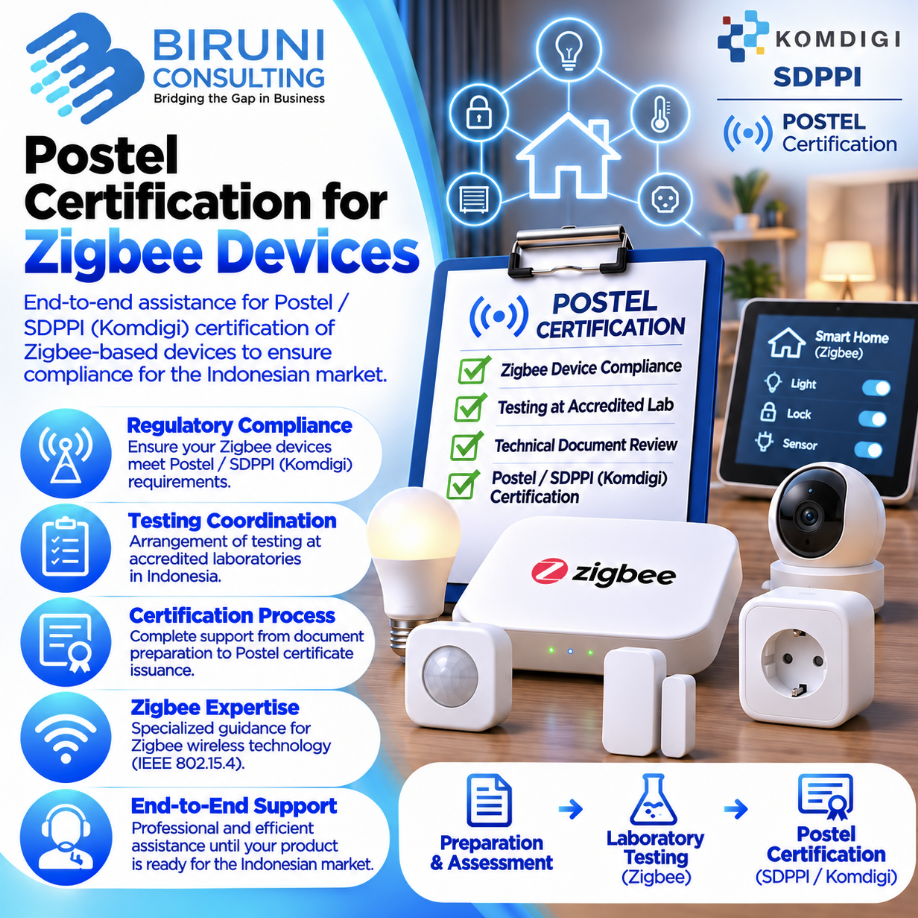
Guide to DJID/SDPPI Certification for Zigbee and IEEE 802.15.4 devices in Indonesia
Zigbee devices are widely used in smart-home systems, building automation, industrial sensors, smart lighting, energy monitoring, access control, IoT gateways, and other automation applications. Zigbee is designed for relatively low-power wireless communication and can operate in networks containing coordinators, routers, and end devices.
In Indonesia, Zigbee products need to be assessed under the telecommunications-device certification framework because they incorporate active radio communication. Minister of Communication and Informatics Decision Number 260 of 2024 on Short Range Device Technical Standards remains listed in DJID’s official regulations and includes Low Rate Wireless Personal Area Network, or LR-WPAN IEEE 802.15.4. Postel
The overall certification process is governed by Minister of Communication and Informatics Regulation Number 3 of 2024, which requires conformity with applicable Technical Standards to be demonstrated through testing and certification. JDIH Komdigi
Zigbee and IEEE 802.15.4
Zigbee uses IEEE 802.15.4 as the underlying radio and MAC technology for low-power wireless communication.
For Postel assessment, the commercial term “Zigbee” therefore needs to be connected to the actual radio configuration.
Technical documentation should identify operating frequencies, channels, transmission power, radio modules or chipsets, antennas, and supported radio modes.
A “Zigbee compatible” statement on packaging is not sufficient by itself for certification assessment.
Zigbee as a Short Range Device
Indonesia’s Short Range Device framework includes LR-WPAN IEEE 802.15.4 within the scope of Decision Number 260 of 2024. Postel
Zigbee sensors, hubs, gateways, coordinators, controllers, smart switches, and other active radio equipment should therefore be assessed against the applicable SRD requirements.
The descriptions “short range” and “low power” do not automatically create an exemption from DJID Certification.
2.4 GHz Zigbee Devices
Many commercial Zigbee products use the 2.4 GHz band.
Current DJID certification records provide examples of Zigbee equipment certified under Decision Number 260 of 2024 at 2.4–2.4835 GHz. One Certificate issued in 2025 for a product supporting both Bluetooth and Zigbee identifies Zigbee operation across this range with transmission power below 100 mW. sertifikasi.postel.go.id
A DJID Certificate issued in June 2026 for an access point also lists ZigBee operation at 2.4–2.4835 GHz under Decision Number 260 of 2024. sertifikasi.postel.go.id
These Certificates demonstrate current certification practice for those particular configurations. They should not be treated as proof that every IEEE 802.15.4 device has identical frequencies or power settings.
Zigbee Transmission Power
Transmission power is an important parameter in Zigbee certification assessment.
Current DJID Certificates provide examples of 2.4 GHz Zigbee configurations with transmission power below 100 mW. sertifikasi.postel.go.id
However, this value should not be applied universally without reviewing the actual frequency band, antenna configuration, operating mode, and applicable Technical Standard.
The final product’s transmitter configuration should also match the RF laboratory documentation.
Coordinators, Routers, and End Devices
A Zigbee network can contain different device roles.
A coordinator forms and manages the network. A router can relay traffic within a mesh network. An end device may be a sensor, switch, thermostat, lighting device, actuator, or other endpoint.
From a certification perspective, the relevant question is whether the individual equipment contains active radio transmitters and receivers.
A Zigbee gateway and a separate Zigbee sensor should therefore be assessed according to their respective radio configurations rather than assumed to be covered as one device merely because they operate in the same network.
Zigbee Gateways with WiFi or Ethernet
Zigbee gateways often contain additional communication interfaces.
Zigbee may connect the gateway to local sensors, while WiFi or Ethernet connects the gateway to a router or cloud service.
Where WiFi is enabled, it needs separate assessment under the applicable RLAN Technical Standard. Current DJID practice shows that equipment combining Zigbee, Bluetooth, and WiFi can reference more than one Technical Standard within its Certificate. A DJID Certificate issued in June 2026, for example, references Decision Number 260 of 2024 together with Decision Number 12 of 2025. sertifikasi.postel.go.id
Wired Ethernet should be distinguished from WiFi because it does not itself constitute a radio link.
Zigbee and Bluetooth in One Product
Smart hubs, IoT controllers, and gateways can contain both Zigbee and Bluetooth.
Although both technologies may operate in the 2.4 GHz range, they are separate wireless technologies.
Assessment should determine whether the device uses one multi-protocol chipset or separate modules, how firmware enables each radio, which antenna configuration is used, and whether the laboratory reports cover every active mode.
A current DJID Certificate demonstrates one product where Bluetooth and Zigbee are listed separately as supported radio interfaces. sertifikasi.postel.go.id
Zigbee Modules and Final Products
Manufacturers frequently use ready-made Zigbee or IEEE 802.15.4 wireless modules.
An existing module test report can support certification, but it does not automatically establish conformity for every final product using that module.
Current e-Sertifikasi requirements state that equipment relying on a module LHU/test report must include a block diagram, a photograph showing where the module is installed in the final equipment, and a declaration identifying the module and final product configuration. sertifikasi.postel.go.id
The module therefore needs to be technically linked to the actual commercial device.
Antenna Configuration
The antenna is an important part of the final RF configuration.
A Zigbee module may use a PCB antenna, chip antenna, integrated antenna, or dedicated external antenna.
The same wireless module can produce a different final radio configuration if the antenna, PCB layout, enclosure, or transmitter settings change.
The antenna used in the laboratory test configuration should therefore be compared with the antenna installed in the final product.
Zigbee RF Test Reports
An RF test report provides evidence of the radio configuration that has actually been evaluated.
For Zigbee devices, the report review may include operating frequencies, RF output power, occupied bandwidth, unwanted emissions, antenna configuration, supported radio modes, and test setup.
Current e-Sertifikasi requirements require the LHU/test report to be issued by a designated Indonesian laboratory or a recognised overseas laboratory under the applicable framework. sertifikasi.postel.go.id
CE or FCC reports covering IEEE 802.15.4 can therefore be useful technical evidence, but they do not automatically replace Indonesian DJID/SDPPI Certification.
Documents for Zigbee Certification
For an initial assessment, businesses should prepare product photographs, the exact brand and model, datasheet, user manual, Zigbee/IEEE 802.15.4 specifications, operating frequency, transmission power, module datasheet, antenna information, block diagram, and available RF test reports.
Current e-Sertifikasi requirements for a new Certificate also include NIB and OSS access for business applicants, an LHU/test report, technical specifications, a Declaration of Conformity, colour photographs showing brand and model/type, and a declaration that the submitted information is correct and complete. sertifikasi.postel.go.id
The physical product, technical documents, modules, and laboratory reports should remain consistent.
Multiple Products Using the Same Zigbee Module
A manufacturer may use the same Zigbee module in several products such as smart switches, sensors, lighting controllers, and gateways.
Using the same module does not automatically mean that all final products can share one Certificate.
Regulation Number 3 of 2024 links certification to the brand and equipment type. It also contains a specific variant mechanism for certain other devices below 10 mW having only one identical telecommunications feature, where qualifying conditions are satisfied. JDIH Komdigi
This is a multiple-variant certification mechanism rather than a general certification exemption.
Zigbee Certification Process
The process should begin by identifying the exact product and every communication interface it contains.
The Zigbee operating frequency, transmission power, IEEE 802.15.4 configuration, module, antenna, firmware, and RF reports are then reviewed. Additional radios such as Bluetooth or WiFi should be included in the same radio mapping.
The applicable Technical Standards and suitability of existing test reports can then be determined.
Current business applications are handled through the integrated OSS and e-Sertifikasi process with the applicable administrative and technical documentation. sertifikasi.postel.go.id
Certificate Period and Import Activities
Under Regulation Number 3 of 2024, the Certificate itself is not time-limited.
However, a Certificate holder may manufacture, assemble, or import the covered equipment for trade and/or use in Indonesia for up to three years from the Certificate issuance date. Continued commercial activity after that period requires renewed Technical Standard conformity and a new Certificate. JDIH Komdigi
Importers and distributors of Zigbee products should therefore include the Certificate issuance date in long-term product planning.
Labeling After Certification
After the Certificate is issued, regulatory-marking obligations also apply.
Current e-Sertifikasi requirements state that Certificate holders must implement the Label, QR Code, and Warning Signon the equipment and packaging and report implementation by uploading photographs of the marked equipment. sertifikasi.postel.go.id
Because Zigbee sensors and IoT endpoints can be physically very small, regulatory-labeling space should ideally be considered during product and packaging design.
Conclusion
Postel Certification for Zigbee devices should be determined according to the exact radio configuration of the equipment.
Decision Number 260 of 2024 remains listed as Indonesia’s Short Range Device Technical Standard and includes LR-WPAN IEEE 802.15.4, the underlying radio technology used by Zigbee. Postel
Current DJID Certificates also demonstrate certification of Zigbee equipment operating at 2.4–2.4835 GHz under Decision Number 260 of 2024, including configurations with transmission power below 100 mW. sertifikasi.postel.go.id
The certification assessment should review operating frequency, transmission power, coordinator/router/end-device functionality, modules, antennas, firmware, and RF laboratory reports. Where Bluetooth or WiFi is also enabled, those interfaces should be included in the overall assessment.
Contact Us
Biruni Consulting assists with DJID/SDPPI assessment and certification for Zigbee devices and various wireless products that will be imported or marketed in Indonesia.
Our services include:
- Assessment of DJID/SDPPI certification requirements.
- Transmitter and receiver assessment.
- RF specification review.
- Frequency and transmission power analysis.
- Technical document review.
- Certification document preparation.
- Testing coordination where required.
- DJID/SDPPI Certification assistance.
If you have a Zigbee device, you can prepare product photos, brand, model, datasheet, RF specifications, and wireless module datasheet for an initial assessment of the Postel Certification requirements.