
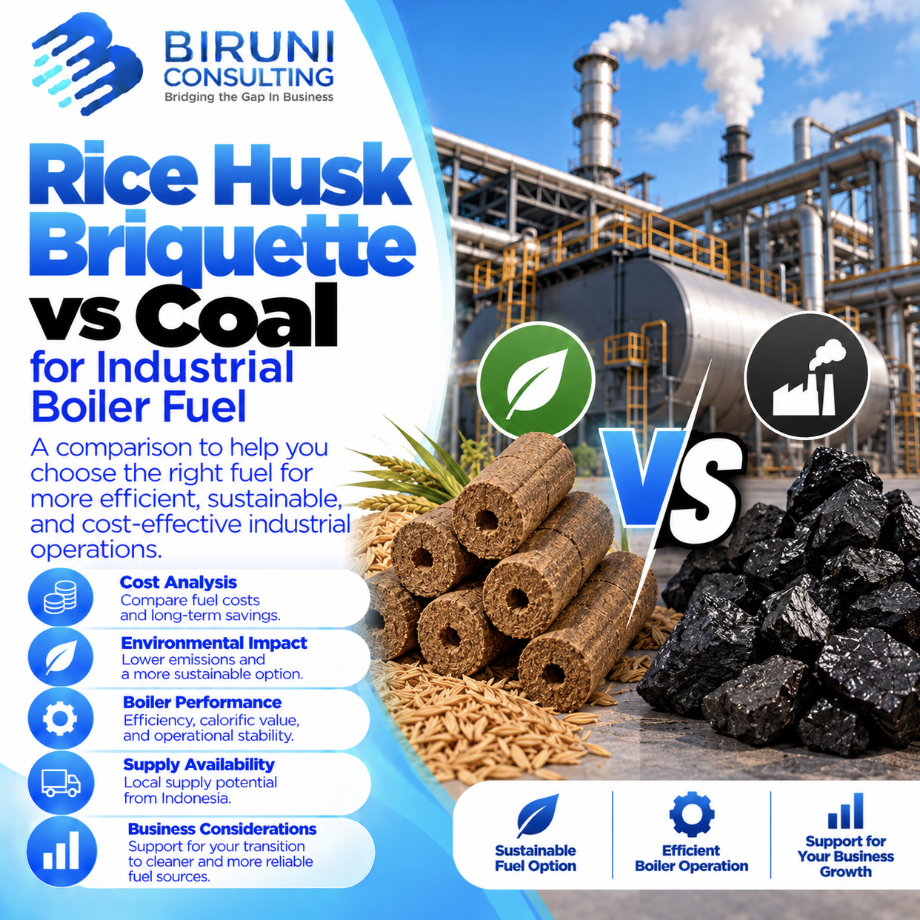
A practical comparison of rice husk briquettes and coal for industrial steam and process-heat generation.
Selecting an industrial boiler fuel should not be based solely on its price per tonne. Rice husk briquettes and coal differ in calorific value, moisture, ash content, combustion characteristics, fuel consumption, storage requirements, handling systems, emissions, and boiler-maintenance requirements.
Rice husk briquettes are produced by densifying rice-husk residue into a more manageable solid fuel. Coal generally provides higher energy density and is already widely used in industrial boilers, but it remains a fossil fuel.
For an industrial facility, the more useful comparison is therefore cost per useful unit of energy or cost per tonne of steam, rather than purchase price per tonne of fuel.
Calorific Value of Rice Husk Briquettes
The calorific value of rice husk briquettes varies according to raw material, moisture, binder, densification process, and whether other biomass is blended with the rice husk.
Research on rice-husk-based briquettes has reported calorific values ranging from approximately 13.54 to 18.74 MJ/kg for different formulations. Another study reported a higher heating value of approximately 16.08 MJ/kg on a dry basis for rice husk briquettes. DOI
A single generic heating-value figure should therefore not be used for every supplier.
Actual laboratory results or a Certificate of Analysis should be used when calculating boiler fuel consumption.
Calorific Value of Coal
Coal generally has a higher calorific value than rice husk briquettes, although coal quality varies significantly according to rank, moisture, ash, and mining source.
As a reference point, the U.S. Energy Information Administration reports that coal consumed in the United States in 2025 averaged approximately 19.167 million Btu per short ton, equivalent to roughly 22 MJ/kg. This is an average reference and should not be treated as the specification of every coal product. U.S. Energy Information Administration
Subbituminous coal can also contain relatively high inherent moisture and have significantly different heat content from higher-rank coal. U.S. Energy Information Administration
Supplier laboratory data should therefore always be used for an actual industrial comparison.
Fuel Consumption Comparison
One tonne of rice husk briquettes should not be expected to replace one tonne of coal on an energy-equivalent basis.
For example, if coal has a net calorific value of 22 MJ/kg while the briquette provides 16 MJ/kg, approximately 1.38 tonnes of briquettes would theoretically be required to provide the same fuel energy as one tonne of coal.
This calculation considers fuel energy only.
Actual boiler consumption also depends on combustion efficiency, excess air, moisture, unburned carbon, furnace conditions, and boiler design.
A more useful performance indicator is therefore kilograms of fuel per tonne of steam.
Moisture Content
Moisture reduces the useful energy available from a fuel because part of the combustion energy is consumed evaporating water.
Research on rice husk briquettes has demonstrated that moisture conditions can significantly affect heating value. One study measured a higher heating value of approximately 17.69 MJ/kg under a particular moisture condition, while other moisture levels resulted in lower values. MDPI
Briquettes should therefore be stored in dry, weather-protected areas.
Coal can also contain substantial moisture, particularly lower-rank and subbituminous coal.
For a fair comparison, both fuels should be evaluated using their as-received specifications.
Rice Husk Ash Content
Rice husk has relatively high ash content compared with many other biomass fuels.
Recent literature reports rice husk ash content of approximately 15.3–24.6% on a dry basis, while the raw husk heating value is commonly reported around 13–16 MJ/kg. PubMed Central (PMC)
Briquetting improves density and handling but does not inherently remove the mineral content of the rice husk.
An industrial plant must therefore consider ash extraction, conveying, storage, disposal, and boiler-cleaning requirements.
High Silica Content in Rice Husk Ash
Rice husk is particularly notable for its silica-rich ash.
Published reviews report that rice husk ash can contain approximately 85–98% silica, depending on the raw material, combustion temperature, pretreatment, and ash-production conditions. PubMed Central (PMC)
This high silica concentration can create opportunities for beneficial ash utilisation where the quality is suitable.
For boiler operation, however, ash chemistry also matters because mineral composition can influence deposits, fouling, agglomeration, and cleaning requirements.
Coal Ash
Coal also produces ash, but both the amount and composition depend heavily on the individual coal specification.
High-ash coal can increase bottom-ash and fly-ash production and place additional load on ash-handling and particulate-control systems.
An industrial comparison should therefore consider both the percentage of ash and its composition.
Rice husk has its characteristic silica-rich ash, while coal may contain a very different mineral mixture depending on the mining source.
Sulfur and SOx
Rice husk generally contains relatively low sulfur compared with some coal products.
Coal sulfur levels vary substantially between sources, and combustion of sulfur contributes to sulfur-oxide emissions. EIA notes that coal can be classified according to its sulfur concentration, including low-sulfur and high-sulfur categories. U.S. Energy Information Administration
Replacing higher-sulfur coal with rice husk briquettes may therefore reduce the sulfur entering the furnace.
Actual emissions performance should nevertheless be verified through stack measurements.
Particulate Emissions from Biomass
Biomass should not be treated as an emission-free fuel.
Biomass combustion can produce particulate matter, carbon monoxide, volatile organic compounds, and other pollutants, particularly when combustion conditions are poorly controlled.
IEA Bioenergy identifies particulate matter, CO, and volatile organic compounds as important emissions considerations in biomass combustion systems. Task32
Depending on boiler size and applicable emission requirements, systems such as cyclones, multicyclones, bag filters, or electrostatic precipitators may therefore still be necessary.
Boiler Efficiency
Fuel heating value alone does not determine boiler efficiency.
A coal boiler designed around a particular coal particle size, volatile-matter content, combustion rate, and feeding method may perform differently when switched to biomass.
Rice husk briquettes differ from coal in bulk density, ignition behaviour, volatile matter, ash chemistry, and combustion characteristics.
Before conversion, an engineering assessment should consider grate loading, furnace volume, residence time, primary and secondary air, ID and FD fans, heat-transfer surfaces, and ash-removal capacity.
Fuel Feeding and Handling
Densification gives rice husk briquettes a major handling advantage over loose rice husk.
However, briquette mechanical strength remains important.
Briquettes that break easily during transport can generate fines, which may create problems in hoppers, screw feeders, conveyors, and combustion beds.
Briquette dimensions should also be compatible with the existing feeding equipment.
For industrial use, consistency in size, density, moisture, and durability is important for stable boiler operation.
Storage and Logistics
Coal generally contains more energy per kilogram, which can reduce fuel mass and storage requirements for a given steam demand.
Rice husk briquettes are significantly denser than loose husk, but their lower calorific value can still require a larger overall fuel volume.
If briquette consumption is approximately 1.3–1.5 times the coal mass, additional truck deliveries, unloading capacity, conveyors, hopper volume, and storage space may be required.
Supplier location can therefore have a major effect on economics.
Locally produced rice husk briquettes may be attractive even if their energy density is lower.
Comparing Fuel Cost Correctly
A more accurate financial comparison uses the cost of useful energy.
A simplified calculation is:
Fuel Cost per Useful GJ = Delivered Fuel Cost ÷ (Fuel LHV × Boiler Efficiency)
A briquette may appear substantially cheaper per tonne while providing less energy and potentially reducing boiler efficiency.
Conversely, low-cost locally sourced briquettes can be highly competitive where the boiler operates efficiently on biomass.
Ash and Maintenance Costs
Fuel purchase price is only one component of boiler operating cost.
Rice husk briquette economics should also include ash removal, ash storage, boiler cleaning, fouling, refractory inspection, fuel handling, and labour.
Coal has its own ash-handling and maintenance costs.
A complete assessment should therefore include:
- Delivered fuel cost.
- Fuel consumption per tonne of steam.
- Ash handling and disposal.
- Boiler cleaning and maintenance.
- Fan and conveyor electricity consumption.
- Emission-control operating costs.
- Potential downtime.
The resulting figure provides a more realistic total cost of steam generation.
Can a Coal Boiler Burn Rice Husk Briquettes?
Some coal boilers can use rice husk briquettes, but direct substitution should not be assumed.
Fuel-flexible grate systems may be easier to adapt than boilers designed very specifically around one coal type.
The assessment should review fuel dimensions, furnace size, grate loading, residence time, combustion-air distribution, feeding systems, ash characteristics, and boiler capacity.
Poorly planned conversion can result in lower steam capacity, incomplete combustion, high CO, excessive smoke, fouling, or increased unburned fuel.
Co-Firing Coal and Rice Husk Briquettes
Co-firing can provide a transitional approach where a plant does not want to move directly from 100% coal to 100% biomass.
Rice husk briquettes can be introduced at a controlled percentage, followed by evaluation of boiler performance.
A trial should monitor steam output, fuel consumption, furnace temperature, oxygen, CO, particulate emissions, ash behaviour, and boiler efficiency.
The biomass ratio can then be adjusted based on actual operating data.
Rice Husk Briquette Specifications to Review
Industrial buyers should request representative laboratory results or a Certificate of Analysis from the supplier.
Important parameters include calorific value, moisture, ash, volatile matter, fixed carbon, sulfur, bulk density, dimensions, and mechanical durability.
Consistency between shipments is particularly important for industrial boilers.
A stable fuel specification can be more valuable operationally than a high advertised calorific value that varies substantially from one shipment to another.
Which Fuel Is Better for an Industrial Boiler?
There is no universal answer.
Coal may be more suitable where the existing boiler was specifically designed for coal, stable high steam output is essential, storage space is limited, and major boiler modifications are undesirable.
Rice husk briquettes may be more attractive where a reliable biomass supply is available, delivered fuel prices are competitive, fossil-fuel reduction is a priority, and the boiler can effectively manage biomass combustion and ash.
The most useful decision metric is usually cost per tonne of steam combined with boiler reliability.
Conclusion
Rice husk briquettes can be used as an alternative or partial substitute for coal in industrial boilers, but the two fuels have substantially different characteristics.
Rice husk briquettes generally provide lower calorific value and therefore require a greater fuel mass. Rice husk also produces relatively high ash with a particularly high silica content. DOI
Coal generally provides higher energy density, although moisture, sulfur, ash, and heating value depend strongly on the individual coal specification. U.S. Energy Information Administration
Before converting fuel, an industrial facility should compare calorific value, moisture, ash, sulfur, delivered cost, boiler efficiency, fuel consumption, logistics, maintenance, emissions, and cost per tonne of steam.
A controlled combustion trial with proper monitoring can provide the most reliable evidence of whether rice husk briquettes are economically and operationally suitable for a particular industrial boiler.
Contact Us
Biruni Consulting assists with technical assessment and review for rice husk briquettes, coal, and various industrial boiler fuel requirements.
Our services include:
- Fuel specification assessment.
- Calorific value and moisture review.
- Ash and sulfur analysis.
- Laboratory report or Certificate of Analysis review.
- Fuel-consumption comparison.
- Useful-energy cost analysis.
- Initial review of fuel and boiler compatibility.
- Technical assessment assistance before fuel implementation.
If you have rice husk briquettes or another industrial boiler fuel, you can prepare the fuel specification, Certificate of Analysis, calorific value, moisture, ash content, sulfur, delivered price, and boiler data for an initial assessment.