
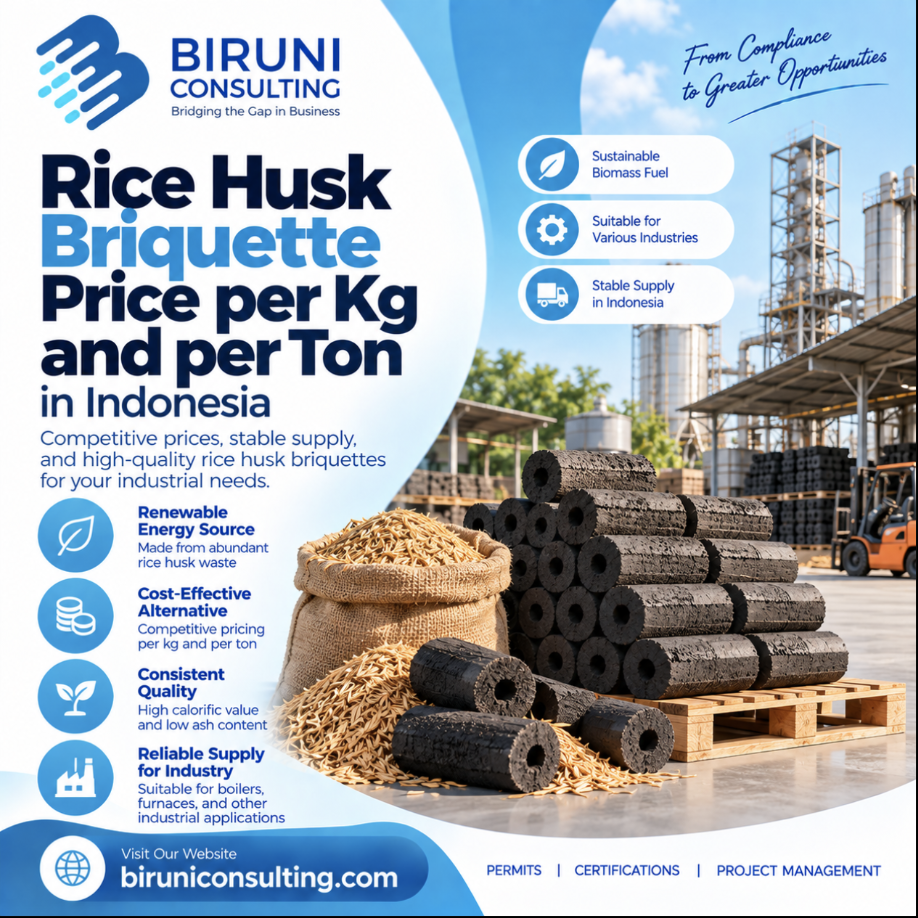
Pricing per kilogram is generally used for small purchases, samples, boiler trials, or applications that do not yet require large-volume supply.
As a general indication, rice husk briquette prices may be around IDR 6,000 to IDR 9,500 per kg, depending on product quality, purchasing volume, packaging, and supplier conditions.
This range should not be considered a fixed price because each supplier may have different specifications and cost structures.
Factors that may influence the price per kilogram include:
- Calorific value.
- Moisture content.
- Ash content.
- Briquette density.
- Size and shape.
- Manufacturing method.
- Packaging type.
- Purchasing volume.
- Supplier location.
- Transportation cost.
Industrial buyers should therefore compare technical specifications in addition to the unit price.
Rice Husk Briquette Price per Ton
For industrial requirements, pricing per metric ton is usually more relevant.
Using an indicative range of IDR 6,000 to IDR 9,500 per kg, the mathematical equivalent would be:
IDR 6,000,000 to IDR 9,500,000 per ton.
However, these figures should not automatically be treated as industrial contract prices.
Orders of 1 ton, 10 tons, 50 tons, or 100 tons per month may receive different quotations because suppliers can adjust production, packaging, warehousing, and transportation arrangements according to volume.
For recurring industrial requirements, customers can request pricing based on monthly consumption.
Why Can the Price per Ton Be Different from the Price per Kg?
Products sold in small packages often include additional costs for packaging, handling, storage, retail distribution, and selling expenses.
Industrial purchases may use different packaging and logistics arrangements.
For example, a company purchasing 50 tons every month may use industrial packaging and scheduled deliveries, allowing a different cost structure from a customer purchasing only a few kilograms.
Providing complete purchasing information helps suppliers calculate more appropriate quotations.
Factors Affecting Rice Husk Briquette Prices
Rice husk briquette prices can be influenced by both technical and commercial factors.
1. Calorific Value
Calorific value indicates how much heat energy is generated when the briquette is burned.
For boiler applications, this is an important parameter because it can influence the quantity of fuel required to generate heat or steam.
Two products with different prices may not provide the same operating efficiency if their calorific values are different.
Buyers should therefore request calorific-value specifications before placing large orders.
2. Moisture Content
Moisture content affects briquette combustion performance.
The higher the moisture level, the more energy is required to evaporate the water during combustion.
Moisture levels can be influenced by the drying process, storage conditions, humidity, and transportation.
Industrial users should define an acceptable maximum moisture level when requesting quotations.
3. Ash Content
Rice husk naturally produces ash after combustion.
Ash content is particularly important for boiler users because it can influence cleaning frequency, ash-removal systems, and maintenance requirements.
A cheaper fuel may not always provide lower total operating costs if it produces significantly more ash.
4. Carbonized and Non-Carbonized Briquettes
Rice husk briquettes can be manufactured using different processes.
Some products use carbonized material, while others are made by directly compressing processed biomass without complete carbonization.
These manufacturing differences may result in different combustion characteristics and production costs.
The type of briquette should therefore be confirmed before comparing supplier prices.
5. Briquette Size and Shape
Briquette dimensions should be compatible with the equipment being used.
For boilers with automatic feeding systems, consistent dimensions can be particularly important.
If customized dimensions are required, the supplier may need to adjust production, which can influence price and minimum order quantity.
6. Briquette Density and Mechanical Strength
Strong, dense briquettes are easier to handle during packaging, storage, loading, transportation, and unloading.
Products that break easily can generate excessive fines and dust during handling.
Mechanical strength should therefore be considered as part of product-quality evaluation.
7. Purchasing Volume
Order volume is one of the main commercial factors affecting price.
Purchases of:
- 100 kg,
- 1 ton,
- 10 tons,
- 50 tons,
- or 100 tons per month
can each have different pricing structures.
Regular high-volume orders also allow suppliers to plan production, raw materials, and logistics more efficiently.
8. Packaging Type
Packaging can also influence the final price.
Rice husk briquettes may be supplied in small bags, industrial sacks, jumbo bags, or other packaging formats agreed with the customer.
Smaller packages generally require more packaging materials and handling.
9. Delivery Location
Transportation can represent a significant portion of the total delivered cost.
Transportation expenses may be affected by:
- Delivery distance.
- Vehicle capacity.
- Fuel costs.
- Toll charges.
- Factory accessibility.
- Loading and unloading requirements.
- Delivery frequency.
For this reason, industrial buyers should compare delivered prices rather than product prices alone.
Rice Husk Briquette Price Compared with Loose Rice Husk
Rice husk briquettes should not be directly compared with untreated loose rice husk.
Loose rice husk generally has a lower purchase price because it has not undergone the same level of processing.
Rice husk briquette production may include:
- Raw-material preparation.
- Drying.
- Grinding or size reduction.
- Carbonization for certain products.
- Mixing.
- Addition of binders when required.
- Briquette pressing.
- Final drying.
- Packaging.
- Distribution.
These additional stages increase production costs but produce a denser and more manageable fuel compared with loose biomass.
Production Costs Affect Briquette Prices
The cost of rice husk briquettes is not determined solely by the price of raw rice husk.
Manufacturers may also need to account for:
- electricity,
- labor,
- machinery,
- maintenance,
- drying,
- carbonization,
- binders,
- packaging,
- storage,
- quality control,
- and transportation.
Production scale can also influence the cost per kilogram.
A small producer may have a different cost structure from a supplier producing several tons per day.
This is why price differences between suppliers should always be evaluated together with product specifications.
Rice Husk Briquette Prices for Boilers
For boiler applications, the cheapest price per kilogram does not necessarily result in the lowest operating cost.
Companies should evaluate actual fuel consumption during operation.
Several factors should be compared:
- Price per kg.
- Price per ton.
- Calorific value.
- Moisture content.
- Ash content.
- Briquette density.
- Briquette dimensions.
- Combustion characteristics.
- Feeding performance.
- Transportation cost.
- Ash-management requirements.
- Actual boiler consumption.
A trial can provide better information before moving to regular bulk purchasing.
Importance of Conducting a Boiler Trial
Laboratory specifications provide technical information, but actual performance can also depend on the design and condition of the boiler.
A trial allows companies to evaluate:
- Ease of ignition.
- Combustion stability.
- Fuel consumption.
- Heat or steam generation.
- Ash production.
- Feeding consistency.
- Combustion temperature.
- Deposit or clinker formation.
- Required operator adjustments.
- Overall boiler compatibility.
Trial results can provide a more reliable basis for long-term purchasing decisions.
Example of Monthly Rice Husk Briquette Requirements
Suppose a factory requires approximately 2 tons of briquettes per day.
If the factory operates for 25 days per month, the monthly requirement would be:
2 tons × 25 days = 50 tons per month.
For a requirement of this size, an industrial quotation is more appropriate than a retail price.
The supplier can calculate pricing based on:
- production capacity,
- delivery schedule,
- packaging,
- transportation distance,
- product specifications,
- and payment arrangements.
A monthly requirement of 50 tons can also be divided into several scheduled deliveries according to warehouse capacity.
Ex-Factory and Delivered Prices
When requesting a quotation, companies should confirm whether the price is ex-factory or delivered.
Ex-Factory Price
An ex-factory price generally refers to the product price at the supplier’s production facility or warehouse.
Transportation to the customer’s location is normally calculated separately.
This arrangement can be suitable for customers that have their own fleet or logistics partners.
Delivered Price
A delivered price includes transportation to an agreed destination.
For companies comparing suppliers from different regions, a delivered quotation can provide a clearer picture of total procurement costs.
Buyers should confirm whether the quotation includes:
- Transportation.
- Toll charges.
- Loading.
- Unloading.
- Packaging.
- Taxes where applicable.
- Other logistics charges.
Purchasing 1 Ton of Rice Husk Briquettes
For an order of approximately one ton, companies should provide complete information to the supplier.
Useful information includes:
- Required quantity.
- Delivery location.
- Intended application.
- Boiler type.
- Target calorific value.
- Maximum moisture content.
- Maximum ash content.
- Required briquette dimensions.
- Packaging preference.
- Delivery schedule.
A one-ton order can also be used as a trial before increasing the purchasing volume.
Purchasing Tens of Tons of Rice Husk Briquettes
For customers requiring tens or hundreds of tons per month, supplier capacity becomes increasingly important.
Companies should evaluate whether the supplier has sufficient:
- raw-material availability,
- production capacity,
- product inventory,
- storage facilities,
- quality control,
- transportation partners,
- and delivery capacity.
A supplier offering a low price but having limited production capacity may not be suitable for a customer requiring large monthly volumes.
Supply continuity should therefore form part of the purchasing evaluation.
Long-Term Rice Husk Briquette Supply Contracts
Companies with recurring monthly requirements may consider medium- or long-term supply arrangements.
A contract may define:
- Monthly volume.
- Product specifications.
- Delivery schedule.
- Packaging.
- Quality requirements.
- Payment terms.
- Price-adjustment mechanisms.
- Delivery locations.
- Product-rejection procedures.
- Contract period.
If raw-material, energy, or transportation costs change, the contract can also include a mechanism for periodic price review.
How to Obtain an Accurate Rice Husk Briquette Price
Companies can obtain more accurate quotations by providing complete purchasing requirements.
Relevant information may include:
- Monthly consumption.
- Delivery location.
- Boiler type.
- Boiler capacity.
- Required calorific value.
- Maximum moisture content.
- Maximum ash content.
- Briquette dimensions.
- Packaging requirements.
- Delivery frequency.
- Trial requirements.
- Target starting date.
This information helps suppliers determine whether the requested specifications, volume, and delivery schedule can be consistently fulfilled.
Is Regular Purchasing More Economical?
Regular purchasing can provide logistical and planning advantages.
Suppliers can plan raw materials, production capacity, inventory, and transportation according to a stable schedule.
For example, a recurring requirement of 50 tons per month can be managed differently from a one-time purchase of one ton.
However, the final price will still depend on product quality, technical specifications, delivery location, supplier capacity, payment terms, and market conditions.
How to Compare Rice Husk Briquette Suppliers
Companies should avoid comparing suppliers solely on price.
A more complete supplier evaluation may include:
- Price per ton.
- Delivered price.
- Calorific value.
- Moisture content.
- Ash content.
- Product dimensions.
- Briquette density.
- Production capacity.
- Monthly supply capacity.
- Quality consistency.
- Packaging.
- Delivery capability.
- Trial availability.
- Technical documentation.
A supplier that can maintain consistent quality and reliable delivery may be more suitable for long-term industrial requirements.
Rice Husk Briquette Supply in Indonesia
Indonesia has rice husk resources from many agricultural production regions.
Rice husk generated during rice milling can be further processed into biomass products such as briquettes for industrial applications.
However, supply conditions can vary between regions.
Companies should therefore evaluate not only raw-material availability but also the supplier’s production equipment, capacity, quality control, storage facilities, and logistics capability.
How to Request Rice Husk Briquette Prices for Industrial Needs
Instead of asking only:
“What is the rice husk briquette price per ton?”
industrial buyers can provide a more complete request, such as:
“We require approximately 50 tons of rice husk briquettes per month for an industrial boiler. Please provide product specifications, calorific value, moisture content, ash content, packaging, monthly supply capacity, price per ton, and delivery cost to our factory.”
Providing complete requirements helps suppliers prepare more relevant commercial proposals.
Contact Biruni Consulting
Biruni Consulting can assist companies requiring rice husk briquettes for business and industrial applications in Indonesia.
To obtain rice husk briquette pricing per kilogram or per ton, prospective buyers can provide:
- Required monthly volume.
- Delivery location.
- Application such as boiler, furnace, dryer, or biomass burner.
- Boiler type and capacity.
- Required product specifications.
- Packaging preference.
- Delivery frequency.
- Target starting date.
- Sample or trial requirements.
Pricing can be adjusted according to product specifications, purchasing volume, supply capacity, packaging, and delivery location.
Contact Biruni Consulting for further information regarding rice husk briquette prices per kg and per ton, product specifications, trial requirements, and large-volume industrial supply.