
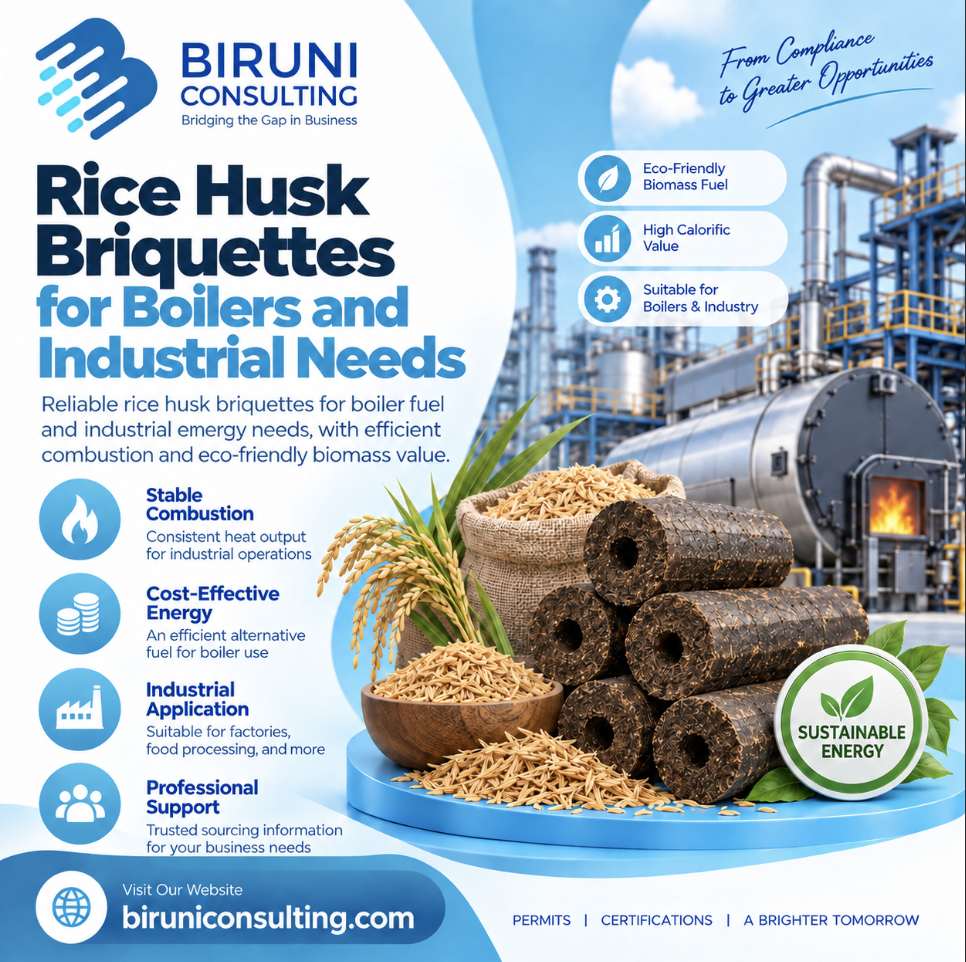
Rice Husk Briquettes as Fuel for Industrial Boilers
Rice husk briquettes are a form of biomass fuel that can be utilized for various heating and industrial production requirements. Rice husks are processed and compressed into briquettes, creating a fuel product that is more practical to store, transport, and handle compared with loose rice husks.
For companies operating boilers, furnaces, dryers, or other heating systems, fuel selection is an important part of maintaining smooth production operations. Rice husk briquettes can be considered as one biomass fuel alternative, depending on the combustion system and energy requirements of each industrial facility.
The compact and relatively uniform shape of briquettes can also simplify fuel handling. For companies requiring large quantities on a regular basis, it is important to ensure that the briquettes meet the required specifications and that the supplier can maintain a continuous supply.
Rice Husk Briquettes for Boiler Applications
Boiler fuel requirements vary depending on boiler capacity, feeding system, required temperature, operating hours, and production characteristics. Therefore, before purchasing rice husk briquettes in large quantities, companies should first evaluate their boiler’s technical requirements.
Rice husk briquettes can be used in combustion systems designed or adapted for solid biomass fuels. The burner type, combustion chamber, fuel-feeding system, and ash-removal system should be evaluated to determine whether the briquettes are suitable for the equipment.
For industrial operations with high fuel consumption, continuity of supply is also essential. A supplier should be capable of providing sufficient quantities according to daily or monthly demand so that production activities are not interrupted due to fuel shortages.
Advantages of Rice Husk Briquettes for Industrial Applications
Rice husk briquettes have several characteristics that make them worth considering as biomass fuel for industrial applications.
1. More Compact Form
The densification process produces a more compact material compared with loose rice husks. This characteristic can improve handling, storage, and distribution efficiency.
A more compact fuel can also be arranged more efficiently in storage facilities, making it easier for companies to manage fuel inventory.
2. Easier Storage
Loose rice husks generally require relatively large storage areas because of their low bulk density. Converting rice husks into briquettes creates a more compact product that can be easier to manage.
For companies with limited fuel-storage areas, this can become an important consideration when selecting biomass fuels.
3. Easier Transportation and Handling
The relatively uniform shape of briquettes can make transportation and material handling more practical. Suitable packaging and transportation methods can also help reduce material loss during distribution.
This is particularly important for industrial customers that require large-volume and scheduled deliveries.
4. Utilization of Agricultural Biomass
Rice husk is a by-product generated during rice milling. Through further processing, this material can be utilized as a biomass fuel source for various industrial applications.
Processing rice husks into briquettes also supports the broader utilization of agricultural biomass resources.
Rice Husk Briquette Specifications for Boilers
When purchasing rice husk briquettes, price should not be the only consideration. Companies also need to understand the technical characteristics of the product because fuel specifications can influence combustion performance.
1. Calorific Value
Calorific value indicates the amount of heat energy that can be generated through combustion. A suitable calorific value can help companies calculate fuel requirements for boiler operations.
For industrial applications, companies can request product specifications or available test results from the supplier before making large-volume purchases.
2. Moisture Content
Moisture content is an important parameter for biomass fuels. Water contained in the material can affect combustion because part of the generated energy is used to evaporate moisture.
Storage conditions and protection from rain or excessive humidity therefore need to be considered during transportation and storage.
3. Ash Content
Rice husk produces ash during combustion. For this reason, ash content is an important parameter, particularly for industrial operations that continuously use biomass fuel.
Companies should also evaluate the boiler’s ash-removal and management systems to ensure that operations remain efficient.
4. Briquette Size
Briquette dimensions should be compatible with the boiler’s fuel-feeding system. Briquettes that are too large or too small may require adjustments depending on the feeding equipment.
Before placing a large order, buyers should provide information regarding the boiler type and feeding system to the supplier.
5. Briquette Strength and Density
Briquettes with sufficient mechanical strength are easier to handle during packaging, transportation, unloading, and storage. If the product breaks too easily, additional fine particles may be generated during handling.
Density and mechanical strength should therefore form part of the quality evaluation when selecting a supplier for long-term requirements.
Rice Husk Briquettes for Various Industrial Sectors
Rice husk briquettes can be considered for industries that use heating, drying, steam generation, or other thermal processes.
Potential applications may include:
- Industrial boilers.
- Agricultural drying systems.
- Food and beverage processing.
- Agricultural processing industries.
- Wood-processing industries.
- Certain furnaces and heating systems.
- Biomass burner systems.
- Other production processes requiring thermal energy.
Suitability should always be evaluated according to equipment specifications, combustion-system design, required operating temperature, and the fuel recommendations of the equipment manufacturer.
Large-Volume Rice Husk Briquette Supply
Industrial users generally require fuel not only in large quantities but also on a continuous basis. Therefore, a supplier’s ability to maintain regular supply is an important factor when establishing a long-term cooperation arrangement.
Fuel requirements can be calculated based on daily, weekly, or monthly consumption. Using this information, suppliers can prepare production volumes, inventory, and delivery schedules according to customer requirements.
For large-volume requirements, buyers should provide information about expected monthly consumption, delivery location, operating schedule, boiler type, and specific fuel requirements. This information supports better supply and logistics planning.
Delivery of Rice Husk Briquettes for Industrial Customers
Distribution is an important part of industrial biomass fuel procurement. Because industrial consumption can involve significant volumes, delivery methods should be planned according to order quantities and customer locations.
Deliveries can be arranged according to shipment volume or regular schedules based on customer inventory requirements. Vehicle capacity, factory access, and unloading facilities should also be considered when planning deliveries.
Companies with consistent fuel consumption can use scheduled deliveries to maintain adequate inventory without storing excessive quantities at their facilities.
Importance of Conducting a Trial Before Large Purchases
Before using rice husk briquettes on a regular basis, companies can conduct an initial trial on the boiler or combustion equipment.
A trial helps evaluate how the product performs during actual combustion. Companies can observe factors such as combustion stability, fuel consumption, ash generation, feeding performance, and compatibility with the existing boiler system.
The results can then be used to determine whether the product specifications are suitable or whether adjustments are required before moving to larger purchasing volumes.
Choosing a Rice Husk Briquette Supplier for Industrial Needs
Supplier selection should involve more than simply comparing prices. The ability to maintain consistent product quality and sufficient supply volumes is essential for industrial customers.
Several factors can be considered when selecting a supplier:
- Raw material availability and supply continuity.
- Briquette production capacity.
- Product specification consistency.
- Calorific value, moisture, and ash content.
- Briquette dimensions and shape.
- Ability to fulfill large-volume requirements.
- Packaging arrangements.
- Delivery capability to the customer’s location.
- Delivery frequency and schedule.
- Availability of samples for initial trials.
These considerations become particularly important when rice husk briquettes are intended to be used as a primary fuel or as a regular part of production operations.
Rice Husk Briquettes for Industrial Needs in Indonesia
Indonesia has a significant rice-processing sector that produces rice husks as a by-product of milling activities. Processing this material into biomass products such as briquettes creates opportunities to support the fuel requirements of various industrial sectors.
Companies searching for rice husk briquettes should provide information regarding expected consumption, delivery location, and required specifications from the beginning. This allows supply requirements to be evaluated according to product availability and operational needs.
Working with a supplier that can maintain communication, product quality, and delivery continuity is particularly important for companies that consume fuel every day.
Contact Biruni Green Solution
Biruni Green Solution provides rice husk-based product solutions for industrial and business requirements. We can assist companies seeking biomass supplies according to their required volume, specifications, delivery location, and intended application.
For large-volume rice husk briquette requirements, potential buyers can provide several pieces of information, including:
- Required monthly briquette volume.
- Delivery location.
- Boiler or equipment type.
- Required briquette specifications.
- Target delivery schedule.
- Sample or initial trial requirements.
This information will help us evaluate product requirements, supply capacity, and the appropriate delivery arrangement.
Contact Biruni Green Solution for further information regarding rice husk briquettes, biomass supply requirements, product specifications, and delivery for industrial applications.