
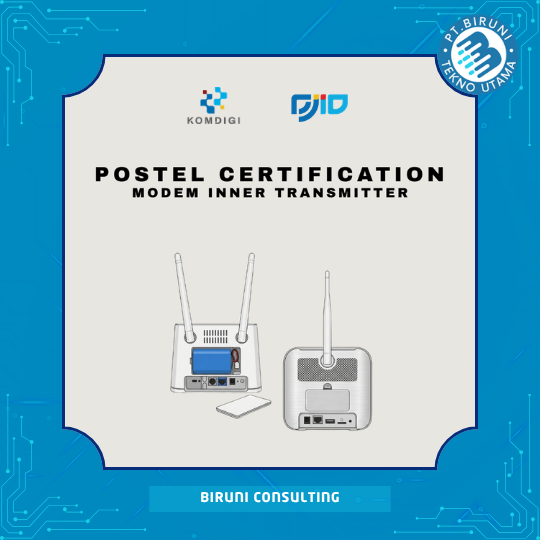
Guide to Inner Transmitter Modem Postel Certification in Indonesia
An Inner Transmitter Modem is a telecommunications module designed to transmit and receive data as an integrated component within a communication system. It is commonly used to support data communications through cellular networks, radio systems, satellite communications, or other wireless technologies. These modem modules are widely deployed in industrial equipment, IoT (Internet of Things) devices, automation systems, SCADA systems, monitoring equipment, smart devices, and various communication applications.
Because these modules incorporate Radio Frequency (RF) communication technology, Inner Transmitter Modems generally require DJID (formerly Postel/SDPPI) Certification before they can be legally imported, distributed, or marketed in Indonesia. Certification ensures compliance with Indonesian telecommunications technical standards, radio spectrum regulations, and network compatibility requirements.
Understanding certification requirements early helps manufacturers, importers, distributors, and brand owners accelerate regulatory approval while ensuring compliance with Indonesian telecommunications regulations.
What Is an Inner Transmitter Modem?
An Inner Transmitter Modem is an embedded communication module installed inside an electronic device to provide wireless data transmission and reception capabilities. Depending on the application, the module may support GSM, LTE, 5G, NB-IoT, LoRa, satellite communications, or other radio technologies.
Rather than operating as a standalone device, the modem is integrated into products such as industrial machines, payment terminals, telemetry systems, IoT gateways, smart meters, security systems, medical devices, and communication equipment.
Because these modules utilize radio communication technologies, they must comply with Indonesian telecommunications technical regulations.
Does an Inner Transmitter Modem Require DJID (Postel) Certification?
Yes. Inner Transmitter Modems equipped with radio transmitting and/or receiving functions generally require DJID (Postel) certification before they can be legally imported, marketed, or distributed in Indonesia.
During certification, DJID evaluates Radio Frequency (RF) characteristics, radio spectrum utilization, electromagnetic compatibility (EMC), communication performance, transmission power, and other technical parameters according to applicable regulations.
Certification requirements vary depending on the communication technology employed, including cellular, satellite, or other radio-based systems.
Inner Transmitter Modem Certification Requirements
Companies applying for certification generally prepare the following documentation:
- Company legal documents.
- Business Identification Number (NIB).
- Technical product specifications.
- User Manual.
- Product Datasheet.
- Product Label.
- Product Photographs.
- Block diagrams and system architecture.
- Accredited laboratory test reports where applicable.
- Additional supporting documents required by DJID regulations.
Complete documentation helps streamline certification while minimizing administrative revisions.
Inner Transmitter Modem Certification Process
The certification process begins by identifying the communication technology, operating frequency, radio modules, and communication functions of the device.
Technical and administrative documentation is reviewed before laboratory testing is conducted where required. Testing may include Radio Frequency (RF), Electromagnetic Compatibility (EMC), communication performance, radio emission characteristics, and other technical assessments according to product specifications.
Following successful technical evaluation and administrative review, DJID issues certification authorizing legal commercialization of the Inner Transmitter Modem in Indonesia.
Certification timelines vary depending on communication technology, product complexity, testing scope, and documentation completeness.
Benefits of Inner Transmitter Modem Certification
Obtaining DJID certification provides important advantages for manufacturers, importers, distributors, and brand owners.
Key benefits include:
- Compliance with Indonesian telecommunications regulations.
- Support for product importation and commercial distribution.
- Verification of technical conformity.
- Reduced regulatory risks.
- Increased customer and business partner confidence.
- Legal commercialization throughout Indonesia.
Certification also demonstrates compliance with national technical standards while improving competitiveness in the Indonesian telecommunications market.
Types of Inner Transmitter Modems Commonly Requiring Certification
Examples of products commonly requiring certification include:
- Cellular Modem Modules.
- LTE Modem Modules.
- 5G Modem Modules.
- GSM/GPRS Modem Modules.
- NB-IoT Modem Modules.
- LTE-M Communication Modules.
- Satellite Modem Modules.
- Industrial Communication Modems.
- Embedded RF Modems.
- IoT Communication Modules.
Certification requirements vary according to each product’s communication technology, operating frequency, radio modules, and technical specifications.
Contact Us
Biruni Consulting provides professional consulting services for DJID (Postel) certification of Inner Transmitter Modems and other telecommunications equipment in Indonesia.
We assist companies with:
- Regulatory analysis for Inner Transmitter Modem products.
- Identification of applicable DJID certification requirements.
- Preparation of technical and administrative documentation.
- Coordination with accredited testing laboratories.
- End-to-end certification support until approval is granted.
With extensive experience in Indonesian telecommunications certification, we help manufacturers, importers, distributors, and brand owners obtain certification efficiently while ensuring full regulatory compliance.
Contact us today for professional consultation regarding Inner Transmitter Modem Postel Certification and telecommunications equipment approval requirements in Indonesia.