
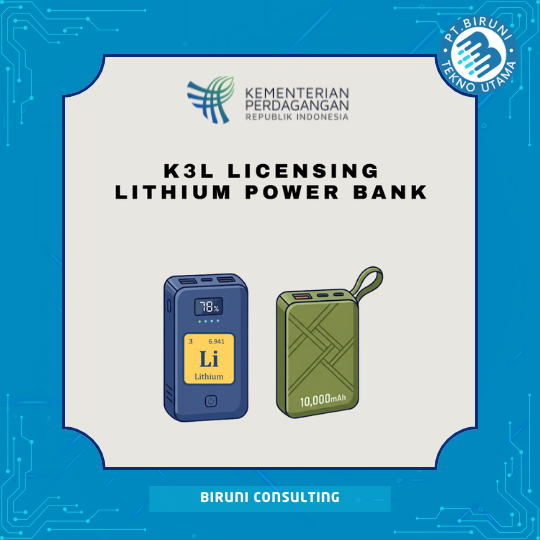
Guide to Lithium Power Bank Product Licensing for Safe Distribution and Compliance with Electronic Product Requirements
Lithium power bank product licensing is a process conducted by manufacturers or importers to ensure that products comply with applicable requirements before entering the market.
Lithium power banks are categorized as portable electronic devices designed to store and supply electrical energy to smartphones, tablets, cameras, earphones, smartwatches, and other rechargeable devices. These products use lithium-based batteries, which are widely preferred due to their high energy density, portability, and charging efficiency.
Because lithium batteries involve electrical energy storage, product safety becomes highly important. Improperly designed or manufactured power banks may create risks such as overheating, battery swelling, electrical short circuits, charging instability, or even fire hazards.
The licensing process helps ensure that lithium power bank products meet technical, electrical, and safety requirements before being legally distributed in the market.
Regulations Related to Lithium Power Bank Products
Lithium power bank products distributed in the market must comply with provisions related to consumer protection and supervision of electronic products.
Several relevant provisions include:
- Law No. 3 of 2014 concerning Industry
Regulates obligations for manufacturers to ensure products comply with technical requirements. - Law No. 8 of 1999 concerning Consumer Protection
Ensures that products distributed to consumers are safe and suitable for use. - Market supervision provisions for electronic products
Authorities supervise electronic products circulating in the market to ensure compliance. - Battery and electrical safety requirements
Products must comply with safety aspects related to charging systems, battery stability, thermal protection, and electrical performance.
These provisions help ensure that lithium power bank products complete evaluation procedures before entering the market.
Why Lithium Power Bank Products Require Licensing?
Lithium power banks use rechargeable lithium battery systems that may create certain risks if products do not meet technical requirements.
Several important reasons why licensing is necessary include:
- Preventing electrical short circuits
Products must include electrical protection systems for safe charging and usage. - Reducing overheating risks
Battery systems must operate safely during charging and discharging cycles. - Ensuring product quality and performance
Charging capacity, battery efficiency, and output stability must be evaluated. - Increasing consumer confidence
Consumers prefer products that comply with licensing and testing requirements. - Supporting legal market distribution
Licensed products are easier to distribute through official retail and commercial channels.
Licensing Process for Lithium Power Bank Products
The licensing process for lithium power bank products generally includes several stages.
1. Product Specification Identification
Manufacturers or importers identify technical specifications such as:
- Battery capacity
- Lithium battery cell type
- Charging system
- Electrical output capacity
- Battery protection features
2. Preparation of Technical Documentation
Several supporting documents are usually required, including:
a. Product technical specifications
b. Electronic circuit diagrams
c. User manuals
d. Product labeling information
e. Manufacturer or importer details
3. Laboratory Product Testing
Testing is conducted to evaluate product safety and technical performance.
Testing may include:
- Battery safety testing
- Charging and discharge testing
- Overheating resistance testing
- Product durability testing
4. Compliance Evaluation
Authorities or related institutions evaluate technical documents and testing results to determine product compliance.
5. Issuance of Certification or Licensing Documents
After all requirements are fulfilled, certification or licensing documents may be issued for legal market distribution.
Benefits of Licensing Lithium Power Bank Products
Obtaining licensing for lithium power bank products provides several advantages for manufacturers and distributors.
Important benefits include:
- Ensuring products are safe for consumers
- Supporting legal market distribution
- Increasing business credibility
- Improving product competitiveness
- Building consumer trust in product quality
With proper licensing, lithium power bank products can be marketed more professionally and responsibly.
Contact Biruni Consulting
Biruni Consulting is a professional consulting firm that assists companies with lithium power bank product licensing services.
Our services include:
- Licensing requirement analysis
- Technical documentation assistance
- Electronic and lithium battery product consultation
- Laboratory testing assistance
- Product certification and licensing processing
With experience in product compliance consulting, Biruni Consulting is ready to help ensure that your lithium power bank products meet applicable requirements before entering the market